"Accuracy equivalent to hitting a £1 coin from a kilometre away." "£10 a shot." These two lines turn up in almost every story about DragonFire, the British laser weapon. Both come straight from the UK government. Lay the same government documents out in date order, though, and they show a good deal more than those two lines.
DragonFire is a laser directed energy weapon (LDEW) that the UK's Defence Science and Technology Laboratory (Dstl) runs for the Ministry of Defence (MOD). This article uses only press releases on the GOV.UK website and written answers to Parliament. It follows what was tested and when, and how the plan to put the weapon on ships has been worded over time. A table at the end separates the numbers that were published from the blanks.
2017: a £30 million demonstrator contract
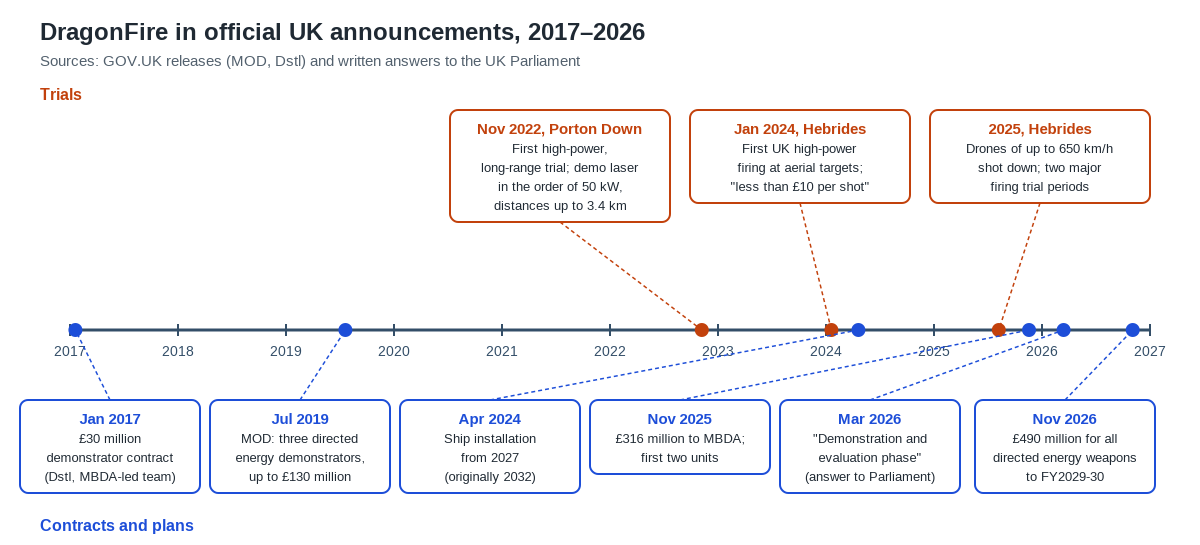
The starting point is a contract from January 2017. Dstl gave £30 million to the Dragonfire consortium, a group of companies. The aim was a demonstration of what laser weapons could do. It included assessing how well the system could pick up and follow targets at different ranges, in different weather, over land and over water.
MBDA in the UK led the consortium, with QinetiQ, Leonardo, GKN, Arke, BAE Systems and Marshall as partners. A Dstl release in September of that year set out the plan: tests on UK ranges from 2018, ending with a big demonstration in 2019. The same release notes that Dstl scientists had worked on lasers since the 1970s.
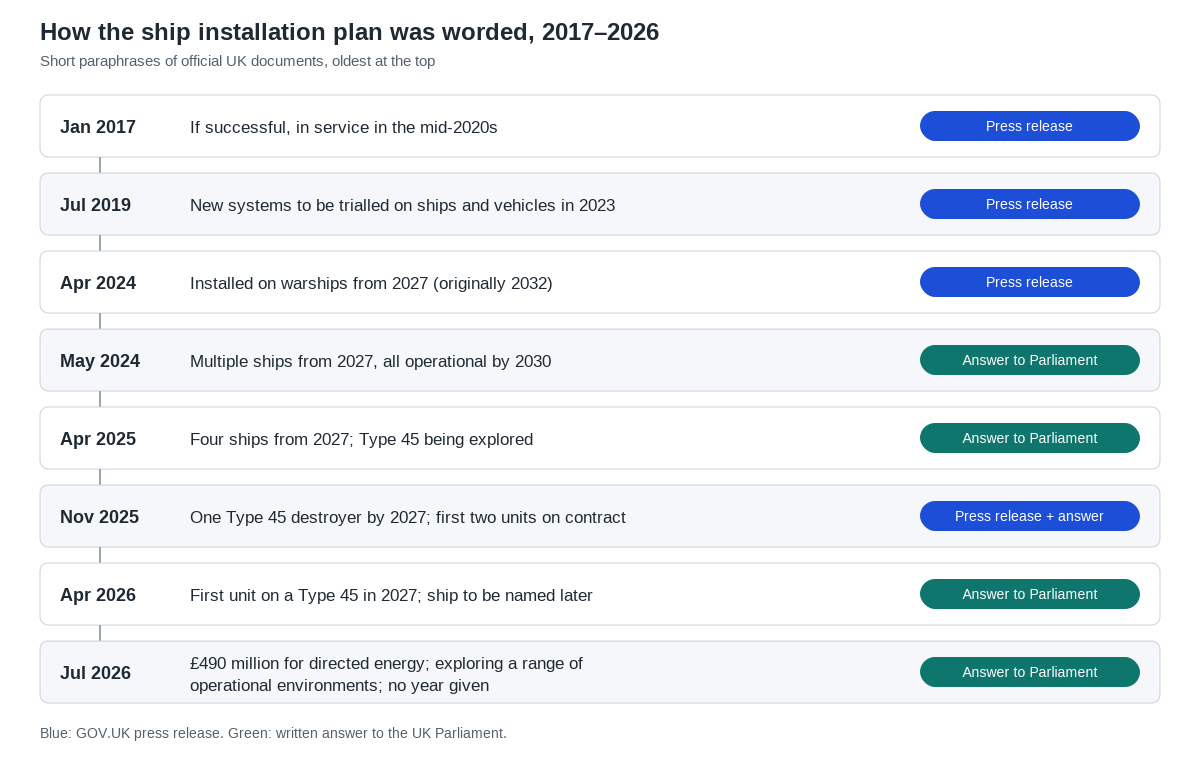
The service date at this stage came with a condition. The January release said that if the project succeeded, the first laser weapons could enter service in the mid-2020s. In July 2019 the MOD announced plans for three new directed energy demonstrators and named a figure of up to £130 million. It said the new systems were expected to be tried out on navy ships and army vehicles in 2023.
2022, Porton Down: testing the laser itself
In November 2022 Dstl announced the UK's first high-power, long-range laser weapon trial at its Porton Down range. The DragonFire demonstrator fired at several targets over several distances. The distances were set inside the range, and the farthest was 3.4 km.
This release gives the most detailed public split of the work. MBDA held overall responsibility for the system and built the command and control and the image processing. Leonardo built the beam director, the part that tracks a target and points the beam at it. QinetiQ built a laser that joins several lasers by matching their phase, and the release put its output "in the order of 50kW."
Joining beams by matching their phase is called coherent beam combining (CBC). The principle is covered in Coherent beam combining: the principle. The 2019 release described DragonFire in the same terms, as a weapon that combines several laser beams.
The last line of the 2022 release reads: "The capability of DragonFire is classified." The 50 kW figure describes the laser in the demonstrator tested in 2022. No official release gives the output of the system that will actually be fitted.
January 2024, the Hebrides: the first high-power firing at aerial targets
The release of 19 January 2024 is the document most often quoted today. It reports that at the MOD's Hebrides range, DragonFire made the UK's first high-power laser weapon firing against aerial targets. The "£1 coin from a kilometre away" line comes from here.
The cost per shot comes from this release too: firing the laser for 10 seconds costs about as much as running an ordinary heater for an hour. Operating it is "typically less than £10 per shot." The range stays classified. What the release does give is that DragonFire is a line of sight weapon that can engage any target it can see.
The £10 figure is the MOD's own, and the release does not show how it was worked out. A laser does not finish the moment it fires; it has to stay on the target for a while. That point is covered in Why a laser weapon does not finish "the instant it fires", and it is why the release talks about a 10-second shot.
Eleven days later a parliamentary answer gave the next step. The team was evaluating the results and drawing up plans to speed up testing against representative targets in harder scenarios.
The ship plan: from 2032 to 2027
On 12 April 2024 the MOD announced that the first Royal Navy warships would get DragonFire from 2027. Laser weapons had been expected to reach the forces in 2032, and a new way of buying equipment brought that forward by about five years. Its core idea is to hand the forces a "minimum deployable capability" first and finish development once the system is in service.
Money and ship numbers came out in parliamentary answers. A May 2024 answer put government spending at £350 million by April 2027 to deliver the minimum deployable capability. The demonstrator since 2017 had taken £50 million from the MOD and £50 million from industry.
Another answer the same day spoke of fitting multiple ships from 2027, with all systems planned to be operational by 2030. An answer in April 2025 was more specific: four Royal Navy ships starting from 2027, with Type 45 destroyers being explored as the most suitable platform.
On 20 November 2025 a trial and a contract appeared in the same release. In trials at the Hebrides range, DragonFire shot down drones able to fly at up to 650 km/h. The release called it a UK first to track, target and bring down such drones above the horizon.
In the same release MBDA won a £316 million contract, with new systems to reach the Royal Navy starting in 2027. The wording was one Type 45 destroyer fitted by 2027, which the release put at five years ahead of the original plan.
What the 2026 parliamentary answers say now
Members of Parliament kept asking written questions in 2026, and the wording of the answers shifted step by step. A January answer kept the plan to start delivery from 2027. It added that DragonFire is a modular capability, so the specific ships could not be listed.
An answer on 18 March said DragonFire "remains in its demonstration and evaluation phase." One on 26 March said spiral development would improve the capability step by step after installation.
A Lords answer on 30 March said there were two major periods of firing trials in 2025. It described the November 2025 contract as one for the first two DragonFire units, the first of them due on a Type 45 destroyer in 2027. An answer on 20 April said the first unit was on track for 2027. The exact destroyer would be named later, since installation has to fit around the fleet's operational commitments.
The answer of 20 July, to a question on fitting Type 45 destroyers from or by 2027, had a different shape. Under the Defence Investment Plan, it said, £490 million goes to directed energy weapons, DragonFire included. It added that it is exploring how DragonFire could be used in a range of operational environments, drawing on lessons from the recent conflict in the Middle East. The year 2027 does not appear in this answer.
The latest answers came on 2 November 2026. Asked about progress toward the first system by 2027, the MOD pointed back to the answer of 20 July. Asked how much would go to DragonFire each year, it said the £490 million covers directed energy weapon development as a whole up to and including financial year 2029-30. The yearly share for DragonFire is balanced within that sum against other projects.
Numbers published and blanks left
| Item | What the official documents state | Document |
|---|---|---|
| First demonstrator contract | £30 million (2017) | Dstl 2017 |
| Joint demonstrator investment | About £100 million, £50 million each from the MOD and industry | Dstl 2022, parliamentary answer May 2024 |
| Government spend on the accelerated program | £350 million by April 2027 | Parliamentary answer May 2024 |
| Industry contract | £316 million to MBDA, first two units | MOD Nov 2025, Lords answer Mar 2026 |
| All directed energy weapons | £490 million up to financial year 2029-30 | Parliamentary answers Jul 2026 and Nov 2026 |
| Demonstrator laser output | In the order of 50 kW (2022 demonstrator) | Dstl 2022 |
| Trial distance | Up to 3.4 km at Porton Down in 2022 | Dstl 2022 |
| Target drone speed | Up to 650 km/h (2025 trials) | MOD Nov 2025 |
| Cost per shot | Typically less than £10 (Jan 2024), £10 (Nov 2025) | MOD |
| Range, fitted-system output, performance | Stated to be classified | Dstl 2022, MOD Jan 2024 |
| First ship to be fitted | "Announced in due course" | Parliamentary answer Apr 2026 |
| Ammunition savings | Answered only that it depends on operational use | Parliamentary answer Oct 2026 |
The top of the table holds money and trial conditions; the bottom holds the blanks. The government has said range and performance are classified. If a story gives a value for them, that number did not come from a UK government release.
Questions to ask of the announcements
The 650 km/h figure is how fast the target drones could fly. It says nothing about how long the laser took to bring one down at that distance. The 50 kW figure belongs to the 2022 demonstrator laser and has never been announced as the output of the system due on a ship in 2027.
The cost per shot also has conditions. The "typically less than £10" in 2024 is the MOD's estimate of operating cost, and the comparison in that release was an hour of an ordinary heater. The 2025 release compared it with traditional missiles, which it said cost more than several hundred thousand pounds a shot. Yet a parliamentary answer in October 2026 said only that the savings in ammunition will depend on how the capability is used.
Schedules need to be read with their dates. Installation in 2027 was repeated in several documents from April 2024 to April 2026, and the answers of July and November 2026 do not state that year. The ship count also differs between documents: "multiple ships", "four ships", "the first two units" and "not possible to list". How to handle gaps like these is covered in How to read laser weapon news.
What to read next
- Laser weapon programs that have been made public: DragonFire in one table with official announcements from South Korea, the United States, Germany and France.
- Public High-Energy Laser Tests, 1975–2026: A Timeline: where the 2024 Hebrides firing sits in the test record since 1975.
- How to read laser weapon news: "kW-class", "range" and "cost per shot": how to read the words in this article's table when they appear in the news.