Stand next to a sheet-metal cutting machine and you may see sparks but no beam. If the machine uses a CO2 laser, that is expected. Its light is infrared at a wavelength of 10.6 µm, which the human eye cannot see.
The material that makes the light is just as surprising. It is carbon dioxide, the CO2 gas in every breath you exhale. How can a tube of gas produce light strong enough to cut steel?
This article starts with how the vibrations of a CO2 molecule turn into light. It then follows why this laser held factory floors for decades. Along the way it looks at where it gave way to the fiber laser, where it still holds on, and the mark it left on laser weapon history.
How a vibrating molecule makes light
Every laser needs a gain medium, the material that amplifies light. In a solid-state laser a crystal or glass does that job. In a CO2 laser, gas molecules do it.
A CO2 molecule is a straight line: one carbon atom in the middle and an oxygen atom on each side. The molecule never sits still and vibrates in three ways. In the symmetric stretch both oxygens move out and back together. In the asymmetric stretch one side stretches while the other shrinks, and in the bending mode the line bends.
Each kind of vibration has fixed energy steps. When the molecule drops from a higher vibration step to a lower one, the energy difference leaves as light. In a CO2 laser the light comes from transitions between these vibrational-rotational levels of the molecule. In many lasers electrons climb and fall inside atoms; here the motion of the whole molecule forms the steps.
So what wavelength comes out? The abstract of the first paper on continuous operation, published in Physical Review in 1964, reports laser lines near 10.4 µm and 9.4 µm. The strongest line was at 10.6324 µm. The familiar "10.6 µm" refers to that line.
What nitrogen and helium do
The tube of a CO2 laser holds more than carbon dioxide. Nitrogen and helium go in too. In the common fast-axial-flow type, a turbine or blower pushes the blend of the three gases around at high speed.
Energy goes in through an electric discharge. Feeding in energy to prepare a laser to work is called pumping. A voltage across the tube drives a current through the gas, and electrons that pick up energy collide with gas molecules and set them vibrating.
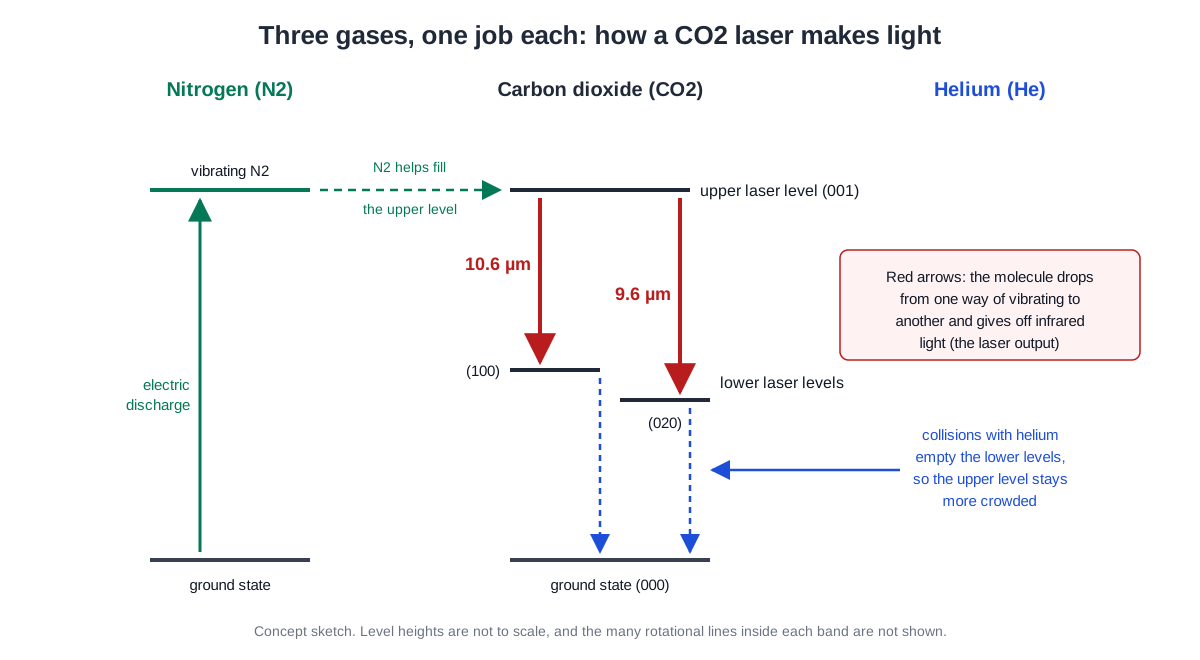
In the discharge, nitrogen helps fill the upper laser level. Helium does the opposite job. After a CO2 molecule gives off light and lands on a lower level, collisions with helium help send it back to the ground state, emptying the lower level.
Why does the lower level need emptying? To amplify light, a laser needs more molecules in the upper level than in the lower one. That state is called population inversion. In a gas laser the lower level usually drains far more quickly than the upper one, which creates the inversion, and helium speeds up that draining.
The way the discharge is driven has changed over time. DC excitation runs a direct current through electrodes inside the tube, while RF excitation uses radio-frequency energy, which is the more popular choice today. With RF the electrodes sit outside, which avoids problems with electrodes wearing away.
What stands in for glass lenses
Light builds up inside an optical resonator. A CO2 laser places a mirror at each end of its discharge tube, so the beam bounces many times and grows stronger. One of them, the output coupler, lets the usable beam out.
Reaching several kilowatts takes a resonator several meters long. Factory units therefore split it into several discharge tubes in a row and fold the beam path with highly reflective mirrors to save space.
Getting the beam from the resonator to the part also differs from a fiber laser. In a fiber-laser machine, the light travels inside the fiber core all the way to the cutting head. In a CO2 machine, a chain of mirrors carries it instead. Even a flatbed 2D cutting machine needs at least two moving mirrors.
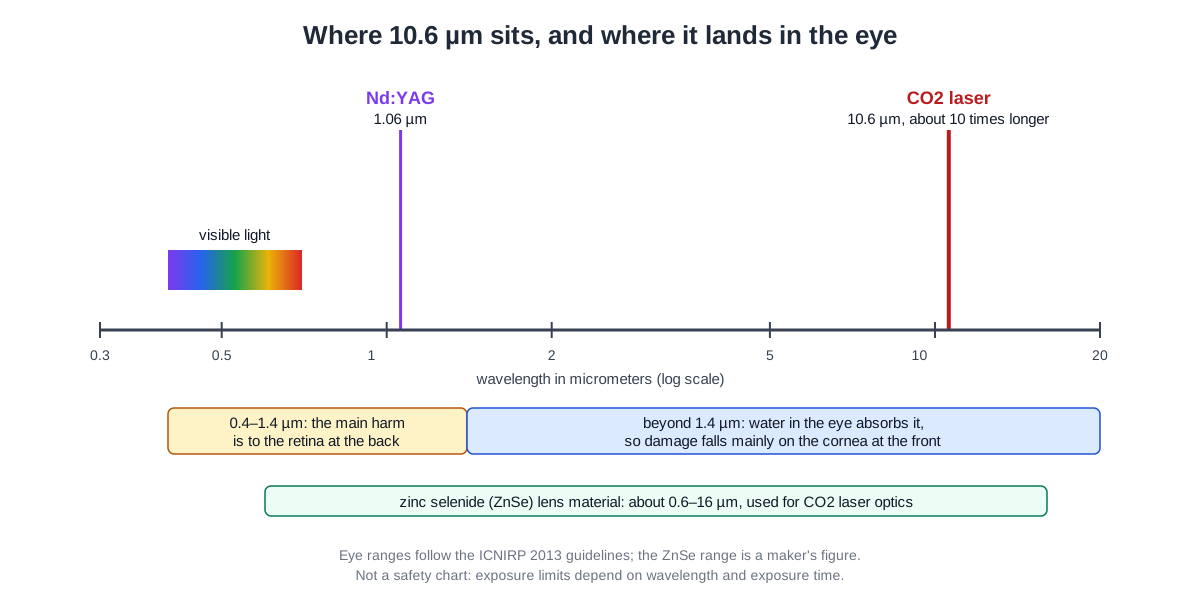
The lens that focuses the beam onto the part is special too. A CO2 cutting head holds a focusing lens made of zinc selenide (ZnSe). ZnSe is a lens material used across a broad infrared range of about 0.6–16 µm.
It absorbs little and copes well with sudden heating, which makes it the top choice for high-power CO2 laser optics. On the other hand, it is soft and scratches easily, so it needs careful handling.
More mirrors also means more upkeep. A TWI laser FAQ says CO2 laser systems typically need their mirrors cleaned and realigned every 500 hours, while ytterbium fiber lasers need no general maintenance.
From 1 mW at Bell Labs to kilowatts in factories
The CO2 laser was first built by C. Kumar N. Patel of Bell Laboratories, who joined the lab in 1961.
In 1963 Patel found that carbon dioxide could lase on its vibrational-rotational lines. In 1964 he devised a way for molecules to pass vibration energy to one another efficiently. That work led to experiments showing the CO2 laser could deliver very high power at high efficiency.
The start was small. The paper published in November 1964 measured a continuous-wave (CW) output of about 1 mW. Years later, Patel recalled in an interview that his most exciting moment came one late night in the lab, when a CO2 laser first passed 10 W.
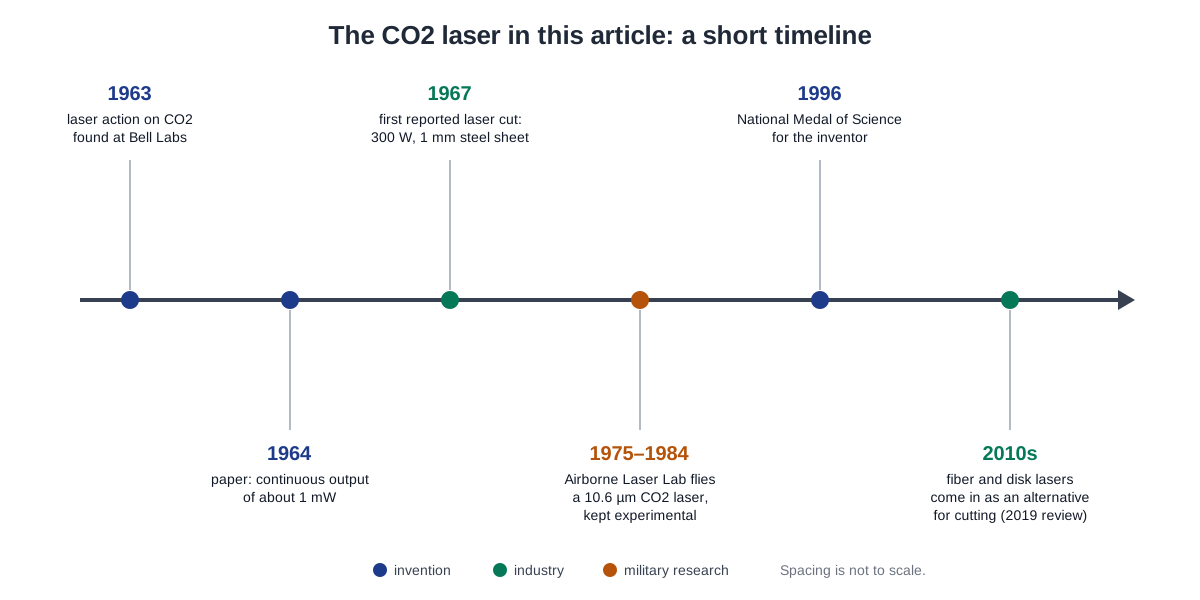
The road to the factory was short. The first reported laser cutting is credited to P. Houldcroft in 1967. His 300 W CO2 laser, helped by a jet of oxygen, cut through steel sheet 1 mm thick.
For many years after that, the CO2 laser did most of the laser cutting of metal. According to TWI, commercial CO2 lasers are available up to 15 kW. That is more than ten million times the 1 mW of 1964.
How efficient is it? The share of electricity from the wall socket that comes out as laser light is called wall-plug efficiency.
For CO2 lasers the figure depends on the source. TWI gives a typical 10–12%. A laser physics course at the University of New Mexico puts the CO2 laser below 20% and Nd:YAG below 10%.
CO2 lasers come in more than one shape. Sorted by how the gas moves, the main types are fast axial flow, slow axial flow, transverse flow, and the slab design. Among pulsed lasers, the transversely excited atmospheric (TEA) CO2 laser is the most common.
There is also the gas-dynamic laser, which creates population inversion by expanding very hot gas at supersonic speed. Gas-dynamic CO2 lasers have produced CW power of up to 1 MW.
The ground it lost to fiber lasers, and what it kept
The CO2 laser led metal cutting for so long mainly because of price. Metals absorb light from solid-state lasers such as Nd:YAG better, yet the CO2 laser used to cost less. Once affordable disk and fiber lasers arrived, that changed, and CO2 lasers were pushed out of many applications.
A 2019 review of laser cutting sums up the shift. In the decade before it, powerful fiber and disk lasers arrived as a substitute for the traditional CO2 source. They turn more electricity into light, and metal sheets absorb their beams better. Fiber lasers also make a far smaller spot than CO2 systems, which suits them to cutting reflective metals.
That does not mean the CO2 laser disappeared. The same review adds that on thicker plates, typically over about 4 mm, the cut surface from fiber and disk lasers is much worse than with CO2 technology. Such parts may need follow-up work such as deburring.
Change the material and the picture flips. Organic materials such as plastics and wood absorb 10.6 µm light strongly. Newport goes as far as saying nothing can replace the CO2 laser for these materials. In plastic welding, CO2 laser light is absorbed by any plastic, clear or not, and the CO2 laser leads this field together with the diode laser.
Medicine is another place it stayed. Apart from special uses, most gas lasers have given way to diode-pumped solid-state lasers and laser diodes. CO2 and excimer lasers buck that trend and still hold large shares of the markets for laser processing and eye surgery. In medicine, CO2 lasers are used for cutting and for skin resurfacing.
Where it is dangerous to the eye
If CO2 laser light enters the eye, what gets hurt? The International Commission on Non-Ionizing Radiation Protection (ICNIRP) addressed this in its 2013 guidelines. For visible and near-infrared light from 400 to 1,400 nm, they name retinal damage as the main effect. That is because the media of the eye let this light through.
Light from a 1.06 µm Nd:YAG laser falls in this range too. At 10.6 µm the story changes. Infrared beyond 1.4 µm is absorbed by the water in the eye, which makes the ocular media opaque, so the damage falls mainly on the cornea at the front. The guidelines also list the surgical CO2 laser as a typical infrared source that causes thermal injury to tissue.
Missing the retina does not make it safe. Past 1,400 nm, the light can burn the cornea and the skin. By laser safety class, every material processing laser is Class 4, and its radiation should be treated as potentially dangerous. For how to read the classes and safety eyewear, see "Laser safety: classes and how to read eyewear labels."
The CO2 laser in laser weapon history
The CO2 laser did not stay in factories. The citation for Patel's 1996 National Medal of Science credits his invention with a large effect on industry, science, medicine and defense.
A public example on the defense side is the Airborne Laser Lab. According to an Air Force Test Center article, the program ran from 1975 to 1984 on an NKC-135 aircraft. The modified NKC-135A carried a 10.6 µm carbon dioxide laser. Its tests brought down small air-to-air missiles as well as drones, but the system never left the experimental stage.
The idea of putting a high-energy laser (HEL) on an aircraft carried on. The Scud missile threat of the Gulf War revived interest in a laser on an aircraft, and that interest produced the Boeing YAL-1. The rest of that story, and the move to today's electric lasers, continues in "A history of laser weapons: from chemical to electric lasers."
What to read next
- "Laser types at a glance: gas, solid-state, fiber, semiconductor": a table of how the CO2 laser compares with other laser families.
- "How a laser processes material: absorption, heating and melting": why the wavelength each material absorbs matters.
- "Why fiber lasers became so widely used: from the lab to the factory": the story of the laser that took over much of the CO2 laser's ground.
- "Excimer Lasers: Ultraviolet Light for Chipmaking and Eye Surgery": an upcoming article on another gas laser that held on.