From the ground, a green laser line slicing across the night sky looks like a toy. It is striking that a dot from your hand can reach the clouds. But when that light lands in the cockpit of a passenger jet coming in to land, the story changes.
In a 2024 safety notice, the UK Civil Aviation Authority (CAA) wrote that aircraft in flight continue to be lit up by lasers. It added that most cases are deliberate acts by people with hand-held lasers, so "attacks" is the more accurate word. Why is one small dot from a hand so dangerous?
A small dot becomes a big flash in the cockpit
Laser light travels very straight, but it does not stay perfectly narrow. Any beam of fixed width slowly widens as it goes. A dot that is small in your hand becomes a much broader patch of light high in the sky. How a beam spreads is explained in Why a beam spreads: divergence, focus and aperture.
Most laser attacks happen when police, air ambulance or search and rescue helicopters are at work, and when airliners are on approach to an airport. That does not make other moments safe. An aircraft can be targeted in any stage of flight, and control towers and airport vehicles have been hit by lasers too.
In the UK, these attacks are logged in the Mandatory Occurrence Report (MOR) database, more than 1,000 of them every year, and the number is rising again. The CAA adds that it does not hear about every attack, so the real total may be much higher. Most attacks happen over or near large towns and cities.
The danger is the reaction, not just the eye
People tend to picture eye injuries first when they hear "laser attack." The main threat lies elsewhere: the human reaction to the light. Every attack comes without warning, is intensely bright and pulls attention away, and they can leave temporary vision problems for some time afterward.
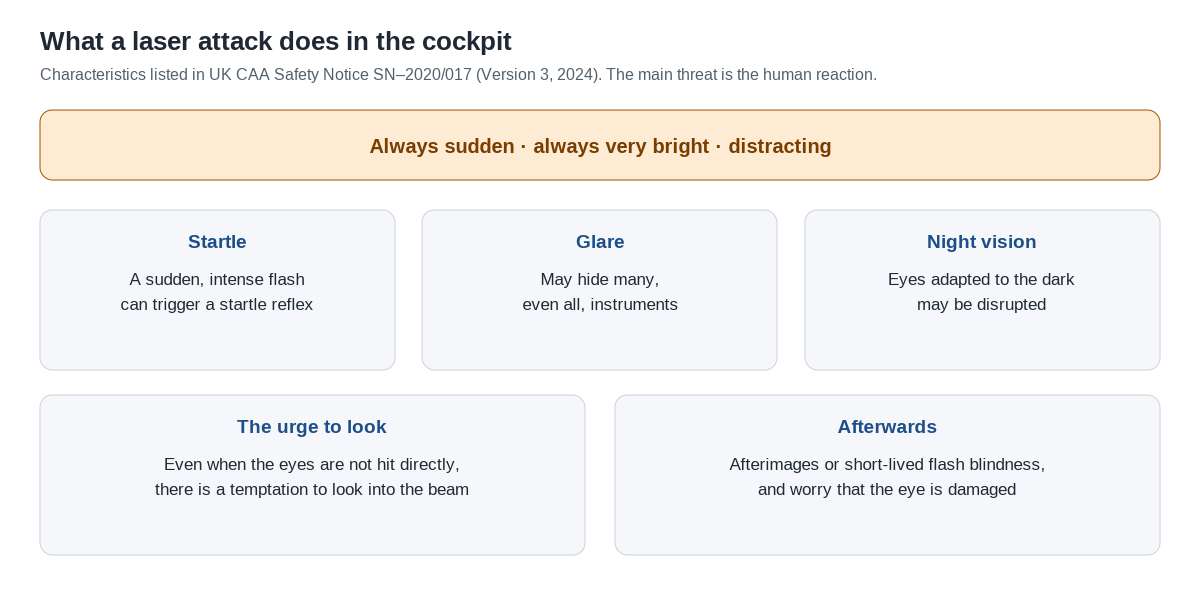
Here is what can happen in the cockpit. A sudden, intense flash can set off a startle reflex. Glare can hide many of the instruments, possibly all of them, and night vision that has adjusted to the dark can be disrupted. Even when the beam does not hit the eyes directly, there is an urge to look into it.
The effects can last after the attack ends. Afterimages or brief flash blindness may follow, and pilots may worry that their eyes are permanently damaged. Picture all of this happening during the descent toward an airport, and the danger becomes clear.
The CAA is careful about permanent damage. It says no civil aircrew in the UK are on record as having lost sight permanently from an attack, and that current knowledge suggests it is unlikely. Hand-held lasers that can be bought legally have little power, and the distance and the cockpit window give some protection. Even so, it says permanent damage from illegal, more powerful lasers cannot be ruled out, and there are signs that such devices are entering the country.
Why green lasers are a bigger problem
The earliest attacks used red lasers. According to the CAA, more than 80% of attacks now use green lasers at around 532 nm. Police aircrews have reported blue lasers as well.
Why does the color matter? Our eyes respond far more strongly to green than to other colors. For the same output power, a green laser looks much brighter and hits the pilot harder. The idea that the same number of watts (W) can look brighter or dimmer depending on the wavelength connects to Why wavelength matters: visible and invisible light.
What the law says
On February 14, 2012, the United States made this a specific federal crime. The law, 18 U.S.C. § 39A, covers anyone who knowingly aims a laser pointer beam at an aircraft in U.S. jurisdiction, or at its flight path. The penalty is a fine, up to 5 years in prison, or both. Aiming at the flight path counts even if the beam never touches the aircraft.
The law defines a "laser pointer" as a device that amplifies light by stimulated emission and gives off a beam used to point at a place or object. It also lists exceptions. They are authorized flight tests and research, official work by the Defense and Homeland Security departments, and distress signals sent with a laser emergency device.
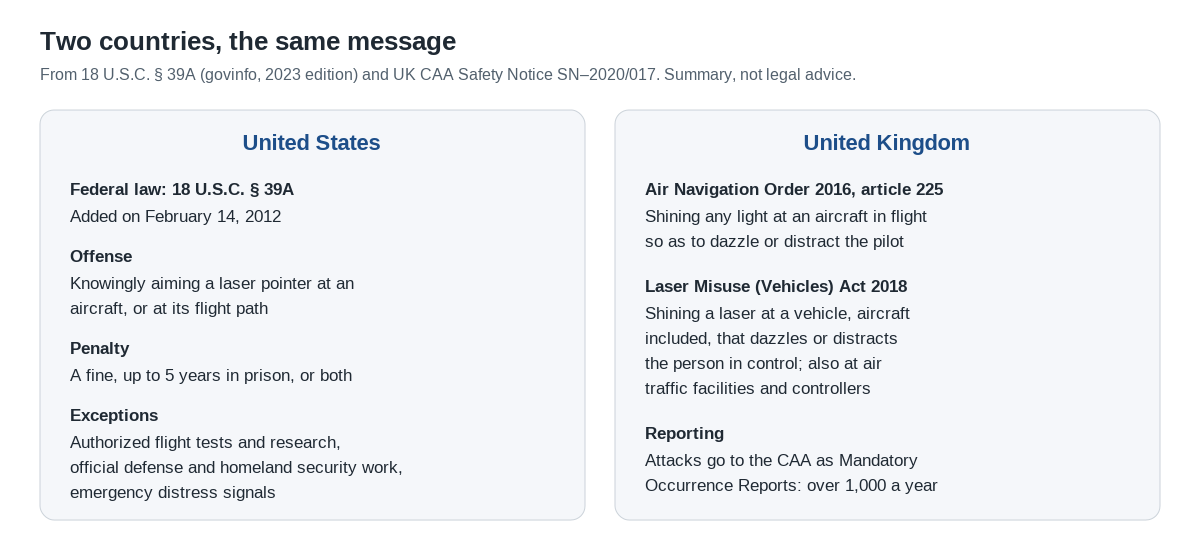
In the UK, article 225 of the Air Navigation Order 2016 makes it an offense to shine any light at a flying aircraft to dazzle or distract the pilot. The Laser Misuse (Vehicles) Act 2018 makes it a crime to dazzle or distract whoever controls a moving vehicle with a laser. It also makes it a crime to aim a laser at an air traffic facility or controller. The first offense, covers both aircraft and airfield vehicles.
In South Korea, Article 56(3) of the Airport Facilities Act bars anyone from throwing objects at an aircraft or doing anything else that may endanger air navigation. Article 47 of the Act's Enforcement Rule lists "emitting laser beams without the approval of the regional aviation administration" as one such act. It also requires laser protection airspace to be set around airfields. Under Article 65 of the Act, breaking this ban can bring a fine of up to 20 million won.
What the aviation industry does, and what laser owners should do
On the aviation side, laser attacks must be filed as Mandatory Occurrence Reports when the law requires it, and the CAA strongly encourages voluntary reports otherwise. It tells crews and controllers to expect an attack at some point and to prepare for it. It asks operators to set up laser awareness training, and it advises anyone worried about lasting eye damage to see an optometrist or ophthalmologist.
For anyone who owns a laser pointer, the rule is simpler: do not switch it on toward the sky, and above all not toward an airplane or helicopter. Even one beam shone as a joke becomes a sudden flash in the cockpit, and the United States, the UK and South Korea all ban it by law. Laser hazard classes and how to read safety eyewear are covered in Laser safety: classes and how to read eyewear labels.
What to read next
- Laser safety: classes and how to read eyewear labels: what laser classes mean
- Why a beam spreads: divergence, focus and aperture: why a small dot grows over distance
- Eye safety and international rules: the protocol on blinding laser weapons: how countries agreed to ban lasers aimed at eyes