On August 26, 1958, a manuscript arrived at Physical Review, the journal of the American Physical Society. Its title was "Infrared and Optical Masers," and its authors were Arthur Schawlow and Charles Townes. It appeared that December 15 in volume 112, page 1940.
The paper did not build a laser. Instead, it showed in theory that a maser could work at optical wavelengths and proposed how to do it in particular systems. Two years later, when a working device appeared, its paper cited this proposal.
From microwaves to light
The background is the maser. In early 1954 Townes's group first amplified and generated electromagnetic waves, in this case microwaves, through stimulated emission. The next question came naturally. Could the same thing work at far shorter wavelengths, in light?
The first sentence of the abstract is exactly that question: it takes up stretching the maser method to infrared and visible light. Townes's Nobel biography puts it more plainly. The two showed in theory that masers could run at optical and infrared wavelengths, and proposed how to do it in particular systems. The maser's own story is in 1954: The Maser Came First.
Three points in the abstract
The abstract is short but carries three key points. First, it showed that an optical resonator a few centimeters across, with many resonant modes, could work. Pumped with a reasonable amount of incoherent light, it could reach maser oscillation at these wavelengths.
Second, it named a limit. For wavelengths much shorter than the ultraviolet, maser-type amplification looked quite impractical. Third, it illustrated the design principles with a system using potassium vapor.
Mirrors only at the ends
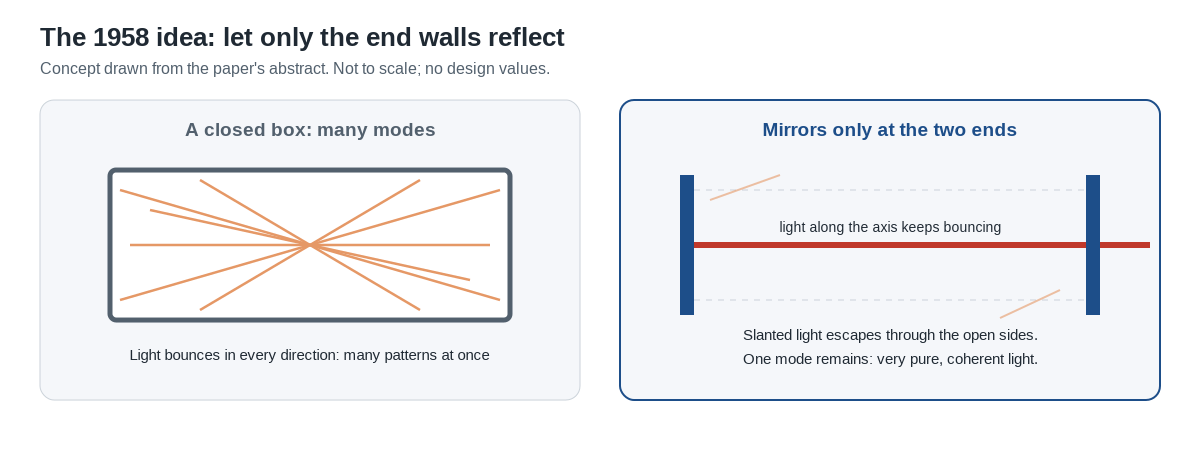
The idea that lasted longest is the shape of the resonator. The abstract says a single mode can be picked even in a resonator with many modes. Only the two end walls are made strongly reflective, and the angular aperture is kept suitably small. The result is extremely monochromatic, coherent light.
In a room lined with mirrors, light bounces every which way and many patterns form at once. Put mirrors only at the two ends, and only light traveling along the axis keeps coming back, while slanted light leaks out the sides. A real device is more complicated than this picture, because mirror reflectance, aperture and the gain medium all have to match. A resonator of two facing mirrors is one of the basic parts of a laser, as covered in The three parts of a laser: gain medium, pump and resonator.
Bell Labs, Columbia, and a weekend book
The paper lists Bell Telephone Laboratories in Murray Hill, New Jersey, with Columbia University as Townes's permanent address. The two were also related by marriage. Townes's biography calls Schawlow his brother-in-law.
Schawlow's Nobel autobiography describes their time together. He worked with Townes at Columbia as a postdoctoral fellow, and from 1951 to 1961 he was a physicist at Bell Labs. During those years he spent weekends writing the book Microwave Spectroscopy with Townes, published in 1955. From 1961 he was a professor of physics at Stanford.
Then, in 1957 and 1958, while still mainly doing superconductivity experiments, Schawlow worked with Townes on what it would take to extend the maser principle to much shorter wavelengths. In his words, the goal was "an optical maser or, as it is now known, a laser."
Two years later: ruby
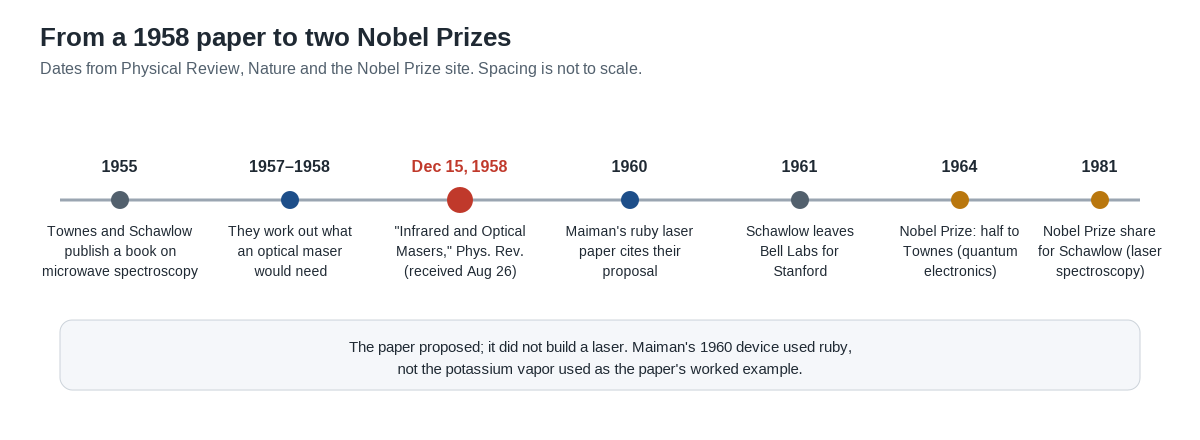
In 1960 Theodore Maiman published a short paper in Nature reporting stimulated emission of light from ruby. Near its start, Maiman cites the Schawlow–Townes proposal. They had suggested an alkali vapor as the active medium for very monochromatic infrared and optical radiation. The medium Maiman actually used was ruby, and the wavelength of the stimulated emission was 694.3 nm (6943 Å).
So a solid crystal succeeded first, not the potassium vapor of the 1958 example. That story continues in May 16, 1960: Maiman's Ruby Laser.
Two Nobel Prizes
The 1964 Nobel Prize in Physics went half to Townes and half jointly to Basov and Prokhorov. It honored basic work in quantum electronics that made maser- and laser-based oscillators and amplifiers possible.
Schawlow received a quarter of the 1981 Nobel Prize in Physics "for their contribution to the development of laser spectroscopy." In the 1960s, the Nobel Prize site explains, he used intense, coherent laser light to remove the Doppler effect. That let him pin down the energy levels of atoms and molecules with great precision. He proposed taking the maser to light in 1958, and some twenty years later was honored for using that tool to measure atoms.
Further reading
- 1954: The Maser Came First: where the 1958 proposal started
- May 16, 1960: Maiman's Ruby Laser: the day the proposal became real
- The three parts of a laser: gain medium, pump and resonator: where the two-mirror resonator sits in today's lasers