"This is what it is like on a typical day." Defense Secretary McNamara said it at a White House lunch on 23 January 1968. He listed three events from that one day. U.S. forces had crossed into Cambodia by mistake, a B-52 carrying four hydrogen bombs had been lost, and North Korea had captured an intelligence ship.
That ship was the USS Pueblo. It was seized off Wonsan in the Sea of Japan (East Sea) with 83 people aboard, and eleven months passed before its crew walked back across the line at Panmunjom. U.S. diplomatic records and Korean sources show what happened at sea that day. They also show how an agreement brought home 82 survivors and the body of one sailor.
A patrol boat at noon, a last message in the afternoon
The Pueblo was a small ship listed in the records under the ship type symbol AGER-2. Its job was to collect radio signals for intelligence, a field covered in signals intelligence. A State Department telegram sent that day called it a small trawler-class Navy vessel.
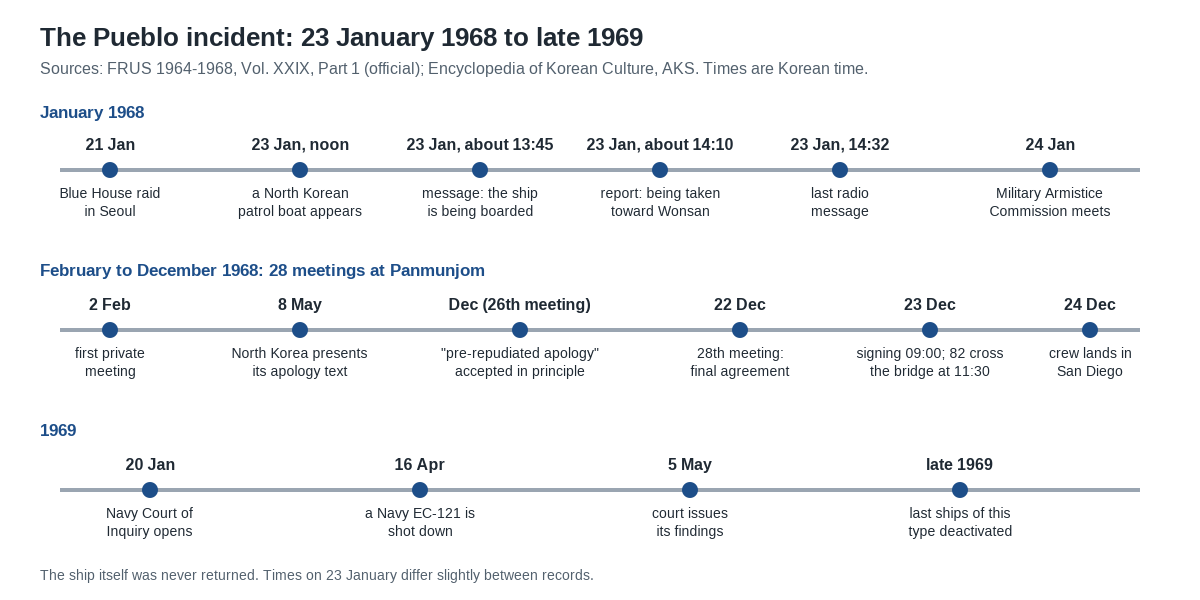
Notes from the White House meeting record what General Wheeler, chairman of the Joint Chiefs, reported. At noon Korean time the ship met a North Korean patrol boat, and at 13:45 a message said the ship was being boarded. The telegram adds the captain's report: the ship was well outside any territorial waters when it came under fire and men were badly wounded. North Korean craft then surrounded it and took it toward Wonsan harbor, about 25 miles away, and this report came at about 2:10 p.m.
The Encyclopedia of Korean Culture records that four armed patrol boats and two MiG fighters took part, and that the last message came at 2:32 p.m. On board were 6 officers, 75 enlisted sailors and 2 civilians, a total of 83. One of the crew, Seaman Duane Hodges, died in the attack.
Sixteen miles and two sets of coordinates
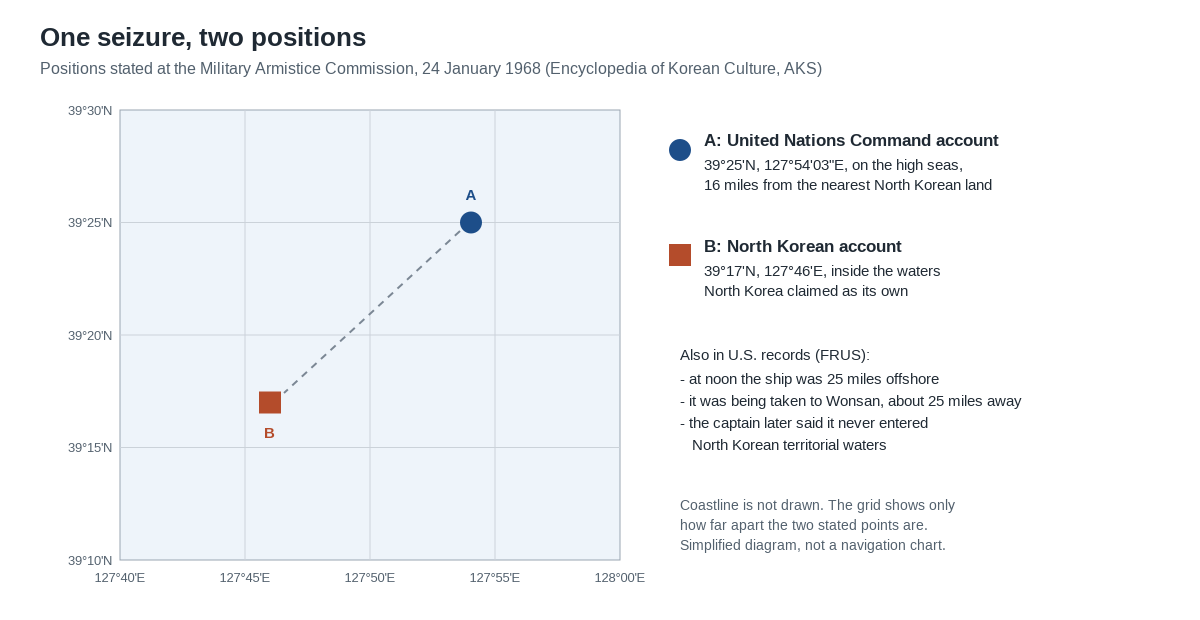
The first dispute was over where the seizure took place. According to the Encyclopedia of Korean Culture, the next day, 24 January, the Military Armistice Commission met at Panmunjom at 11 a.m. The United Nations Command side said the ship was taken on the high seas at 39°25′N, 127°54′3″E, 16 miles from North Korean land.
The North Korean representative gave another position. He said the ship was seized at 39°17′N, 127°46′E and had entered North Korean waters. The two points differ by about 8′ in both latitude and longitude.
Some things were still unclear in Washington that afternoon. McNamara said his only report placed the ship in international waters more than fifteen miles out. He did not know whether it had gone closer to the coast earlier. Wheeler pointed to a map and said that at noon the ship was 25 miles offshore and 16 miles from the nearest North Korean land.
Two days after the Blue House raid
The seizure came at a tense moment on the peninsula. Two days earlier, on 21 January, North Korean commandos had raided the Blue House in Seoul in an attempt to kill President Park Chung-hee. At the 23 January meeting, CIA Director Helms called the seizure part of a pattern of rising harassment and pointed to the Blue House plot.
The preface to the Korea volume of the State Department's Foreign Relations of the United States (FRUS) series sums up what Washington faced in Seoul. South Korea called for retaliation, and trust in the United States fell sharply there. The same lunch heard a complaint from the South Korean defense minister. The U.S. had long urged Seoul not to retaliate, he noted, and now it was in the same position.
The United States sent the aircraft carrier Enterprise to waters near Wonsan. It asked the Soviet Union to mediate, but Moscow refused and said the matter was not its problem. On 29 January State Department analysts judged that the Soviets were staying out of it in public while trying to keep tensions down, and that China was keeping its distance.
Twenty-eight meetings at Panmunjom
A military response was ruled out, and the United States turned to diplomacy. Between 29 and 31 January the two sides set up a way to talk face to face. The first private meeting took place at 11 a.m. on 2 February in the Neutral Nations Supervisory Commission conference room inside the Joint Security Area at Panmunjom.
From the start the issue was a single document. North Korea wanted the United States to sign a text that admitted espionage and intrusion into its waters, apologized for both, and promised it would not happen again. The United States would not admit espionage, and it refused to apologize for acts it did not believe had taken place.
For months the talks circled around that one paper. On 8 May North Korea presented its text. U.S. officials then weighed an idea: write one line on that paper, a receipt for 82 surviving crew members and the body of Seaman Hodges, and sign only that line. North Korea condemned the idea as a "petty stratagem."
The opening came at the end of the year. Christmas was close, and a new administration would take office on 20 January 1969, so the State Department used that timing as a deadline and offered two proposals. At the 26th meeting in December, North Korea accepted one of them in principle, a "pre-repudiated apology." The U.S. negotiator, General Woodward, would sign the North Korean document but would first read a statement rejecting its contents.
The statement made three points. The ship had done nothing illegal, and no convincing evidence showed that it ever entered the waters North Korea claimed. The United States could not apologize for events it did not believe had happened. It went on to say "my signature will not and cannot alter the facts," and closed by saying he was signing for one reason only, to get the crew released.
Eighty-two men cross the Bridge of No Return
The 28th meeting, on 22 December, produced the final agreement. Signing was set for 9 a.m. the next day, with the crew to be released at 11 a.m. On 23 December the last meeting lasted 47 minutes; Woodward read a short statement and signed as planned.
The release time changed once more at the table. General Pak, the North Korean representative, said the State Department broke the deal by announcing the release time early, so both sides settled on 11:30 a.m. At 11:30 the 82 crew members crossed Panmunjom's Bridge of No Return one by one and reached the southern half of the Demilitarized Zone. Two of them carried the body of Seaman Hodges.
At a press conference, Commander Bucher said the Pueblo had never entered North Korean territorial waters, and he described the beatings and abuse the crew suffered in captivity. Medical checks at a U.S. Army hospital near Seoul found the after-effects of beatings and signs of malnutrition. The men landed at Naval Air Station Miramar in San Diego on 24 December. After interviewing the crew, the Navy later concluded that their mistreatment had been officially sanctioned rather than the acts of individuals.
What the incident left behind
The ship never came back. The Encyclopedia of Korean Culture states that North Korea confiscated the hull and equipment, and the FRUS editorial note states that the ship was never recovered. As President Johnson's term was ending, the State and Defense Departments discussed ways to get it returned, but the ship stayed in North Korea.
A Navy Court of Inquiry opened on 20 January 1969 at Coronado, California, closed on 13 March, and released its findings on 5 May. It recommended courts-martial for the captain and another officer. The Secretary of the Navy set that aside, saying the crew had already suffered enough in captivity, and with that decision the Navy closed the case.
The intelligence loss was also large. A final damage assessment by the National Security Agency (NSA) described it as having no precedent in U.S. cryptologic history. It judged that encrypted messages stayed safe, since they could not be read without the keys. The full extent of the loss only came out in 1985, after a spy ring run by John Walker inside the U.S. Navy was uncovered.
On 16 April 1969, North Korean jets shot down a U.S. Navy reconnaissance plane, recorded in the hearings as the EC-121 incident. A special House subcommittee held hearings on both events. The House then passed a resolution: manned ships and aircraft on intelligence missions should not go into danger areas without adequate protection. Intelligence work using ships of the Pueblo's type was suspended, and the last of them were deactivated in late 1969.
An earlier case of a spy plane being shot down was the 1960 U-2 incident. The Pueblo was different: a ship and its whole crew were captured at sea. How Panmunjom became the place for such talks is covered in Hill Battles and the Armistice.
What to read next
- The January 21 Incident, 1968: The Blue House Raid and What Changed After It: the attack in Seoul two days before the Pueblo was seized
- Signals Intelligence: A History of Listening to Radio Waves: the wider history of the work the Pueblo did
- The 1960 U-2 Incident: The Day Flying High Stopped Being Safe: an intelligence incident in the air
- Hill Battles and the Armistice: Two Years of Negotiation: how the Panmunjom talks began