Picture the first laser and you may imagine a large piece of lab equipment. It was actually so small that a photographer thought it too tiny for a picture. At its center sat a single piece of pink ruby measuring 1 × 2 cm, wrapped in a flash lamp of the kind used in photography.
On May 16, 1960, at Hughes Research Laboratories in Malibu, California, this small device produced laser light for the first time. Why ruby, and why was the device in the famous photo not the real one? If you want to start with what a laser is, read What is a laser? How it differs from a light bulb first.
Spring in Malibu
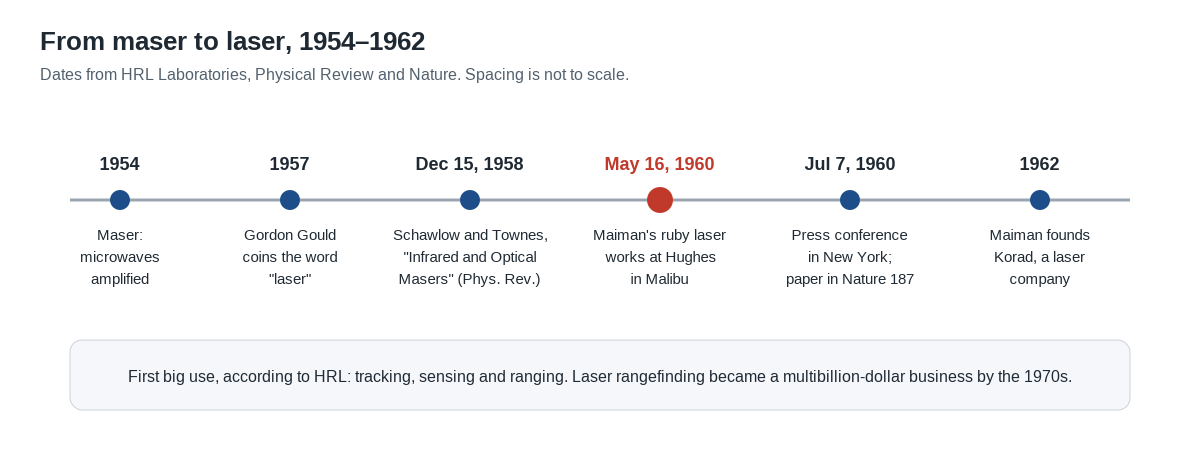
In the late 1950s, several laboratories were racing to build the first laser. A paper by Arthur Schawlow and Charles Townes, published in Physical Review on December 15, 1958, pointed the way. It proposed carrying the methods of the maser, which amplified microwaves, over to infrared and visible light. HRL notes that the word "laser" had been coined earlier, in 1957, by the physicist Gordon Gould.
Theodore Maiman's group at the Hughes lab was studying masers and lasers too. He suggested a man-made ruby crystal as the material to amplify the light, and began experiments in the spring of 1960. The earlier proposals cited at the start of his paper dealt with alkali vapor or gases excited by electrons. Maiman chose a solid crystal.
A piece of ruby and a flash lamp
The heart of the device was a pink ruby measuring 1 × 2 cm. Its two ends were made parallel and coated with silver. The ruby went inside a small, helical xenon flash lamp made for photography, and the whole assembly sat in a reflecting aluminum housing. A small hole scratched in the middle of one silver coating let the light out to be measured.
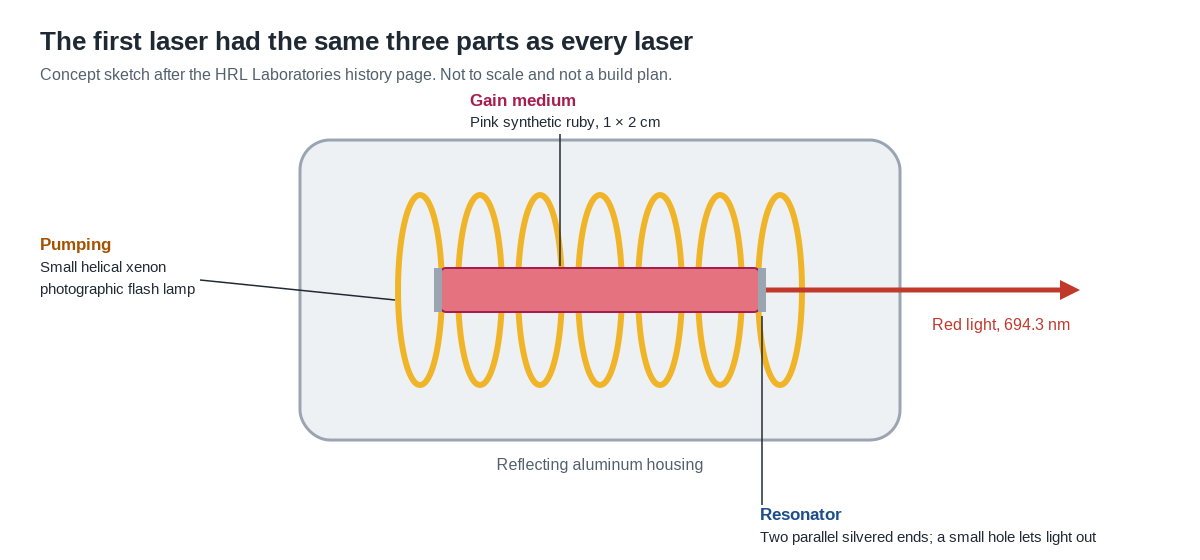
This setup has the same three parts as a laser today. The ruby is the gain medium that amplifies the light, and the flash lamp is the pumping that feeds energy into the ruby. The two silvered ends act as the optical resonator that sends the light back and forth. What each part does is explained in detail in The three parts of a laser: gain medium, pump and resonator.
The 1958 paper had sketched something similar. Schawlow and Townes wrote that a resonator a few centimeters long, pumped with a modest amount of incoherent light, could oscillate. They added that a single mode could be picked out if just the two end walls reflected strongly. The material in their example, however, was an alkali metal vapor, while Maiman used solid ruby.
The moment the light changed
Maiman switched the device on with his colleagues, Irnee D'Haenens and Charles Asawa. With weak flashes, the ruby gave off red light at a wavelength of 694.3 nm that faded away over 3 milliseconds. That was the expected spontaneous emission.
As the flash lamp's discharge energy went up, the picture changed. Sudden, strong pulses of stimulated emission appeared. Maiman later recalled that "the output trace started to shoot up in peak intensity and the initial decay time rapidly decreased." The light had gone from leaking out at random to light calling up more light and pouring out all at once.
Maiman reported the result in a short paper in Nature volume 187 (1960), "Stimulated Optical Radiation in Ruby." It said that optical pumping of a fluorescent solid had produced "negative temperatures" and stimulated optical emission at 6943 Å. That value is the same as 694.3 nm.
"Negative temperature" refers to a population inversion, with more atoms in the upper energy state than in the lower one. The material was ruby, which is chromium in corundum.
The "first laser" in the photo was not the first laser
On July 7, 1960, Hughes Aircraft held a press conference at the Hotel Delmonico in New York. Maiman announced that "for the first time in history a source of 'coherent' light has been attained."
Before the announcement, Hughes's public relations firm hired a photographer. The photographer liked to pose inventors behind what they had built, and the real device was too tiny for that. He asked for a larger lamp and a larger ruby rod instead, and that picture was printed far and wide as the "first laser."
Other researchers copying Maiman's experiment used the larger lamp in the photo. They used a different lamp from the original, and still had working lasers in a matter of weeks. HRL says the original small ruby laser still works.
What came after
HRL writes that the military was especially interested in the technology for weapons, but its biggest early uses were tracking, sensing and ranging. Military rangefinding work at Hughes produced the company's first long laser link, running between its Malibu and Culver City sites. Its researchers also explored holography, which the laser made possible.
By the 1970s, laser rangefinding had become a multibillion-dollar business for Hughes. Measuring distance from light's round trip is covered in Laser Rangefinders: Measuring Range from Light's Round Trip.
Maiman founded the laser company Korad in 1962. He joined the National Inventors Hall of Fame in 1984 and received the Japan Prize in 1987. He died in Vancouver, Canada, in 2007.
The laser that began with a small piece of ruby later spread to other materials, such as gases, semiconductors and optical fibers. Yet its three parts, gain medium, pumping and resonator, are the same as in that device from May 1960.
What to read next
- The three parts of a laser: gain medium, pump and resonator: what each part of the first laser does
- Laser Rangefinders: Measuring Range from Light's Round Trip: ranging, the laser's first big use
- 1954: The Maser Came First: the laser's older cousin