Laser products are assigned a class, and most laser eyewear carries an etched marking such as "400-550 nm OD 6+". What do these markings say, and what do they leave unsaid?
A laser safety class groups lasers by how much potential they have to cause harm. In the words of the booklet "Ubiquitous Lasers" from Public Health England (PHE), a UK government agency, the classification indicates the potential risk of adverse health effects. Depending upon the conditions of use, exposure time or environment, these risks may or may not actually lead to adverse health effects.
An eyewear marking tells in which wavelength range the eyewear reduces light, and by how much. The sections below read three terms, class, optical density (OD) and maximum permissible exposure (MPE), with the meaning and the conditions that the official documents give. They take up the two class systems, what MPE is and who sets it, and how to read the wavelength and OD on eyewear. This article only explains how to read classes and markings, and it does not replace safety training or on-site judgment.
Why lasers are a hazard to the eye
A class is about whether the beam can injure the eye or the skin. The OSHA Technical Manual states that the classes are based upon the ability of a beam to cause biological damage to the eye or skin. The ANSI Z136.1-2022 sample pages published by the Laser Institute of America (LIA) name the same ability as the basis of hazard classification, with the words "during operation" added. ANSI stands for the American National Standards Institute.
The damage caused when a laser beam strikes a person depends on the organ or tissue exposed. The PHE booklet singles out the eyes as a particular hazard, because the eye lens can focus the beam.
Which part of the eye is affected at which wavelength is covered in the earlier article "Why wavelength matters: visible and invisible light". That article followed the guidelines of the International Commission on Non-Ionizing Radiation Protection (ICNIRP). In the visible and near-infrared range, the eye's focusing makes the retina more vulnerable to damage than other parts of the body. What follows is how the documents express that hazard in classes and markings.
How do the documents define reflected light? The OSHA glossary defines intrabeam viewing as the viewing condition whereby the eye is exposed to all or part of a direct laser beam or a specular reflection. This definition includes specular reflection. A diffuse reflection is defined there as taking place when different parts of a beam incident on a surface are reflected over a wide range of angles.
How hazardous reflected light is cannot be put in one general statement. The documents state it differently for each class and each condition. The class tables below carry those conditions as the documents give them.
Safety classes: from Class 1 to Class 4
There is more than one class system. The US FDA uses classes with Roman numerals (I, IIa, II, IIIa, IIIb, IV). The system of IEC 60825-1, a standard of the International Electrotechnical Commission (IEC), uses Arabic numerals (1, 1M, 2, 2M, 3R, 3B, 4 and others). The names look alike, but the two systems are not the same, so the tables below keep them apart.
The FDA recognizes four major hazard classes (I to IV) of lasers, including three subclasses (IIa, IIIa and IIIb). According to the FDA guidance, the higher the class, the more powerful the laser is and the greater the potential to pose serious injury if used improperly. The PHE booklet groups lasers into eight classes (1, 1C, 1M, 2, 2M, 3R, 3B, 4), and there too the higher the class, the greater the potential to cause harm.
The PHE booklet explains that the classification is based on the concept of the accessible emission limit (AEL). The AEL takes into account not only the output of the laser product but also human access to the laser emission. The US regulation 21 CFR 1040.10 defines it as the maximum accessible emission level permitted within a particular class. A class is not set by one output figure alone.
Table 1 shows what each IEC class says, but it does not quote IEC 60825-1 itself; it quotes the PHE booklet's sentences on each class. Each sentence is given with its conditions, so the first half of a sentence should not be read alone. "Intra-beam viewing" is the booklet's term, and "viewing" in these tables simply means looking.
| IEC class | Wording in the PHE booklet |
|---|---|
| 1 | "Safe under reasonably foreseeable conditions of operation, including long-term direct intra-beam viewing, even when using optical viewing instruments (eg eye loupes or binoculars)." |
| 1M | "As Class 1: safe for the naked eye under reasonably foreseeable conditions of operation, but may be hazardous if the user employs magnifying optics (eg eye loupes or binoculars) within the beam." |
| 1C | ① "A laser product which is designed explicitly for contact application to the skin or non-ocular tissue." ② "The irradiance or radiant exposure levels may exceed the skin MPE as necessary for the intended treatment procedure." ③ "During operation, ocular hazard is prevented by engineering means, ie the accessible emission is stopped or reduced to below the AEL of Class 1 when removed from contact with the skin or non-ocular tissue." |
| 2 (visible laser beams only) | ① "Laser products that emit visible radiation and are safe for momentary exposures, even when using optical viewing instruments, but can be hazardous for deliberate staring into the beam." ② "Class 2 laser products are not inherently safe for the eyes, but protection is assumed to be adequate by natural aversion responses, including head movement and the blink reflex." |
| 2M (visible laser beams only) | ① "As Class 2, laser products that emit visible laser beams and are safe for short-term exposure only for the naked eye, but possible eye injury for exposures when using loupes or telescopes." ② "Eye protection is normally provided by aversion responses, including the blink reflex." |
| 3R | ① "Direct intra-beam viewing is potentially hazardous, but in practice the risk of injury in most cases is relatively low for short and unintentional exposure." ② "However, it may be dangerous for improper use by untrained personnel." ③ "The risk is limited because of natural aversion behaviour for exposure to bright light for the case of visible radiation and by the response to heating of the cornea for far-infrared radiation." ④ "Class 3R lasers should only be used where direct intra-beam viewing is unlikely." |
| 3B | ① "Hazardous for the eyes if exposed to the direct beam at distances shorter than the nominal ocular hazard distance (NOHD)." ② "Viewing diffuse reflections is normally safe, provided the eye is no closer than 13 cm from the diffusing surface and the exposure duration is less than 10 s." ③ "Class 3B lasers which approach the upper limit for the class may produce minor skin injuries or even pose a risk of igniting flammable materials." |
| 4 | ① "Laser products for which direct viewing and skin exposure are hazardous within the NOHD and for which the viewing of diffuse reflections may be hazardous." ② "These lasers also often represent a fire hazard." |
Every place where Table 1 says "safe" comes with a condition. For IEC Class 1 it is "under reasonably foreseeable conditions of operation", and Class 1M adds "for the naked eye". For IEC Class 2 it is "for momentary exposures", and for Class 2M it is "for short-term exposure only for the naked eye". The Class 2 entry also has a separate sentence that these products are not inherently safe for the eyes.
For Class 3R, "relatively low" applies "in most cases" and "for short and unintentional exposure". The next sentence states that it may be dangerous for improper use by untrained personnel. For Class 3B, the statement on diffuse reflections carries two conditions together, a distance and an exposure duration. For IEC Class 4, the viewing of diffuse reflections may be hazardous.
The NOHD is a distance that the booklet sets out separately in its definitions. The 13 cm and 10 s in the table are the conditions that the booklet attaches to diffuse reflections for Class 3B. They are not given here as a safety rule for the reader to follow.
Table 2 shows how the US FDA pairs the two systems. It comes from the FDA page "Laser Products and Instruments". The FDA describes the IEC classes in it as "roughly equivalent" IEC classes, included for products labeled under the classification system of the IEC. The groupings and the hazard wording are kept as they are in that table.
| FDA class | IEC classes listed beside it in the FDA table | Hazard wording in the FDA table |
|---|---|---|
| I | 1, 1M | "Considered non-hazardous. Hazard increases if viewed with optical aids, including magnifiers, binoculars, or telescopes." |
| IIa, II | 2, 2M | "Hazard increases when viewed directly for long periods of time. Hazard increases if viewed with optical aids." |
| IIIa | 3R | "Depending on power and beam area, can be momentarily hazardous when directly viewed or when staring directly at the beam with an unaided eye. Risk of injury increases when viewed with optical aids." |
| IIIb | 3B | "Immediate skin hazard from direct beam and immediate eye hazard when viewed directly." |
| IV | 4 | "Immediate skin hazard and eye hazard from exposure to either the direct or reflected beam; may also present a fire hazard." |
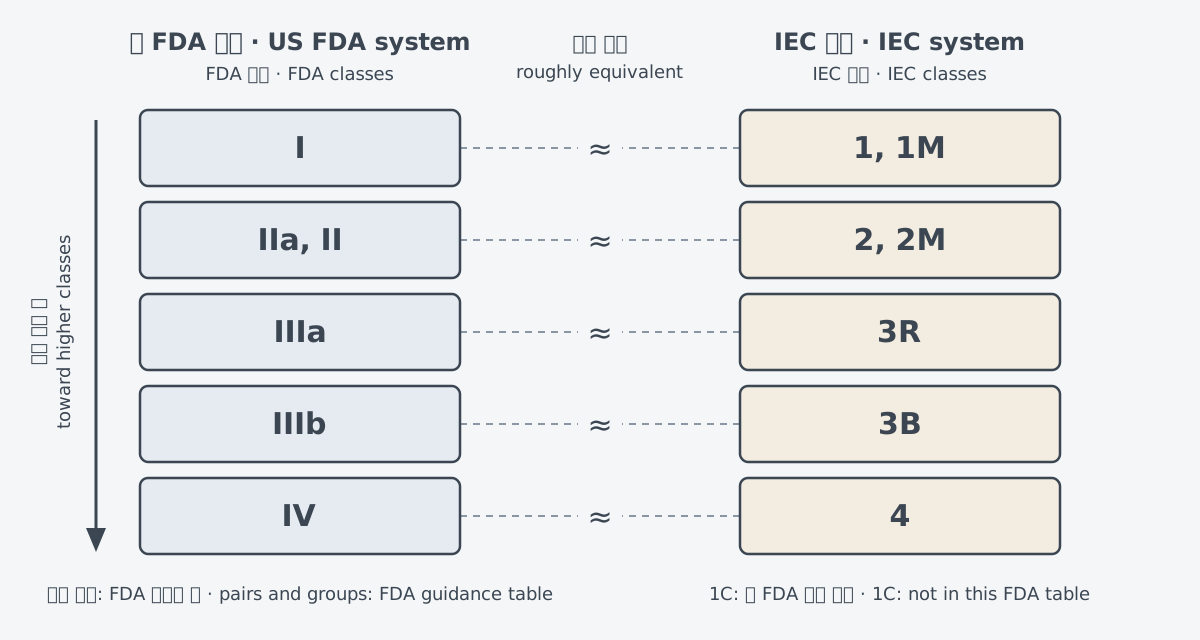
The groupings in Table 2 need care. The FDA table puts 1 and 1M in one cell beside Class I, and 2 and 2M in one cell beside Classes IIa and II. As Table 1 shows, 1 and 1M, and 2 and 2M, are classes with different descriptions. The wording of a grouped cell should therefore not be read as the definition of any one class.
Class 1C does not appear in this FDA table. "Considered non-hazardous" in the Class I cell is the wording of the FDA table, and it must be read with the sentence on optical aids that follows it. "Roughly equivalent" is also the wording of the FDA table and means only that. As the grouped cells show, the classes of the two systems do not match one to one.
Another FDA document, Laser Notice No. 56, recognizes many similarities between the FDA performance standards and IEC 60825-1 Edition 3 and IEC 60601-2-22 Edition 3.1. It treats the classification clauses as comparable, and it lists separately the IEC clauses that it considers not comparable. This article does not use the notice as evidence that the classes of the two systems are the same or different.
Table 3 shows the sentences attached to the definitions of the FDA classes. The US regulation 21 CFR 1040.10 defines each class by which table of AELs the laser radiation accessible to a person during operation exceeds. A footnote to each definition then gives the hazard of that level in one sentence. The table quotes those footnotes.
| FDA class | Radiation named in the definition | Wording of the footnote in 21 CFR 1040.10 |
|---|---|---|
| I | laser radiation | "Class I levels of laser radiation are not considered to be hazardous." The definition is a laser product "that does not permit access during the operation to levels of laser radiation in excess of the accessible emission limits contained in table I". |
| IIa | visible laser radiation | "Class IIa levels of laser radiation are not considered to be hazardous if viewed for any period of time less than or equal to 1 × 10³ seconds but are considered to be a chronic viewing hazard for any period of time greater than 1 × 10³ seconds." |
| II | visible laser radiation | "Class II levels of laser radiation are considered to be a chronic viewing hazard." |
| IIIa | visible laser radiation | "Class IIIa levels of laser radiation are considered to be, depending upon the irradiance, either an acute intrabeam viewing hazard or chronic viewing hazard, and an acute viewing hazard if viewed directly with optical instruments." In the glossary of this site, irradiance is listed under intensity. |
| IIIb | laser radiation | "Class IIIb levels of laser radiation are considered to be an acute hazard to the skin and eyes from direct radiation." |
| IV | laser radiation | "Class IV levels of laser radiation are considered to be an acute hazard to the skin and eyes from direct and scattered radiation." |
In Table 3 too, "not considered to be hazardous" comes with conditions. The FDA Class I footnote must be read with the definition: a product that does not permit access to radiation above the limits in the table. The Class IIa footnote applies to viewing times of 1 × 10³ seconds, that is 1,000 seconds, or less.
Like the 1,000 seconds, every numerical condition in the tables of this article is a condition that the document attaches to that class. None of them is given as a safety rule for the reader to follow. "Acute" and "chronic" are the words of the regulation.
The class also appears on the product label. Under the FDA guidance, the labeling for Classes II–IV must include a warning symbol that states the class and the output power of the product.
Roman-numeral classes also differ in scope from one document to another. The laser chapter of the OSHA Technical Manual uses Roman-numeral class names, and the ANSI Z136.1 that it cites is the 1993 edition. It notes that the CDRH (the FDA Center for Devices and Radiological Health) standard assigns Class IIIA to visible wavelengths only, while ANSI Z136.1 assigns it to all wavelength ranges. This is why the same Roman numeral cannot be taken to mean the same thing in every document.
In Korea, the standard to look at for the IEC class system is KS C IEC 60825-1 (Safety of laser products, Part 1: Equipment classification and requirements). On the national standards site KSSN it appears as identical (IDT) to IEC 60825-1:2014. The issuing authority shown there is the Korean government agency 국가기술표준원 (KATS). The public summary in the IEC webstore gives IEC 60825-1:2014 as Edition 3.0, and a new class, Class 1C, was introduced in this edition.
Korea also has a scheme for portable consumer laser products. In a 2022 press release, KATS announced an extension of the consumer products subject to safety confirmation. The extension covers portable laser products emitting laser light at wavelengths of 400–700 nm. Industrial, business, performance and military products are excluded.
The idea of maximum permissible exposure (MPE)
MPE is a value set for the exposure a person receives, not for a product. The PHE booklet defines MPE as the maximum level of laser radiation to which, under normal circumstances, people may be exposed without suffering adverse effects. It adds that laser products should be engineered so that people are not exposed to levels above the MPE. The OSHA glossary defines MPE as the level of laser radiation to which a person may be exposed without hazardous effect or adverse biological changes in the eye or skin.
One standard that uses the term MPE is the US standard ANSI Z136.1, which has a section on it. According to the OSHA Technical Manual, American National Standards (ANSI standards) are intended as a guide for manufacturers, consumers and the general public. Compliance is voluntary unless specifically required by an organization. The ANSI Z136.1-2022 sample pages published by the LIA are not the full standard, but they include part of the description of MPE.
Exposure below the MPE should not be read as exposure with no effect at all. The sample pages state that MPE values are by definition below known hazardous levels, yet exposure at the MPE value may be uncomfortable to view or feel upon the skin. They add that visual interference effects can result from exposures to visible laser beams at levels below the MPE. These effects include temporary flashblindness, glare and startle, and can create secondary hazards.
ANSI is not the only body that issues limits for the exposure a person receives. ICNIRP also publishes guidelines which apply to human exposure to optical radiation emitted by lasers. As the PHE booklet introduces them, they establish the levels below which no adverse biological effects are expected to the eyes and the skin. ICNIRP calls its own values exposure limits, not MPE.
The guidelines give their purpose as establishing the maximum levels of exposure to laser radiation which are not expected to cause adverse biological effects to the eyes and the skin. They are intended for use by the various experts and national and international bodies who develop regulations, recommendations or codes of practice.
About its own exposure limits, ICNIRP states that they should not be regarded as thresholds of injury or as sharp demarcations between "safe" and "dangerous" exposure levels. It states that the limits should be used as guidelines for controlling human exposure to laser radiation. It also states that exposure at levels below the exposure limits should not result in adverse health effects.
ICNIRP does make two exceptions, however. It states that the guidelines are considered to be adequate for the general population as well as for occupational exposure, and that only two exceptions need to be made. Some rare photosensitive or photosensitized individuals may react to UVR irradiances below the specified exposure limits. The limits for ocular exposure from 300 nm to 400 nm do not adequately protect the retina of infants and aphakic individuals.
The scope has limits too. The guidelines apply to exposures to laser radiation producing acute onset of observable biological responses. ICNIRP also states that in general there is a lack of knowledge regarding the injury threshold for effects from long term chronic exposure. So even within the ICNIRP document, the exposure limits are not described as a boundary that holds for every person and every exposure.
As the PHE booklet points out, MPEs are dependent on wavelength. Finding and applying those values belongs to the standards and to the people assigned to that work.
Reading eyewear labels: wavelength and OD
A laser eyewear marking has two things to read. One is the wavelength range that the marking is for, and the other is how much the eyewear reduces light in that range. The OSHA Technical Manual requires all laser eye wear to be clearly labeled with OD values and wavelengths for which protection is afforded. The PHE booklet likewise says protective eyewear should be clearly marked with the wavelength range and corresponding protection level.
Optical density (OD) expresses on a logarithmic scale how much a filter reduces light. The page of the US Army Public Health Center (APHC) defines OD as a logarithmic measure of how much light is attenuated by a filter. The OSHA glossary points the same way and calls it a logarithmic expression for the attenuation produced by an attenuating medium, such as an eye protection filter. The larger the OD value, the more light is blocked.
Because the scale is logarithmic, each increase of 1 in OD cuts the light that passes at the marked wavelength to one tenth. With T as the fraction of light that passes, the line below gives the relation, and the table under it puts OD values into that line. The line and the table are calculated in this article and are not quoted from an official document.
T = 10^(−OD)
| OD | Fraction of light that passes | Reduction factor |
|---|---|---|
| 1 | 10% | 10 times |
| 2 | 1% | 100 times |
| 3 | 0.1% | 1,000 times |
| 6 | 0.0001% | 1,000,000 times |
The calculated values agree with two examples on the APHC page. One is that eyewear with an OD of 6.0 has a transmission of 0.0001%. The other is that eye protection with an OD of 3.0 has 100 times more light blocking ability than eye protection with an OD of 1.0. Since the scale is not linear, small changes in the values of OD lead to a large change in the stopping power.
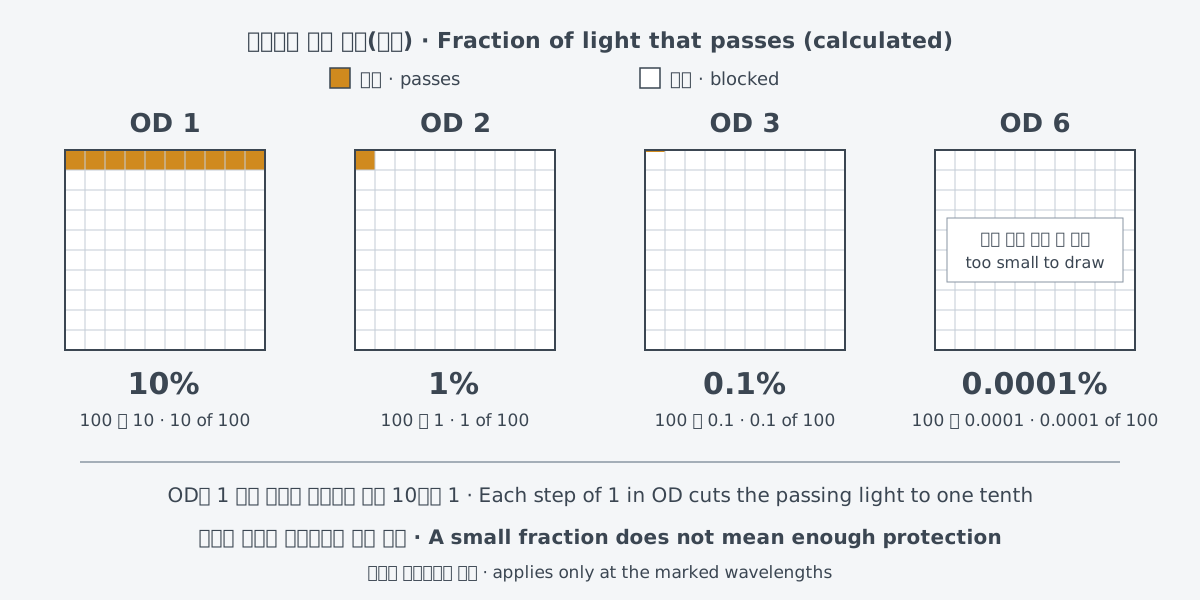
The point that needs the most care is that a small fraction does not mean enough protection. The APHC page states that eyewear with an OD of 6.0 might still not give enough attenuation to reduce a laser exposure to safe levels. It states this even though the transmission of that eyewear is only 0.0001%. It adds that the OD requirements are always specific to each laser, so no rule of the form "an OD of so much is enough" is given here.
The PHE booklet first addresses the case where the other measures are inadequate to control the risk of eye exposure in excess of any applicable MPEs. In that case, it states, eye protection recommended by the equipment manufacturer or optical radiation safety adviser should be worn. The eye protection is also to be specifically designed for the wavelengths and output.
The same booklet states that the level of attenuation provided by protective eyewear should be at least sufficient to decrease the exposure level below applicable MPEs. This is a minimum requirement stated in that booklet, not a way to decide whether a given pair of eyewear is sufficient. As shown above, the APHC page states that even an OD of 6.0 might not give enough attenuation. The ANSI sample pages state that visual interference effects can result from visible laser beams below the MPE.
Wavelength comes next: according to the APHC page, most laser eye protection will have a range or ranges of wavelength with an associated OD for each range. As an example of the etching, it gives "400-550 nm OD 6+, 600-700 nm OD 4+". The page then explains that the example means between 400 and 550 nm an OD of 6.0, and between 600 to 700 nm an OD of 4.0.
This explanation only states what the marked values are. Whether they are enough for a given laser cannot be read from the marking; the APHC page states that the OD requirements are always specific to each laser.
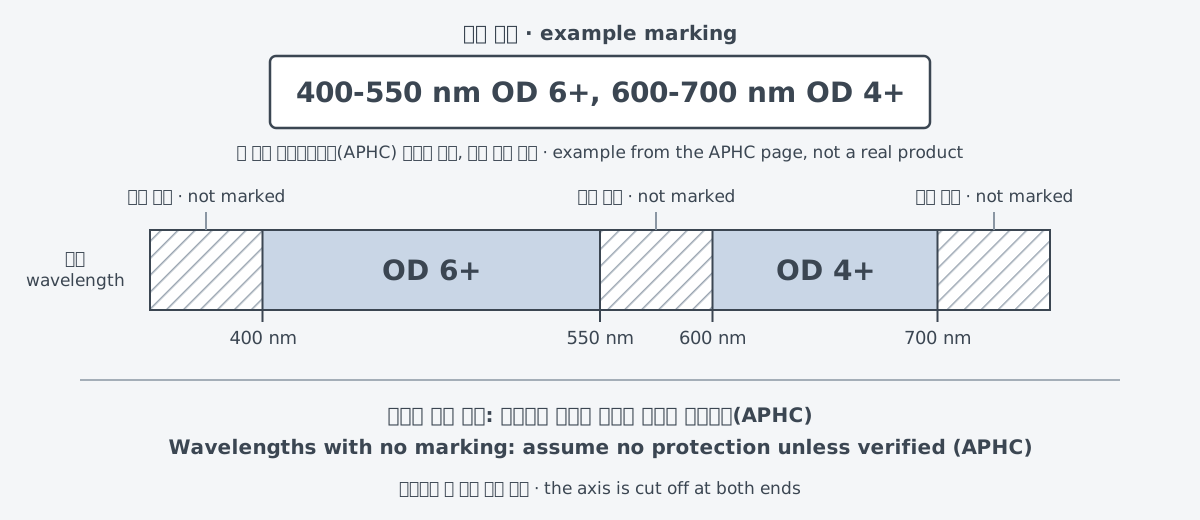
An OD should be read as a value for the marked wavelength range. The APHC page states that optical devices not marked with the level of protection at the laser wavelength should be assumed to offer no protection unless verified. It also states that protection against a certain wavelength range does not imply protection of nearby wavelengths. The example above marks two ranges, 400-550 nm and 600-700 nm, and no value is marked for the wavelengths between them.
Two other documents also address wavelength. The ANSI Z136.1-2022 sample pages state that laser protective eyewear is specifically designed to protect against a single wavelength, set of wavelengths, or band of wavelengths. The eyewear used, they add, must be appropriate for the wavelength of the laser in use. The PHE booklet makes the point that the degree of protection offered by personal protective equipment, which includes eyewear, may also be wavelength dependent.
Reflected light also appears in the descriptions of eyewear. The APHC page states that glasses should protect against direct exposure and reflections from a possible glancing angle. It adds that if glasses do not fit closely enough to the face, or slip, the eyes can be at risk of direct and reflected exposure. The ANSI sample pages state that eyewear shall be specifically selected to withstand either direct or diffusely scattered beams, depending upon the anticipated circumstances of exposure.
The OSHA Technical Manual states that, in general, other controls should serve as primary protection rather than depending on employees to use protective eye wear. This is also why this article covers only how to read an eyewear marking and not how to choose a means of protection.
Another standard that sets eyewear markings is BS EN 207. A product page of the BSI (British Standards Institution) presents it as a European standard that defines the requirements, test methods and marking for filters and eye-protectors against laser radiation. It applies to eye-protectors used for protection against accidental exposure to laser radiation. The page adds that a risk assessment should first be undertaken before selecting eye protection.
What this article does not cover
This article only explains how to read classes and markings, and it does not replace safety training or on-site judgment. It does not replace a qualification either, and it cannot serve as a basis for deciding which laser may be handled under which conditions. Decisions about real work must follow the applicable standards, the safety officer on site and the manufacturer's instructions.
This article leaves out the following.
- The numerical values of MPE and AEL, and how the NOHD is found
- The output limits and wavelength ranges of each class
- How the required OD is determined, and the choice of eyewear or any other product
- The meaning of the letters in a European EN 207 marking
- The clauses that the FDA notice (Laser Notice No. 56) lists as not comparable
- Where the regulation's line between "acute" and "chronic" lies
- The content of on-site controls and management procedures
- Medical judgment when an exposure is suspected
The evidence has limits too: the full texts of IEC 60825-1 and ANSI Z136.1 are paid documents. The IEC class descriptions in this article therefore quote the PHE booklet, and the statements about ANSI quote the sample pages published by the LIA. The laser chapter of the OSHA Technical Manual cites the 1993 edition of ANSI Z136.1. The exact wording and edition should be checked in the standard itself and in official guidance.
What to read next
The next article is "Units and dB notes: reading W, dBm and ratios". It covers how to convert between the different units that sources use.