On September 30, 2021, a hurricane was tearing across the Atlantic, and a small boat in the middle of it was filming the storm from the waves. Nobody was on board. It was the first video from inside a major hurricane taken by an unmanned surface vessel (USV).
Drones fly in the sky, and boats with no one aboard also travel on the water. This article looks at how USVs are grouped, where ocean science and navies use them, and how their story runs back more than a hundred years, using public sources. The field changes quickly, so the article reflects the situation as of October 2026.
A drone on the water, starting with the name
A USV moves across the sea surface like a boat and gathers data about the ocean and the air above it, but it carries no people. NOAA Ocean Exploration says USV is the most widely accepted name for a surface craft with no crew on board. You will also see terms such as uncrewed surface vehicle and autonomous surface vessel, and some people simply call them drones or robots.
Having no crew does not mean the boat makes every choice by itself. Operators at sea or ashore can steer it remotely, or give it a planned mission and step in only a little while it runs. Most USVs have some autonomy, but in NOAA's words no USV is fully autonomous. Survey USVs stay under the watch of qualified operators the whole time.
Sorting them by size and power
There is no standard shape for a USV. Some look like motorboats or sailboats, and others look more like a surfboard or an oversized bath toy. In the end, the job decides the shape.
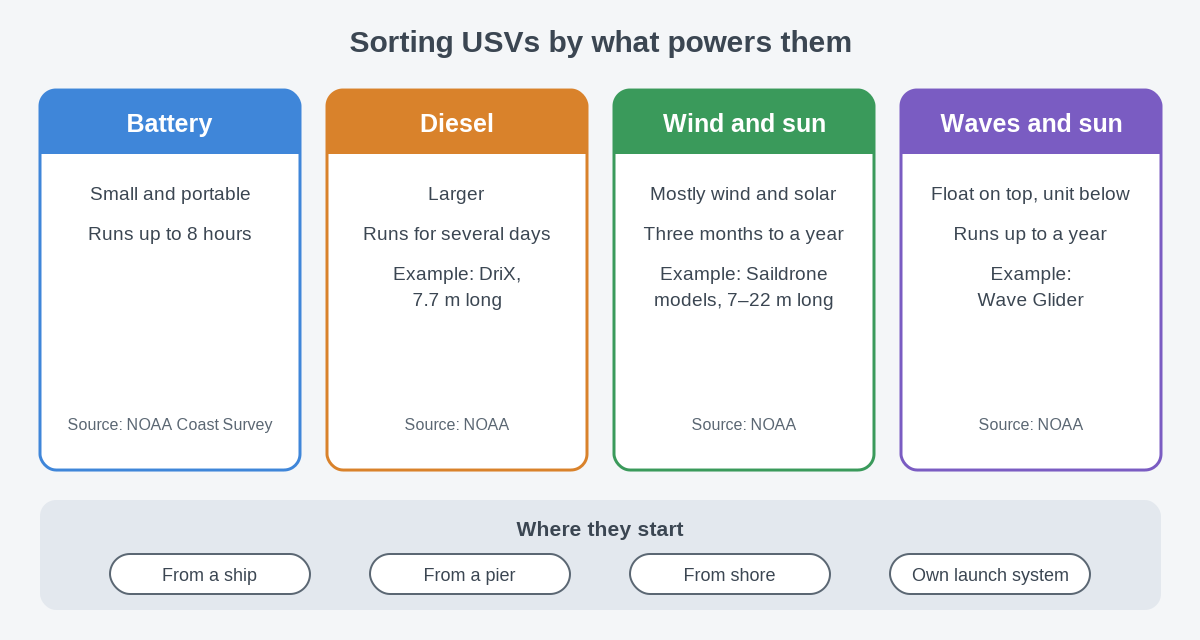
Sorting them by what drives them makes the differences clear. At the small end are portable battery boats that run for up to 8 hours. Larger diesel boats can stay at sea for several days. DriX, which NOAA has tested, is a 7.7 m diesel USV shaped like a submarine, and it can run either by remote control or on supervised autonomy.
Some USVs use wind, sunlight or waves instead. Saildrone vessels, driven mostly by wind and solar power, can work in rough, remote waters for three months to a year. The three models described on the NOAA page are 7–22 m long. A Wave Glider hangs an underwater unit below a surface float, moves forward on wave energy, recharges its electronics with sunlight and can keep going for up to a year.
USVs also start from different places. Most are lowered into the water at a pier or over the side of a ship, and a few carry their own launch gear. Once at sea, a USV may work beside a ship, travel alone or move with other USVs.
Measuring the sea: maps and observations
Start with measuring the sea. A USV's sensors collect data above and below the surface and often send it to a ship or to shore by satellite in real time. On the ocean side they measure depth, temperature, saltiness, oxygen in the water, currents, waves and sound. In the air they measure temperature, wind, pressure and humidity.
NOAA's Office of Coast Survey, which carries out hydrographic surveys, has studied uncrewed survey systems since 2004. It started with small autonomous underwater vehicles (AUVs) that one person can carry, then added both small and large USVs. The work supports safe navigation, emergency response and seafloor mapping.
Small USVs carry a multibeam sonar that measures depth and a side scan sonar that makes images of the bottom. Response teams send them out quickly after natural disasters or accidents at sea, and they collect measurements in water too shallow for a crewed boat to enter safely. Large USVs that can stay out for days work in pairs with NOAA survey ships and make those ships more productive.
USVs also team up with vehicles under the water. They give AUVs and remotely operated vehicles (ROVs) help with navigation, pass on instructions and keep a communications link open. Some even act as a moving station where other uncrewed systems can dock, hand over data and recharge.
In September 2021, NOAA and Saildrone sent a USV into the middle of a category 4 storm, Hurricane Sam. There it kept collecting data in 50-foot waves and winds above 120 mph. A NOAA scientist said the data should help forecast models predict rapid intensification, when a hurricane's winds grow much stronger within hours.
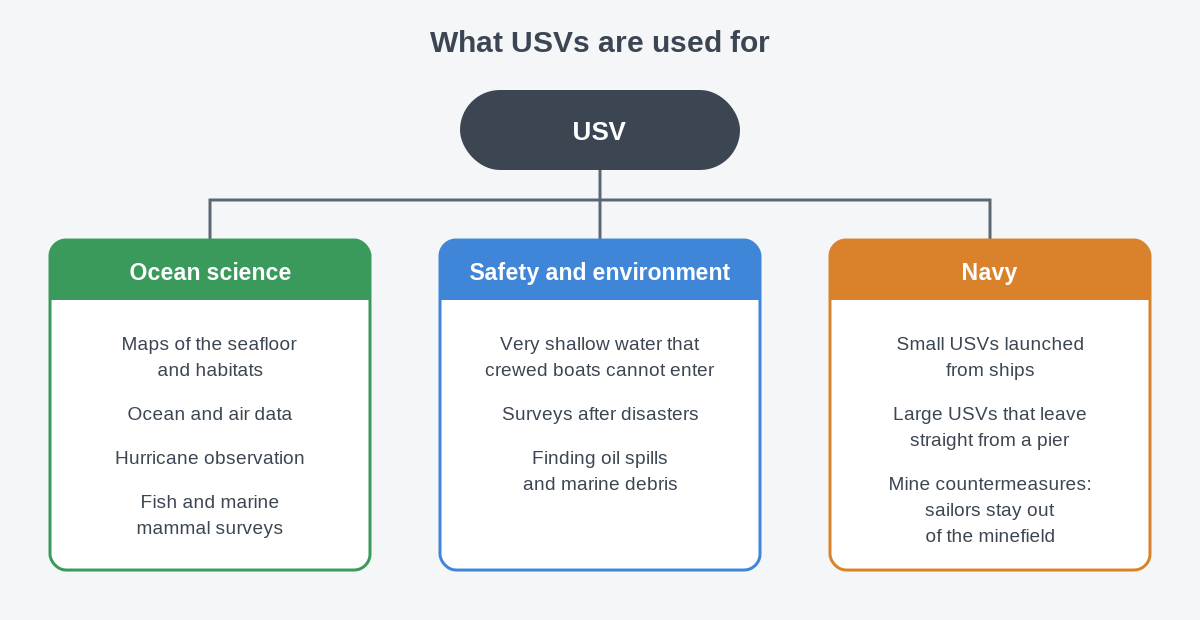
The list of uses goes further. USVs survey marine mammals and fish stocks, check water and air quality and look for underwater heritage sites. They also help find trash floating at sea, oil slicks, harmful chemicals and illegal activity, and people have begun trying them as cargo vessels and passenger ferries.
Navy uses: small boats, large boats, mines
Navies sort USVs by size as well. According to the Congressional Research Service (CRS), the U.S. Navy is developing and buying small USVs that launch from crewed ships and submarines. They stretch how far those ships can reach. Large USVs, by contrast, are roughly as big as a large patrol craft and leave straight from a pier to do missions that crewed ships might otherwise handle.
The programs and technical problems of large USVs are covered in Unmanned surface vessels: ships without crews. This section looks instead at the first USV for which the U.S. Navy declared an initial operating capability.
That boat deals with naval mines hidden at sea. The Navy's Mine Countermeasures Unmanned Surface Vehicle (MCM USV) is a semi-autonomous, diesel-powered boat with an aluminum hull. It tows the equipment for both minesweeping, which clears mines, and minehunting, which looks for them. The sweep system used with it can be operated from littoral combat ships, from shore or from other ships pressed into service.
On July 22, 2022, the U.S. Navy declared that the unmanned sweep system paired with this boat had reached initial operating capability (IOC). It was the first IOC for any unmanned surface platform in the U.S. Navy. The program manager said the aim was to protect sailors by keeping them away from the minefield.
From radio-controlled boats to today
The idea of moving a boat without anyone steering on board is older than it sounds. Around 1901, Leonardo Torres Quevedo, a Spanish engineer, started building a remote-control system so he could test his airships without putting lives at risk. In 1903 he patented it under the name Telekine, meaning "movement at a distance."
He then fitted the system to engine-driven boats and, in 1905 and 1906, tested a small boat on a pond in Madrid. In the Bilbao estuary, he took full control of a small boat carrying eight people from more than 1.25 miles away. Those boats had people aboard, so they were not USVs in today's sense. Still, the work set down the principles of wireless remote control, and it is now an IEEE Milestone.
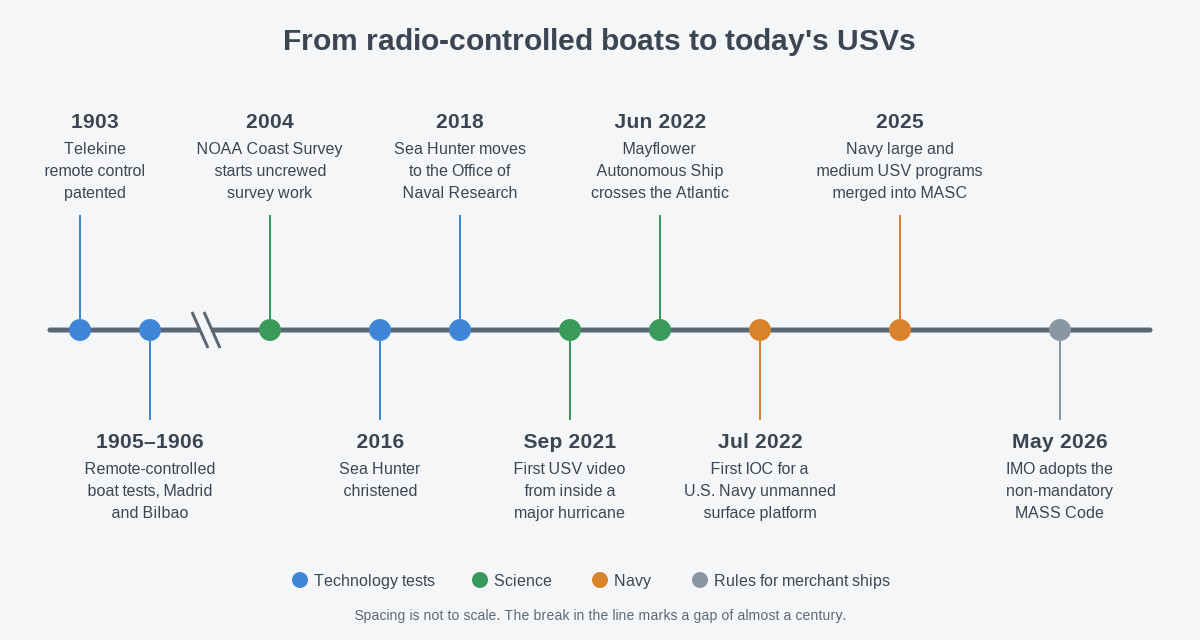
The story then jumps ahead to the 2000s. NOAA's Coast Survey began its uncrewed survey work in 2004, and Sea Hunter, a prototype from the Defense Advanced Research Projects Agency (DARPA), was christened in April 2016. In 2017 Sea Hunter passed three stages of tests on following the International Regulations for Preventing Collisions at Sea (COLREGs). In January 2018 it moved to the Office of Naval Research.
On the science side, the 2021 hurricane video was followed by an ocean crossing. On June 30, 2022, Mayflower Autonomous Ship reached Plymouth, Massachusetts, after sailing across the Atlantic from Plymouth in the United Kingdom. NOAA describes the 15 m vessel as the largest USV to cross the Atlantic steered by an artificially intelligent "captain."
On the Navy side, the mine countermeasures USV received its first IOC in 2022. In 2025 the large and medium USV programs were merged into one, the Modular Attack Surface Craft (MASC) program. For merchant ships, the International Maritime Organization (IMO) adopted the MASS Code in May 2026, a non-mandatory set of rules for commercial ships that are run remotely or autonomously. Even so, IMO notes that no SOLAS cargo ship in international commercial service currently runs autonomously or by remote control.
Not a replacement for ships
The advantages come first. In general, USVs do the work more efficiently than traditional ship-based operations, cost less and are safer, because people do not have to go to sea. Those running on renewable energy can stay out for long periods, and they can reach remote or dangerous places.
Even so, NOAA is clear that USVs will not replace ships or people. They work alongside ships, crews, AUVs and ROVs, so that each one covers for the weak points of the others. Used that way, they widen the scope, scale and speed of data collection.
As noted earlier, no USV is yet fully autonomous, and survey boats at sea are still watched by people the whole time. Like drones in the air, drones on the water take work off people's hands without leaving human hands altogether.
What to read next
- Unmanned surface vessels: ships without crews: how large USVs try to handle the rules of the road, communications and breakdowns.
- Unmanned underwater vehicles: robots beneath the sea: what changes when an uncrewed vehicle goes under the water instead of across it.
- Naval Mines and Mine Countermeasures: why mine countermeasures USVs are needed, seen from the side of the mines.
- Naval Drones in the Black Sea: How Uncrewed Boats Appeared: an upcoming article on how USVs were used in war, told through the dates and events in official statements.