Late on July 5, 1997, a small vehicle 30 cm tall and weighing 10.6 kg rolled down the rear ramp of a lander on Mars. It was called Sojourner, and it was the first robotic rover ever delivered to the Martian surface. Five years later, in Afghanistan, a small tracked robot with a camera and an arm was peering around corners and into caves.
The two had different jobs and very different homes, yet they share one name. Both are unmanned ground vehicles (UGVs): vehicles that move over the ground with nobody aboard. Flying drones are familiar by now. So what bodies have the drones on the ground used, and what work have they done?
This article follows the kinds of UGV, their uses and half a century of history that began on the Moon in 1970, using public sources. The field changes fast, so the article reflects the situation as of October 2026.
UGVs in the unmanned systems family
The U.S. National Institute of Standards and Technology (NIST) set out a definition in a 2008 terminology guide. An unmanned system (UMS) is a physical system with its own power and no human operator riding on its main components. It works in the real world to complete the tasks it is given.
The family has several members. The examples are UGVs on land, unmanned aircraft systems (UAV/UAS) in the air, unmanned surface vessels (USV) on the water and unmanned underwater vehicles (UUV) below it. Unattended munitions and unattended ground sensors are on the list too. Missiles, rockets, submunitions and artillery do not count as principal components of an unmanned system.
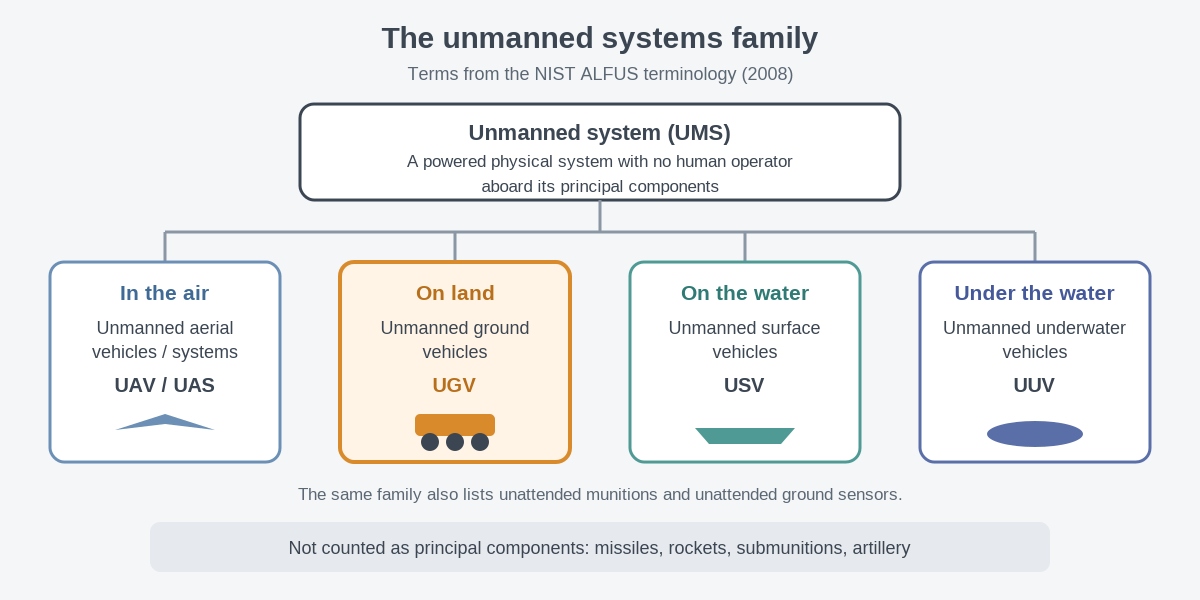
The phrase "drones on the ground" comes from this family tie. Most people picture a flying aircraft when they hear "drone," but the air branch is simply the best known. The difference is real, though. Unlike an aircraft, a UGV has to deal directly with the shape of the land, from hills and rocks to caves.
How much a person stays in control, from remote control to full autonomy, is covered in Unmanned ground vehicles: robots for dangerous places. That article also covers the U.S. Army's robot programs by weight and the Defense Department's policy on autonomy in weapons. This one focuses on bodies, jobs and history.
Wheels, tracks and legs
There are three broad ways to move over land. A vehicle can roll on wheels, crawl on tracks or walk on legs. Setting one public example beside each makes the split clear.
On the wheeled side is the U.S. Army's load-carrying robot, S-MET. The program behind this eight-wheeled robot is covered in the earlier UGV article.
Many bomb disposal robots run on tracks. PackBot, used in Afghanistan from 2002 onward, had a simple layout: one camera and one extendable arm on a base with two tracks. MTRS, the medium robot meant to replace the TALON family, is also a tracked vehicle, and a Soldier drives it with a handheld controller.
Some UGVs walk. The U.S. Defense Advanced Research Projects Agency (DARPA) developed a four-legged robot, LS3, to move alongside a squad of soldiers or Marines. In January 2012 the prototype climbed up and down a hill in its first outdoor assessment.
Humanoids that walk on two legs have also entered competitions. Among the designs entered in DARPA's disaster response robot competition was a two-legged robot called Hubo.
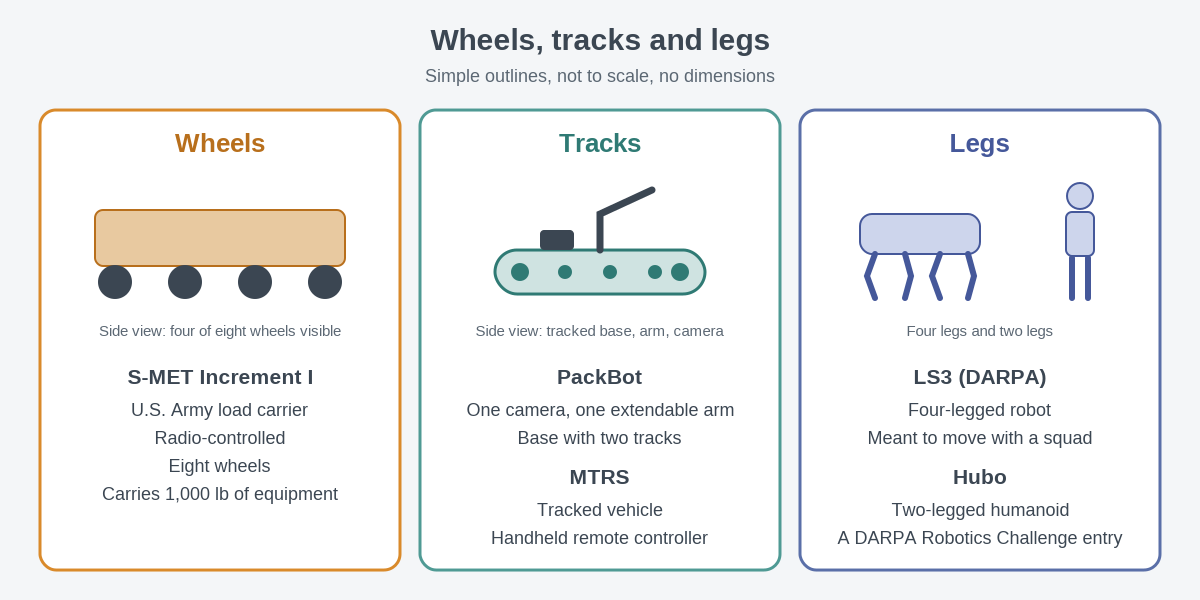
No single line can say which of the three is best. A robot that carries cargo, a robot that looks around corners and a robot that follows a squad up a hill each have a different body.
From backpack robots to vehicles
Sizes vary widely too. Sojourner, seen above, stood 30 cm tall and weighed 10.6 kg. At the other end, Hubo, entered in the DARPA Robotics Challenge, was a complete, full-sized humanoid. That competition wanted robots to use people's tools and equipment as they are.
Military ground robots also range from small ones a Soldier carries in a pack to large ones. The U.S. Army's programs by weight class, and the weight of each class, are set out in the earlier UGV article.
The need for a big body usually comes from the job. A 2018 U.S. Army article named disarming bombs carried in vehicles as a capability it wanted from a large robot, and said that takes a robot of significant size. The job sets the size of the body.
Dull, dirty and dangerous jobs
The 2018 Army article has a phrase for the work robots might take over: "dull, dirty and dangerous" jobs. As robots get better, the question becomes how much more of this work they can take from Soldiers.
Bomb disposal is one of the jobs handed to robots early on, and TALON saw use in Tikrit, Iraq, in 2005. It was one of the earliest systems to let Soldiers take apart improvised explosive devices (IEDs) from a distance. They worked it with a remote controller inside the bomb disposal vehicle. Keeping Soldiers at a safe distance while they find and remove explosives and chemical hazards is still an open problem.
The same body with different equipment does a different job. Depending on what it is fitted with, MTRS can detect and remove land mines, IEDs and unexploded shells, or handle chemical, biological, radiological and nuclear (CBRN) hazards.
Carrying loads is another job. On its LS3 program page, DARPA wrote that a dismounted warfighter's gear can pass 100 lb (about 45 kg), wearing the body down and lowering performance. The four-legged LS3 was built to take some of that weight off.
There is work away from the battlefield as well. The DARPA Robotics Challenge aimed at human-supervised ground robots that could do complex tasks in dangerous, degraded environments built by people. Entrants built robots that could use the standard tools and equipment common in human spaces, from hand tools to vehicles.
There is also work underground. DARPA's Subterranean (SubT) Challenge aimed to help warfighters and first responders explore underground places so dangerous, dark or deep that sending people in would put lives at risk. In the final event, robots walked, rolled or flew into tunnels, urban underground spaces and caves.
The most distant workplace is another world. Rovers on the Moon and Mars are vehicles that travel over the ground with nobody aboard. Perseverance touched down on Mars in 2021 with the job of looking for signs of ancient life.
Half a century on a timeline
The timeline in this article starts on the Moon in 1970. On November 17, 1970, the Soviet Luna 17 landed on the Moon carrying the lunar rover Lunokhod 1. On January 15, 1973, Luna 21 delivered Lunokhod 2.
Mars came much later. Mars Pathfinder launched on December 4, 1996, and landed on July 4, 1997, and the next night Sojourner rolled down its ramp. It was the moment the first robotic rover reached the Martian surface.
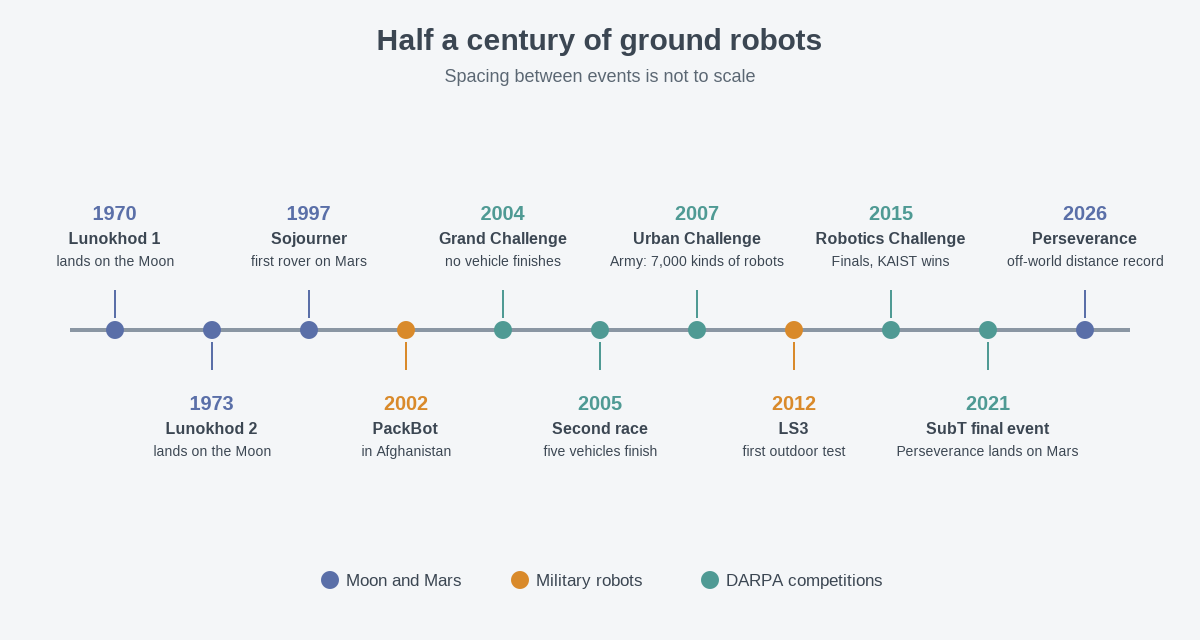
PackBot, in Afghanistan from 2002, became the first ground robot to see wide use. In 2005 TALON was in use in Iraq, and from that year robotic platforms spread widely across the battlefield. By around 2007 the Army had 7,000 kinds of robots.
In the same years, DARPA used prize competitions to draw out vehicles that drive themselves. On March 13, 2004, 15 vehicles set off from the start in the desert outside Barstow, California, on a 142-mile (about 229 km) course, and none reached the end. At the next race on October 8, 2005, five vehicles out of 195 entered teams finished a 132-mile (about 212 km) course. In the 2007 Urban Challenge, 6 of 11 teams drove through a staged city while obeying traffic rules.
Legs and hands appear on the timeline in the 2010s. The four-legged LS3 had its first outdoor assessment in January 2012. At the DARPA Robotics Challenge Finals on June 5–6, 2015, in Pomona, California, the KAIST team took the top prize.
Two things overlapped in 2021. The SubT final event took place on September 21–24 at the Mega Cavern, an underground site in Louisville, Kentucky, and Perseverance landed on Mars that year. On October 11, 2026, its odometer reached 45.22 km, passing the 45.16 km record set by Opportunity (2004–2018). Perseverance covered that ground in about 5½ years, against almost 15 for Opportunity.
Why driving alone is hard
The 2004 race showed how hard it is to drive alone over the ground. On the 142-mile course, even the best vehicle went only 7.5 miles (about 12 km), and the $1 million prize for finishing went unclaimed. Over the longer term, DARPA wanted to speed up the technical groundwork for autonomous vehicles that could stand in for people in hazardous military jobs such as supply convoys.
One day after the first race ended, DARPA announced a second one, 18 months later. At that 2005 race, held after the lessons learned had been analyzed, five vehicles made it to the end. Research on off-road autonomy, such as RACER, followed later, and that story is in the earlier UGV article.
Communication is another problem. Through supervised autonomy, the DARPA Robotics Challenge sought robots that could keep working through poor links with low bandwidth, long delays and dropped connections. Another goal was to let supervisors who are not experts control robots better.
As people step further back, a question follows about where human judgment should sit. That question continues in other articles, together with the difference between teleoperation and autonomy and the policy on autonomy in weapon systems.
Where this meets lasers: eyes on the ground
To drive on its own, a vehicle first has to see the ground. The test vehicles in RACER, DARPA's off-road autonomy research, carried multiple lidars. A lidar measures distance from the time a laser pulse takes to hit an object and come back.
The lidar was not alone. The same vehicles also had pairs of stereo cameras, color and infrared cameras, radar, inertial measurement sensors and event sensors.
The principle of measuring distance with a laser is explained in Measuring with lasers: range finding and lidar basics. How the military uses lidar to map terrain and objects is in Military Lidar: Mapping Terrain and Objects with Lasers.
What to read next
- Unmanned ground vehicles: robots for dangerous places: the four ways of running an unmanned system, from remote control to autonomy, and the U.S. Army's ground robots by weight.
- Drone autonomy: navigation is not the same as communication: how unmanned systems behave when the link drops.
- Measuring with lasers: range finding and lidar basics: the principle behind lidar, one of the sensors unmanned vehicles use to see the ground.
- Ground Robots on Ukraine's Front: Supply and Evacuation: the record of UGVs in that war, told through dates and events.