Look up at the drones in the sky and you will see very different shapes. Some are small crosses with four propellers. Some spread long wings like a model airplane. Others have wings and a row of upward-facing propellers as well.
The shapes differ for one main reason: what holds up the aircraft's weight. It can be spinning rotors, a wing moving forward, or a switch between the two during the flight. That choice decides where the aircraft can take off and land, whether it can hover, and how long it can stay up.
The principles here come from NASA and Federal Aviation Administration (FAA) education material, and the examples come from articles the U.S. Army has published. The article reflects what was public as of October 2026.
What holds the aircraft up
Four forces act on anything that flies. Weight pulls it down, lift pushes up against the weight, thrust pushes it forward, and drag resists forward motion. The three kinds of drone differ in where they get their lift.
The U.S. federal aviation regulations (14 CFR 1.1) make the difference clear. An airplane is a fixed-wing aircraft kept aloft by air pushing back on its wings. A rotorcraft is held up mainly by lift from one or more rotors.
A separate group, powered-lift, takes off, lands and flies slowly on engine-powered lift devices or on the engines' own thrust. In level flight it switches to wings that do not rotate. These definitions were written for crewed aircraft, yet they line up neatly with the three kinds of drone.
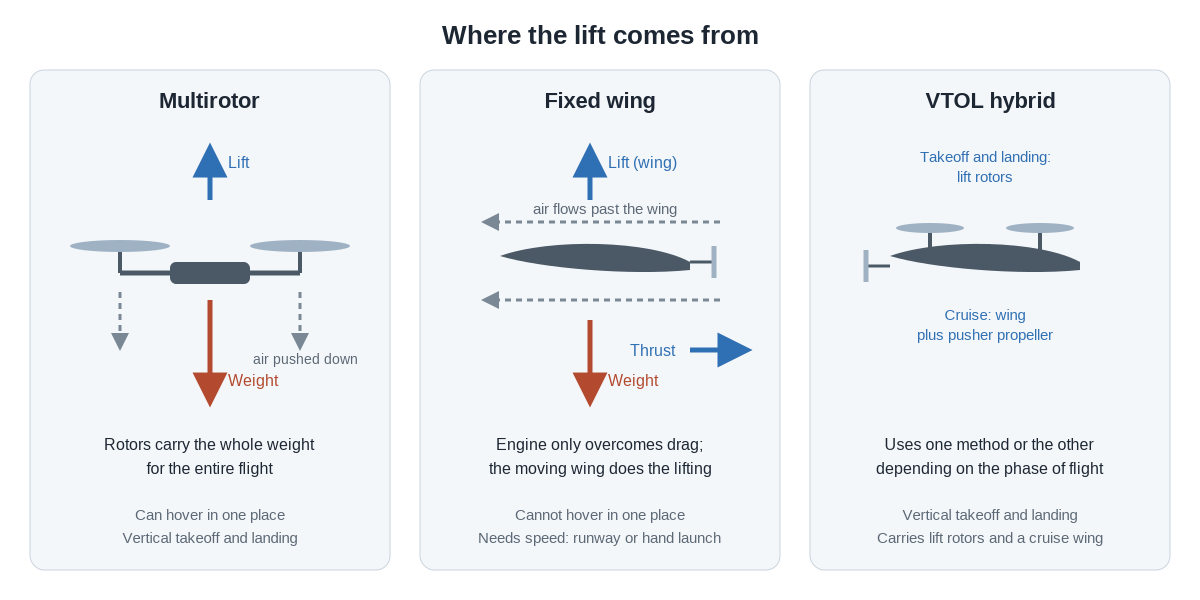
Researchers sort these differences by "type," which in NASA researchers' usage describes how an aircraft is laid out and how it is controlled. By that measure, a helicopter with one main rotor, a tiltrotor, a quadrotor and a propeller airplane each count as a separate type. NASA's air taxi work alone considered many of them: helicopter, multicopter, tiltrotor, tiltwing, compound, vectored thrust and lift+cruise, among others. This article covers three of them: the multirotor, the fixed wing, and hybrids such as lift+cruise.
Multirotors: pushing air down
A multirotor is a rotorcraft with several rotors. With four, it is called a quadcopter, a name that comes from flying on four propellers. The spinning propellers push air down, and the reaction pushes the aircraft up. Each propeller makes its own lift, and the total lift is the sum of all four.
When that total is larger than the weight, the aircraft climbs. When it equals the weight, the aircraft stops moving up or down and stays in one place. That is a hover.
The FAA's helicopter handbook describes the same thing for a rotor. A rotor's lift and thrust act at right angles to the disk the rotor sweeps, and holding a steady height takes lift equal to the aircraft's weight. All that time, the engine or motors must keep producing enough power to turn the rotors and overcome drag and friction.
It is a little like treading water to keep your head above the surface: you cannot stop kicking. A multirotor carries its whole weight on its rotors for as long as it stays up. The comparison has limits: a swimmer gets help from buoyancy and a multirotor gets none. Wind or forward motion also changes the airflow through the rotors, and so the power they need.
Steering with rotor speed
A quadcopter makes all three of its movements, up and down, sideways and turning in place, with its four propellers. The trick is to run the propellers at different speeds.
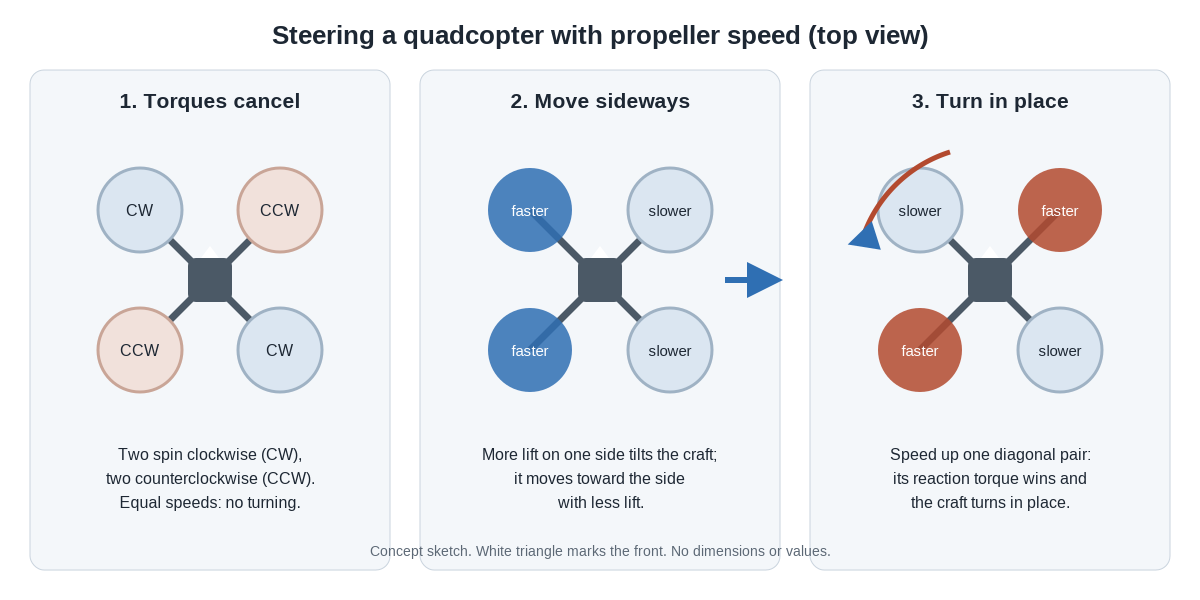
When lift acts straight up, the craft moves only up or down. When lift is tilted, it also moves sideways. Speeding up the pair of propellers on one side, or slowing the pair on the other, makes the lift uneven, and the craft moves toward the side with less lift.
That leaves torque, the twisting force a spinning propeller creates. Its reaction tries to turn the aircraft the other way, which is why a helicopter carries a tail rotor. A quadcopter spins two propellers clockwise and two counterclockwise, so the torques cancel. Spin one pair faster than the other, and that pair's reaction wins, so the craft turns in place.
Steering by speed alone has conditions. NASA researchers designing a passenger-carrying quadrotor concept compared collective control, which changes the blade angle, with rotor speed control. They noted that speed control must respond very quickly and needs a design answer for the case where every motor stops.
Rotor size is a condition too. A separate NASA study steered the lift rotors of a lift+cruise aircraft by speed. Its authors expected larger rotors to have more rotational inertia, until speed changes alone could not respond fast enough for maneuvering. So they set an upper limit on rotor size.
In other words, the method gets easier as rotors get smaller. Rotors and tail rotors are covered in more depth in Helicopter rotors.
Fixed wings: lift that needs forward motion
The wing of a fixed-wing drone does not spin. NASA Glenn Research Center's beginner's guide explains that lift is an aerodynamic force made by the aircraft moving through the air, and that the wings make most of it. The engine's job is to overcome drag, not to lift the aircraft. The wings do the lifting.
This is the biggest difference from a multirotor. A multirotor's motors must hold up the whole weight, while a fixed-wing aircraft's engine or motor only has to overcome drag as it moves forward.
That difference ties into how long an aircraft can stay up. A multirotor spends power holding up its weight the whole time it is aloft, while a fixed wing hands that job to its wing. The NASA study covered below looked at passenger-carrying concepts. It likewise listed a potential benefit of the hybrid: cruising like an airplane can cut energy use a lot and allow smaller batteries.
This article does not compare flight times in numbers. Where the energy comes from is covered in Drone power.
The price is that a fixed wing makes no lift unless it moves. It cannot stop and hang in one place, and it needs speed before it can fly. Some small ones, like the Raven covered below, are thrown into the air by hand.
Moving air helps rotors as well. According to the FAA helicopter handbook, when a helicopter starts to accelerate out of a hover, translational lift makes the rotor more efficient, leaving more power than the hover needed. At the moment it starts to move forward, though, part of the thrust is turned forward, some lift is lost, and the helicopter begins to sink. How wing shapes change with speed is covered in Wing shapes.
VTOL hybrids: splitting the two jobs
To take off and land without a runway and still fly on wings, an aircraft can split the two methods between phases of flight. An aircraft that combines vertical takeoff and landing (VTOL) with wing-borne flight fits the powered-lift group from earlier. One such layout is the lift+cruise type.
As NASA researchers describe it, a lift+cruise aircraft flies like an airplane as much as possible and uses its upward-facing lift rotors only in the VTOL phases. Its most distinctive feature is that the rotors that lift are separate from the ones that push it forward. In cruise, the lift rotors sit idle, stopped and lined up with the airflow. The type was chosen to represent a group of recently developed VTOL aircraft, crewed and uncrewed.
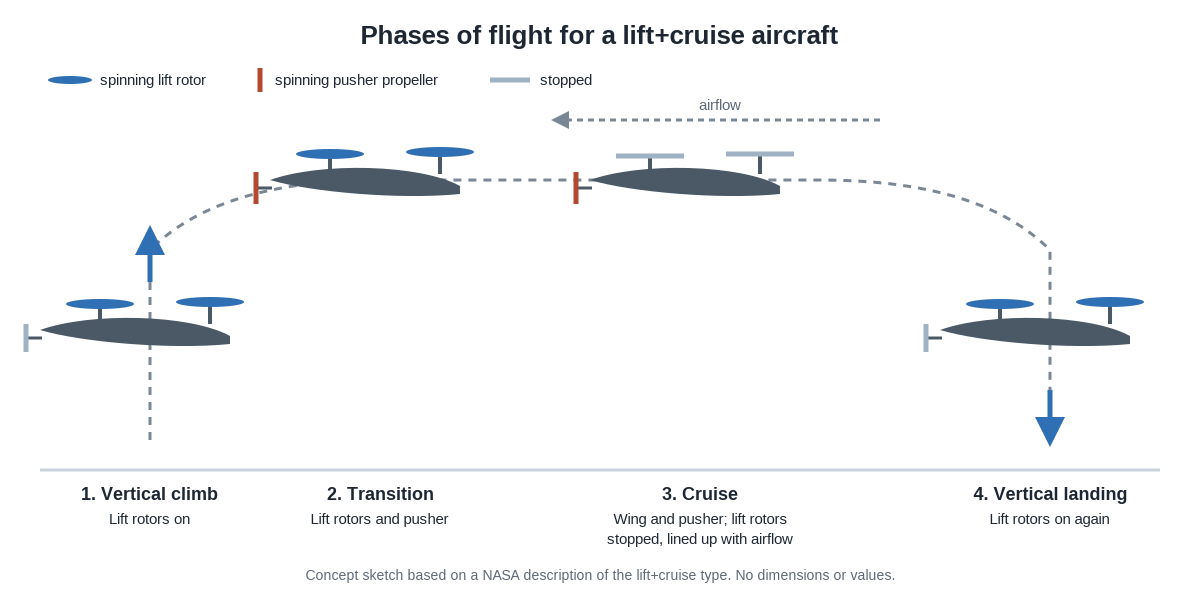
The "potential benefits" the researchers listed as design guides come from this layout. Cruising like an airplane can cut energy use a lot, so the aircraft can carry smaller batteries. Small lift rotors can be simple propellers steered by speed, with no blade-angle mechanism. And when hovering takes much less time than cruising, the energy spent hovering is small.
There is a cost. Of the three types this study compared (side-by-side, quadrotor and lift+cruise), the lift+cruise concepts were the heaviest. The researchers named the wing and propeller, which are still on board during hover, as the most likely targets for cutting weight.
The comparison was for passenger-carrying concepts on the same mission, so it does not transfer directly to small drones. Still, weight being a hard problem for vertical flight echoes what crewed aircraft show in VTOL and STOVL. A different approach, tilting the rotors themselves so one rotor does both jobs, is covered in Tiltrotors.
Three examples the military has published
U.S. Army public material includes all three kinds. The fixed-wing example is the RQ-11B Raven. A 2014 Army page describes the Raven as a hand-launched small unmanned aircraft system (SUAS) and says its wings span 4.5 feet and it weighs 4.2 pounds. Two soldiers operate it, and it is designed to be carried in a rucksack.
The multirotor example is the Skydio RQ-28A. An Army article from October 12, 2022, called it the Army's first "program of record quadcopter." It was delivered to the Army's small-drone master trainer school at Fort Benning in early September that year.
It weighs less than 5 pounds, can take off and land vertically, hover, and "perch and stare," and it is launched by hand and can be recovered in confined areas. The school runs the Army's Group 1 UAS qualification course, which includes the Raven. Group classes are the subject of "How Drones Are Classified: Size, Altitude, Mission and Groups 1 to 5."
The third example is a requirement. The U.S. Army announced the first increment of the "Future Tactical Unmanned Aircraft System" (FTUAS) on August 18, 2022. In that announcement, the Army said its workhorse RQ-7B Shadow must be replaced by an aircraft that takes off and lands vertically, needs no runway, and makes less noise. That was the requirement as announced in 2022, and this article does not cover what happened afterward.
Before that, soldiers spent a year trying out and evaluating VTOL-capable drones.
Put the three side by side and the choice becomes clearer. A multirotor fits jobs that mean taking off from tight spaces and staying in one place, and a fixed wing fits jobs that are mostly flying forward. When both are needed, a hybrid carries both methods on one airframe. The question is less which type is better and more which one suits the task.
What to read next
- Drone Power: Batteries, Engines and Hybrids: where the energy that turns rotors and propellers comes from.
- VTOL and STOVL: flying from short runways: how crewed aircraft lift off vertically, and what it costs.
- Tiltrotors: Taking Off Like a Helicopter, Flying Like a Plane: another hybrid that tilts its rotors.
- Counter-drone systems: why one device is not enough: why stopping drones of many shapes takes a mix of equipment that includes laser weapons.