In January 2025, news reports described a demonstration in Ukraine where more than a dozen drones from various domestic makers were shown together. These drones link the pilot and the aircraft not by radio but by a thin optical fiber. Tying a cable to a flying machine sounds like a step backward at first.
So why use a wire? This article traces the reason to radio interference and to how optical fiber works. It shows that steering through a wire first appeared in missiles and deep-sea vehicles, and it looks at what the wire takes away, using public sources. Drone technology moves fast, so this article reflects the situation as of October 2026.
Most drones are tied to the pilot by radio
Flying a drone takes more than the aircraft. The U.S. Federal Communications Commission (FCC) defines an unmanned aircraft system (UAS) as the aircraft together with its communication links and the parts that control it.
Information moves both ways over that link. The pilot's commands go to the aircraft, and the camera video and status data come back to the pilot. For higher-risk flights, such as flying beyond the pilot's line of sight, the FCC holds that highly reliable two-way radio communication is required.
What happens if the link drops? A NASA researcher's conference paper notes that the control link supports safety-critical functions and that losing or compromising it can have potentially catastrophic results.
Radio comes with two built-in conditions. The first is line of sight. Radios on the ground usually serve short distances of no more than 50 miles, limited by line of sight. Many are held to that range by the curvature of the Earth.
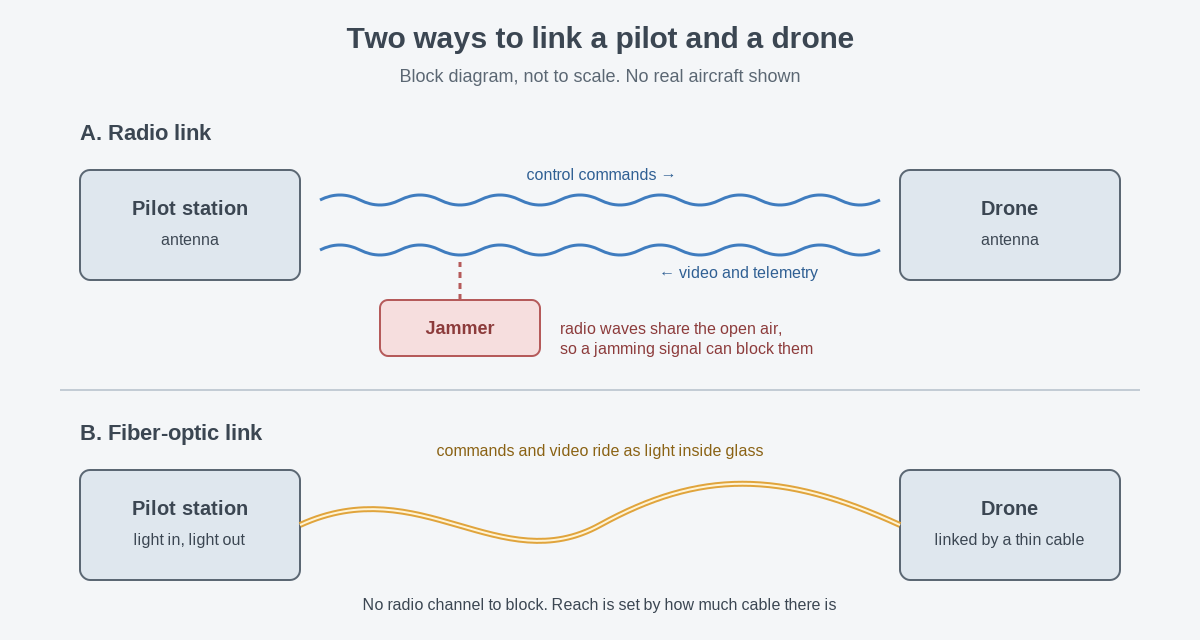
The second is that everyone shares the same air. Jamming blocks a signal. When interfering radio waves fill the sky that the control signal crosses, commands and video stop getting through. Until now, drones could be jammed by various electronic warfare tools that cut their communications, and a cut link meant a failed mission.
The difference between jamming and spoofing is covered in Jamming and spoofing: interference versus deception, and the wider contest over the spectrum in Electronic warfare: the invisible contest.
What changes when the link is a wire
A fiber-optic controlled drone does not send its commands and video through the air as radio. Light signals travel inside a thin glass line that joins the control station and the aircraft. There is no radio channel to block in the first place.
If someone shouts in a room, a walkie-talkie conversation gets drowned out. A call on a wired phone goes through no matter how loud the room is. The real case differs in a few ways. What travels in the fiber is light, not electricity, and a phone line is fixed to a wall while a drone's line is tied to a moving aircraft.
The U.S. Army has pointed to this shift. An article on the Army's official site in January 2026 looks ahead. As technology evolves, it says, drone threats will start shifting away from networked links toward fiber-optic drones, which become impervious to jammers. The equipment that article names is jammers, which target communications.
Light travelling inside a glass strand
A wire could also be metal. A fiber instead carries light, trapped inside glass. How does a thin strand of glass hold on to light?
Light heading at a slant from water toward the surface can fail to leave and reflect back into the water. That effect is the basis of fiber technology. In a glass fiber, the central core has a higher refractive index and the surrounding cladding has a lower one. Light undergoes total internal reflection (TIR) at that boundary, stays in the core and travels along it with low loss.
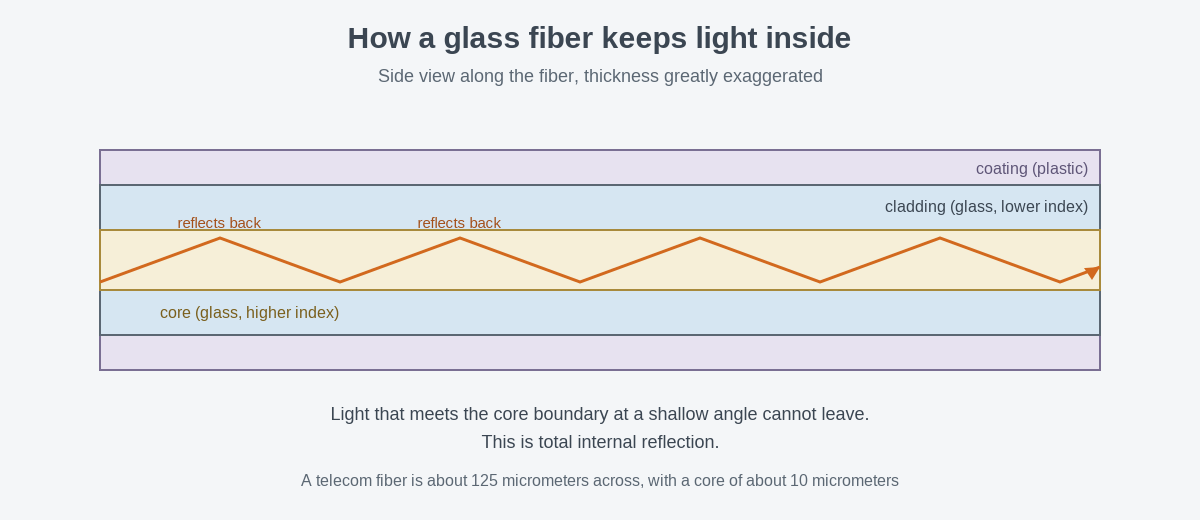
Fiber is very thin. A telecom fiber is about 125 micrometers across, and its core is typically about 10 micrometers, thinner than a single hair.
Glass was not always this clear. In the 1960s, a fiber kept only 1 percent of its light after 20 m. Today 95 percent remains after 1 km. How the core traps light is drawn out in How a fiber guides light: core and cladding.
An old idea: wire-guided missiles and FOG-M
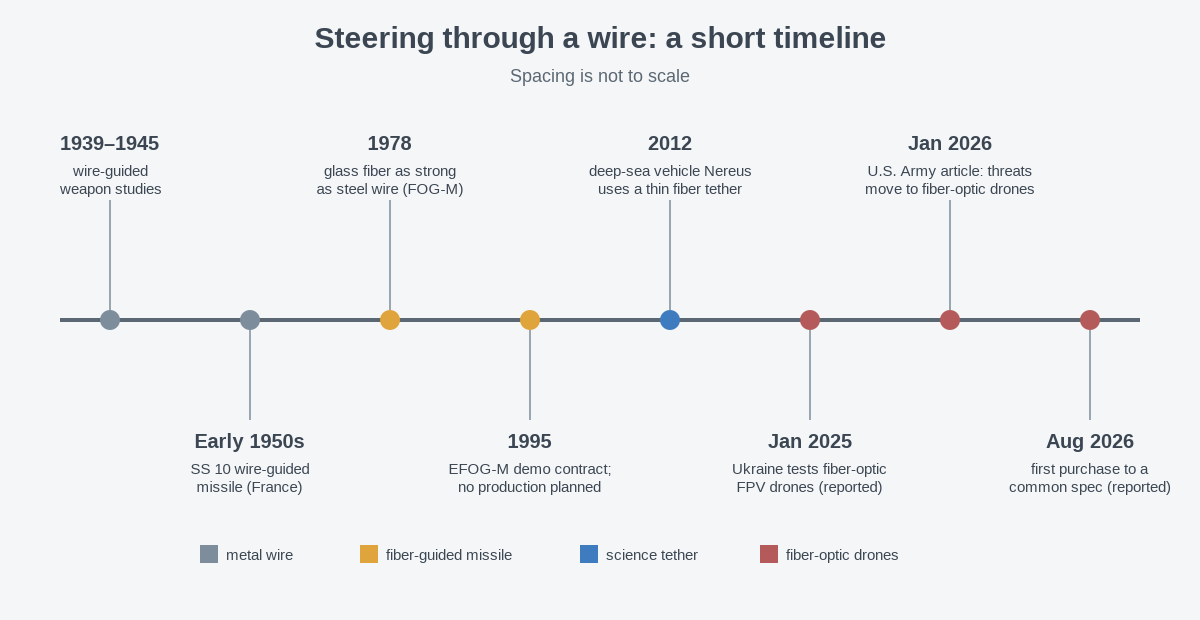
Sending steering signals down a wire is much older than drones. The U.S. Army history office at Redstone Arsenal records that several countries studied wire-guided weapons during World War II. In those weapons, a wire ran from the operator at the firing point to the missile and carried its steering commands while it flew. In the early 1950s, French work led to the SS 10, a wire-guided missile.
The U.S. anti-armor missile TOW carries the method in its name. It is tube-launched, optically tracked and wire-guided. How guided anti-tank missiles differ from rockets is covered in Anti-tank guided missiles: rockets versus guided missiles.
Some missiles used fiber in place of metal wire. In 1978, scientists at Hughes developed a way to make glass optical fiber as strong as steel wire. That fiber went into the Fiber Optic Guided Missile program, FOG-M. Light signals steered the missile in flight, and television pictures from the missile went back to the launch site on the ground.
The improved version, EFOG-M, appears in a 1995 report by the U.S. General Accounting Office (GAO). A fiber-optic data link let a person see what the missile's seeker saw and send guidance commands. The contract for demonstration equipment was signed in May 1995, and the Army did not plan to put the system into production after development.
Wire-guided weapons serve as an example of weapons a person guides directly. DoD Directive 3000.09 on autonomy in weapon systems does not apply to munitions manually guided by the operator, such as laser-guided or wire-guided munitions. The debate over autonomy and human control is summarized in Autonomous weapons and human control.
Fiber tethers under the sea
Survey vehicles that explore the deep sea have also been steered through a line. Real-time work with a remotely operated vehicle (ROV) usually requires a tether.
The uncrewed vehicle Nereus of the Woods Hole Oceanographic Institution (WHOI) was built to survey ocean trenches as deep as 11,000 m. For that job, the team developed a thin fiber-optic cable to carry real-time control signals. The cable cut down on large tether-handling gear and let the vehicle travel up to 12 miles from where it was launched.
Through the tether, pilots on the ship received high-quality live video and sent commands to the vehicle. That is the same structure a fiber-optic drone uses. The difference is that the setting is underwater and the purpose is science.
Fiber-optic drones in the war in Ukraine: public statements
In the Russia-Ukraine war, the Ukrainian government has made statements about fiber-optic drones. Two of them, confirmed through news reports, follow in date order.
On January 8, 2025, the U.S. defense outlet The Defense Post reported that Ukraine had tested fiber-optic controlled FPV (first-person view) drones designed to resist interference and hacking better. More than a dozen drones from various domestic makers took part in the demonstration. The report added that because these drones send data through a cable, they are less susceptible to electronic warfare attacks. The head of unmanned aviation systems at Ukraine's Main Directorate of Defense Innovations said that Russia keeps building up its fiber-optic drone technology.
On August 22, 2026, the Ukrainian outlet Euromaidan Press reported a first. The Defense Procurement Agency (DOT) had announced its first purchase of fiber-optic FPV drones built to specifications set by the Defense Ministry. The purchase was not for a specific maker or model. The drones were sorted into classes by values such as range, meaning the length of the fiber-optic cable, and camera type.
The ministry's explanation in the same report runs as follows. Ordinary FPV drones need a radio signal for control and video, but fiber-optic drones connect to the operator by cable and do not rely on a radio channel. For that reason, they work far better where electronic warfare is active. What an FPV drone is in the first place is covered in FPV drones: flying through the drone's eyes.
What the wire costs
A wire does not make the problems go away. It brings different ones.
The first is range. Range was one of the values the Ukrainian ministry used to sort fiber-optic FPV drones into classes, and that range was the length of the fiber-optic cable. Radio reaches as far as line of sight allows, but an aircraft tied by a line can go only as far as the line runs.
The second is the weakness of the line itself. WHOI said that the Nereus fiber tether breaks easily, is nearly as fine as a human hair and must be discarded after a single use. Of ordinary ROV tethers, it wrote that they break or get damaged easily close to built structures or sea ice, which limits where the vehicle can work.
That is a story about underwater gear, so it does not carry over directly to drones in the sky. Still, it shows the conditions that come with tying a machine to a line.
Put together, a fiber-optic drone trades one problem for others. It gives up a radio link that can be blocked and takes on a reach set by the cable and a line that is easy to damage.
What to read next
- Jamming and spoofing: interference versus deception: what the radio interference that fiber avoids actually is.
- How a fiber guides light: core and cladding: how light is trapped in the drone's line, explained from the laser side.
- FPV drones: flying through the drone's eyes: the FPV drone type that the reported fiber-optic drones belong to.
- Anti-tank guided missiles: rockets versus guided missiles: the basics behind missiles guided through a wire.
- Counter-drone systems: why one device is not enough: why the means of stopping drones never come down to a single device.
- Drone Datalinks: How Control and Video Signals Travel: an article in progress on the radio side of the link.