A laser that cuts sheet metal in a factory, a laser scalpel in an operating room, a laser that measures distance. Papers on two lasers that have long done jobs like these, Nd:YAG and CO2, came out of Bell Labs in Murray Hill, New Jersey, in 1964. One is a crystal with metal ions added; the other makes light from carbon dioxide gas.
Two papers came out that May and two more that November, all from the same lab. CO2 laser action itself had first been found a year earlier, in 1963.
1964: two branches from one lab
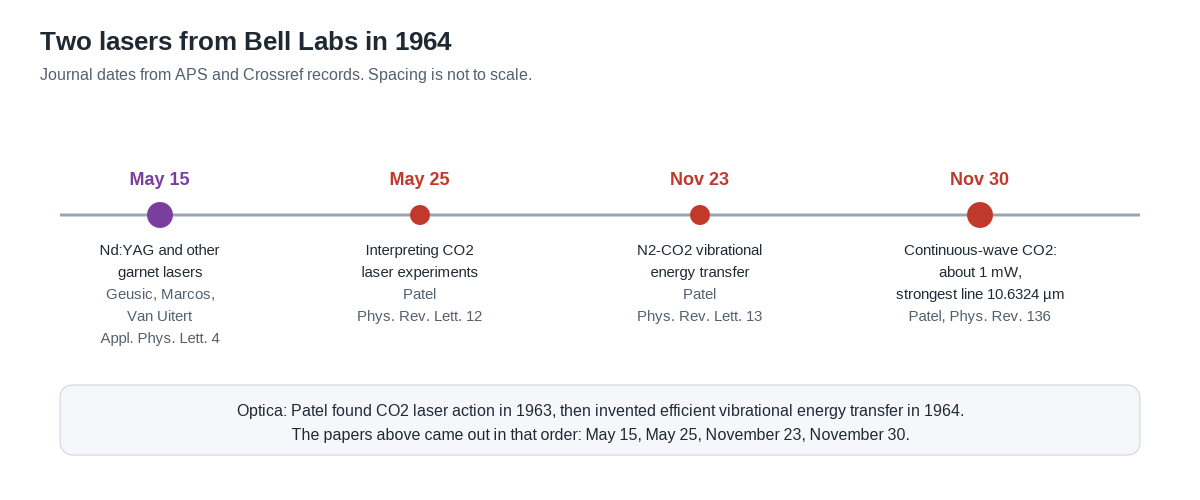
On May 15, 1964, Applied Physics Letters, volume 4, page 182, carried a paper by Joseph Geusic and his Bell Labs colleagues Marcos and Van Uitert. Its title was "Laser Oscillations in Nd-Doped Yttrium Aluminum, Yttrium Gallium and Gadolinium Garnets."
Ten days later, on May 25, Kumar Patel of the same lab published a CO2 laser paper, and two more followed in November.
Nd:YAG: neodymium in a garnet crystal
The name Nd:YAG simply spells out the materials. YAG is a crystal called yttrium aluminum garnet, and Nd is the neodymium placed inside it. If the crystal is a house, the neodymium ions are guests living in it, and the guests do the actual work of amplifying light. In a real crystal, the guests take over some of the house's atomic sites, and the house shapes the light the guests give off.
The 1964 paper covered not just YAG but three garnet crystals. The one that lives on in the name Nd:YAG is yttrium aluminum garnet. Like the ruby laser, it is a solid-state laser that uses a crystal as its gain medium.
The meaning of the discovery was summed up by an award nearly 30 years later. Geusic received the Wood Prize in 1993. His Optica biography gives the reason as "the discovery of the Nd:YAG laser and the demonstration of its usefulness as a practical solid state laser source." Geusic joined Bell Labs in 1958 and worked there until 1994.
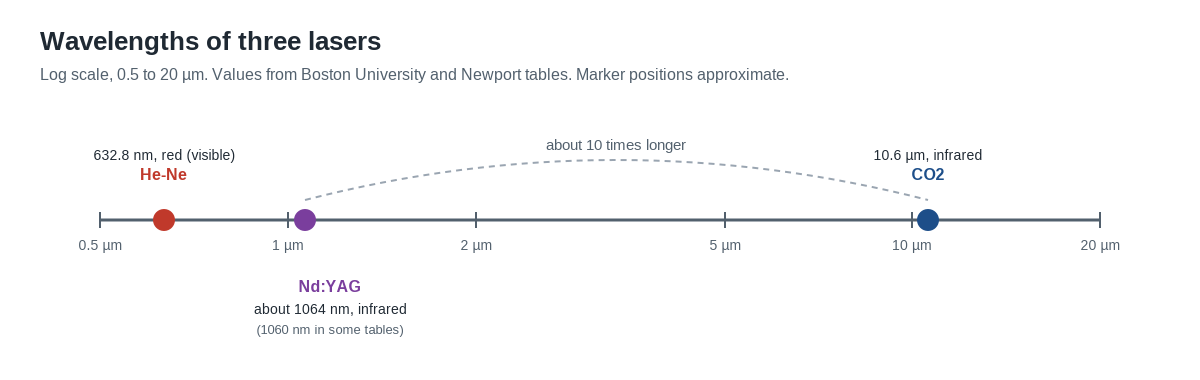
The light from Nd:YAG is infrared, invisible to the eye. Its wavelength is 1064 nm, given as 1060 nm in some tables.
CO2: long infrared light from molecules
The CO2 laser gets its light from molecules, not single atoms. According to Patel's Optica biography, in 1963 he found that carbon dioxide molecules could lase when they changed their vibration and rotation together. That is light given off when the way a molecule shakes and spins changes.
The May 25 paper, in Physical Review Letters, was titled "Interpretation of CO2 Optical Maser Experiments." The same year he came up with an efficient way to pass vibrational energy between molecules.
On November 23 came "Selective Excitation Through Vibrational Energy Transfer and Optical Maser Action in N2-CO2." The idea is that vibrational energy moving between nitrogen and CO2 molecules selectively excites the CO2. It resembles the way two gases split the work in the helium-neon laser.
A week later, on November 30, Physical Review carried a paper on continuous CO2 laser operation. Its abstract reports continuous oscillation on several lines near 10.4 µm and 9.4 µm, with the strongest at 10.6324 µm. The continuous output measured was about 1 mW, or one thousandth of a watt.
Optica says the invention of vibrational energy transfer led to experiments showing that the CO2 laser could deliver very high continuous and pulsed power at high conversion efficiency. Patel named the night he first got a CO2 laser past 10 W at Bell Labs as his most exciting moment.
Two beams, ten times apart
Both lasers give off infrared light, but their wavelengths differ widely. Nd:YAG is 1064 nm and CO2 is 10.6 µm. The CO2 wavelength is about 10 times longer. That also matches the 10.6324 µm in Patel's paper.
When the wavelength changes, the same material can absorb the light to a different degree. Why wavelength matters is explained in Why wavelength matters: visible and invisible light.
Where the two workhorses work
Newport's table lists uses for Nd:YAG as material processing, rangefinding, surgery, tattoo and hair removal, and pumping other solid-state lasers. How a laser measures distance is covered in Laser Rangefinders: Measuring Range from Light's Round Trip.
For CO2 lasers, the same table lists material processing, surgery, dental lasers and military lasers. The National Inventors Hall of Fame says the CO2 laser became common because it is efficient and reasonably priced. It is widely used to cut, weld, engrave and drill metal, ceramics and plastic, and it also serves as a surgical laser scalpel. Today's CO2 laser equipment is described in CO2 Lasers: The Gas Laser That Ran Factories for Decades.
Patel received the US National Medal of Science in 1996 and entered the National Inventors Hall of Fame in 2012. From 1960 to 1964, lasers that make light from crystals, gases and semiconductors appeared one after another. The full family is laid out in Laser types at a glance: gas, solid-state, fiber, semiconductor.
What to read next
- CO2 Lasers: The Gas Laser That Ran Factories for Decades: what the CO2 laser of 1964 has become
- Laser types at a glance: gas, solid-state, fiber, semiconductor: the branches of solid-state, gas, semiconductor and fiber lasers
- The 30-Year Patent Fight: Who Invented the Laser?: the patent battle that grew as lasers became an industry