At 09:51 Coordinated Universal Time on 14 September 2015, a detector in Livingston, Louisiana, recorded a very short signal. Seven milliseconds later, a detector in Hanford, Washington, recorded a signal of the same shape. Both belonged to the Laser Interferometer Gravitational-Wave Observatory (LIGO).
The source was a pair of black holes. LIGO scientists estimated that black holes roughly 29 and 36 times as massive as the Sun had merged 1.3 billion years ago and sent out gravitational waves. It was the first direct observation of gravitational waves themselves, and it led to the 2017 Nobel Prize in Physics.
Yet the instrument did not measure black holes. It measured the distance between mirrors, and the change in that distance was far smaller than a single proton. How can a change that small become a clear signal? The answer lies in the interference of laser light.
A device that splits light and joins it again
An interferometer is a tool that merges light into an interference pattern and then measures that pattern to learn something. The LIGO Laboratory explains that interferometers were pioneered in the mid- to late-1800s and are often used for tiny measurements that no other method can make.
The simplest form, the Michelson interferometer, has four parts. There is a light source, a beam splitter that divides the light in two, two mirrors, and a photodetector that records the pattern. The two halves travel along arms at right angles, bounce off the end mirrors, come back, and are joined again.
LIGO has the same skeleton. Two arms of equal length form an L, and the light splits and rejoins at the corner.
What differs is the size and the light. The first Michelson interferometer of the 1880s used ordinary white light, while LIGO uses a laser. The famous Michelson–Morley apparatus had arms about 1.3 m long; LIGO's arms are 4 km.
Dark when the arms match, a leak when they don't
What happens when two beams overlap is set by interference. Where the crest of one wave meets the crest of another, the light gets brighter. Where a crest lines up exactly with a trough, the light disappears. The result depends on how well the two waves are in step, which is their phase.
The basics are in Interference and diffraction: how light adds up and spreads.
In LIGO, the only thing that sets the step between the two beams is the distance each one travels in its arm. LIGO was deliberately designed so that, when the two distances match, the returning light cancels completely and no light leaves the instrument. In normal running, the detector's exit is dark.
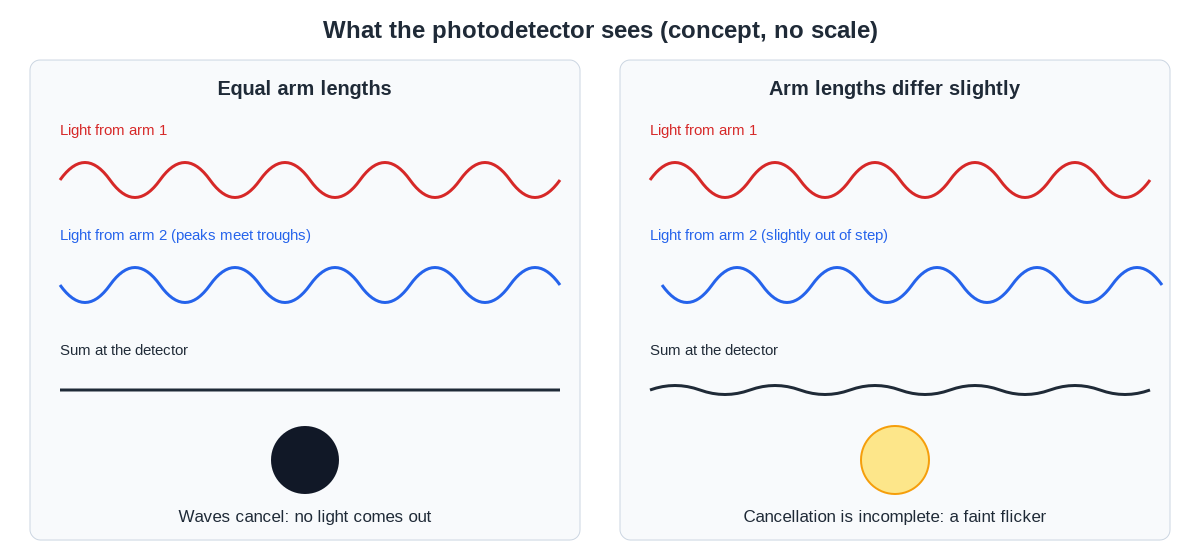
A passing gravitational wave changes this. It stretches spacetime in one direction while squeezing it in the perpendicular direction. So when one arm shortens, the other lengthens, and the two beams travel different distances.
Because the two arms move in opposite ways, LIGO calls this motion "Differential Arm" motion. The rejoined light no longer cancels completely, and a faint flicker of light appears at the exit.
How small is the change?
The LIGO Laboratory's interferometer page says the change in arm length from a gravitational wave may shrink to 1/1,000 of a proton's width. The February 2016 discovery release said the instrument can detect a change smaller than one ten-thousandth of a proton's diameter (10⁻¹⁹ m). The two sources differ by a factor of ten, but both put the change below the size of an atomic nucleus by a factor of thousands.
The Nobel Foundation turns this size into a distance. Picture finding the distance to a star 10 light-years off with an error no wider than a hair. Meanwhile, ordinary events on Earth make vibrations billions of times larger. That is why the measurement is so hard.
Using a 4 km arm like a 1,200 km arm
The longer the arms, the larger the absolute length change that a given gravitational wave produces. According to the LIGO Laboratory, though, even 4 km arms would be too short for a simple Michelson interferometer. Yet a precision instrument much larger than 4 km runs into practical limits. The fix was to make the light travel the same arm many times.
Add one more mirror in each arm near the beam splitter, and the space between it and the end mirror 4 km away becomes a Fabry–Perot cavity.
It is a form of optical resonator: two facing mirrors that trap light. The light bounces about 300 times in this space before it joins the beam from the other arm. The effective path grows from 4 km to about 1,200 km. In Michelson's original instrument, the light traveled only 11 m.
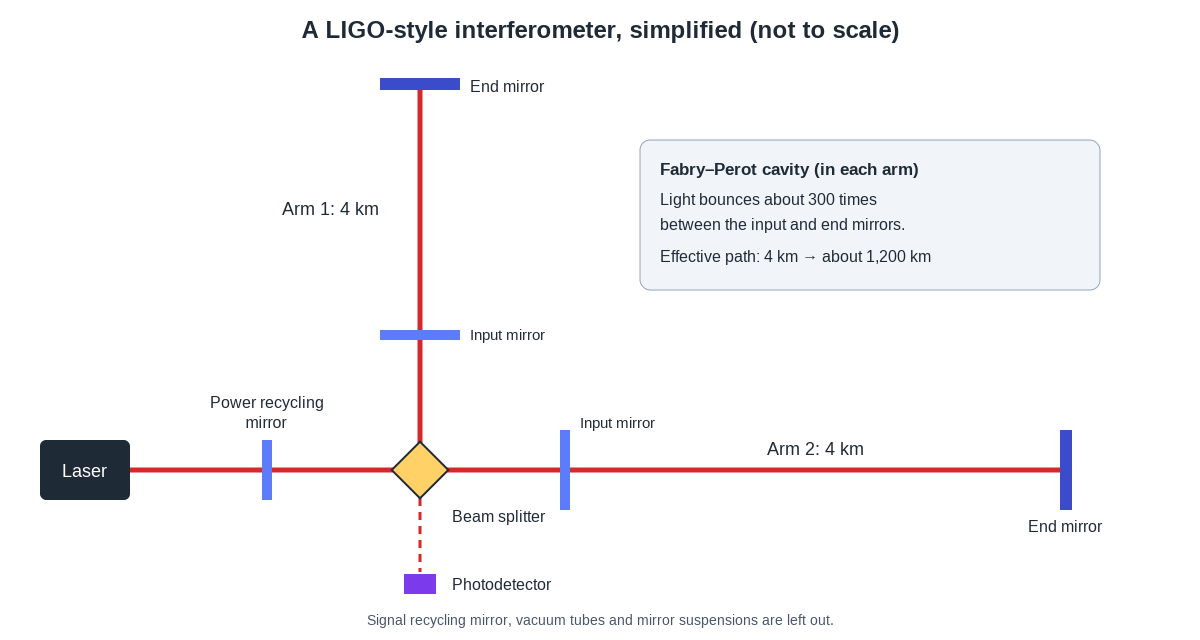
The amount of light also sets the sensitivity. The more photons that merge from each arm, the sharper the fringes the photodetector sees. According to the LIGO Laboratory, the laser enters at about 40 W, but the interferometer needs to work closer to 750 kW.
Nobody can build such a laser from the start. Instead, a power recycling mirror sends light that has already gone through the instrument back inside, building up the stored light.
The extra mirrors and the recycled light raise the effect without changing the real arm length or the laser's own output. At the exit there is also a signal recycling mirror that boosts the signal reaching the detector.
Fighting vibration
The principle is simple, but the measurement is hard. The Nobel Foundation's explainer says the laser's wavelength and intensity have to stay as steady as they can, and the beam has to land exactly on the hanging mirrors. The mirrors should barely shake when leaves fall from nearby trees or a truck passes on a distant road. Yet they must still swing freely when a gravitational wave goes by.
The team also had to deal with the thermal motion of atoms on the mirror surfaces and quantum effects in the laser light. The tubes the light travels through are kept in vacuum, at one-trillionth of sea-level air pressure.
Over 4 km, the Earth's surface curves away by nearly 1 m. So the floor under the tubes had to be leveled with great care. Ways to keep precision optics still in a lab are in Optical Tables and Mounts: Holding Optics Perfectly Still.
Vibration is also why there are two observatories. They are 3,002 km apart, and each site has its own noise. Comparing the data and noise from both sites is crucial to claiming a detection.
A signal seen at two distant sites can also be confirmed as coming from space rather than from a local event. Because the first signal reached Livingston 7 milliseconds earlier, the team could say the source lay in the southern sky.
A forty-year measurement and the 2017 Nobel Prize
Attempts to catch gravitational waves began before lasers were used for it. According to the Nobel Foundation's explainer, Joseph Weber at the University of Maryland built the first detector in the 1960s, shaped like a tuning fork. In the 1970s he said he had heard signals, but no one could repeat his results, and they are now seen as false alarms.
The existence of gravitational waves was first shown another way. In the 1970s and 1980s, astronomers watched the orbit of a binary system with a pulsar shrink as it lost energy, work that earned the 1993 Nobel Prize in Physics.
In the mid-1970s, Rainer Weiss at MIT analyzed the sources of background noise that would disturb a measurement and designed a laser interferometer detector to overcome it. Kip S. Thorne at Caltech worked with Ronald Drever, whose first prototypes were built in Glasgow; Drever later moved to Caltech. The three proposed LIGO in the 1980s.
At the 2016 announcement, the director of the U.S. National Science Foundation (NSF) recalled that LIGO's initial funding, approved in 1992, was the biggest investment the NSF had ever made. In 1994 Barry C. Barish took over LIGO and turned a group of about 40 people into an international collaboration of more than 1,000. The idea was simple, but making it work took more than forty years.
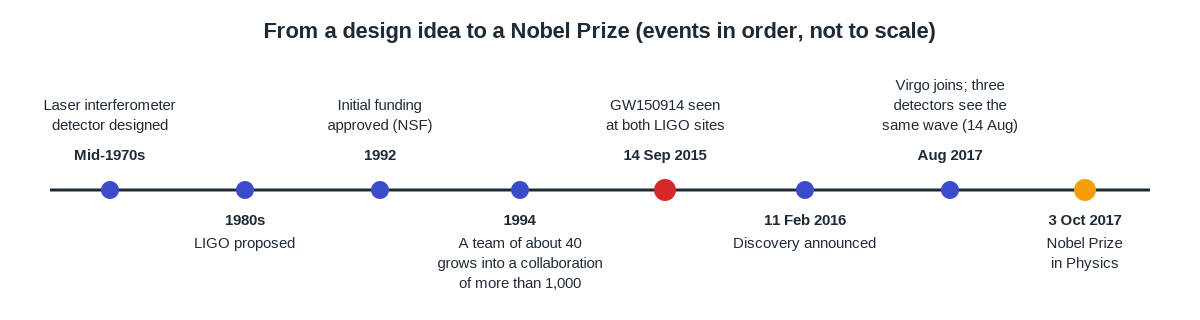
In September 2015, after an upgrade that lasted several years, LIGO was about to start again with lasers ten times more powerful and mirrors weighing 40 kg. The first signal arrived a few days before the official start of observations and was named GW150914. The team refined its calculations and announced the discovery only on 11 February 2016.
The Royal Swedish Academy of Sciences announced the Nobel Prize in Physics on 3 October 2017.
One half went to Rainer Weiss, professor of physics at MIT. Barry C. Barish and Kip S. Thorne of Caltech shared the other half.
The citation reads "for decisive contributions to the LIGO detector and the observation of gravitational waves." In August that year, the European detector Virgo near Pisa, Italy, joined, and on 14 August all three detectors observed the same gravitational wave.
Seen from the laser side
LIGO is a science instrument with no link to laser weapons. Still, it gathers the basic skills of laser technology in one place. There is the beam splitter that divides and joins light, and interference that only works when the waves are in step. There are mirror cavities that trap light, and mechanical design that must handle the tiniest vibration.
The same interference idea appears where engineers try to raise laser power. Combining several beams into one by matching their phase is covered in Coherent beam combining: the principle, from published reviews. How parts that protect a high-power laser from returning light were tested for gravitational-wave detectors is in Faraday Rotators: The Part That Twists Polarization Inside an Isolator.
What to read next
- Interference and diffraction: how light adds up and spreads: the basics of constructive and destructive interference and coherence.
- Dichroic Mirrors and Beamsplitters: Splitting Light by Color and Strength: the light-splitting part at the heart of an interferometer.
- Optical Tables and Mounts: Holding Optics Perfectly Still: why interferometers are so sensitive to vibration and how labs deal with it.
- Coherent beam combining: the principle, from published reviews: using interference to raise laser power.