At 7:53 a.m. on April 30, 1975, the last helicopter lifted off from the US embassy in Saigon with the Marine guards on board. More than 400 Vietnamese people whom the Americans had promised to take out were still on the embassy grounds. A few hours later, North Vietnamese tanks drove through the front gate of Saigon's presidential palace. The State Department's Office of the Historian marks that moment as the effective end of the war.
Only two years earlier, in January 1973, the United States and North Vietnam had signed a peace agreement in Paris. What was left behind that agreement, so that South Vietnam could not hold out for even two months against an offensive that began in March 1975? This article follows those four months through period documents published by the Office of the Historian and through presidential speeches. It also draws on the Ford Presidential Library, the Vietnam Center at Texas Tech University and the Australian War Memorial.
Most of these records come from the United States and its allies. Numbers such as the count of evacuees also differ by source, so it matters which record each number comes from.
Two years after the peace agreement
President Richard Nixon took over the war when he was sworn in on January 20, 1969. He began pulling US troops out that year, and the withdrawal never stopped. The plan was to fill the gap by building up South Vietnam's own forces, a program called "Vietnamization."
The agreement was initialed on January 23, 1973, and signed on January 27. It let the United States leave the war and bring its prisoners of war home. Neither Vietnamese party kept to it, however, and the fighting went on.
Through letters and envoys, Nixon promised South Vietnamese President Nguyen Van Thieu that the United States would give military support if North Vietnam broke the accords. Those promises were not kept. The Office of the Historian points to three factors that came together. Congress and the public were unwilling to go back into the war, the economy set limits, and the Watergate scandal weakened Nixon.
Some Americans stayed after the troops left. A force of 159 Marines guarded the embassy and the consulates in Da Nang, Nha Trang, Bien Hoa and Can Tho. Another 50 officers formed the new Defense Attaché Office (DAO), which watched the situation and handled US aid and the delivery of weapons and ammunition.
The wider picture changed sharply in 1974. After the 1973 Arab-Israeli war, inflation and oil prices rose, and Nixon resigned in August 1974. Americans spoke out more and more against paying for a war that was supposed to have ended, and Congress cut military and financial aid deeply. An undated internal State Department paper wrote that already in 1973, Congress had taken away the means to enforce the Paris Agreement.
Preparations on the other side continued. North Vietnam rebuilt its forces and its logistics system, and in secret it planned a major offensive to push deep into South Vietnam in early 1975.
March 1975: from the highlands to the coast
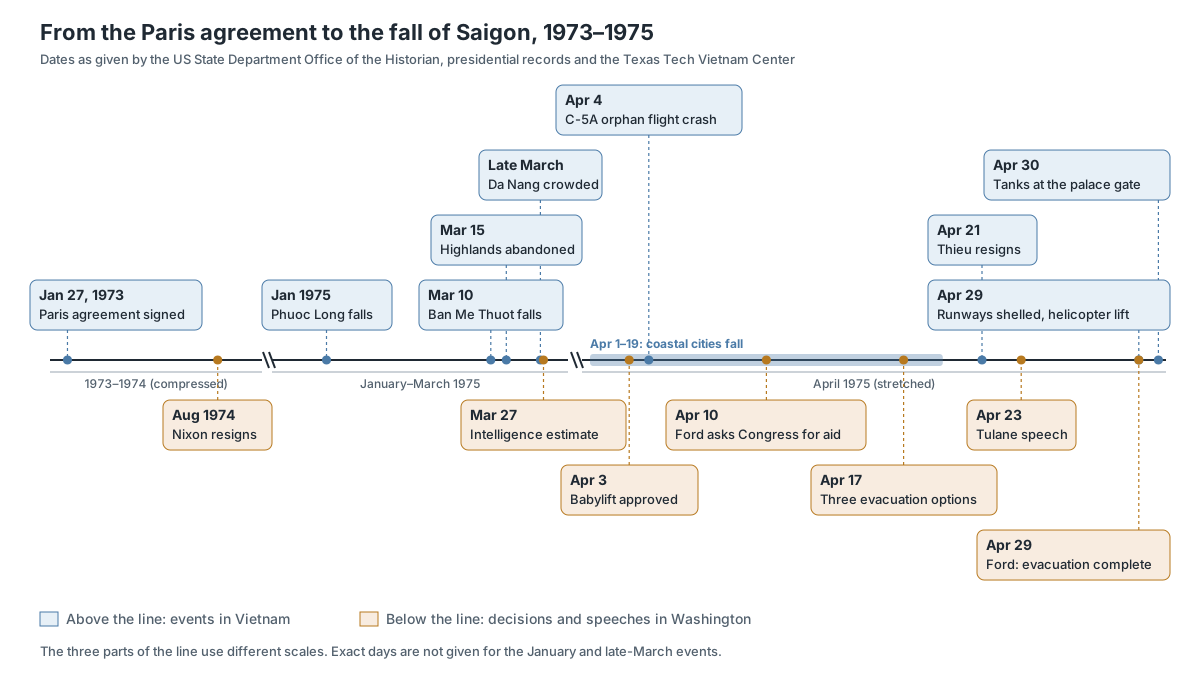
The first sign came in January 1975, when Phuoc Long fell. In March, North Vietnamese forces launched a large offensive in the Central Highlands, and the highland town of Ban Me Thuot fell on March 10.
In mid-March, Thieu made a large decision. He would give up the highlands and gather his forces along the crowded coast and around Saigon. A Special National Intelligence Estimate (SNIE), prepared jointly by US intelligence agencies and dated March 27, explained his reasons. His forces were spread too thin, they faced a much stronger North Vietnamese army, and US aid looked likely to shrink.
The trouble was how the decision was made. According to the same estimate, the South Vietnamese Joint General Staff and the regional commanders had no briefing beforehand, and US officials were not told either. Without a plan, the pullback was largely disorderly.
On March 15, senior officers left Pleiku, Kontum and Darlac, and civilians and the remaining soldiers had to find their own way to safety. The Texas Tech exhibit records that 30,000 to 40,000 people were killed or starved during the fifteen-day retreat. The press called it the "Convoy of Tears."
Through March, refugees and soldiers without leaders crowded into Da Nang on the northern coast until there were almost one million people. Many boarded boats with only the clothes they wore. When the boats reached Cam Ranh Bay on April 1, many refugees had died of thirst.
What did the March 27 estimate expect next? It judged that the government would likely end up holding little more than the delta and the Saigon area, with defeat likely by early 1976. It added that a quick attack on Saigon was unlikely, because the North Vietnamese lacked supplies stocked near the front. In fact, Saigon fell a little over a month later.
In April the coastal cities fell one after another. Qui Nhon and Nha Trang fell on April 1 and Cam Ranh on April 3, then Phan Rang on April 15 and Phan Thiet on April 19.
April in Washington
On April 10, President Gerald Ford spoke to a joint session of Congress, citing a report from General Frederick Weyand, whom he had sent to Vietnam. He asked for $722 million in emergency military aid and an initial $250 million in economic and humanitarian aid. He also asked Congress to clarify at once its limits on using US forces in Southeast Asia, so that troops could protect Americans during an evacuation. He wanted action on all of it by April 19.
The speech also carried the administration's reading of events. Ford claimed that North Vietnam had broken the ceasefire systematically from the moment it signed and had sent more than 350,000 men into the South. He said the South Vietnamese pullback was decided without consultation, poorly carried out, blocked by floods of refugees, and so turned into panic. For the same period, the Office of the Historian writes that neither Vietnamese party kept the agreement.
In Washington, meetings on how to evacuate went on. At an April 17 meeting of the Washington Special Actions Group, three options were on the table. The first used the coastal town of Vung Tau, and the second used both Tan Son Nhut airfield and Vung Tau. The third used helicopters only and took out Americans only.
Two days later the basic idea of a helicopter lift took shape. The decks of the aircraft carriers in the South China Sea would be cleared, and helicopters would shuttle between Tan Son Nhut's DAO compound and the flight deck. Each round trip was expected to take about two hours.
Thieu resigned on April 21. The Texas Tech exhibit says he hoped a successor could negotiate better terms with Hanoi. Two days later, on April 23, Ford spoke at Tulane University in New Orleans. He said America could regain the pride it had before Vietnam, but not by refighting a war that is "finished as far as America is concerned."
From airplanes to helicopters
The evacuation plan did not appear overnight. The DAO and the embassy had been reviewing it since December 1974. It was first called Talon Vise and later renamed Frequent Wind.
From April 1, the DAO at Tan Son Nhut ran an Evacuation Control Center around the clock. The rest of the DAO compound became a refugee center that could hold 1,500 people waiting to leave. The paperwork was hard. The South Vietnamese government would not let men of draft age leave the country.
Children were flown out too. On April 3, Ford approved moving thousands of Vietnamese orphans to the United States, an effort known as Operation Babylift. The next day, April 4, a C-5A transport took off from Tan Son Nhut. Its rear doors tore away soon after takeoff, and it turned back and crashed in a rice paddy near the airfield.
The numbers for this crash differ by source. The Texas Tech exhibit says the flight was meant to carry 250 orphans and 50 staff, and only 175 survived. A memoir by Sheila Weidenfeld, quoted by the Ford Library, says more than 200 people were killed, most of them children. On April 5, Ford met a plane carrying about 325 orphans at San Francisco International Airport.
After the crash, a new rule allowed passengers only if they had a seat and a seat belt. That cut a large C-141 to 94 passengers and a C-130 to 75. Even so, the pace grew. About 5,000 people left from April 1 to 19, then 5,000–10,000 a day after April 20, and from April 21 planes left day and night.
At 3:58 a.m. on April 29, North Vietnamese shells hit the runways at Tan Son Nhut. The shelling killed two Marines, Corporal Charles McMahon and Lance Corporal Darwin Judge. They were the last American soldiers killed on Vietnamese soil. After the shelling, the runways could no longer be used.
The only way left was by air, straight up. On April 29 and 30, Navy, Marine and Air America crews flew and coordinated the helicopter missions together. The last evacuees left the DAO compound by about 8:00 p.m. on April 29, and the Marines left it for good at 12:12 a.m. on April 30.
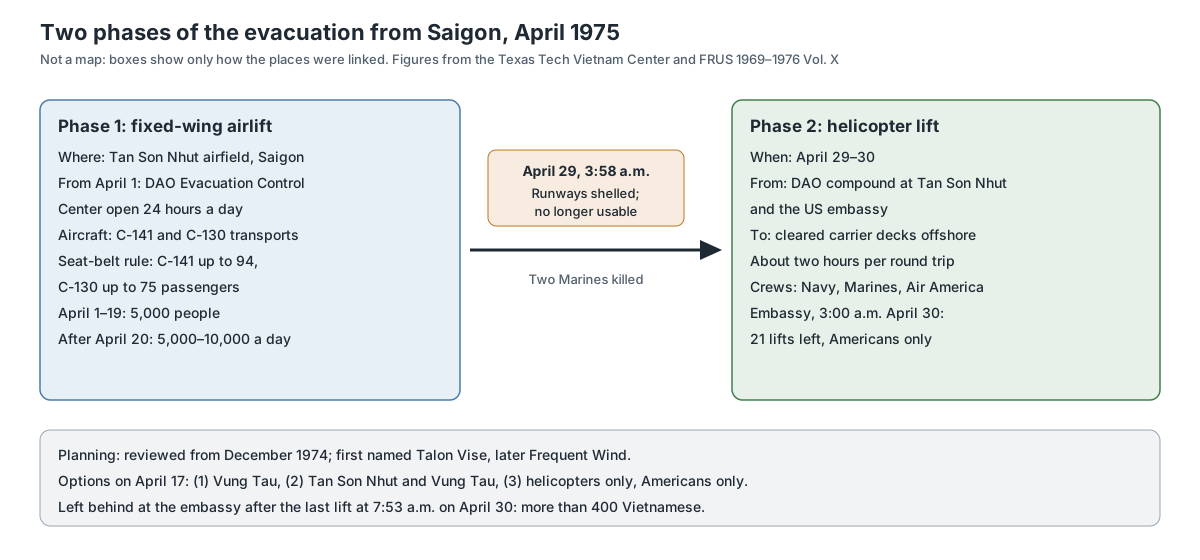
The embassy was another story. The original plan expected only a small group to leave from there, but as the day went on, more and more people came to the embassy hoping to get out. At 3:00 a.m. on April 30, a message from the President was broadcast to the helicopters in the lift. Only 21 lifts remained, and only Americans would be carried.
Ambassador Graham Martin boarded a CH-46 military helicopter and left the embassy at 4:45 a.m. At 7:53 a.m. the last helicopter left with the last Marine guards, and more than 400 Vietnamese who had been promised a place stayed behind on the grounds. The times in the State Department editorial note are given in universal time and differ from these local times by a few minutes.
April 30, and the numbers
In the week after Thieu resigned, the presidency changed hands twice and ended with General Duong Van Minh, known as "Big Minh." On April 30, North Vietnamese tanks drove through the front gate of Saigon's presidential palace. Saigon later became Ho Chi Minh City.
The new government named the event differently. A photo caption in the Texas Tech exhibit describes a rally held on May 7 in front of the former presidential palace. Soldiers of the Provisional Revolutionary Government (PRG) and North Vietnamese troops attended it to celebrate the "liberation of Saigon." One side remembers the day as a fall, the other as a liberation.
In Washington on April 29, Ford issued a short statement. He said he had ordered all American personnel out of Saigon and that the operation was over.
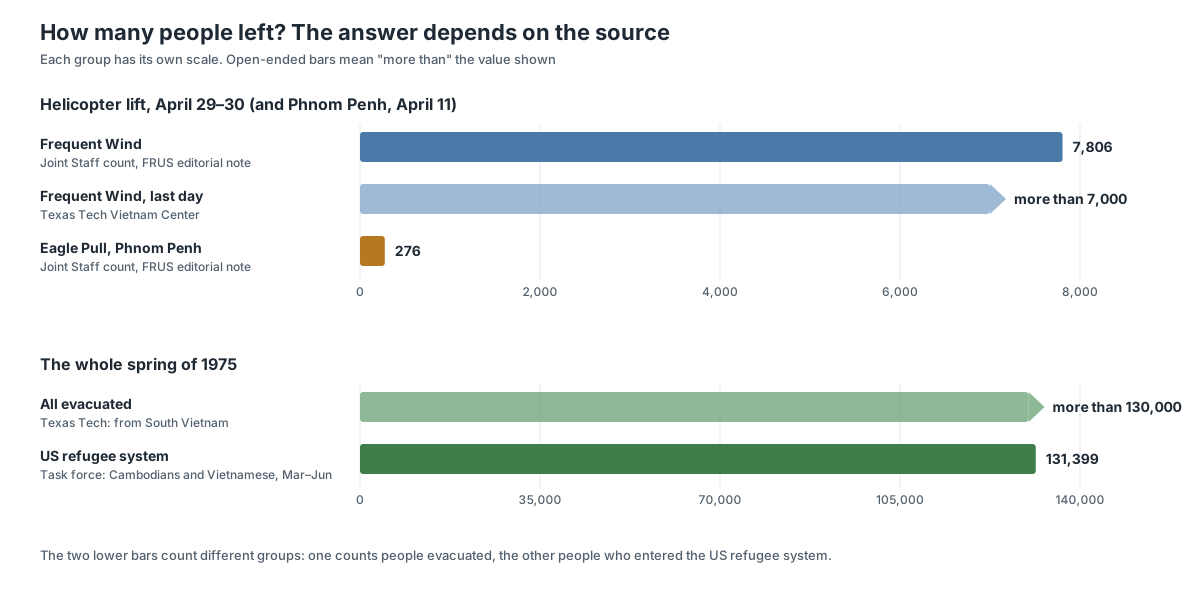
So how many people left? Quoting a Joint Staff count, the Office of the Historian's editorial note says the US military evacuated 7,806 US citizens and foreign nationals during Operation Frequent Wind. The Texas Tech exhibit says that on the last day, more than 662 helicopter missions carried more than 7,000 people. It adds that three helicopters and two crew members were lost during the operation.
For the spring as a whole, the numbers are more than ten times larger. The Texas Tech exhibit says more than 130,000 people in all were evacuated from South Vietnam. A June 15 report of the Interagency Task Force for Indochina Refugees counted 131,399 Cambodians and Vietnamese who entered the US refugee system from March to June 1975. The two figures look alike, but they count different groups.
Cambodia saw an evacuation before Saigon did. On April 11, Operation Eagle Pull took 276 Americans, Cambodians and people of other nationalities out of Phnom Penh.
The United States was not the only country taking people out. Australia's part in the war was formally ended by a proclamation of the Governor-General on January 11, 1973, and the platoon guarding its embassy left in June 1973. In April 1975, 7–8 Hercules transports of the Royal Australian Air Force flew relief flights for displaced civilians and carried orphans out. On April 25 they brought out the embassy staff.
What remained, and the verdicts that differ
For those who stayed, April 30 was not the end. Many people were soon told to report to "reeducation camps." Millions tried to leave the country any way they could, and the exodus went on for decades. Those who got out settled in the United States or Europe and often had to start their lives over with nothing.
Inside the US government, views on what went wrong differed. Secretary of State Henry Kissinger spoke at a press conference on April 29. He named one big reason the Paris Agreement failed: the authority of the US executive branch had weakened, for reasons that had nothing to do with foreign policy.
He said it would take Americans a long time to discuss the war calmly, in speech or in print. He also said the war met neither the goals of those who began the involvement nor the goals of those who tried to end it.
An undated State Department paper, "The Lessons of Viet-Nam," looks elsewhere. It says the government the United States backed could not, in the end, rally the support of its own people. It adds that the United States came to treat saving South Vietnam as more important than the South Vietnamese themselves did. It also carries a warning: the greater risk may be applying the lessons too broadly, rather than forgetting them.
The records split on the broken agreement as well. Ford's April 10 speech put North Vietnam's violations first, while the Office of the Historian's summary says neither Vietnamese party kept the agreement.
The Office of the Historian names four themes for its document volume on this period. The first two are how military force and diplomacy fit together and the contest between the White House and Congress over who sets policy. The other two are whether other countries could rely on US promises and how far American power could reach.
Nearly all the records behind this article see the events through American and allied eyes. How North Vietnam and the PRG planned this offensive and remember it becomes fully visible only when Vietnamese official records are read alongside them.
What to read next
- "The Vietnam War at a Glance: 1955 to 1975": the twenty years that led to these four months.
- "The Tet Offensive: When the Military Result and Public Opinion Split": how the 1968 offensive unfolded and why its verdicts split.
- Helicopter rotors: how coaxial helicopters fly without a tail rotor: how the helicopters that carried out the last evacuation stay in the air.
- Aircraft carriers: turning a ship into an airport: what the flight decks the helicopters shuttled to are like.
- Military logistics: performance must be sustainable: background for thinking about how supply sets the pace of an offensive.