Would you believe that a bomber whose last airframe left the factory in 1962 is planned to keep flying into the 2040s? That is the story of the U.S. Air Force B-52. The Air Force wants to keep the remaining 74 in service until sometime in the 2040s.
Aircraft like the B-52 are called strategic bombers. They are big, they fly far, and they carry a lot. But the word "strategic" does not come from the size of the aircraft.
Unpacking the name also shows how bombers changed after World War II. It shows what place they hold today in nuclear forces and arms control treaties, too.
Why the word "strategic"
A 2025 report by the Congressional Research Service (CRS) calls the bombers the U.S. Air Force flies "strategic (or heavy) bombers." Strategic bomber and heavy bomber are two names for the same aircraft. These bombers carry heavy loads over long distances and for long periods of time.
The meaning of "strategic" survives in the way nuclear weapons were sorted during the Cold War. Long-range missiles and heavy bombers were called strategic nuclear delivery vehicles. Short- and medium-range systems counted as nonstrategic nuclear weapons. Reach was the dividing line.
Think of a delivery scooter that circles a neighborhood and a cargo plane that crosses an ocean. In practice, distance is not the only test. What a treaty counts, and whether an aircraft is equipped to carry nuclear weapons, are tied up in the split as well.
Bombers today do not fly only nuclear missions. They count as an essential part of air superiority, one of the main conventional jobs of the Air Force, and they support that mission with long-range precision strike. A bomber that can fly both nuclear and conventional missions is called dual-capable.
From World War II to the Cold War
What bombers are for has shifted from era to era. In World War II, the United States designed new kinds of bombers and turned out tens of thousands of them. From 1942 to 1945, a combined bomber offensive with the United Kingdom aimed to destroy Germany's military, industrial and economic system.
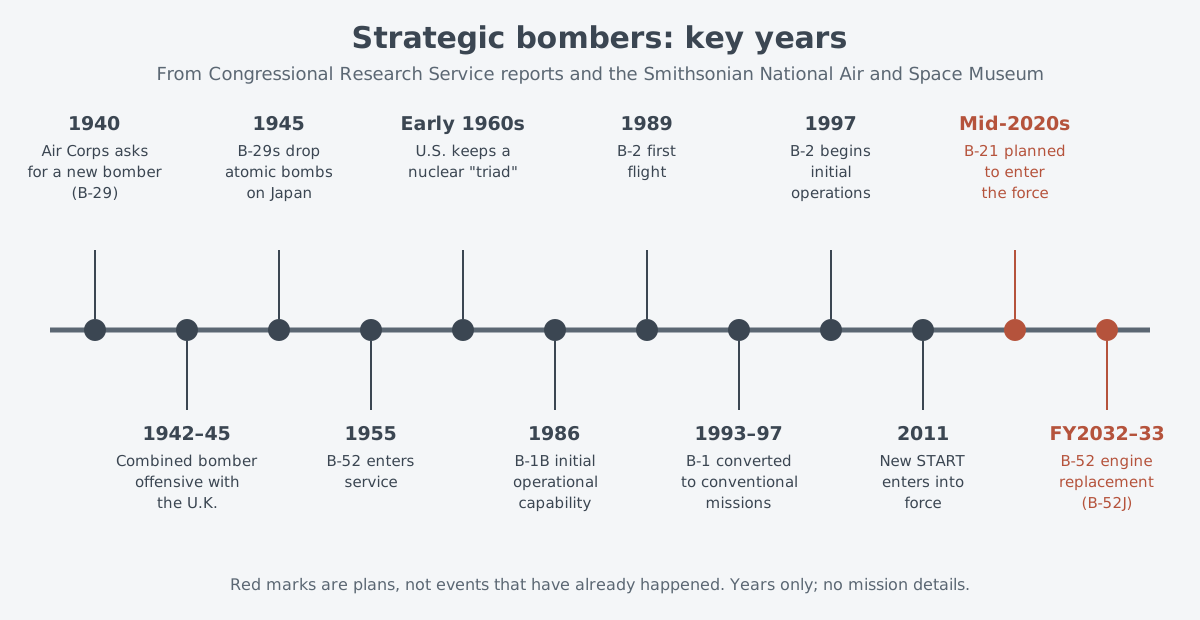
The call for bombers that could fly much farther came in the same period. In the late 1930s, leaders of the U.S. Army Air Corps concluded that the service needed bombers able to fly much farther than the B-17 Flying Fortress and outperform it. In February 1940, the Air Corps set out what it wanted in the new bomber.
The result, the B-29 Superfortress, was the first bomber to put its crew in pressurized compartments. When it flew above 18,000 feet, the air pressure and temperature in the crew areas could be controlled, which made the work far more comfortable.
On August 6, 1945, the B-29 Enola Gay dropped an atomic bomb on Hiroshima, Japan, the first such weapon ever used in combat. Three days later, another B-29, Bockscar, dropped a second one on Nagasaki. On August 14, 1945, Japan accepted the Allied terms for unconditional surrender.
In the Cold War years, accounts of Soviet bomber strength pushed the United States to raise defense spending and grow its bomber fleet. The B-52 entered service in 1955. From the early 1960s on, the country has kept up a "triad" of strategic nuclear delivery vehicles, with bombers as one of its legs.
The three types the U.S. flies today
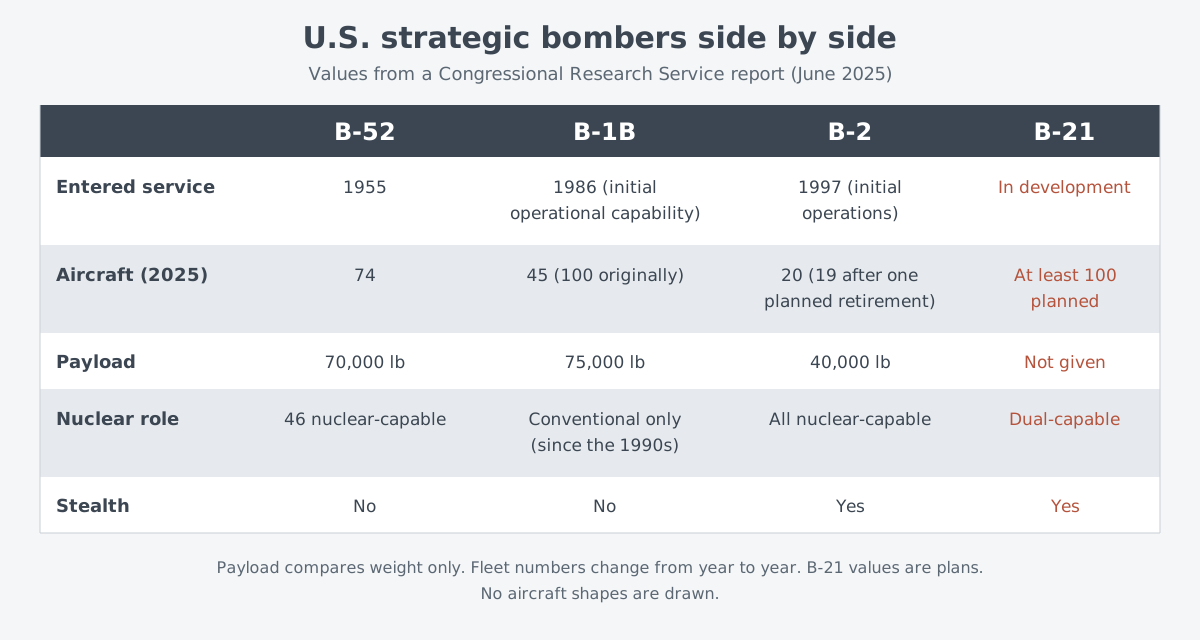
As of the 2025 CRS report, the Air Force's strategic bombers are the B-52, the B-1B and the B-2. The three came along at different times and do different jobs.
The B-52 Stratofortress is the oldest. Boeing built 744 of them, and 74 remain. It can fly 8,800 miles, about 14,000 km, without aerial refueling and can carry 70,000 lb, about 32 tonnes, of weapons. According to the Department of Defense, 46 of them can carry nuclear weapons.
The B-1B Lancer was first designed as a dual-capable bomber and a successor to the B-52. It reached initial operational capability in 1986 and was switched to conventional-only missions in the 1990s. Its payload of 75,000 lb, about 34 tonnes, is the largest conventional load in the Air Force inventory. Of an original fleet of 100, 45 remain.
The B-2 Spirit is a multirole heavy bomber with four engines. Its first flight came in 1989, and initial operations started in 1997. Its payload is 40,000 lb, about 18 tonnes.
There are 20 at Whiteman Air Force Base in Missouri. One was damaged in a 2022 accident and became too expensive to repair, so the 2025 report says the Air Force plans to retire it, leaving 19. According to the Department of Defense, every B-2 can carry nuclear weapons.
The B-2 has a feature the other two lack. Its design and materials reduce how easily enemy radar can detect it, so it is considered a stealth aircraft. The flying-wing, triangular shape, composite materials and surface coating all shrink its radar cross section (RCS). The B-2 was built to help the United States get through Soviet air defenses more readily.
Stealth aircraft: truly invisible? goes deeper into how stealth works.
Bombers in the nuclear triad
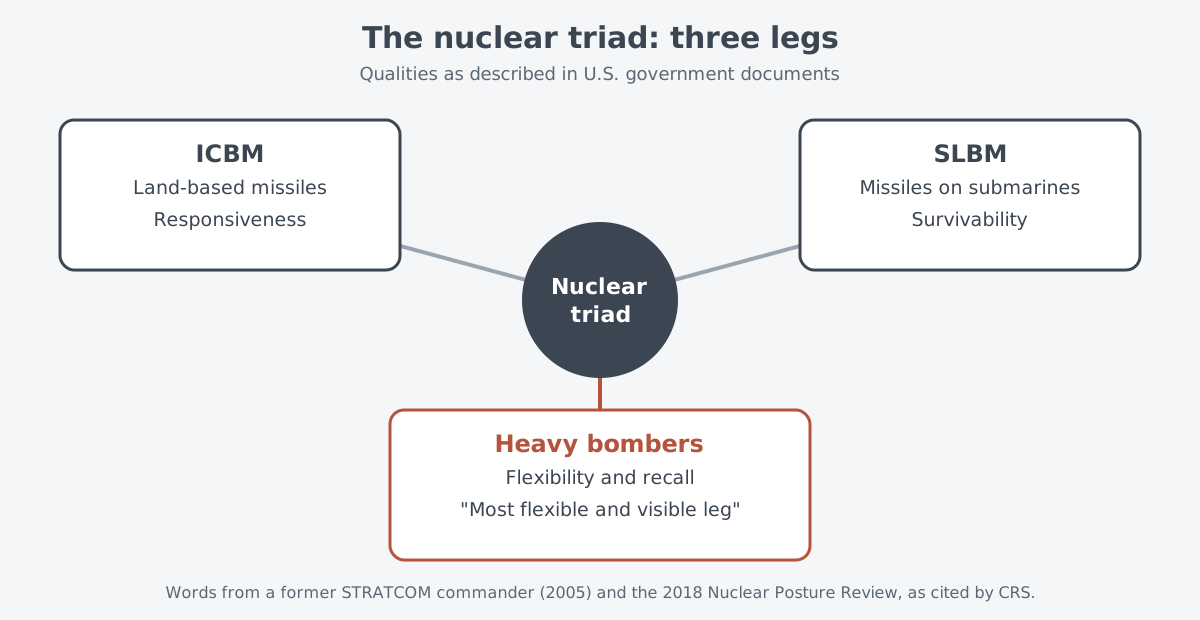
The U.S. nuclear triad stands on three legs. One is the land-based intercontinental ballistic missile (ICBM). Another is the submarine-launched ballistic missile (SLBM) carried by strategic nuclear submarines. The third is the long-range heavy bomber.
The three legs were not the product of a neat plan from the start. CRS explains that each military service wanting part of the nuclear arsenal was a large reason the United States built all three. Later, the Department of Defense came to argue that the different basing modes had strengths that complement one another and strengthen deterrence.
So what does the bomber leg add? The answer in U.S. government documents is mostly "flexible" and "visible." The 2018 Nuclear Posture Review (NPR) called heavy bombers "the most flexible and visible leg of the triad." The 2010 NPR said heavy bombers can be deployed forward in plain view to signal U.S. resolve and commitment in a crisis.
Recall comes up often too. Cold War analysts held that heavy bombers could be dispersed and launched quickly to survive, and called back to base if a crisis did not turn into war. Admiral James Ellis led U.S. Strategic Command in the past. In 2005, he said the ICBM force brings responsiveness, the SLBM force brings survivability, and bombers bring flexibility and the ability to be called back.
Deployments to allies are one example of the "visible" use. In 2018, Air Force Global Strike Command launched what it calls Bomber Task Force deployments. Under them, bombers travel to allies in many parts of the world and join patrols and exercises there.
Day to day, things look different from the Cold War. U.S. bombers today do not carry nuclear weapons on a daily basis. Neither the United States nor Russia keeps nuclear weapons on its bombers day to day.
How treaties count bombers
For missiles, a treaty can count the warheads actually on board. What about bombers? A bomber can carry several weapons at once, and on a normal day it sits at its base without nuclear weapons on board.
The New START treaty between the United States and Russia, which entered into force in 2011, chose a simple rule. A deployed heavy bomber fitted for nuclear weapons is counted as a single nuclear warhead. It makes no difference whether the bomber carries cruise missiles or gravity bombs. In practice a single bomber can hold as many as 20 bombs or cruise missiles, yet the treaty still counts just one.
On the other hand, a heavy bomber fitted for none of the three, meaning nuclear bombs, nuclear air-to-surface missiles or long-range nuclear cruise missiles, falls outside the treaty limits. That is why converting a bomber to conventional-only use can take it out of the treaty count.
The B-1 is a case in point: in the 1990s, under START I, the B-1B was switched to conventional-only missions. The Air Force started the conversion in 1993 and finished it in 1997, and since then the B-1 has lacked the equipment to carry nuclear weapons. In 2011, under the terms of New START, the United States showed the bomber to Russia. The display confirmed that it could no longer deliver nuclear weapons and would stay outside the treaty's limits.
The treaty's limits ended in early 2026. Until then, U.S. strategic forces stayed within the New START framework.
New bombers and old ones
The Air Force is bringing in a new bomber, the B-21 Raider, which the 2025 CRS report describes as a dual-capable, penetrating-strike stealth bomber in development. It resembles the B-2 but is a little smaller, and it was designed with an open systems architecture so new software can be added faster. The Air Force plans to buy at least 100, with the first arriving in units in the mid-2020s. As of 2026, the aircraft is in testing and initial production.
When the new bomber effort first began, the Air Force wanted more than stealth and long range. It also wanted "persistence," the ability to stay in the air and on call for very long periods. The strategic bomber's core traits, going far and staying long, carried over into the new aircraft's requirements.
Older aircraft get upgrades so they can keep flying. The B-52 Commercial Engine Replacement Program (CERP) fits eight Rolls-Royce F-130 engines to produce a new version, the B-52J. The Air Force expects to upgrade 51 aircraft by FY2032 and the remaining 23 in FY2033. If the plan holds into the 2040s, the last airframe built will be flying close to 80 years after it left the factory.
There are difficulties as well. The 2021 CRS report noted that all three types are aging and that many in the Air Force think they may not be enough to meet emerging challenges. The Air Force has said the B-2 needs substantial money for upkeep and modernization.
Cost and fleet size are also under debate. The Air Force projected that each B-21 would cost $550 million in 2010 dollars, based on buying 100 aircraft. In March 2025, the commander of U.S. Strategic Command told Congress that 145 B-21s might be needed. Some groups outside government put the need at 200 or more stealth bombers instead of the 100 now planned.
What to read next
- Aerial refueling: sharing fuel in the air: how long-range bombers led the Air Force to make the boom its standard.
- Stealth aircraft: truly invisible?: what stealth means, and its limits, for aircraft like the B-2 and B-21.
- Weight and platforms: fitting on a vehicle, ship or aircraft: what has to be weighed when equipment such as a laser goes on a large aircraft.