A resident registration card in the wallet, and a reserve training notice every year. Anyone who grew up in South Korea knows both so well that few ask where they came from. Both took their present form in 1968. The records trace each of them back to one night in Seoul that January.
On 21 January, 31 North Korean special forces soldiers came as far as Jahamun, close to the Blue House, the presidential residence. This article looks at what happened that night, why the records give different numbers, and what the incident left in South Korea's defense system, using published official records.
1967: clashes on the rise
The raid did not come out of nowhere. The State Department's Office of the Historian publishes Foreign Relations of the United States (FRUS). The preface to its Korea volume says border clashes and North Korean infiltration grew in 1967. It describes the January 1968 attempt on the Blue House as the peak of that campaign.
The North Korean side had been preparing as well. North Korea's Ministry of National Defense formed Unit 124, a special guerrilla force under its reconnaissance bureau, in April 1967. The 31 men of January 1968 came from this unit.
The Korean War ended in 1953 with an armistice, not a peace treaty. The guns fell silent, but the war was paused rather than closed. How the armistice was reached is told in Hill Battles and the Armistice. The clashes of the late 1960s took place along that paused line.
The night of January 21, at Jahamun
The 31 men received their order to attack the Blue House on 13 January and crossed the Military Demarcation Line on the 18th. On the night of 21 January, police stopped them for questioning at the Jahamun checkpoint in Seoul, and the shooting began.
Senior Superintendent Choi Kyu-sik, the Jongno police chief who led the response at the scene, was shot and killed. Two police officers were badly wounded. Civilians also lost their lives that night.
An American record tells the same story. The FRUS editorial note says about 30 North Korean infiltrators attacked late on 21 January, killing several South Korean civilians and police.
A joint search by soldiers and police went on until the end of January. One member of the unit was captured, and most of the rest were killed during the search. For several days, clashes also flared at points along the Demilitarized Zone.
Different records, different numbers
The numbers confuse most readers who meet this event for the first time. For the same night, the records give different counts of men killed, captured and lost.
A cable from Seoul to Washington on 22 January reported at least five infiltrators killed and at least two captured. It was a first report, sent before the search ended. The Encyclopedia of Korean Culture gives one captured and 28 killed by 31 January, with the last two presumed to have escaped when the operation closed. By that count, five civilians died that night.
A summary from the Capital Defense Command, posted with an event notice on the Seoul city website, differs again. In this version, one was captured, 29 were killed and one escaped. South Korean losses were 8 civilians and 30 soldiers and police killed, with 52 wounded.
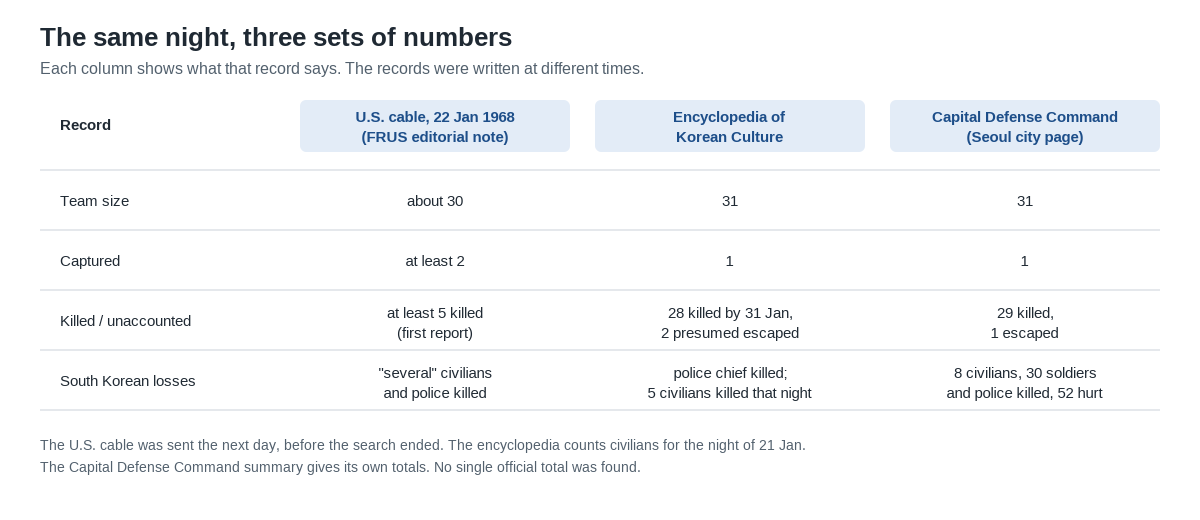
The three records were written at different times and count different spans. A first report sent the next day cannot match a tally made after a search that ran ten more days. So any number for this event should come with the name of the record it comes from.
The Pueblo two days later, and the U.S.–South Korea relationship
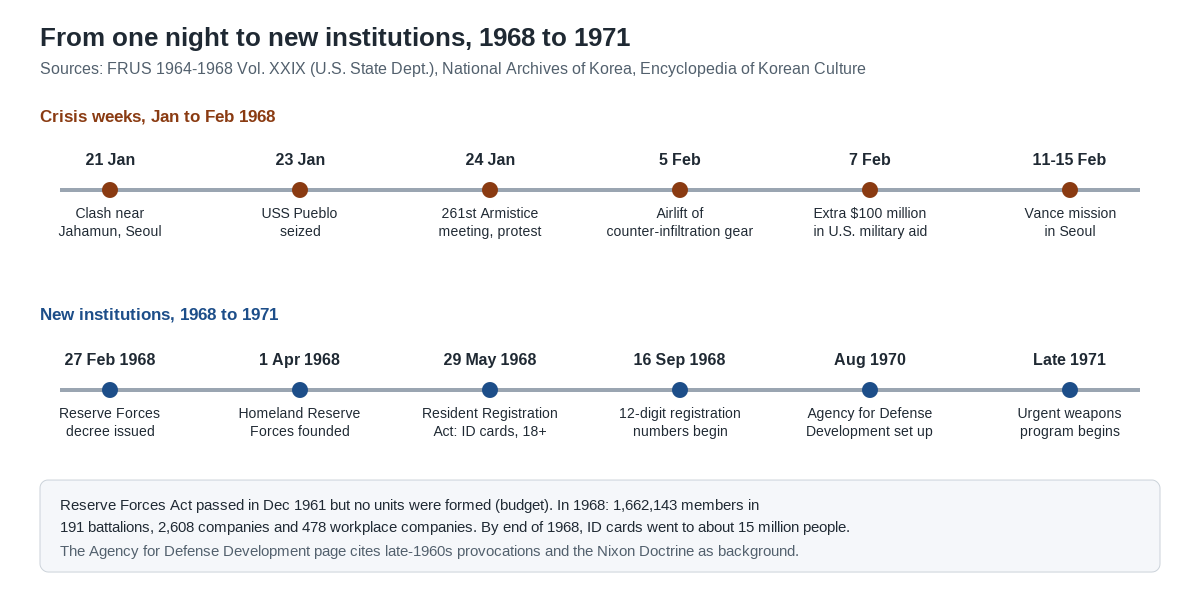
On 23 January, two days after the raid, North Korea seized the U.S. Navy intelligence ship USS Pueblo off Wonsan and detained its crew. Fewer than 48 hours had passed since the attempt on the Blue House. The ship's story continues in "The USS Pueblo Incident, 1968: An Intelligence Ship Seized in the East Sea."
The United Nations Command at once called for a meeting of the Military Armistice Commission. The 261st plenary meeting took place at Panmunjom on 24 January. There the UN Command's senior member condemned the Seoul raid and the killing of civilians, along with the Pueblo seizure. The encyclopedia also records that after North–South talks began in the 1970s, Kim Il Sung admitted the raid was the act of "ultra-leftist extremists."
The two events, so close together, strained relations between Seoul and Washington. The FRUS preface says the United States faced South Korean demands for retaliation and a deep loss of confidence in Seoul. It names the Johnson administration's effort to calm the crisis as the basic theme of these documents.
The U.S. response appears in the documents day by day. U.S. Forces Korea and the South Korean Joint Chiefs had drawn up a counter-infiltration equipment package. On 5 February, its urgent items were cleared for airlift, with the same priority as shipments to Vietnam. On 7 February, President Johnson said he would raise military aid to South Korean forces for that fiscal year by $100 million.
On 9 February, he told President Park Chung Hee that he was sending Cyrus Vance as a special envoy. Vance's party stayed in Seoul from 11 to 15 February.
Reserve forces and ID cards
Of everything the South Korean government did in response, the new institutions lasted longest. A law on Homeland Reserve Forces had been passed in December 1961. Budget problems and other issues had kept any units from being formed.
After the raid and the Pueblo seizure, the government announced plans to arm 2.5 million reservists and to build a weapons factory within the year. Some members of the National Assembly objected, but the view that the country needed to prepare for guerrilla warfare won out.
An enforcement decree followed on 27 February, and 1,662,143 members were organized into 191 battalions, 2,608 companies and 478 workplace companies. The founding ceremony took place on 1 April 1968 at the public stadium in Daejeon.
Resident ID cards date from the same year. On 29 May 1968 the Resident Registration Act was amended so that residents aged 18 and over would receive ID cards. From 16 September, 12-digit registration numbers came into use. By the end of the year, about 15 million people had cards.
The system faced opposition from the start. The National Archives notes that the amendment passed over objections from the opposition party. There was also strong debate over whether the system harmed individual rights and whether numbering people was ethically right.
The road to the Agency for Defense Development
Where would the weapons for the reservists come from? That question explains why a weapons factory was part of the 1968 announcement.
The National Archives record on the Agency for Defense Development gives as background the North Korean provocations of the late 1960s and outside changes such as the Nixon Doctrine. It says these raised calls to speed up self-reliant defense. The agency was set up in August 1970. In late 1971 it began an urgent weapons development program, known as the Beongae ("Lightning") project, to grow the defense industry and arm the reserve forces sooner.
How Korean weapons move today through agencies and stages is shown in A map of Korean defense technology. One far end of that map reaches back to this winter of 1968.
What to read next
- The Pueblo Incident, 1968: An Intelligence Ship Seized in the Sea of Japan (East Sea): the event two days later, off the east coast
- The 1976 Panmunjom Axe Incident and Operation Paul Bunyan: a crisis at Panmunjom eight years later
- Hill Battles and the Armistice: Two Years of Negotiation: where the Military Armistice Commission came from
- A map of Korean defense technology: from the Agency for Defense Development to today's weapons