An MRI scanner in a hospital and the GPS behind a phone's map share a hidden link. Both are places where quantum sensors do the work. MRI relies on control of nuclear spin, and GPS relies on atomic clocks carried by satellites.
Defense planners have high hopes for the next generation of quantum sensors. A leading example is knowing your position and the time even where GPS signals are weak or blocked. Yet reports from U.S. government agencies make the open problems just as clear as the hopes.
The sections below follow what a quantum sensor measures, how atomic clocks shrank to the size of a chip, what defense wants from these devices, and where progress is stuck.
What a quantum sensor measures
A quantum sensor measures things by using quantum mechanical properties: the energy levels of atoms, the quantum states of light, or the spin of elementary particles. That is the definition in a 2022 report by the U.S. National Science and Technology Council (NSTC). The list of what they can measure is long, from time, distance and temperature to gravity and electromagnetic fields.
Why are atoms so good for precise measurement? Each element and compound takes in and gives off electromagnetic radiation only at frequencies of its own. That rate repeats every time it is measured, so an atom can act like a pendulum on which a more accurate clock can be built.
Two words come up often in quantum technology: superposition and entanglement. Superposition is the ability of a quantum system to be in two or more states at the same time. Entanglement links the properties of particles so that measuring one reveals information about the others. The U.S. Government Accountability Office (GAO) explains that these properties allow measurements that classical physics cannot provide.
These properties break easily. Quantum states can be disturbed by tiny movements, changes in temperature or other effects in the surroundings, which makes superposition and entanglement hard to sustain. The same sensitivity that makes the sensors precise also makes them react to every outside disturbance.
Quantum sensors already around us
Quantum sensors are not only a technology of the distant future. Successful examples include atomic clocks, which have many uses including GPS navigation, and MRI scanners, a common tool in medicine. GAO counts MRI and atomic clocks among the quantum sensors sold commercially since the mid-20th century, and it ranks quantum sensors as the most developed branch of quantum technology. Some sensors, though, still need better reliability and cost-effectiveness.
The NSTC report includes a striking aside. The people who built the first atomic clocks likely did not foresee that ride-hailing and food delivery apps would one day use atomic clocks through GPS. The report uses the example to show how hard it is to predict which quantum sensors will turn out to be most useful.
From the ammonia clock to the fountain clock
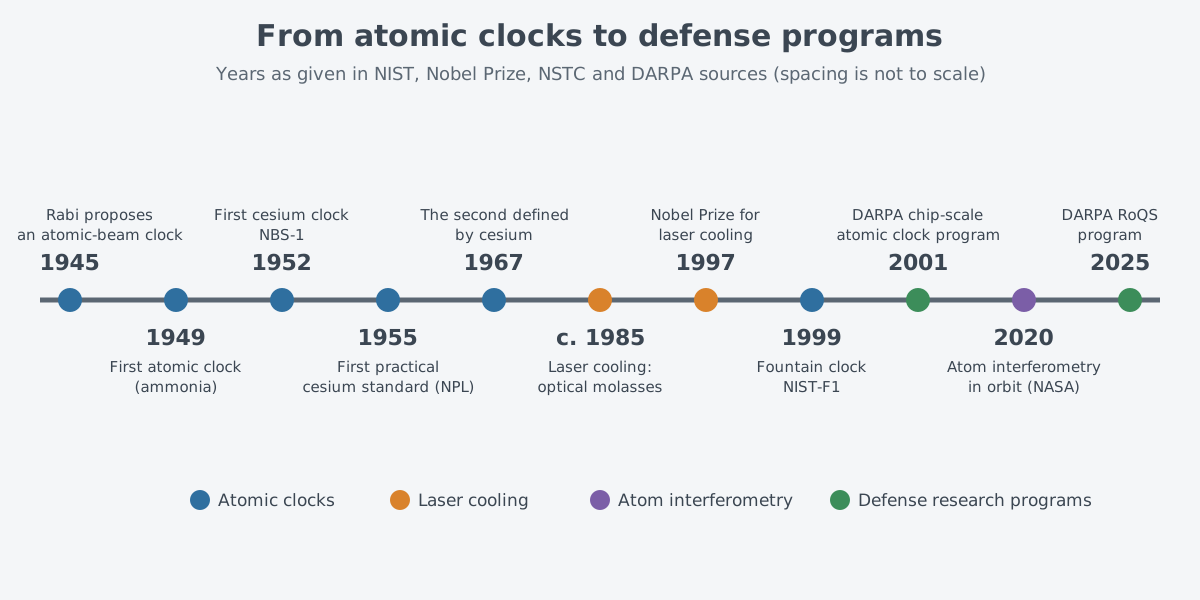
The idea of an atomic clock dates to 1945. Isidor Rabi, who taught physics at Columbia University, suggested that a clock could be built with atomic beam magnetic resonance, a technique he had developed in the 1930s. In 1949, the U.S. National Bureau of Standards, now NIST, announced the first atomic clock, which used the ammonia molecule.
The first clock was not much better than the standards already in use. Attention soon shifted to atomic-beam devices based on cesium, and in 1952 NIST announced NBS-1, the first atomic clock using cesium. The National Physical Laboratory (NPL) in England built the first practical cesium frequency standard in 1955.
In 1967 the unit of time itself changed. The 13th General Conference on Weights and Measures set 1 second equal to exactly 9,192,631,770 cycles of the natural resonance of the cesium atom. With atoms replacing the old definition based on the Earth's motion, world timekeeping no longer rested on astronomy.
Cesium is not the only choice. Atomic clocks based on rubidium vapor are more compact, cost less and use less power. The kind of atom and the shape of the clock change with the job.
Cooling atoms with lasers
At room temperature, the molecules in air fly about at around 4,000 km/h. Atoms moving that fast leave the spot being studied almost at once. To look at atoms for longer, they first had to be slowed down.
The 1997 Nobel Prize in Physics went to methods of cooling and trapping atoms with laser light. The laureates were Steven Chu, Claude Cohen-Tannoudji and William D. Phillips. Chu and his co-workers developed the method around 1985 at Bell Laboratories, and the laser light that slowed the atoms was likened to a thick liquid and named "optical molasses."
A spoon stirred through honey slows down quickly, and atoms slow down in light in a similar way. In reality, there is no sticky substance. Each time an atom absorbs a photon of the right energy, it takes on that photon's momentum and slows down a little.
The 1997 Nobel press release looked ahead to more precise atomic clocks for uses such as space navigation and accurate positioning. Work had also begun on the design of atom interferometers that could measure gravity very precisely.
NIST-F1, which NIST put into service as the national primary frequency standard in December 1999, uses laser-cooled atoms. Six infrared laser beams meet at right angles in the middle of a vacuum chamber, gather cesium atoms into a ball and chill them almost to absolute zero. Vertical lasers then toss the ball about 1 m upward through a cavity filled with microwaves, and gravity pulls it back down. One trip up and down takes about 1 second.
The atoms rise and fall like water in a fountain, so it is called a fountain clock. Cold, slow atoms give the microwaves more time to probe them, which produces a sharper signal. When NIST announced the clock, it said the clock would not drift by even 1 second in nearly 20 million years.
Putting a clock on a chip
In 2001, the U.S. Defense Advanced Research Projects Agency (DARPA) began funding a program to develop a commercial chip-scale atomic clock (CSAC). The aim was to serve two military needs: secure wireless links and GPS receivers that hold up against jamming. A small atomic clock inside a receiver gives it its own timing signal, which greatly reduces the effects of jamming.
It was not an easy task. The first DARPA program manager described shrinking an atomic clock that filled a whole room onto a millimeter-scale chip as an example of a very hard problem. NIST researchers cut size and complexity with coherent population trapping (CPT), a method that excites the atoms with laser light alone.
The first devices used a small semiconductor laser diode (LD) called a vertical-cavity surface-emitting laser (VCSEL). A chip-scale atomic clock is less precise than a larger atomic clock. In exchange, it is about one-seventh the size, uses about one-fiftieth as much power and runs on a battery.
Over 100,000 chip-scale atomic clocks have been sold commercially. The effort took more than a decade and almost $100 million in total. DARPA funded the work until 2008, after which a U.S. Army program carried it to commercial products, and the clocks are now used in defense, geophysical surveys and cellular communication.
Next in line: atom interferometers and magnetometers
What comes after the atomic clock? The NSTC report gives five kinds of quantum sensors as examples. They are atomic clocks, atom interferometers, optical magnetometers, devices that use quantum optical effects and atomic electric field sensors, and the list is not meant to be complete.
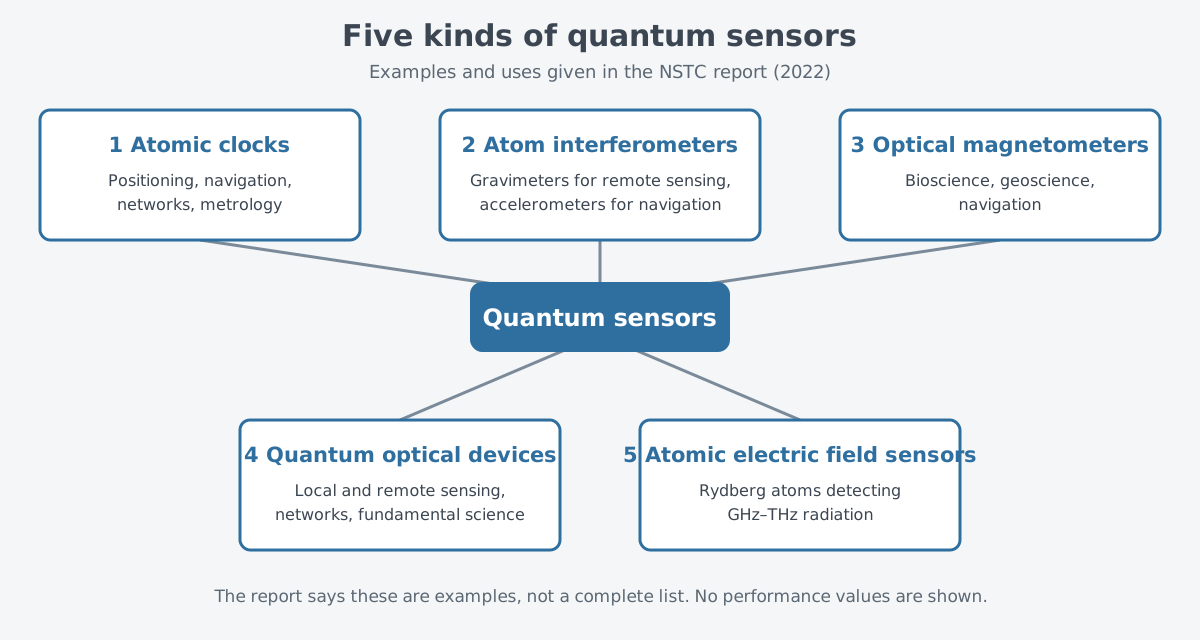
An atom interferometer treats atoms as waves. Matter-wave optics began with de Broglie's hypothesis that particles travel like waves, and modern atom interferometry was first demonstrated in 1991. The idea carries the interference of light over to atoms, and gravimeters and accelerometers built this way are the main uses.
The use that defense watches most closely is navigation. The NSTC sees atom interferometers as able to compete as gyroscopes and accelerometers in inertial navigation. In some situations they could reduce the need for sonar or GPS and might cut the errors that build up over time compared with traditional inertial measurement technologies.
In 2020, atom interferometry experiments were carried out in orbit with NASA's Cold Atom Lab. Even so, engineering challenges still stand in the way of commercial use.
An optical magnetometer measures magnetic fields using things such as the spins of atoms in a vapor. It could be used for sensing nearby or at a distance, for mapping, and for navigation. In magnetoencephalography (MEG), which measures the brain's magnetic fields, vapor-cell devices can come close to, or even pass, the sensitivity limits of SQUID-based devices without any cryogenic cooling.
An atomic electric field sensor uses Rydberg atoms as a kind of quantum antenna. It stands out because it can measure electromagnetic fields over a wide range of frequencies, from direct current up to THz.
What defense is hoping for
The CRS defense primer reports a view of the Defense Science Board (DSB). The board named three applications of quantum technology as the most promising for the Department of Defense: quantum sensing, quantum computers and quantum communications. It judged quantum sensing to be the most mature military application and "poised for mission use."
The hope mentioned most often is knowing your position without relying on GPS. Quantum sensing could in theory give militaries other positioning, navigation and timing (PNT) options that let them keep operating at full performance where GPS is degraded or denied. NATO released a summary of its quantum technologies strategy in January 2024. Its examples include PNT capabilities that do not rely on a global navigation satellite system (GNSS) and better space-based data collection.
Atomic clocks are already key to GPS navigation. Backup networks of atomic clocks and precise time-transfer methods can make navigation systems more resilient at times when the usual GPS signals cannot be used. Why satellite and inertial navigation are used together is covered in Inertial and satellite navigation: knowing where you are.
GAO also expects better measurements of time and position from quantum sensors, which would help navigation when GPS is missing or weak and might help the military get past jamming. A possible role in intelligence, surveillance and reconnaissance (ISR) is also mentioned. On stealth, GAO notes that the sensors could help detect it, and it lists the concern that adversaries could use the same sensors as a question for policymakers.
Not every hope carries the same weight. For quantum radar, which has been hypothesized to identify the performance characteristics of objects, the DSB concluded that it will not provide upgraded capability to the Department of Defense. A technology with "quantum" in its name is not automatically mature.
The money is worth a look too. For fiscal year 2026, the Department of Defense asked for $593.7 million for quantum technologies. For fiscal year 2025, it received an appropriation of $781.2 million. These figures cover quantum computers and communications as well as quantum sensing.
Leaving the lab is the hard part
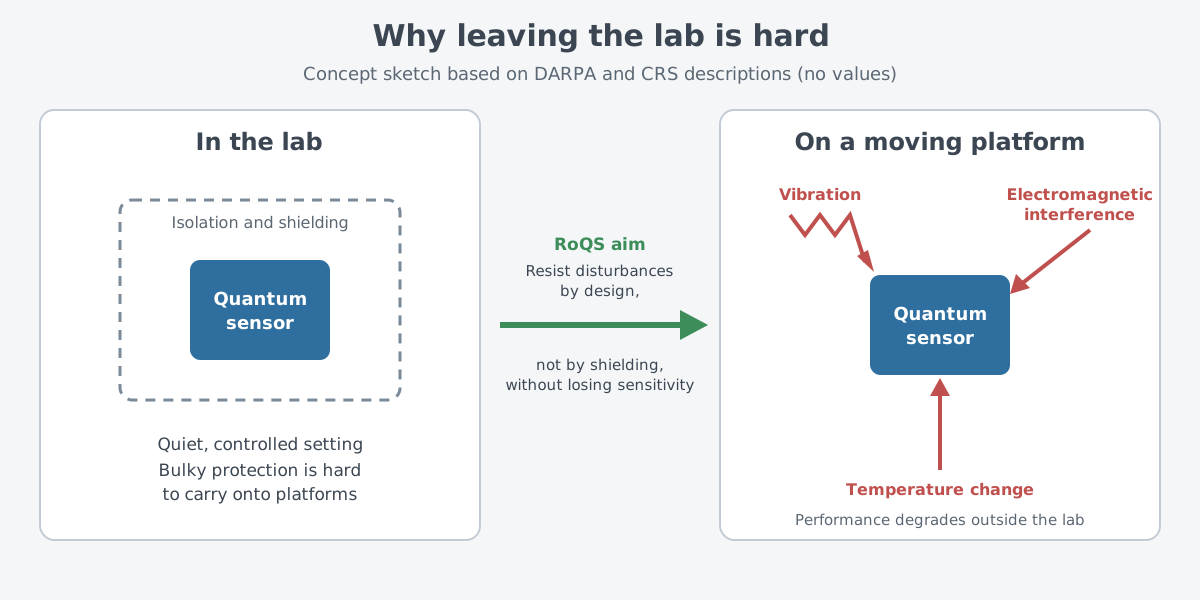
Quantum sensors are known for being fragile in real-world settings because of their extraordinary sensitivity. On moving platforms in particular, disturbances such as vibration and electromagnetic interference degrade their performance. Today's fixes, isolating the sensors or wrapping them in bulky shielding, are impractical for wide use.
That is why DARPA announced the Robust Quantum Sensors (RoQS) program in February 2025. The goal is a sensor that resists disturbances by design without losing sensitivity, so that it can be trusted outside the lab. In Phase 1, which began in August 2025, performer teams build small sensors and fly them for testing on a helicopter supplied by the government.
The helicopter was chosen for its tough conditions: strong electromagnetic fields, vibration and gradients. Integrating the sensors onto actual Department of Defense platforms is the job of the second phase. For now, the work is still about testing prototypes in a harsh setting.
The problem is not only technical. The NSTC likens the step from a prototype that proves a principle to a device that makes economic sense to crossing a "valley of death." New sensors must compete with familiar classical technologies, and size, weight, power and cost (SWaP-C) must be improved step by step. Many quantum sensor concepts are also still at low levels of technology readiness.
Parts and people are hurdles too. Certain quantum sensors depend on parts such as compact lasers, which may be hard to obtain when factories or special materials are in short supply. The field also needs a workforce that spans several disciplines. It can take years, sometimes decades, of innovation before such technology pays off broadly for society.
Where this meets lasers
Lasers turn up all through the quantum sensors in this article. A fountain clock gathers and cools atoms with six lasers, and a chip-scale atomic clock excites atoms with a small semiconductor laser. Work on atom interferometer design also began alongside laser cooling.
The NSTC's third recommendation is to develop parts with many uses, for example small, dependable lasers and integrated optics, to help quantum technology develop and to reach economies of scale. The chip-scale atomic clock itself borrowed compact laser technology first developed for other industries.
Some sensors use the quantum nature of light itself. "Squeezed light" lets the Laser Interferometer Gravitational-Wave Observatory (LIGO) and partner observatories abroad work below the noise floor that was traditionally expected. How laser light differs from ordinary light is explained in What is a laser? How it differs from a light bulb.
What to read next
- Inertial and satellite navigation: knowing where you are: the inertial navigation that works alongside GPS when signals are blocked.
- Jamming and spoofing: interference versus deception: the difference between blocking satellite signals and faking them.
- What is a laser? How it differs from a light bulb: the properties of the laser light that cools and excites atoms.
- How GPS Works: Satellites Carrying Clocks: how the atomic clocks on satellites fix a position.
- Technology Readiness Levels: Stages Within "In Development": the steps between a lab prototype and usable equipment.