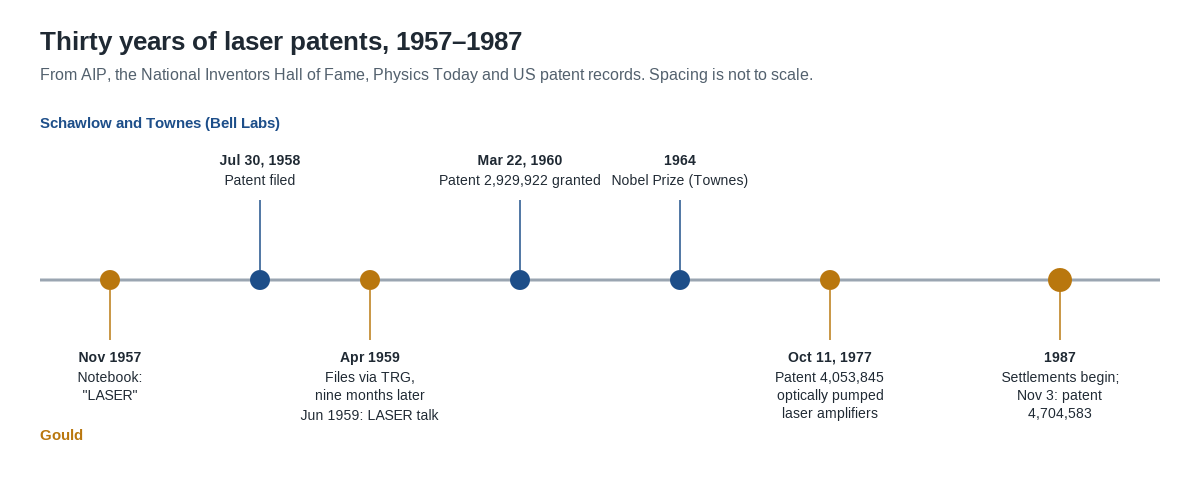
One night in November 1957, Gordon Gould, then studying for his doctorate at Columbia, could not sleep. He later recalled that the idea for the laser came to him that night. He added that it came only after his mind had been working on the pieces for years.
Gould wrote the idea down in a notebook. He titled it "Some rough calculations on the feasibility of a LASER: Light Amplification by Stimulated Emission of Radiation." The National Inventors Hall of Fame records this as the first use of the acronym LASER.
Yet the fight over laser patents went on for close to 30 years after that. So who invented the laser? Notebooks, patents and prizes each point to different names.
The notebook of November 1957
For his thesis, Gould was working on pumping, which lifts atoms to higher energy states. He discussed the problem with Charles Townes and hit on an arrangement with a mirror at each end. Worried about being scooped, he wrote his ideas down for the record.
Gould gave the not-yet-invented device the name LASER. The laser exhibit of the American Institute of Physics (AIP) explains that while thinking through what it could do, he realized he had something far beyond the much-discussed "infrared maser." The name went public in June 1959 at the Ann Arbor optical pumping conference at the University of Michigan. Gould's talk was titled "The LASER: Light Amplification by Stimulated Emission of Radiation."
Townes was working on the same problem at the time. He talked it over with his colleague and brother-in-law Arthur Schawlow, and Schawlow found the method of placing a mirror at each end of a long space. The result is in Schawlow and Townes, 1958: The Optical Maser Paper That Proposed the Laser.
Nine months apart
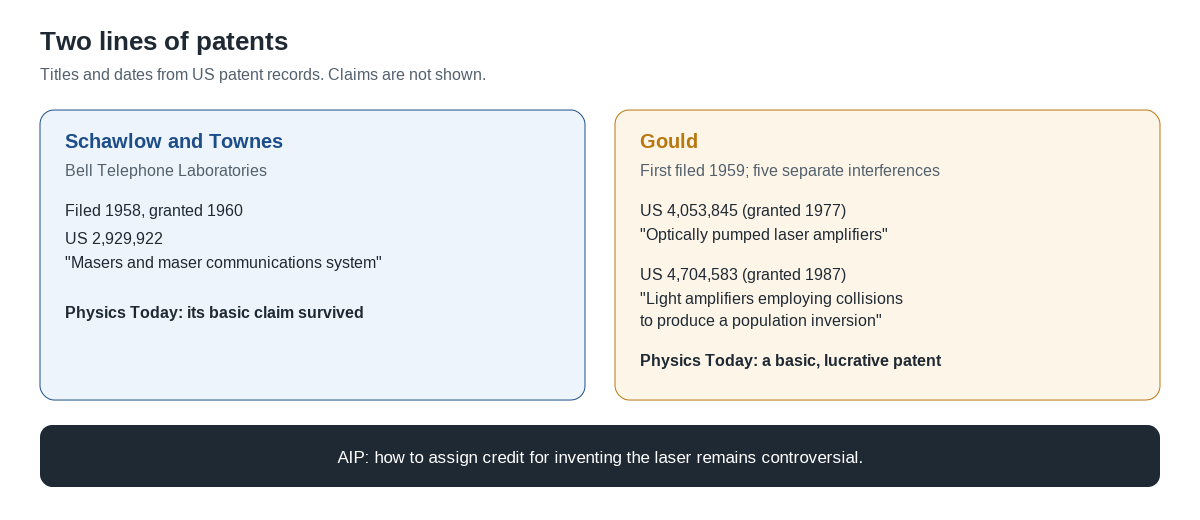
Schawlow and Townes filed first. The record for US patent 2,929,922, "Masers and maser communications system," shows a filing date of July 30, 1958, with Bell Telephone Laboratories as the original assignee. Schawlow was a Bell Labs employee, and Townes advised the lab as a consultant.
Gould did not file until April 1959, through his employer, the research firm TRG. The two filings were nine months apart. He filed late because he misunderstood a lawyer's advice.
Gould was also shut out of his own company's laser project. After the Schawlow and Townes paper appeared, TRG won Pentagon money for a project. Because the work was classified secret, Gould was kept off it: during the war he had spent a short time in a Marxist study group.
The 1960 Bell patent and the lawsuit
The Schawlow-Townes patent was granted on March 22, 1960. The American Physical Society (APS) newsletter points out that this was the same year Theodore Maiman built the first laser at Hughes. That first laser is covered in May 16, 1960: Maiman's Ruby Laser.
Once Bell received its patent, Gould went to court, arguing that the idea had been his first. At the US Court of Customs and Patent Appeals (CCPA), he challenged the Schawlow-Townes patent. He claimed he was the first to conceive the Fabry-Perot arrangement of two parallel flat mirrors that produces laser action. It is the same arrangement now called a laser's optical resonator.
Five reviews and the first patent in 1977
Why did Gould's patents take so long? His original application held several inventions at once, and the Patent Office put it through five separate interference proceedings. An interference is the Patent Office's process for deciding which party invented a claimed invention first. As a result, the first of his basic laser patents did not issue until 1977.
The APS historic site page reports one court ruling from those years. In 1973, it says, the CCPA found the original Schawlow-Townes patent too general to show how to build certain key parts of a working laser. After that, according to the same page, Gould won patent rights.
That patent is US patent 4,053,845, "Optically pumped laser amplifiers." Its record shows a filing date of August 16, 1974, and a grant date of October 11, 1977. It covers amplifiers that use optical pumping, which excites the medium with light. On November 3, 1987, US patent 4,704,583, "Light amplifiers employing collisions to produce a population inversion," was granted.
These patents grew more valuable over time. Valid Gould patents would mean payments from anyone making or using lasers. While the decision dragged on, the laser industry grew, and the patents gained value with it. From 1987, settlements started to come in for Gould and those who had backed him.
So who invented the laser?
On the record alone, there is no single answer. Former Bell Labs researchers writing in Physics Today sum it up this way. The core claim of the Schawlow-Townes patent held up, while Gould ended up with a fundamental and very profitable patent covering optically pumped laser amplifiers. Both lines of patents stood.
Scientific recognition took yet another path. The 1964 Nobel Prize in Physics went to Townes and to Nikolay Basov and Aleksandr Prokhorov. The person who actually got the first laser running was Maiman, and Gould entered the National Inventors Hall of Fame in 1991.
The AIP exhibit says the question of how to assign credit for inventing the laser remains controversial. Most of the ideas were patented by someone, it adds, but patents reveal little about where ideas really came from or how they moved between scientists. The same exhibit holds that physicists in many countries who devised ways to pump atoms, and others reaching back to Einstein, were in a sense inventors of the laser too.
A patent is a legal document that settles rights. Who first thought of what is told by notebooks, papers and conference talks taken together. In the case of the laser, those records do not point to one person.
What to read next
- Schawlow and Townes, 1958: The Optical Maser Paper That Proposed the Laser: the paper behind the patent that was filed first
- May 16, 1960: Maiman's Ruby Laser: the first laser, switched on in the middle of the patent fight
- 1917: Einstein and Stimulated Emission, the Seed of the Laser: the idea the AIP exhibit means by "reaching back to Einstein"