What would you use to switch laser light on and off far faster than a mechanical shutter? Any shutter built from blades or mirrors, however refined, still has to push and pull a physical object with mass. Many laser systems hand this job to sound instead.
An acousto-optic modulator (AOM) is a part that sends ultrasound through a clear crystal. Wherever the sound passes, the refractive index changes slightly, and that pattern bends light. Turn the sound on and off and the light is deflected or not. Change the sound frequency and both the deflection angle and the light frequency change with it.
With this one property, an AOM can act as a switch, as a pulse device inside a laser, and as a tool for choosing a beam's direction and frequency. The sections below start from an experiment in 1932 and move through the physics inside the crystal, the main uses, and the trade-offs that cannot be avoided.
1932: ultrasound fans light out
In 1932, two research teams in the United States and France found the same effect independently. A beam of light passing through a region filled with ultrasound broke up into a fan of diffraction spectra. The American pair was Debye and Sears, and the French pair was Lucas and Biquard.
Debye and Sears were both in the Department of Physics at MIT. Their paper, "On the Scattering of Light by Supersonic Waves," appeared in the Proceedings of the National Academy of Sciences (PNAS) in June 1932.
Theory soon followed. Raman and Nagendra Nath worked in the Department of Physics at the Indian Institute of Science in Bangalore. In a 1936 letter to Nature, they said another researcher's experiments agreed well with their theory. This discovery that sound can bend light is the root of today's AOM.
A moving grating of refractive index
An AOM is a clear crystal with a transducer attached to one face. Feeding a radio-frequency (RF) signal into the transducer creates a sound wave inside the crystal. The wave squeezes and stretches the crystal as it travels at the speed of sound in that material.
When a material is squeezed and stretched, its refractive index changes a little. This is the acousto-optic effect, also called the photoelastic effect. The crystal therefore holds a pattern of alternating high-index and low-index bands, and this pattern acts on incoming light like a diffraction grating.
It differs from an ordinary diffraction grating in two ways. The bands keep moving away from the transducer, and the whole crystal works like a thick diffraction grating.
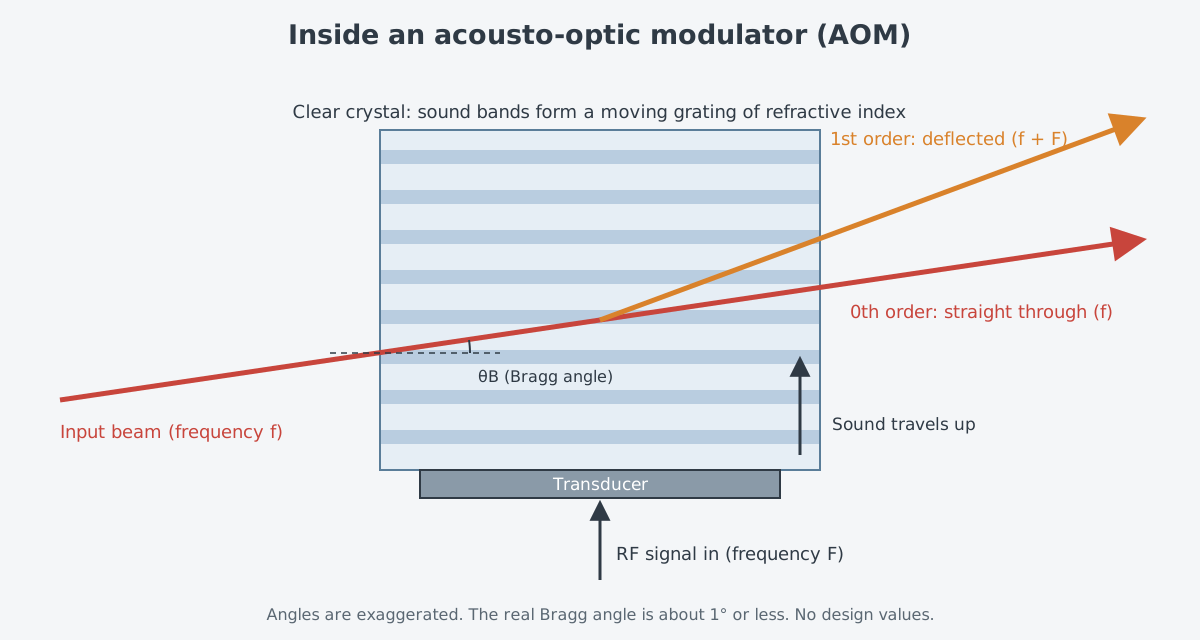
When light meets the bands at the right angle, most of it is deflected in one direction. This angle is called the Bragg angle. Light that goes straight through without bending is the 0th-order beam, and the deflected light is the 1st-order beam.
According to a 2005 paper from the NIST Time and Frequency Division, the Bragg angle is usually no larger than about 1°. With careful engineering, sending more than 80% of the light into a single order is not uncommon. The most light goes into the 1st order when the beam meets the crystal at the Bragg angle and the RF drive is turned up to saturation.
The deflected light changes frequency too
Light deflected by the moving bands goes through one more change. Much as an approaching siren sounds higher, light deflected from a moving sound wavefront has its frequency changed by a Doppler shift. The real difference is that no sound source is moving toward anyone; the change happens as light bounces off a moving pattern of refractive index.
The size of the shift equals the RF drive frequency. Which way it goes depends on the side from which the light meets the sound. Deflection into the +1st order raises the frequency by that amount, and the −1st order lowers it by the same amount.
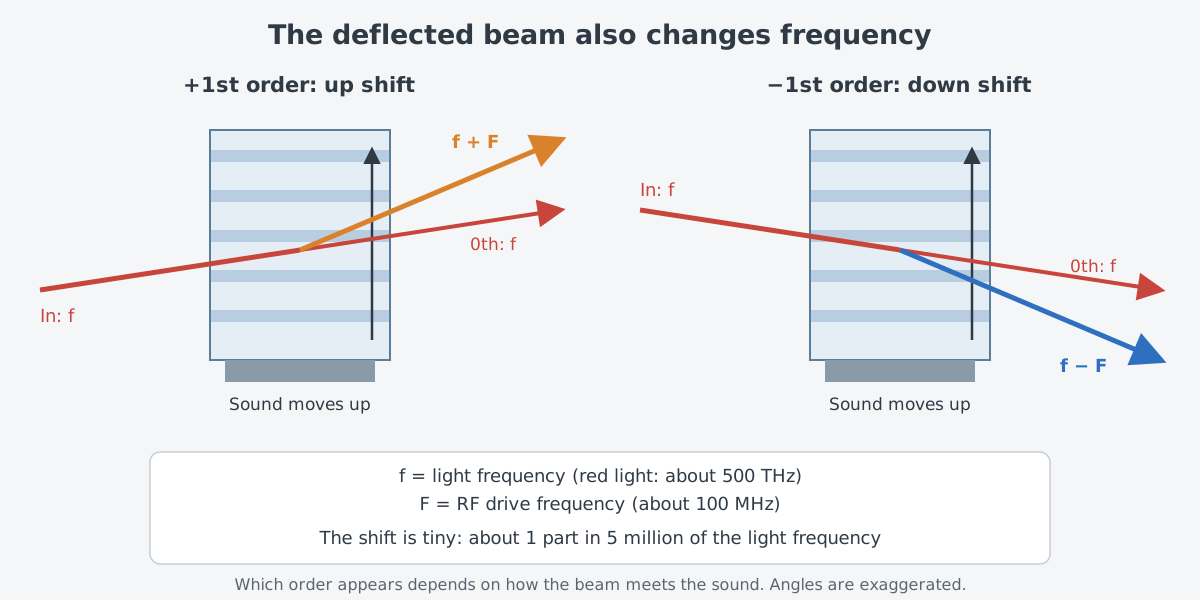
The shift is very small. An application note from Isomet, an acousto-optic parts maker, compares red light at about 500 THz with an AO frequency of about 100 MHz. That is roughly 1 part in 5 million of the light frequency. Even so, tuning the RF frequency lets you pick the size of the shift within the device's bandwidth.
One place where this small shift matters a great deal is in experiments that cool atoms with lasers. AOMs are widely used to control frequency in laser cooling experiments, where the laser frequency often has to change in less than 1 ms. NIST-F1, the atomic fountain clock that serves as the U.S. primary frequency standard, uses AOMs for its frequency sweeps and jumps. It changes the light intensity by controlling the RF power sent to the AOM.
A switch faster than a mechanical shutter
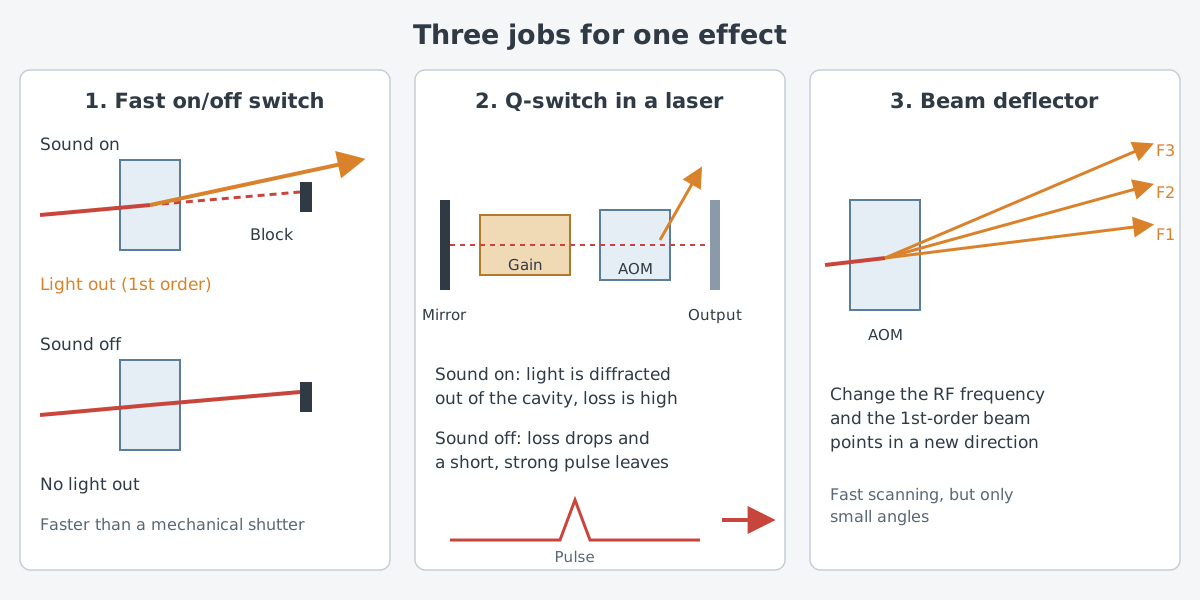
With the sound on, light is deflected into the 1st-order beam. With the sound off, it goes straight on as the 0th-order beam. If only the 1st-order beam is used, the AOM becomes a switch that turns light on and off. Adjusting the strength of the sound sets how much light is deflected, which means it also sets the light intensity.
The optical parts maker Gooch & Housego (G&H) describes its modulators as controlling light intensity at rates far beyond mechanical shutters. Speed has a limit, though. The rise time is how quickly the modulator responds to a signal. It is proportional to the time the sound wave takes to cross the light beam, so it depends on the beam diameter inside the modulator.
Sound is far slower than light, even inside a crystal. The wider the beam, the longer the sound takes to cross it. G&H says its very fast modulators can modulate at up to 200 MHz with rise times as short as 4 ns, with the beam focused very tightly into the device. Slower modulators are free of this limit and can take wider beams.
Inside the laser: Q-switching and mode locking
An AOM can also sit inside a laser's optical resonator. Q-switching holds the resonator's loss high and then drops it suddenly to release a short, strong pulse. With the sound on, part of the light is diffracted out of the resonator and the loss is high. With the sound off, the loss falls.
How quickly the switch opens ultimately limits the pulse duration. Keller's textbook names two switches that are fast enough: electro-optic switches, with a typical switching speed of about 10 ns, and acousto-optic switches, at about 50 ns. In one example from the book, a diode-pumped Nd:YLF laser with an acousto-optic switch produced pulses as short as 700 ps at a repetition rate of 1 kHz.
Beam diameter matters here too. To make the switching fast, the laser beam inside the modulator has to be small. G&H lists uses for acousto-optic Q-switches that include materials processing such as engraving, cutting and drilling, medical surgery, lithography and rapid prototyping.
In mode locking, an AOM makes the loss rise and fall in a sine pattern. The AOM used for this usually reflects the sound back from the end of the crystal to form a standing wave. To a sound wave, the glass/air boundary is like a 100% reflector.
When two sound waves travel in opposite directions and overlap, the loss rises and falls at twice the acoustic frequency. For mode locking to work, this rise and fall has to match the round-trip frequency of the pulse circulating in the resonator. The article on Q-switching and mode locking explains how the pulse forms.
Steering a beam by changing frequency
The deflection angle depends on the RF frequency. Change the RF frequency and the 1st-order beam points in a different direction. A device used this way is called an acousto-optic deflector (AOD).
G&H says its deflectors can pick out hundreds to thousands of separate spots inside an angle of a few degrees, with scan times as short as a few microseconds. The number of spots that can be resolved is set by the time the sound takes to cross the beam and by the RF frequency bandwidth. The typical scan angles the company gives run from about 5 mrad to more than 60 mrad, with the exact range set by wavelength and RF bandwidth.
A comparison with fast steering mirrors, which tilt a mirror to turn a beam, shows the difference. In an AOD the crystal stays in place, and only the RF frequency changes to change the direction. In exchange, the angle it can cover is small, within a few degrees.
A changing angle is not always welcome. If you only want to shift the frequency but the beam direction moves too, the alignment is spoiled. The NIST paper mentioned earlier names this as a practical problem when scanning laser frequency with an AOM. Its answer is a double-pass setup, in which the beam goes through the AOM twice and the change in direction cancels out.
On the second pass, the beam, with its polarization rotated by 90°, travels back along the incoming path, and a polarizing beam splitter separates it from the input beam. On the other hand, where several spatially separated beams are needed, the changing angle becomes useful.
Speed comes at the cost of aperture
G&H explains that every acousto-optic device has to balance speed, aperture size, power handling and durability against one another. As shown above, a fast device needs a tightly focused beam, and a device that accepts a wide beam is slower.
Focusing the beam tightly has its own limit. A strongly focused beam enters over a range of angles, and only part of it meets the Bragg condition. That is why an AOM's diffraction efficiency depends strongly on the beam waist diameter.
Nor can the sound frequency simply keep rising. The loss of sound in the crystal grows with the square of the acoustic frequency, which makes high-frequency acousto-optic modulators harder to build. An AOM that is fast, large and able to handle strong light all at once is hard to get, so each use decides which of these comes first.
What to read next
- Q-switching and mode locking: two ways to make short pulses: the full picture of the two pulse methods that use AOMs.
- Seed Lasers and Phase Modulators: Why Broaden a Narrow Line: another kind of modulator that changes light with an electrical signal.
- Fast steering mirrors: small, quick mirrors that cancel shake: turning a beam by moving a mirror.
- Interference and diffraction: how light adds up and spreads: the basics of diffraction that AOMs rely on.