Behind every news item about a fighter or a missile joining a unit lies a long story. The news also uses phrases such as "passed Milestone B," "became a program of record" and "prototype fielded." What do they actually mean?
Buying weapons is not like picking goods off a shelf. One process decides what is needed, another decides the money, and a third runs the actual development and purchase. They are separate, yet they mesh. This article follows that structure through public U.S. Department of Defense material, then looks at Korea's process and at laser weapons.
Three gears: needs, money and acquisition
A 2014 report by the Congressional Research Service (CRS) sums up three conditions that every U.S. weapon system meets. It must satisfy a specific military need and be paid for from the federal budget. It must also be designed and made inside an acquisition system. So between the first idea and fielding, a weapon goes through three steps: finding the need, setting the budget and acquiring the system.
Together, these three are often called "Big A" acquisition. When people mean only the third step, the Defense Acquisition System (DAS), they call it "little a." Which one a news story means changes how much of the picture it covers.
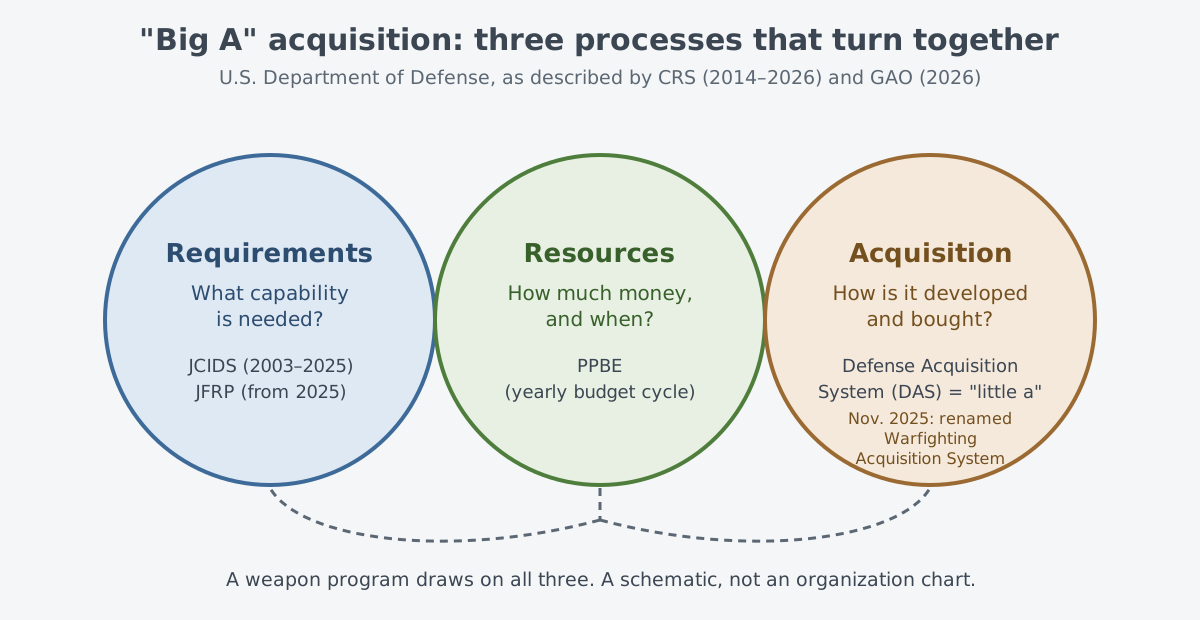
The first gear, the requirements process, long went by the name Joint Capabilities Integration and Development System (JCIDS). It was created in 2003 and run by the Joint Requirements Oversight Council (JROC), chaired by the Vice Chairman of the Joint Chiefs of Staff. A 2026 CRS primer notes that the Joint Force Requirements Process (JFRP) replaced it in 2025.
A requirement does not always lead to a new weapon. A validated need can be met by changes in doctrine, training or organization, or by buying a new weapon system.
Money planning starts two years ahead: the budget process
The second gear is the Planning, Programming, Budgeting, and Execution (PPBE) process. Defense Secretary Robert McNamara set it up in 1961 as PPBS, and it took its current name in 2003. It runs every year and is the framework for deciding which programs to fund, based on strategic goals.
The process follows the calendar. The cycle for one fiscal year typically starts over two years ahead of the year the money is actually spent.
It has four phases. Planning yields the Defense Planning Guidance (DPG). In programming, each component submits a Program Objective Memorandum (POM) that looks five years ahead. Budgeting turns the first year of that plan into budget terms, and in execution, officials review how the money was spent and what the programs achieved.
The budget usually goes to the White House Office of Management and Budget (OMB) in December, and the President's budget request usually reaches Congress in February. Along with the Defense Department's share of that request, the process updates the five-year spending plan called the Future Years Defense Program (FYDP).
Three gates: Milestones A, B and C
The third gear is the acquisition system itself. Large, complex programs move from phase to phase through gates called milestones. At each one, the Milestone Decision Authority (MDA) checks whether the program meets the criteria and decides whether it moves on. Here are the phases as a 2014 CRS report lays them out.
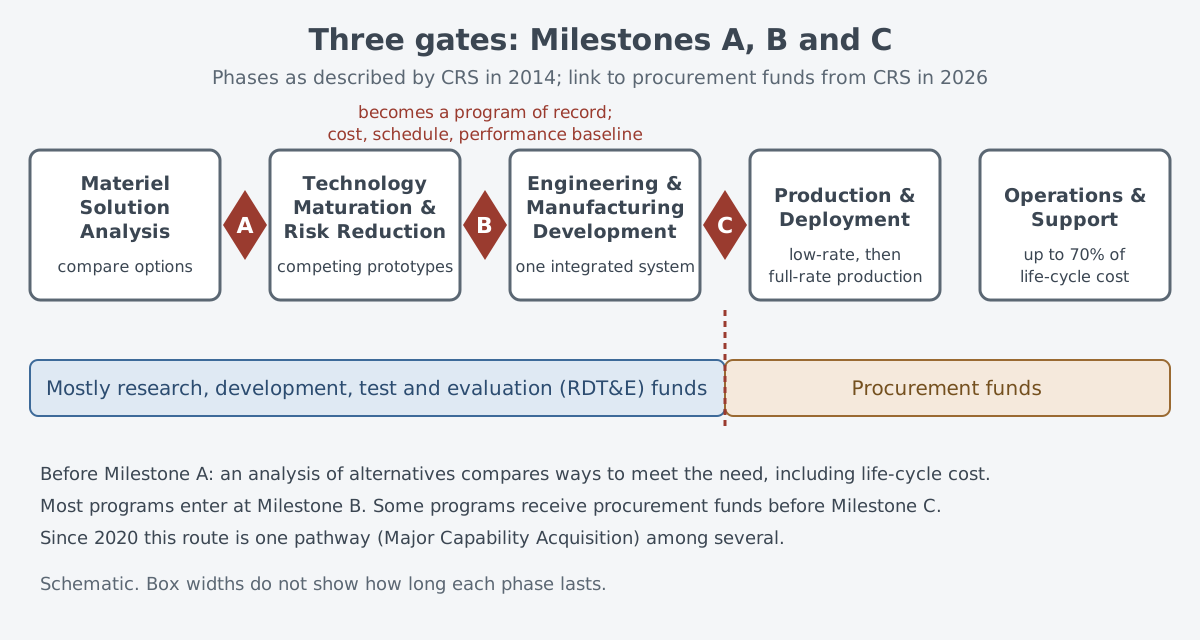
Before the first gate comes the Materiel Solution Analysis phase. An analysis of alternatives compares different ways to meet the need, and it also looks at the cost over the weapon's whole life. Passing Milestone A leads to Technology Maturation and Risk Reduction. Here new technology and the design are refined until officials can judge whether the system can meet the requirement within cost caps, and companies may build competing prototypes.
Milestone B is where a program changes status. Most programs start here, and passing it makes a program a program of record. A baseline with the program's performance, schedule and cost goals is approved at this point.
In the next phase, Engineering and Manufacturing Development, all the technologies are joined into one system and production is prepared. Operational testing checks whether the system is effective, suitable and survivable in operations.
Passing Milestone C leads to Production and Deployment. Low-rate initial production comes first. After enough testing and an approval, the program moves to full-rate production.
According to a 2026 CRS primer, a program that delivers a major capability usually receives procurement funds after Milestone C approval. Before that, it mostly runs on research, development, test and evaluation (RDT&E) funds. Some programs, however, receive procurement funds before Milestone C.
The last phase is Operations and Support, when the weapon is used and maintained in units until it is retired. The 2014 CRS report notes that up to 70% of a system's total life-cycle cost can occur in this phase. Using and fixing a weapon can cost more than buying it, and these costs are called operating and support costs (O&S).
The gates are a little like airport security checkpoints. In both cases, you need the right papers and conditions to enter the next area. The difference is real, though. A checkpoint applies the same rules to everyone, while milestone reviews and documents are tailored to the size and risk of each program.
More than one road: acquisition pathways
Passing every gate in order is not the only route. In 2020 the Defense Department revised its acquisition policies to get new technology to users faster. The Government Accountability Office (GAO) refers to these reforms together as the Adaptive Acquisition Framework (AAF).
The AAF has six pathways, and four of them relate directly to weapon systems. Each pathway has its own milestones, paperwork, and goals for cost and schedule, and the military services can pick one or more pathways to fit the capability they want. Since the 2020 reform, the milestone route above has been one of them, the Major Capability Acquisition (MCA) pathway.
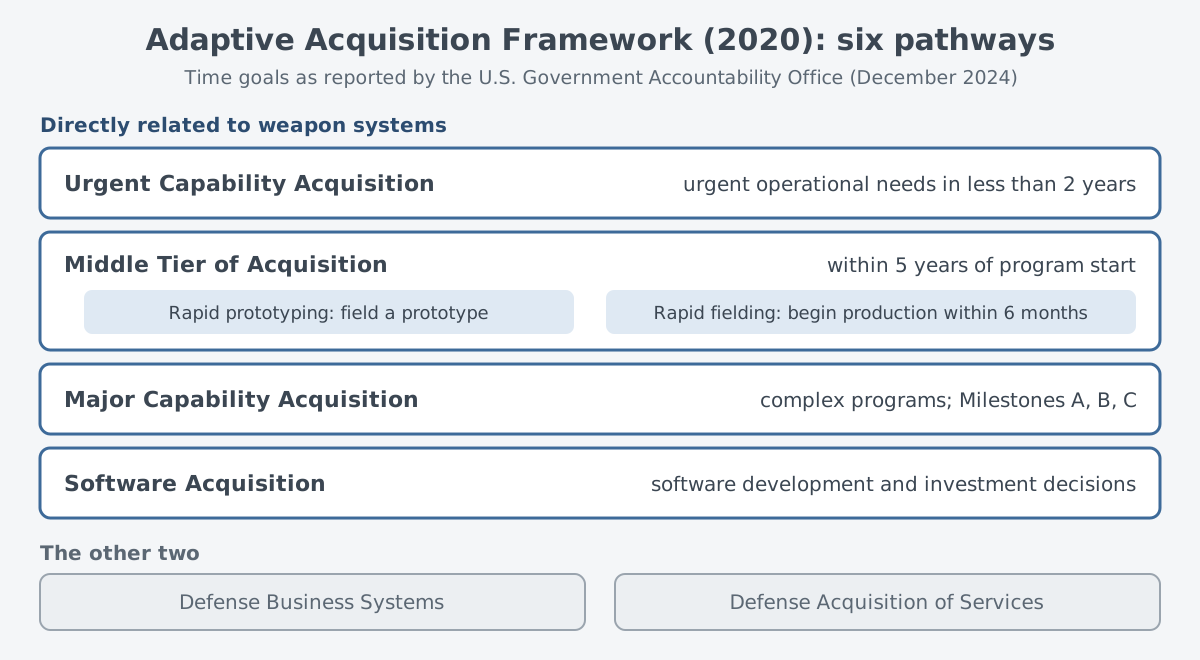
Urgent Capability Acquisition (UCA) aims to answer urgent operational needs in under 2 years. The Middle Tier of Acquisition (MTA) aims to finish within 5 years of program start.
The MTA has two paths. Rapid prototyping quickly builds prototypes that can be fielded, and rapid fielding uses proven technology to field systems quickly. A rapid fielding program must begin production within 6 months.
The MTA traces back to the National Defense Authorization Act for Fiscal Year 2016. That law told the department to set up a different acquisition process for programs meant to finish in 2–5 years. According to GAO, MTA programs get certain flexibilities. For example, they do not have to follow the JROC's policies and procedures.
The Major Capability Acquisition pathway serves complex programs like major defense acquisition programs (MDAPs). An MDAP is generally a program the Secretary of Defense designates, or one with large expected costs. The cost lines are more than $525 million in research and development or $3.065 billion in procurement, measured in constant fiscal year 2020 dollars. Some programs above these amounts, such as those on the MTA pathway, are not treated as MDAPs.
A system that is still changing
This structure is still moving. On the budget side, the PPBE reform commission issued 28 recommendations in March 2024. The first one calls for replacing PPBE with a new Defense Resourcing System (DRS) and cutting its four processes to three: strategy, resource allocation and execution.
On the acquisition side, the executive branch and Congress both put forward reforms in 2024 and 2025. Executive Order 14265 of April 2025 said it aimed to quickly overhaul outdated acquisition rules, focusing on speed, flexibility and execution. In Congress, the Senate's FoRGED Act came in December 2024 and the House's SPEED Act was introduced in June 2025.
Views differ. According to an August 2025 CRS paper, some analysts say more than a decade of reform has improved the process. Others say results have generally been limited, largely because of the department's bureaucracy and processes. It also notes that some proposed changes could spread authority down to program, portfolio or service levels and make acquisition more decentralized.
In November 2025, a 2026 GAO report notes, even the name of the third gear changed. On November 7, the defense secretary put out a policy memo whose title speaks of transforming the Defense Acquisition System (DAS) into the Warfighting Acquisition System. Its aim is to put timely, urgent delivery of operational capabilities first. In a separate memo that same month, the Secretary directed that JCIDS, the system for setting weapon requirements, be disestablished.
Congress created portfolio acquisition executives in the defense authorization law for fiscal year 2026. Programs are grouped into portfolios of capabilities, and each executive holds authority over the plans, budgets and execution of the programs in that portfolio. In the same GAO report's view, though, it is still too soon to see tangible results from these policy changes.
How Korea does it
In Korea, buying and developing weapons falls under the defense capability improvement program. The Defense Acquisition Program Administration (DAPA) describes it as work to improve military strength. It covers buying weapon systems, research and development including new development and upgrades, and building the facilities that go with them.
The starting point is a requirement (소요). A military service raises the requirement and the Joint Chiefs of Staff decide on it. DAPA then names an integrated project team (IPT).
The team sets a program strategy through preliminary research, and the program moves on to research and development or to purchase at home or abroad. After that come production and fielding, operation and support, and disposal.
Set beside the three U.S. gears, the parallels are easy to see. The requirement matches the requirements process, and research, development and purchase match the acquisition system. A November 2014 revision of Korea's Defense Acquisition Program Act moved the mid-term defense plan and test and evaluation functions to the Ministry of National Defense (Joint Chiefs of Staff). The roles of each agency and the test verdicts are covered in more detail in the K-defense technology map.
Where this meets lasers: between prototype and program
News about laser weapons often uses the word "prototype." In a 2023 report, GAO said the Defense Department spends about $1 billion a year on directed energy weapons (DEW). High-energy lasers have shot down drones in demonstrations, but GAO found that moving prototypes into acquisition programs faces challenges.
That gap has a nickname: "the valley of death." It is the distance between the people who develop technology and the people who acquire it. For example, the acquisition side may want technology that is more mature than what the development side can deliver. To move a prototype into an acquisition program, the department needs a transition partner that can carry the technology's development further.
Budget timing is another hurdle. The same report says it can take at least a year and a half from first conceiving a project idea to receiving its first funding. A prototype can end in three ways: it moves into operational use, its technology finds another use, or the effort is stopped. Moving into operational use can itself mean rapid fielding, use by an existing program, or the start of a new program.
Why a news story saying a laser weapon was "fielded" differs from one saying it "became a program of record" is covered in how to read laser weapon news. Cases made public so far are collected in laser weapon programs that have been made public.
What to read next
- How to read laser weapon news: "kW-class", "range" and "cost per shot": how the words prototype and program of record are used in the news.
- K-defense technology map: how Korean weapon systems connect: Korea's acquisition steps and the agencies in charge, in more detail.
- Military logistics: performance must be sustainable: what the operations and support phase needs.
- Technology Readiness Levels (TRL): "in development" has stages too: an upcoming article on the technology maturity the acquisition side asks about.