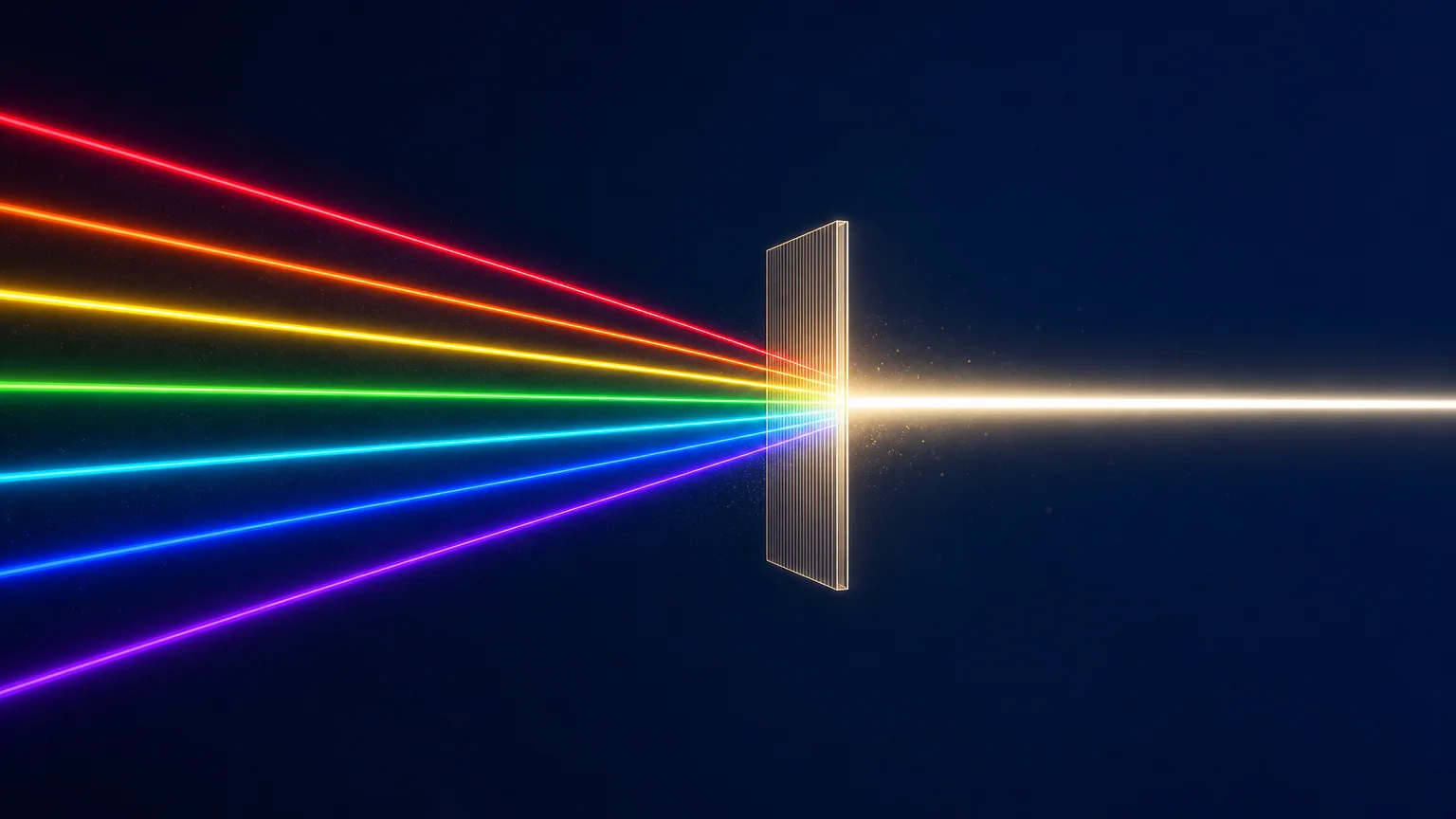
Shine sunlight through a glass prism and a rainbow appears on the wall. Each color bends by a different angle, so the mixed light spreads out. Now run that scene backward. Red, green and blue beams arrive from different directions, meet at one spot and leave as a single beam.
Spectral beam combining (SBC) uses this reversed rainbow to raise laser power. Why beam combining is needed, and its three approaches gave the principle in brief. This time SBC gets the whole article, from start to finish. How is the wavelength range shared out, why is the linewidth broadened on purpose, and what does that cost?
Why combine several lasers
One fiber laser can only go so far. Exail makes optical parts such as phase modulators. Its technical page puts a single fiber laser today at around 1 kW, with some reaching about 10 kW. By the same page's account, merging several sources optically yields a laser in the hundreds of kilowatts.
One of the walls that holds a single laser back is stimulated Brillouin scattering (SBS). It cuts deeply into the power one amplifier can deliver. That is why, instead of pushing one laser without end, designers amplify several lasers separately and then merge them.
There are several ways to merge them. Two of them, SBC and coherent beam combining (CBC), use phase modulators. The job a phase modulator does in SBC becomes clear once SBS enters the story.
Running the prism backward
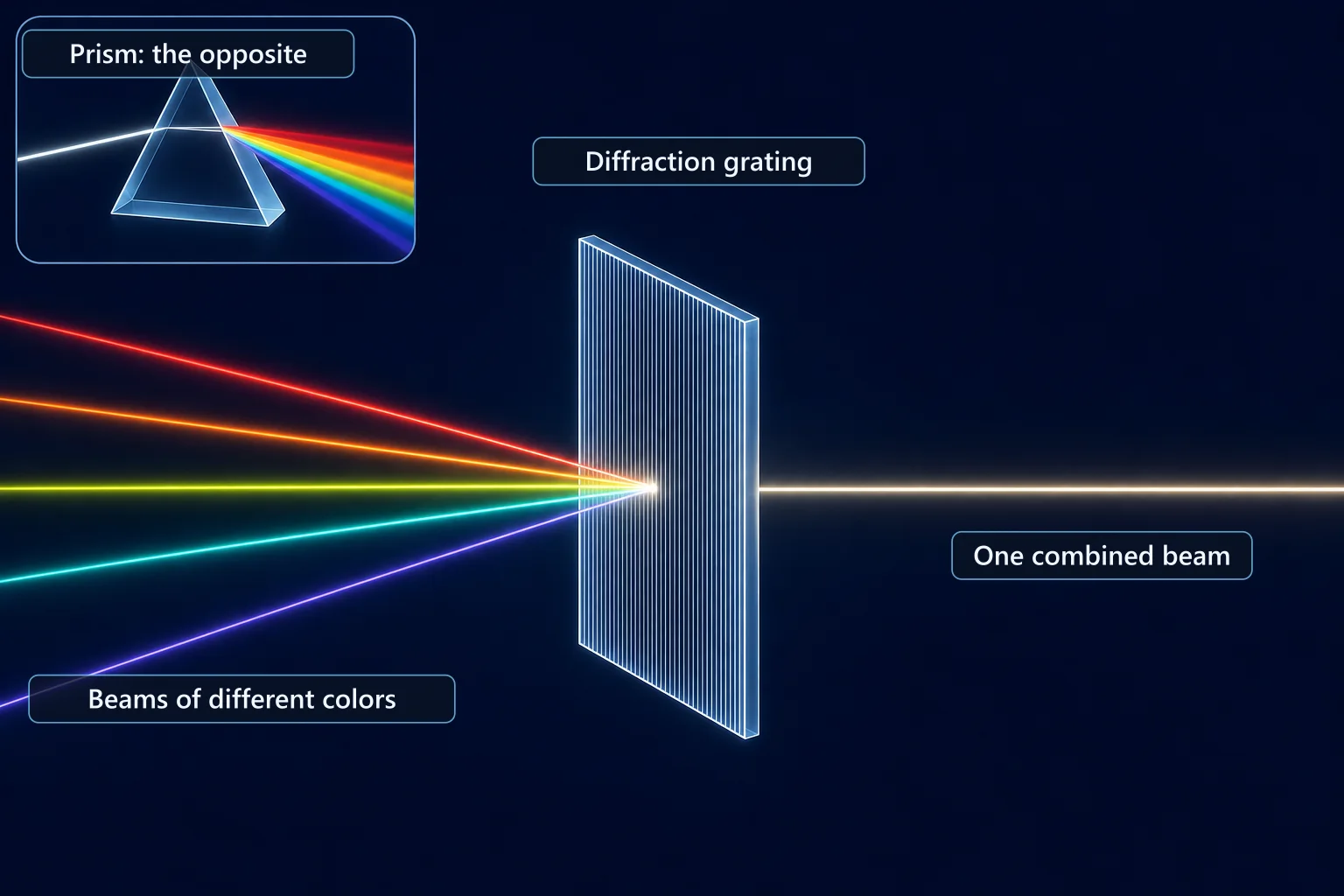
A spectrometer splits the colors mixed in one beam. Spectral combining does the opposite: a dispersive optical element such as a diffraction grating overlaps beams of different wavelengths in one place. Because a grating bends each wavelength by a different angle, beams sent in from just the right directions all leave it heading the same way.
The prism picture differs from the real thing in two ways. Sunlight is a mix of colors from the start, but each laser beam entering an SBC system already has a very narrow wavelength range. The combined beam is not white light either. It holds many wavelengths packed closely inside the set band that the fiber can amplify.
The colors are not real either. Ytterbium fiber amplifies light in the 1 µm band, which is near-infrared and invisible to the eye. The colors in this article's pictures are only there to tell the channels apart.
The result is simple. Several lasers emitting continuous light each take a different wavelength, and the power of the overlapped light grows in proportion to the number of beams combined. That is why SBC needs many laser sources.
Four steps
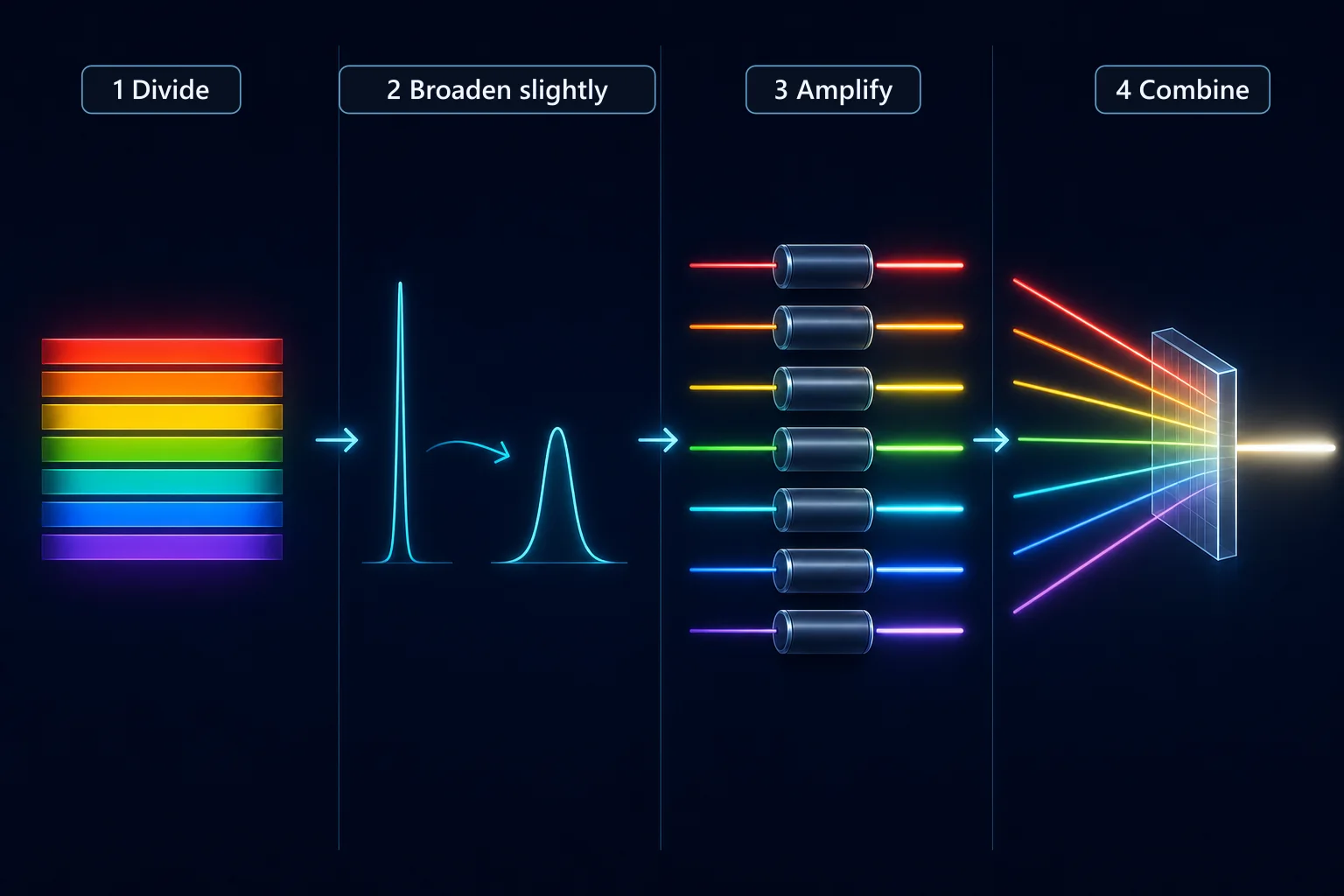
Putting the public sources together, SBC can be drawn in four steps.
- Divide: The wavelength range a fiber amplifier can amplify is split into many slots, called channels.
- Broaden slightly: A phase modulator widens each channel's source linewidth just enough to hold SBS down.
- Amplify: Each channel's broadened light is amplified in its own amplifier.
- Combine: A dispersive element such as a diffraction grating overlaps all the channels into one beam.
The first step asks how many slots there can be. The second asks how wide each slot should be. The interesting part of SBC is that these two questions pull on each other.
Sharing a fixed range: gain bandwidth and channels
The amplifier of a fiber laser cannot amplify just any wavelength. Each gain medium amplifies only a set range of wavelengths, called its gain bandwidth.
The SBC layout on Exail's page splits the gain bandwidth of a double-clad fiber amplifier made with ytterbium-doped fiber (YDF) into many channels. Each channel is a narrow-linewidth fiber laser source, and the channels are gathered and combined.
It is a bit like filling a bookshelf of fixed length. The shelf is the gain bandwidth, and each book's thickness is one channel's linewidth. The thinner the books, the more fit. In reality, however thin the books get, the dispersive element that merges the light sets the minimum width one slot can have.
How many slots? One division answers it.
Number of beams that can be combined = total usable wavelength range ÷ wavelength range given to each beam
Why broaden the line on purpose: SBS
It seems the narrower a channel's linewidth, the better. But when light with a very narrow line is amplified hard in a fiber, something else happens.
Strong light makes the glass shake very finely, and the shaking leaves a pattern of closely spaced stripes inside it. Those stripes act like a mirror and send part of the light back toward the source, which can harm the source and its gain medium. Limits of a single fiber (1): nonlinear effects (SBS, SRS) looks at SBS itself in detail.
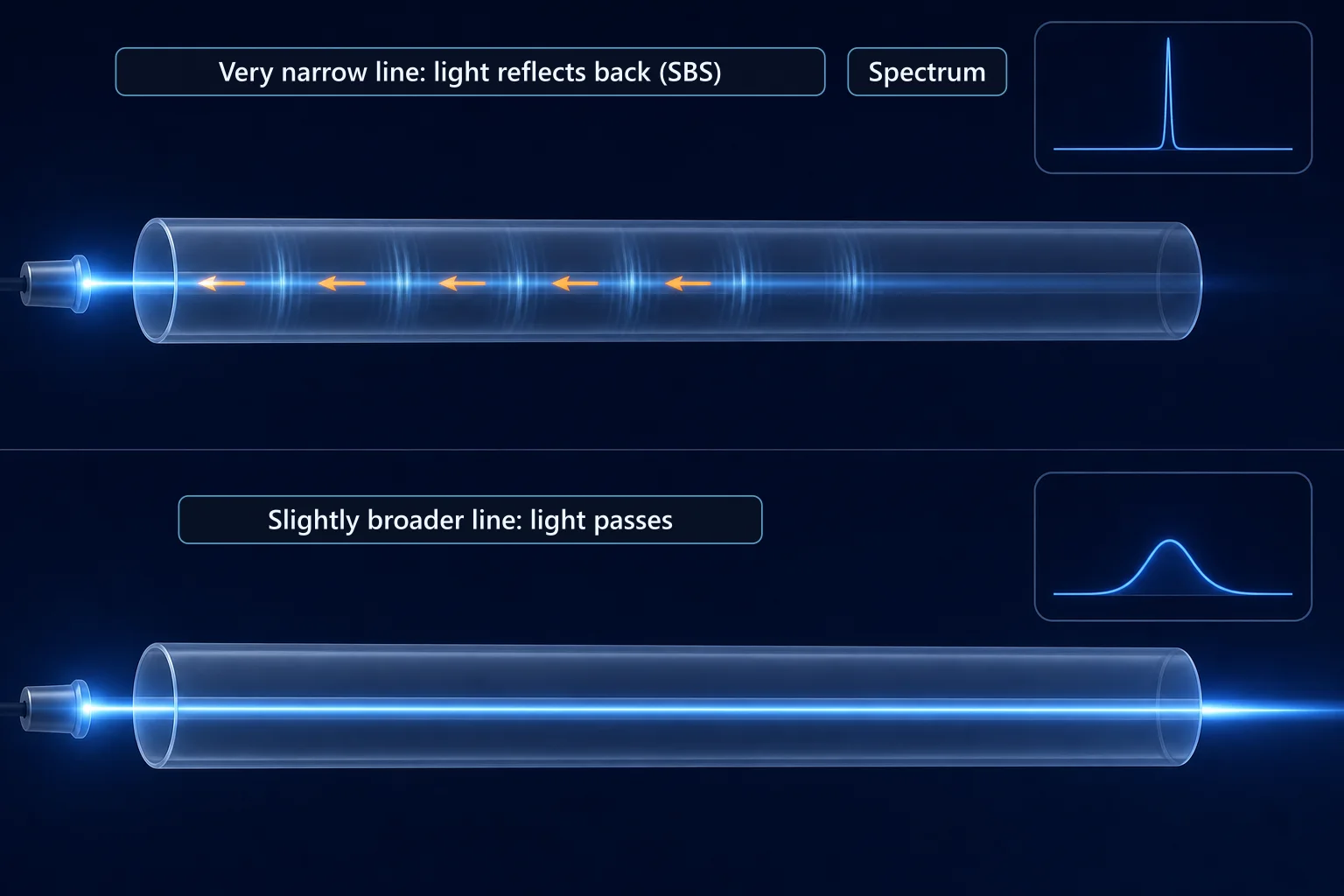
The remedy is to broaden the line a little on purpose. Shaking the light's frequency widens the line so that SBS cannot build up, and an electro-optic phase modulator does this. In SBC, each laser module gets a phase modulator of its own. With SBS out of the way, each channel's power can be pushed higher before the beams are merged again.
Broaden, but only a little: the linewidth trade-off
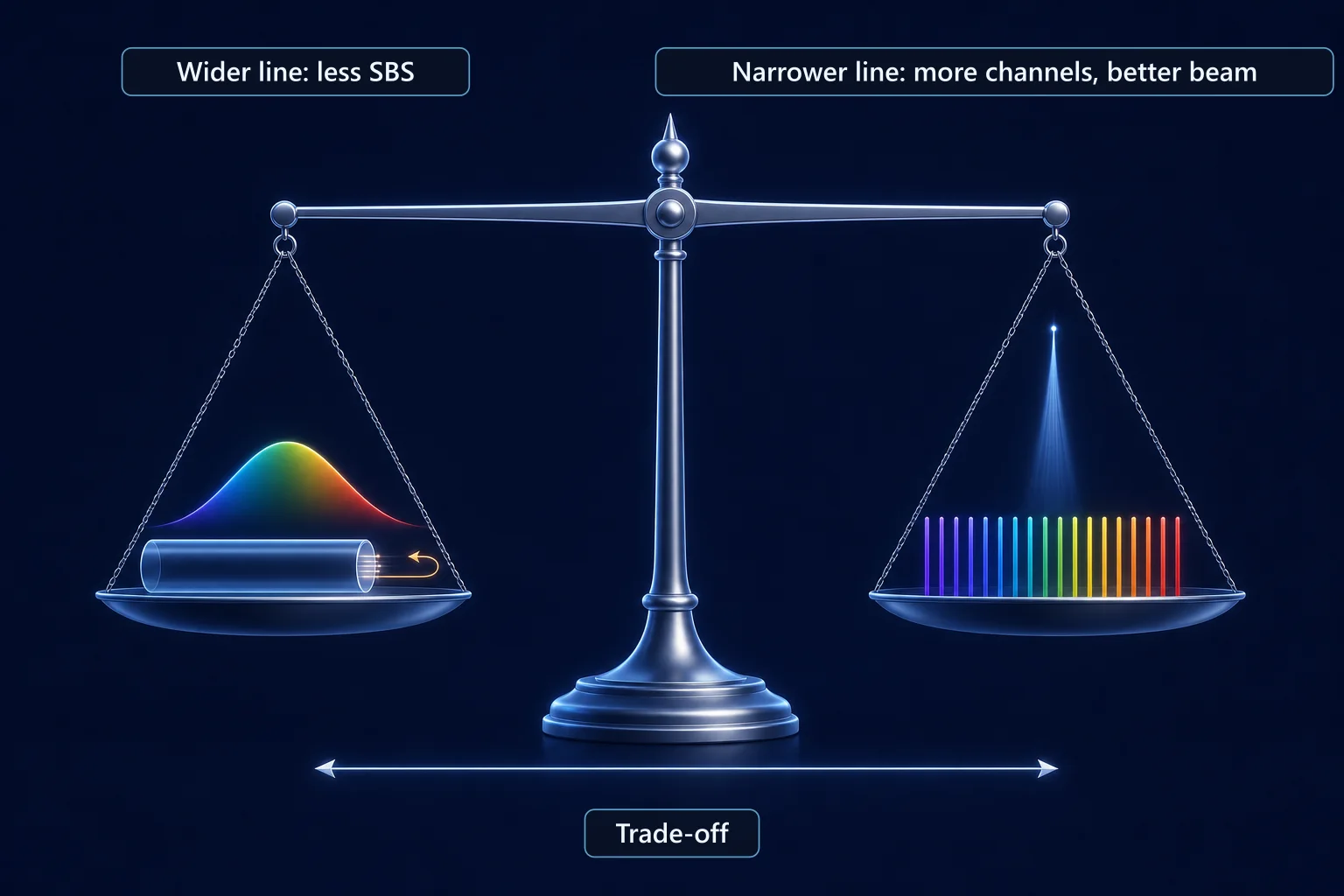
So why not broaden the line generously? In SBC that does not work. The wider the line, the more room each channel takes up.
First, the channel count drops. The gain bandwidth is fixed, so wider slots mean fewer slots. Exail also holds that, to leave room for the most channels, the line should be widened only as far as needed.
Second, beam quality suffers. A grating bends each wavelength by a different angle, so the wavelengths inside one channel also spread in slightly different directions. If the linewidth is not narrow enough, that spread leaves the far-field beam no longer diffraction limited. A diffraction-limited beam spreads only as much as physics allows, which is the best beam quality possible.
So the linewidth in SBC is a tug-of-war. Too narrow, and SBS limits each channel's power. Too wide, and channel count and beam quality are lost. There is no single right answer.
How much broadening is needed hinges on the choice of double-clad fiber and on how the amplifier is built.
Why use SBC anyway
SBC is used despite the trade-off because there is less to match. It asks little in the way of holding the phase steady between channels. It also asks little of spectral purity, meaning how cleanly the light sits at one wavelength. The 2014 article in the MIT Lincoln Laboratory journal likewise sees wavelength control as less demanding than the phase control coherent combining needs.
If each channel's spectrum is very narrow, the combined beam stays diffraction limited, and brightness rises along with power.
Something is given up, though. Split across many wavelengths, the combined light gains less spectral brightness, the strength of light in each slice of wavelength, than coherent combining does. Brightness above measures how tightly a beam can be focused, while spectral brightness measures how much light is crowded into each slice of wavelength, so the two are different yardsticks. Exail names this spectral brightness as the price SBC pays.
SBC and coherent beam combining in one table
The table sets the two methods side by side: what each has to match, and what holds each back when channels are added.
| Item | Spectral beam combining (SBC) | Coherent beam combining (CBC) |
|---|---|---|
| What must be matched | Wavelength and direction of each beam | Relative phase of the beams, in real time |
| Linewidth and SBS remedy | Phase modulator broadens the line, but as little as possible. More broadening means fewer channels and lower beam quality | Phase modulator broadens the spectrum |
| What limits adding channels | Usable wavelength range ÷ each channel's share | Complexity and cost that grow with more channels |
| Demand on phase stability | Low | Active stabilization needed because of thermal and environmental drift |
Both start from the same place: several fiber amplifiers, each amplified on its own, then merged. In fact, nLIGHT says its narrow-linewidth amplifiers can be tuned to suit both kinds of combining. The phase-matching route continues in Coherent beam combining: the principle, from published reviews.
Where it shows up in public sources
The name SBC appears on maker pages too. nLIGHT says a laser it calls 30 kW-class uses its own spectral beam combining technology. For a laser it calls 10 kW-class, it names its own method called dichroic beam combining (DBC). These numbers are class names the company gives its products.
What to read next
- "Diffraction gratings: the part that merges colors": the element that brings the beams together in SBC, and the problems it faces under strong light.
- Coherent beam combining: the principle, from published reviews: the other route, which matches phase instead of wavelength.