
A dot appears on a radar screen. A lot still has to happen before that dot becomes something a weapon can actually aim at. Someone has to follow where the dot is going, foresee where it will be when a shell or missile arrives, and turn the weapon precisely that way.
The link that covers this gap is the fire-control system. When a sensor reports that something is out there, the fire-control system turns that into where to aim so the shot hits.
Between finding and hitting
Finding a target and hitting it are not the same job. The finding side must sweep a wide sky without gaps, while the hitting side must hold one target very precisely. So several steps sit in between.
The figure below lays those steps out in one line. A sensor finds, the fire-control system follows, foresees and aims, the weapon fires, and the result is checked again. What radar finds and how is summed up in "Radar: measuring distance and motion with radio waves".
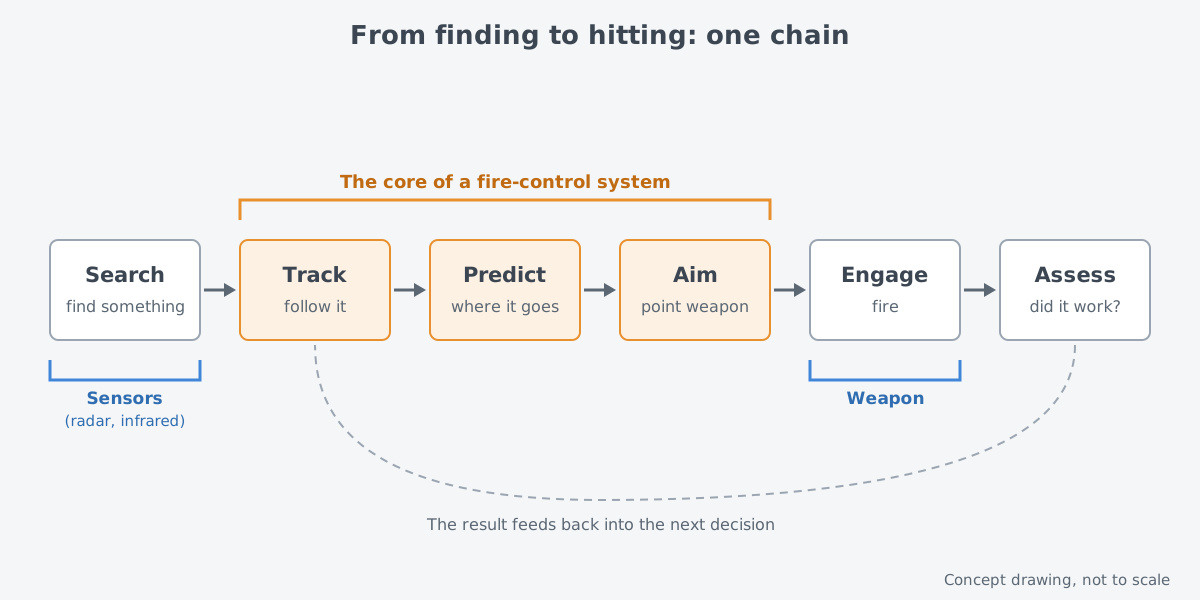
Fire control is an old craft. According to Ben Clymer, who wrote a history of U.S. Navy fire-control computers, mechanical analog computers formed the Navy's fire-control systems for more than 40 years. They pointed big ship guns and set shell fuze timings against ships and aircraft alike. Inside these computers, gears, cams and other mechanical parts did the adding, subtracting and set function work.
Three links of fire control: tracking, prediction, correction
A typical U.S. Navy fire-control computer of World War II had three parts. The first, the tracking section, handled how one's own ship and the target were moving. The second, the prediction section, foresaw the range to the target and the shell's time of flight. The third, the correction section, worked out and applied fixes for the ship's rolling and pitching.
Why prediction is needed is easy to see on a sports field. When you kick a ball to a running teammate, you aim not at where the teammate stands now but at where the teammate will be when the ball arrives. The teammate keeps moving while the ball rolls.
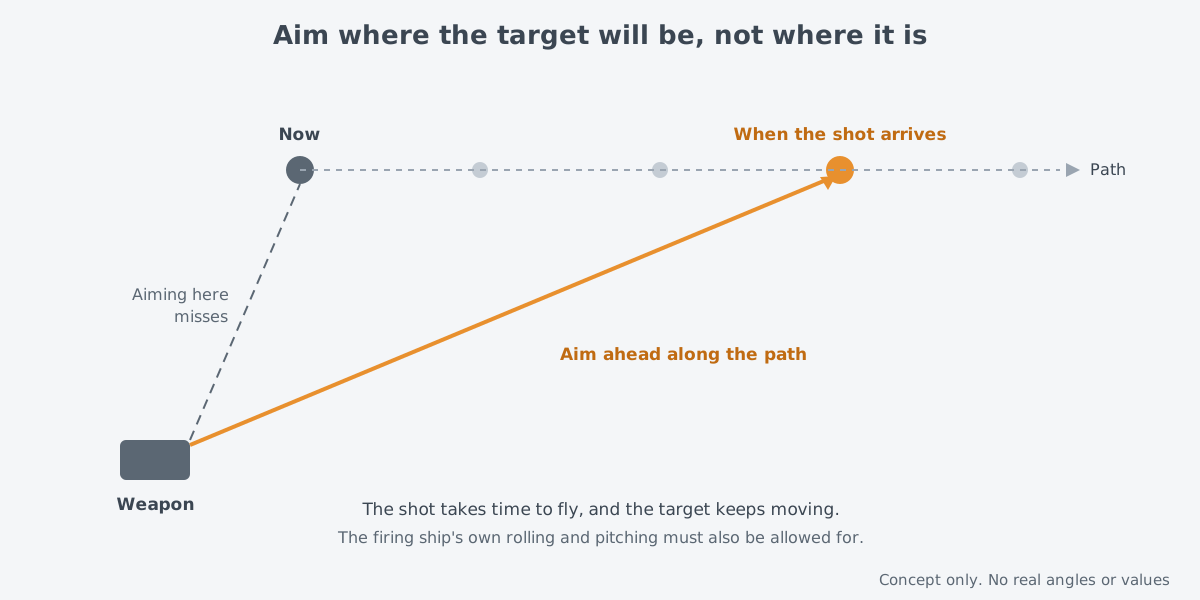
Real fire control is much harder than that pass. The target moves up and down as well as across, and the ship doing the firing heels in the waves as it sails. So following, foreseeing and correcting for the ship's motion all have to happen at once.
Devices to correct for a ship's motion arrived early. Directors, in use from about 1912, were sights held on the target. They served to correct the guns' horizontal and vertical angles for the ship's roll and pitch.
Why targets in the sky are harder
A ship on the sea and an aircraft in the sky are very different problems for fire control. Clymer wrote that Hannibal Ford started work in the late 1920s on the first anti-aircraft fire-control system, which paired a Mark 19 director with a computer. Seen from the ship, an air target can fly fast and change its angle quickly. That makes anti-aircraft fire control by nature much harder than firing at a surface target.
The faster a target moves, the more ground it covers in the same time. So a small error in prediction becomes a large miss. On top of that, an aircraft can change direction.
Even so, a device that became the wartime standard appeared. The Mark 37 director had its first trials in 1939. It soon became the usual director for both air and surface targets. Mechanical analog computers of this kind peaked in World War II and fell out of use in the 1950s.
Radar joins in
At first, the eyes that watched the target were optical instruments. Radar took over part of this role in World War II. The IEEE history wiki records that radar was first used to aim searchlights and then anti-aircraft guns, and that on ships it was also used to direct gunfire.
Early radar alone was not enough. For anti-aircraft fire control, the American SCR-268 needed optical trackers beside it to sharpen its angle readings. At night, searchlights that followed the radar beam helped as well. In other words, radar gave a rough direction and human eyes and optics sharpened it.
The turning point was the microwave. The SCR-584, which began coming off the production line in mid-1943, followed aircraft accurately enough to feed anti-aircraft gun directors directly. Optical tracking still added to the radar data after that. Yet steering anti-aircraft fire and long-range ship guns by radar alone took microwave frequencies.
From the search radar to the aiming radar
Warships carry radars of different kinds side by side. One is the search radar, which sweeps the whole sky widely; the other is the fire-control radar, which puts a narrow beam on one target. David Boslaugh wrote the development history of the U.S. Navy Tactical Data System (NTDS). He noted that a ship's three-dimensional radar mainly served two users: the controllers guiding interceptor aircraft, and the fire-control systems of its guns and missiles.
Between the two radars comes a hand-over. The narrow "pencil beam" radars of anti-aircraft fire control had narrow but very accurate beams, so they had to be pointed at a new target fairly precisely. If they were not, they wasted precious time sweeping in a set pattern to find it.
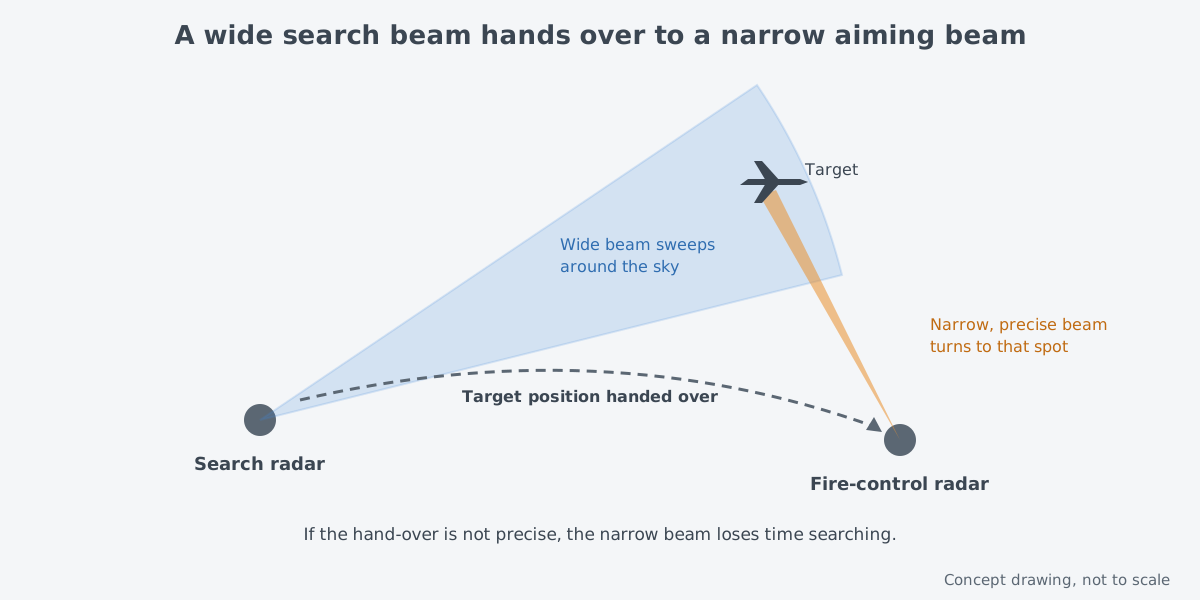
Around 1960, the U.S. Navy set out to make this hand-over happen between computers. The plan was for the tactical data system's computer to pass target data straight to the fire-control computer.
One reason for tying them together was time. Boslaugh pointed to the chance of passing the most dangerous targets on to fire control sooner. He wrote that a few seconds of reaction time could matter a great deal in battle. The joints between the links counted as much as each link.
The whole chain in one unit
Some systems pack the whole chain into one unit. The close-in weapon system on warships is the leading example. Its maker, RTX (Raytheon), says its Phalanx does in one system the jobs usually split among several: searching, detecting, judging the threat, tracking, engaging and checking the result.
The same maker describes Phalanx as a self-contained package that does these jobs automatically. In terms of the figure above, everything from the sensor on the far left to the assessment on the far right sits in one body. What such a system is and where it stands in a warship's defense continues separately in "Close-in weapon systems: a warship's last layer."
The same links in a laser weapon
A laser weapon cannot skip this chain either. Light reaches the target almost at once. Even so, the Congressional Research Service (CRS) notes that a laser needs several seconds to disable a target. Throughout that dwell time, while the light stays on the same spot of the target, the links of following and aiming have to keep running.
On the laser weapon side, these links are called acquisition, tracking and pointing (ATP). What a laser weapon is made of besides the laser is laid out in "A laser weapon is more than a laser: the system at a glance". The gimbal and tracking hardware that hold the beam on one spot are covered in "Gimbals, pointing and tracking: holding the beam on one spot".
What to read next
- "A laser weapon is more than a laser: the system at a glance": how the sensors, beam director, power and cooling of a laser weapon become one system.
- "Gimbals, pointing and tracking: holding the beam on one spot": a closer look at the tracking and pointing links of a laser weapon.
- "Close-in weapon systems: a warship's last layer": a system that ties sensors and a weapon into one unit.