Among the lasers that cut and weld steel in factories are fiber lasers. How did a device that amplifies light inside a thin glass fiber become strong enough to cut metal? The numbers let you trace that path.
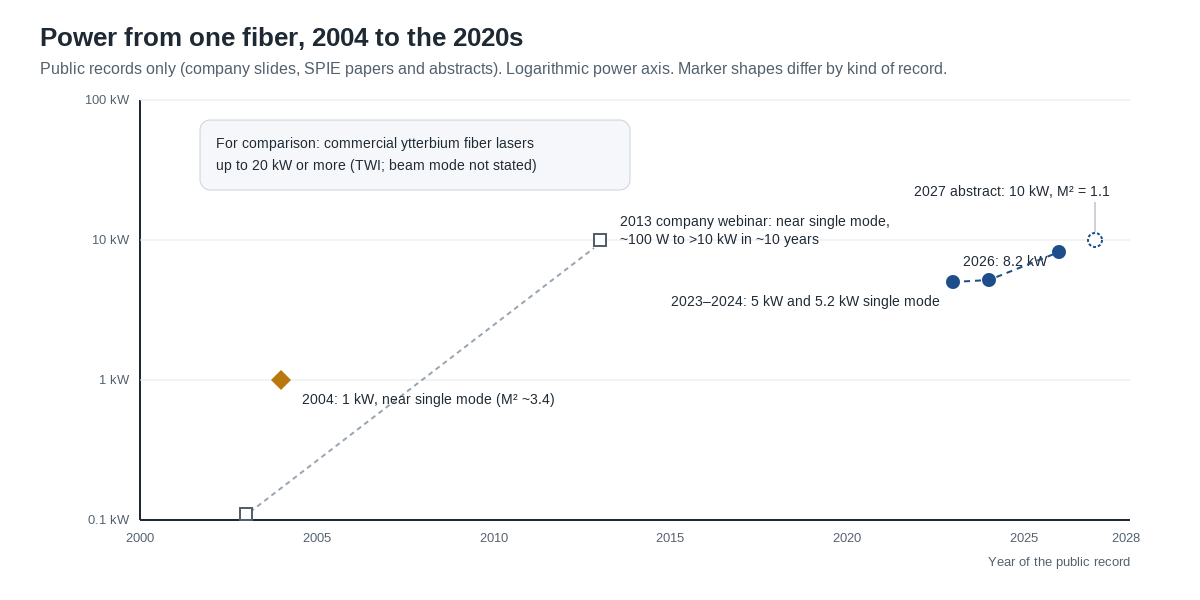
Plot the output figures written in public records year by year, and they make one graph. The figure to watch is power from a single fiber with the beam quality kept high, that is, single-mode output.
1961: the first fiber laser
A milestone record from the IEEE History Center dates the first fiber laser to 1961. Elias Snitzer and colleagues built and ran it at the American Optical complex in the United States. Three years later the same team demonstrated the first fiber amplifier.
The record sums up what came next in one sentence. Fiber lasers became industrial tools that cut and weld steel, and fiber amplifiers now boost signals across the world's optical networks.
2004: the 1 kW threshold
The next number comes about 40 years later. According to public webinar slides from the fiber company Coherent, the first fiber laser to reach 1 kW with a near single-mode beam was demonstrated in 2004. Its M², a measure of beam quality, was about 3.4. The closer M² is to 1, the closer the beam is to ideal.
A value of 3.4 is some way from single mode, which is why the slides call it "near single mode" and the graph draws it as a diamond.
Designs changed too. At the high powers fiber lasers now run, placing free-space optical parts inside the cavity proved unreliable. Designs moved to all-fiber cavities formed by fiber Bragg gratings (FBG) written inside the fiber.
Up to 2013: a hundredfold in ten years
The same company's webinar of November 2013 sums up a much steeper climb. Output from near single-mode fiber lasers rose from about 100 W to more than 10 kW in roughly ten years. The slides add that continuous-wave fiber lasers saw a sweeping change in power scaling, helped partly by the high efficiency of the fiber.
This is not a year-by-year record but a company summary that squeezes ten years into one line. So the graph draws it as a grey dashed arrow rather than as points.
The 2020s: 5–10 kW at conferences
Recent numbers come from talks at SPIE's fiber laser conference. A paper in the 2023 proceedings reports 5 kW single mode without transverse mode instability (TMI). It used an ytterbium fiber with higher loss for unwanted modes, and pump power set the limit. The 2024 proceedings report 5.2 kW from a fiber whose core had a lower thermo-optic coefficient.
The 2026 proceedings describe single-mode operation at 8.2 kW with stimulated Raman scattering (SRS) held more than 40 dB below the signal. And one abstract accepted for the 2027 conference is titled with 10 kW from a single-channel, single-mode laser at M² 1.1. That talk has not been given yet, so the graph shows it as a hollow dot.
The two sets of records use different labels. The 2013 company slides say "near single mode," while the 2020s conference talks put "single mode" in their titles. The graph draws them separately too.
These numbers come from different teams working under different conditions. The dashed line joining the 2020s points does not mean one device improved year by year. Read it only as a rough guide to how high public records reached at each point.
Multimode and commercial lasers are a separate line
The box at the upper left of the graph is for comparison. According to the UK's TWI, commercial ytterbium fiber lasers are available at 20 kW or more. That guide does not say whether the beam is single mode.
The difference matters. A single-mode record and a commercial maximum with an unstated beam mode measure different things, so mixing them on one line can give the wrong picture. That is why the graph joins only the conference single-mode records and puts the commercial figure in a separate box.
Beyond a single strand
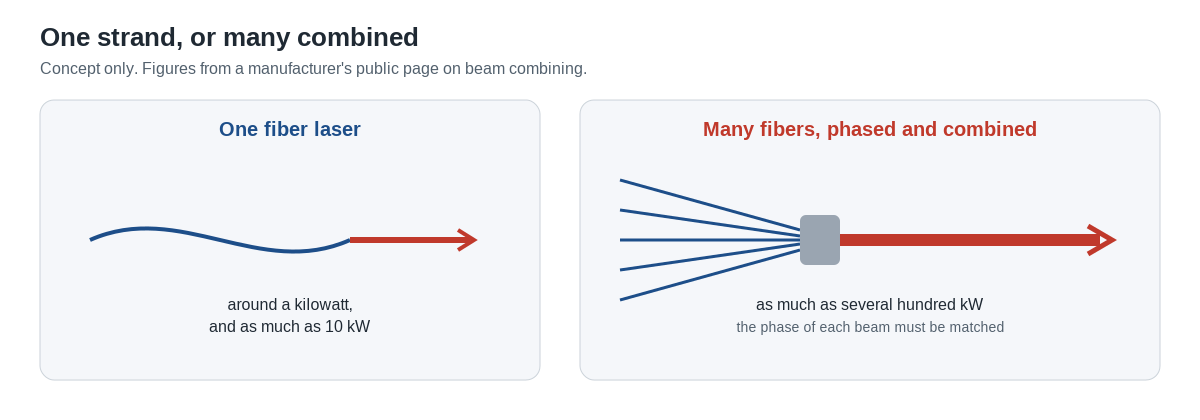
Raising the power of one strand keeps getting harder. As light crowds into a fiber, problems from nonlinear effects and heat grow. The physics is covered in Limits of a single fiber (1): nonlinear effects (SBS, SRS) and Limits of a single fiber (2): heat and mode instability.
The answer has been to combine many strands. A technology page from the optics company Exail puts one fiber laser at around a kilowatt, and as much as 10 kW. Combining several such sources with matched phase, it says, gives a laser of up to several hundred kW. This is coherent beam combining (CBC).
You can picture several streams of water merging into one channel. Light differs in that the rhythm, the phase, must also line up before the beams add into one. The equipment is walked through step by step in Walking Through a Coherent Beam Combining System: From Seed to One Beam.
Further reading
- Fiber laser trends through a conference, 2022–2027: the conference behind the graph's 2020s points
- Limits of a single fiber (2): heat and mode instability: the heat problem that caps power
- Walking Through a Coherent Beam Combining System: From Seed to One Beam: from many strands to one beam