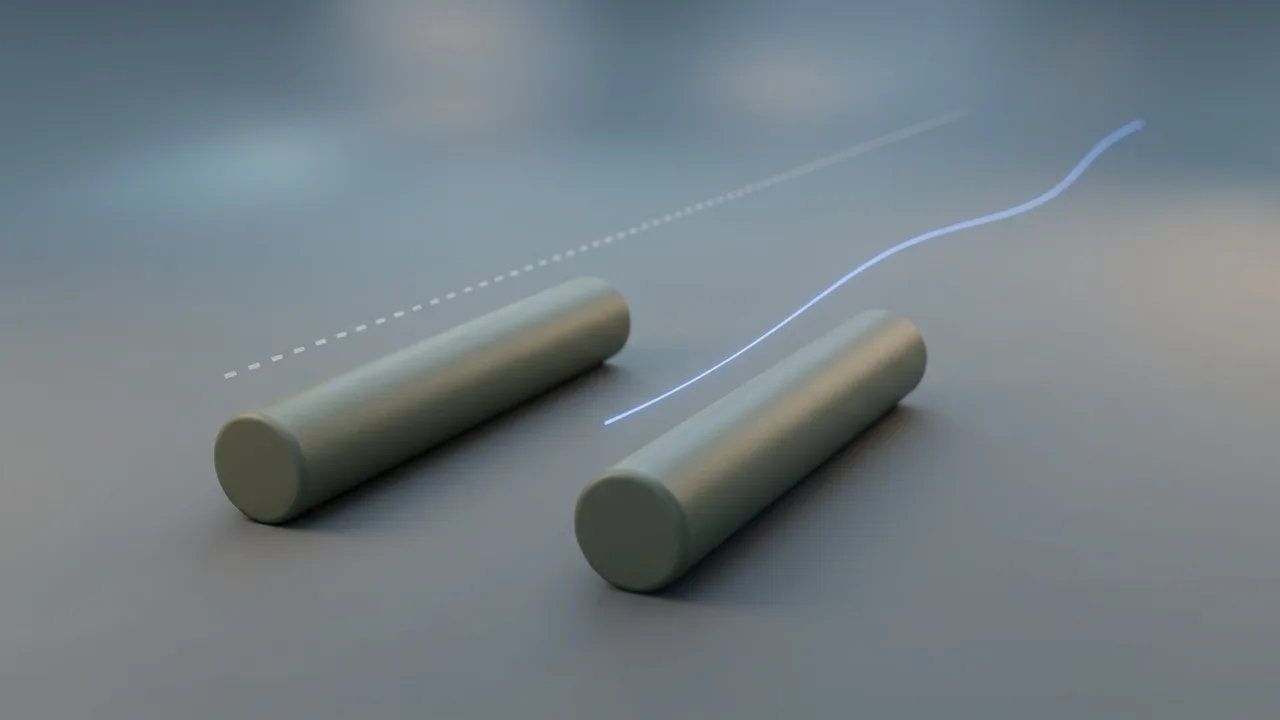
Ask someone to picture a shoulder-fired anti-tank weapon and they will probably think of a thick tube. These weapons can look alike. What sets them apart is whether the thing that leaves the tube can change its path while it flies.
That is exactly where an unguided rocket and a guided missile part ways. Over three generations, anti-tank guided missiles also handed more and more of the gunner's work to the equipment and then to the missile itself. This article traces that story through U.S. Army history pages and a research institute report.
Where a rocket and a guided missile part ways
The RPG-7 and the M72 LAW are two examples of unguided anti-tank weapons. The direction they point at launch is the direction they fly, and nothing can correct the path once they are fired.
An anti-tank guided weapon (ATGW) adds targeting and guidance systems. The missile it fires is a precision-guided munition that can change course in flight to hit the target more precisely. As a result, according to the research institute Small Arms Survey, guided weapons can engage targets from farther away and more accurately than unguided anti-tank light weapons.
The names are worth a moment. "ATGW" can cover guided mortar rounds and guided artillery shells, but it most often means a portable guided missile. The narrower term is anti-tank guided missile (ATGM). These weapons were first meant to stop armored vehicles, yet they are often used against other targets too.
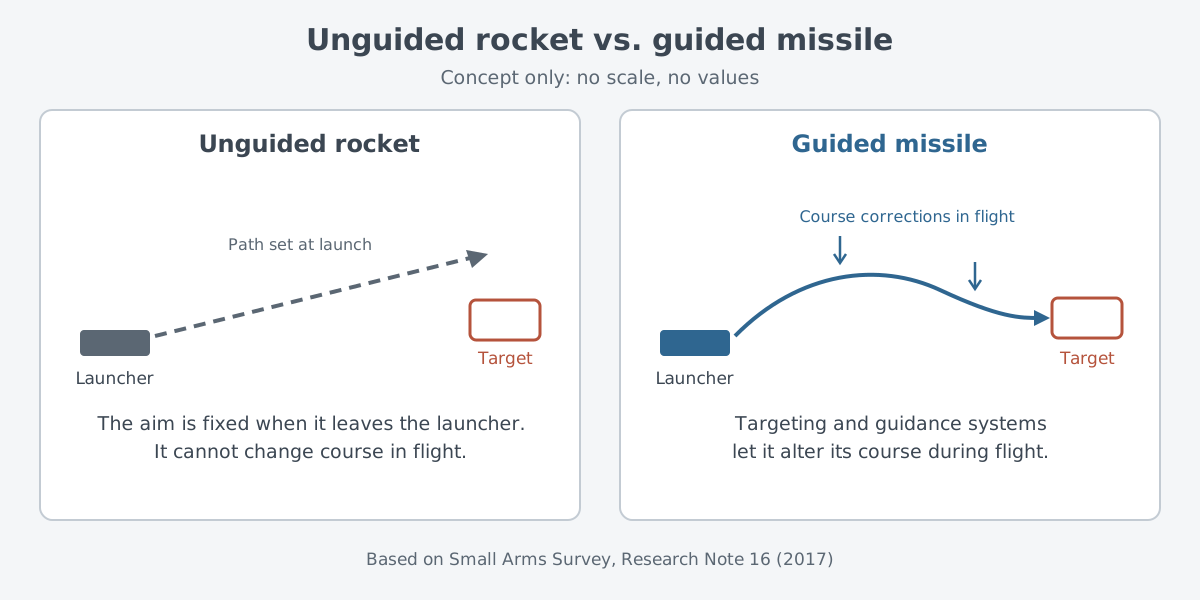
Think of a bowling ball and a remote-control car. Once the bowling ball leaves your hand, its path is set. The remote-control car can still turn while it is moving.
The real picture has one more layer. Who corrects a guided missile's path changes from generation to generation: sometimes a person steers it, and sometimes the equipment or the missile does. That difference is what separates the generations.
First generation: steering by hand
Anti-tank guided weapons have gone through three generations since the 1950s, and each generation broadly follows a step forward in guidance. The first generation used manual command to line-of-sight (MCLOS). The line of sight is the straight line from the gunner's sight to the target, and commands are steering signals sent from the launch end to the missile. In the first generation, the gunner gave those commands by hand and had to guide the missile all the way to the target.
A wire at the back of the missile usually linked it to the launcher. The gunner often steered with a joystick and usually guided the flight from one fixed spot, watching through a magnifying periscope or a pair of binocular sights. It took a lot of skill. Another drawback was that the gunner could not leave that spot while the missile was in the air.
The roots go back to the Second World War. Better tank armor was taking the edge off rocket launchers, recoilless weapons, and older anti-tank guns. The German X-7, used during the war, is seen as the earliest MCLOS system and a forerunner of today's anti-tank guided missiles.
Once the war was over, France's SS.10 and Germany's Cobra, both based on the X-7 design, were the first of these weapons offered for export. The Soviet Union's first man-portable one, the 9K11 Malyutka (NATO name AT-3 Sagger), appeared in 1963.
Many countries that once built first-generation systems later stopped making them. The reasons given are a low chance of hitting, the exposed gunner, the difficulty of dealing with modern armor, and stockpiles that were already large enough.
Second generation: just keep the sight on the target
The second generation uses semi-automatic command to line-of-sight (SACLOS). After launch, the gunner only has to keep the sight on the target. The equipment works out the guidance commands automatically and sends them to the missile by wire, by radio, or along a laser beam.
The change is that the gunner no longer flies the missile. Keeping the target in the sight is enough, so it takes far less training to become skilled than with a first-generation system.
The American TOW is the best-known example. The name stands for three features: tube launched, optically tracked, and wire data link.
The Redstone Arsenal history pages of the U.S. Army explain the thinking. Launching from a tube was meant to keep the missile close to the line of sight early in its flight. Tracking a modulated infrared flare optically, with automatic command control, was chosen to make training and operation easier. The wire link was picked for cost and, above all, to hold up against countermeasures and against the environment wearing down performance.
How the missile was packed also changed around this time. The earliest missiles left from rails or boxy metal housings, while later and slimmer ones came in self-contained launch tubes.
The launcher became a reusable weapon, and the missile in its tube became the ammunition. The TOW missile also sits in a disposable launch container.
One problem remained. Until the missile arrived, the gunner had to stay put with the sight on the target, which left the gunner open to counter-attack.
Third generation: the missile takes over after launch
The third generation solved this with a passive seeker inside the missile. The seeker guides the missile to the target with no input from the gunner during flight. This "fire-and-forget" guidance was first developed in the 1980s, and it lets the gunner move right after firing. What a seeker is made of and what it senses is covered in Missile seekers: the eye at the front.
Javelin, built for both the U.S. Army and the U.S. Marine Corps, belongs to this generation. It has two main parts. One is the Command Launch Unit (CLU), which is used again and again. The other is the missile, sealed inside a launch tube that is thrown away after use.
The CLU has a built-in sight for both day and night. The missile has an imaging infrared seeker and locks on to the target before launch. The Redstone history page names fire-and-forget as Javelin's key feature, because it lets the gunner fire and take cover right away.
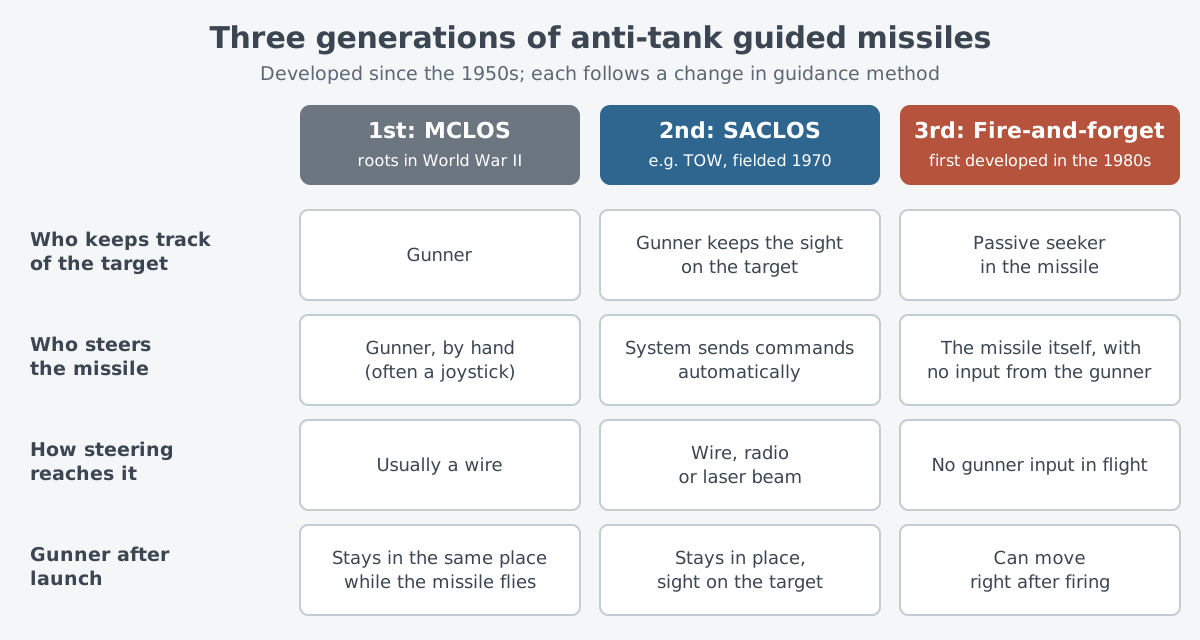
Put the three generations side by side and the pattern is clear. In the first, the gunner watched the target and flew the missile. In the second, steering moved to the equipment. In the third, the missile took over following the target as well.
The story through three U.S. Army missiles
U.S. Army records show this change of generations inside one country. Around the Second World War, several countries studied guided weapons that sent steering signals down a wire. After the war, the work went on, especially in France and Australia. In 1953 the Army put the French SS 10 through tests and found it unsatisfactory for its needs.
The Army then started its own wire-command anti-tank missile, DART. By mid-1958 it was plain that DART would not meet expectations, so the work stopped. As a stopgap, the Army bought an improved SS 10 and, later, the ENTAC and the SS 11.
The Army fielded its first TOW missile, the BGM-71A Basic TOW, in 1970. TOW can be fired from the ground, from vehicles, or from helicopters. On May 2, 1972, U.S. soldiers fired TOW in combat, the first time they had done so with a guided missile made in America.
Dragon reached troops for the first time in 1975. This wire-guided anti-tank missile, rated as medium range, is light enough for one infantry soldier to carry and fire. Javelin, designed to replace Dragon, reached first unit equipped status on June 27, 1996.
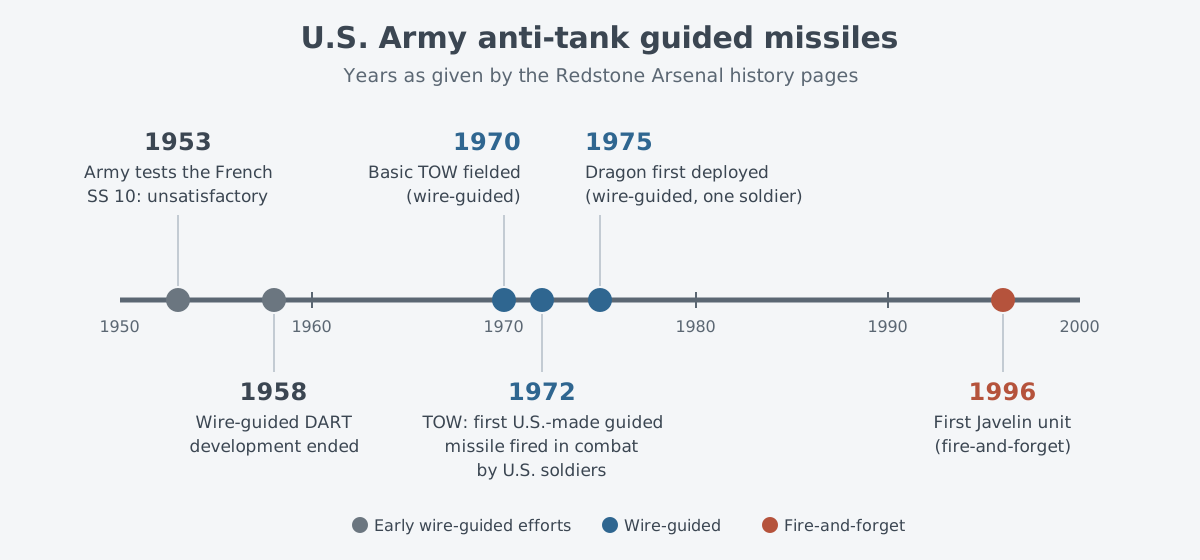
Two wire-guided missiles followed by a fire-and-forget missile: the Army's timeline points the same way as the generation scheme.
Where this meets lasers: light as a guidance signal
In the second generation, a laser beam was one of the paths a command could take. Lasers entered anti-armor guidance in another way too. The U.S. Army's Hellfire, an air-to-ground missile, was built to take on tanks and other single targets. It is laser-guided, and its design leaves room for other guidance packages.
Research on laser guidance also started early. The Army's Missile Command (MICOM) had been doing exploratory work on laser semiactive systems since 1963. What a semi-active seeker receives is explained in the missile seeker article.
Here, the laser is not energy that heats the target. It is a signal that tells the missile where to go. Using the same light as energy is a very different story, told in What is a laser weapon? Film versus reality.
What to read next
- Missile seekers: the eye at the front: the seeker that lets a third-generation missile follow its target by itself.
- What is a laser weapon? Film versus reality: what changes when light is used as energy rather than as a guidance signal.
- Air-to-air missiles: what the missile sees: what passive, semi-active, and active seekers each receive.