In the middle of the 19th century, people tried shining sunlight into a jet of water. The light traveled through the jet and followed its curving shape. Today, light inside a thread of glass thinner than a hair also follows the thread over long distances.
However clear the glass is, it is of no use if the light slips out through the side wall. So why does light racing along a thin thread of glass not leak out sideways?
Because the glass comes in two layers. Light undergoes total internal reflection (TIR) at the boundary between the central core and the cladding wrapped around it. The numerical aperture (NA) found on fiber data sheets, and the term single-mode, also come from this trapping.
The structure of a fiber: core, cladding, coating
Cut a fiber and look at the cross-section, and you see three layers. The core sits at the center, the cladding surrounds it, and a coating covers the outside.
| Layer | Material | What it does |
|---|---|---|
| Core | Glass | Carrying the light and the signal |
| Cladding | Glass | Helping define the optical characteristics; a bigger, stronger fiber for handling |
| Coating | Plastic (acrylate) | Protection and handling. Typically two different layers |
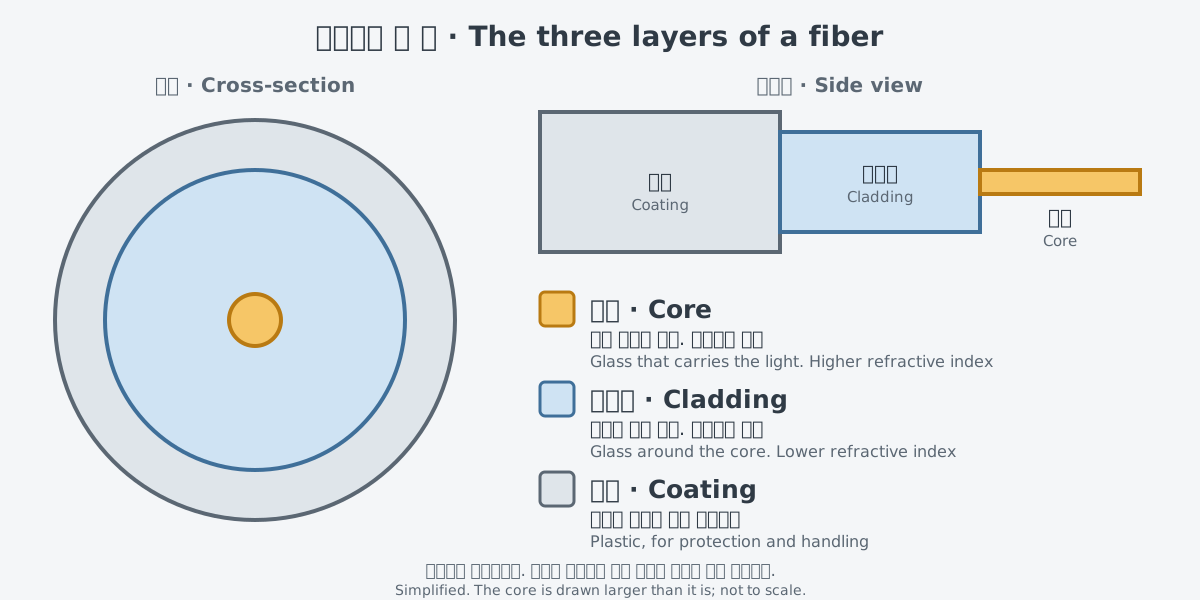
How thin is it? A figure caption in the Nobel Foundation's account puts the optical fiber at about 125 μm. The core is typically about 10 μm in diameter, less than a single hair. One micrometer (μm) is one thousandth of 1 mm.
The core and the cladding are both glass, but their refractive indices differ. The core has the higher index and the cladding the lower one. This difference is what traps the light.
The material singled out for this glass is fused silica. Glass is made from quartz, and it was Charles K. Kao who pointed out that fused quartz, that is, fused silica, could be used to obtain the purest glass.
Put light into a glass fiber of the 1960s, and only 1% of it was left after just 20 m. In January 1966 Kao presented his conclusion: light faded so quickly not because of flaws in the fiber thread, but because the glass was not pure enough. In a fiber of today, 95% of the light remains after a full 1 km. These numbers come from the Nobel Foundation's public account of the 2009 physics prize.
Why light does not leak: total internal reflection
The refractive index tells how much light slows down inside a material. Light bends at the boundary when it enters a material with a different refractive index. Sunlight bends at the surface as it falls into water because the refractive index of water is higher than that of air.
Reverse the direction, and something unexpected happens. Light trying to leave the water for the air may not enter the air at all, and may come back into the water instead. This is total internal reflection.
Total internal reflection has two conditions. One is direction. It happens only when light tries to pass from the higher index to the lower index.
The other is angle. This angle is measured from the normal, a line drawn perpendicular to the boundary. Light going from the higher index to the lower index bends away from the normal, so it lies closer to the boundary.
The more obliquely light meets the boundary, the larger its angle from the normal. Once this angle passes a certain value, the light has no way left to bend out, and all of it is reflected. This value is the critical angle.
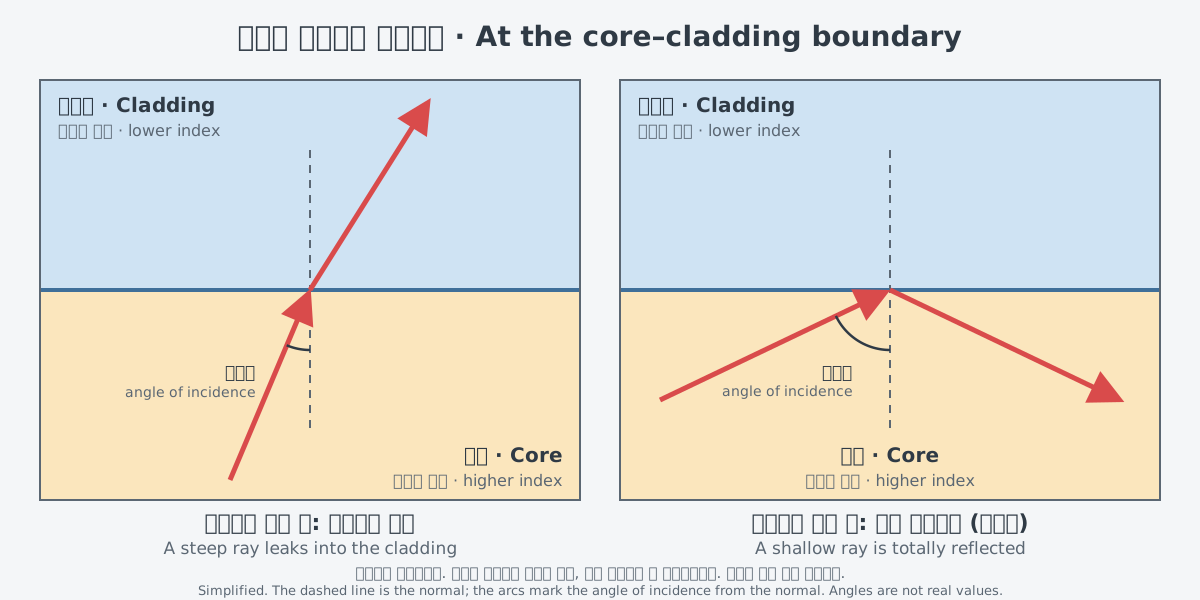
A fiber meets both conditions. The core has a higher refractive index than the cladding, and light running along the core meets the boundary at a very shallow angle. So the light is totally reflected at the boundary with the cladding, stays in the core, and travels along it with low loss.
Skipping a stone gives the picture. Throw a flat stone at a shallow angle and it bounces off the water. Throw it steeply and it goes in. Light, too, must meet the boundary at a shallow angle to bounce.
The real thing differs in two ways. A stone loses force with every bounce and sinks after a few, but in total internal reflection all the light that reaches the boundary comes back. And a stone hits the surface from outside the water, while light hits the boundary from inside the glass with the higher index.
In the jet of water from the opening, too, the light was traveling in water, which has a higher refractive index than air. A bare thread of glass without cladding also has a higher refractive index than the surrounding air. So a ray sent into it bounces against the glass wall and moves forward.
Then why is the cladding needed? The medical profession had used short and simple optical fibers, made of bundles of thin glass rods, since the 1930s. But bare glass threads leaked light where they touched each other, and they wore out easily. Wrapping each thread in a glass cladding with a lower refractive index improved things considerably.
Total internal reflection does not mean the light never fades. The glass itself absorbs and scatters a little of the light passing through it. This loss does not come from the trapping failing; it happens while the light travels through the glass. When a fiber is bent tightly, though, the trapping does fail and light leaks from the core, which is bend loss.
The acceptance angle: numerical aperture (NA)
Because total internal reflection has an angle condition, not all light that arrives at the end face of a fiber is trapped. Light that enters close to the axis of the fiber meets the core wall at a shallow angle and is trapped. Light that enters at too steep a tilt meets the wall steeply and leaks into the cladding.
Collect all the directions that are trapped, and they form a cone in front of the end face. How wide this cone opens is the acceptance angle. The fiber takes in and carries light that comes from inside the cone, and loses light that comes from outside it.
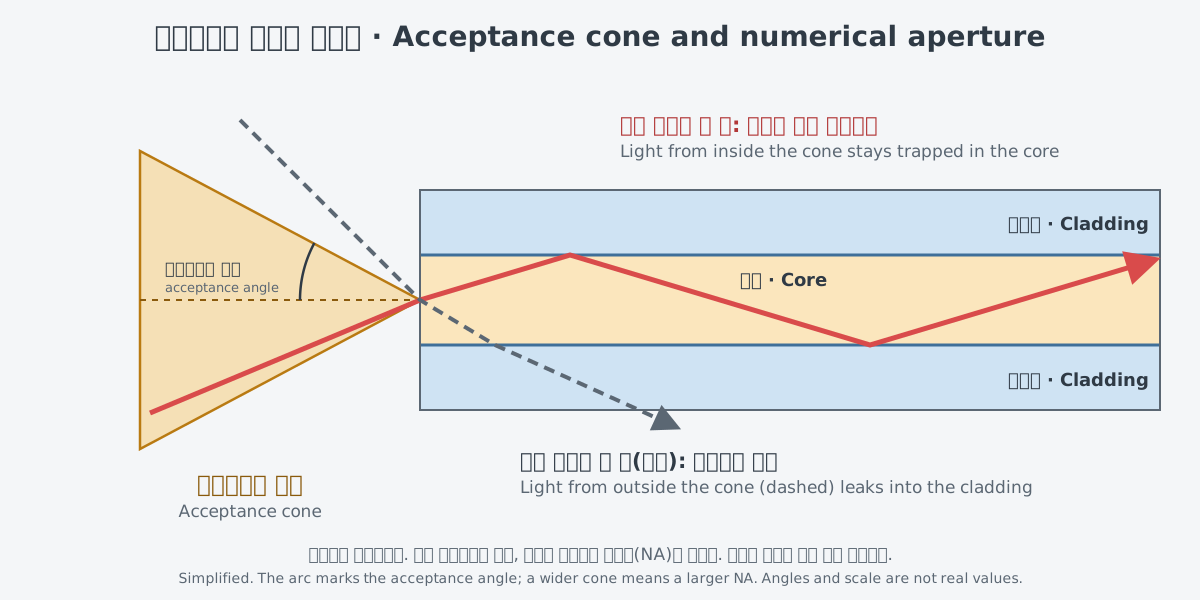
The numerical aperture is the value that describes this acceptance angle. The wider the cone a fiber accepts, the larger its numerical aperture, and the value is set by the refractive indices of the core and the cladding. Slides from a 2013 Photonics Media webinar, posted on the Coherent website, give 0.12 as a typical numerical aperture and 0.05–0.45 as the range.
Fibers for different uses have different numerical apertures. The table below, which compares single-mode and multimode fibers, shows the difference.
Single-mode and multimode
The picture of a ray bouncing off the walls is a simplification. Light is a wave, and a thin core is only a few wavelengths across. In a path this narrow, light cannot travel in just any shape.
Each shape of light that a fiber can guide is called a mode. Think of it as the pattern the light draws on the cross-section of the fiber. In textbook terms, it is a transverse field distribution.
A fiber that can guide only one mode is a single-mode fiber (SMF), and a fiber that can guide many is a multimode fiber. How many modes a fiber guides depends on the size of the core, the wavelength of the light and the numerical aperture together. In a single-mode fiber, the core is only a few wavelengths in diameter. So a fiber that is single-mode at one wavelength may not be single-mode at a shorter wavelength.
The webinar slides mentioned above include a table that sorts fibers into three types. The third type is the large-mode-area fiber (LMA).
| Item | Single-mode | Multimode | Large mode area (LMA) |
|---|---|---|---|
| Number of modes | 1 | about 1000 | 2–5 |
| Core size | 3–10 μm | 50–150 μm | 15–50 μm |
| Numerical aperture (NA) | 0.12–0.20 | 0.20–0.35 | 0.05–0.10 |
| In a fiber laser | Low-power lasers | Pump delivery | High-power lasers |
Sources give slightly different core diameters. Lecture slides from the University of New Mexico list a single-mode fiber with a 6 μm core and a multimode fiber with a 50 μm core. That 6 μm, and the Nobel Foundation's figure of about 10 μm seen earlier, both fall within the single-mode range in the table. The cladding is 125 μm for both types in the New Mexico slides.
The number of modes ties in with the quality of the beam. Beam quality (M²) describes how small a spot the beam can be focused to. As the New Mexico slides sum it up, a single-mode fiber gives high beam quality and a multimode fiber gives poor beam quality. In return, the multimode side can be pumped at higher power.
The phrase "light is trapped in the core" also comes with a qualification. Light does not fit the core exactly and travels slightly outside it as well. By the figure in the webinar slides mentioned above, in a single-mode fiber about 30% of the light can travel outside the core, in the cladding. In a multimode fiber, very little light travels in the cladding because the numerical aperture is high.
Where these ideas appear in laser articles
Nearly every term so far comes up again in articles on fiber lasers. The webinar slides mentioned above list beam quality among the advantages of fiber lasers. It is set by the fiber as a waveguide, a path that traps and guides light, not by the optics of the optical resonator that feeds light back. That makes stable single-mode operation a matter of how the fiber is designed.
Fiber lasers are usually treated separately from "bulk" solid-state lasers. In the overview of laser types by the manufacturer Newport (MKS), the reason is the unique light-guiding properties of fibers, such as strong spatial confinement over long distances.
The last row of the table above is about lasers too. Single-mode fibers are used in low-power lasers, and multimode fibers are used to deliver pump light, the light that puts energy into a laser. In a double-clad fiber, the laser light travels in the single-mode core and the pump light travels in the inner cladding.
At high power, fibers with a thicker core are used. The webinar slides consider a fiber with a larger core diameter and only a few modes desirable in many applications. The large-mode-area fiber is that kind: its core is thick at 15–50 μm, its numerical aperture is the lowest of the three types, and it has 2–5 modes. As noted earlier, the core size alone does not set the number of modes, so the core alone does not tell how many modes a fiber has.
Fibers of this kind are still a subject of research. The fibers developed by the Silica Fibre Fabrication group at the Optoelectronics Research Centre (ORC) of the University of Southampton include large-mode-area and double-clad fibers for high-power lasers. The official page of the ORC is linked from the research groups page.
What to read next
- "Why fiber lasers became so widely used: from the lab to the factory": compares the advantages that sources name for fiber lasers, such as efficiency, heat and beam quality, with other lasers, along with their conditions.
- "Double-clad fibers and how pump light gets in": looks at the structure that brings pump light in through the inner cladding.