In 2022, only seven companies in Ukraine held drone contracts with the government. In October 2026, the home page of Brave1, the government's defence tech cluster, lists more than 500 drone makers. What happened in four years of war?
Put the two figures side by side and the industry seems to have grown about seventyfold. But the first counts firms that won contracts, and the second counts firms that signed up to a cluster. They measure different things.
This article follows, in date order, the rules and the money that grew these firms, using announcements by the governments of Ukraine, the UK and Denmark. Each time a number appears, it also asks what was counted. It does not judge what drones achieved in the war. The article reflects the situation as of October 2026.
2022: only a handful of firms with state contracts
In August 2023, Ukraine's Minister of Digital Transformation summed up the past year. Forty companies had received state contracts, he said, up from seven the year before. Production, by his count, was 100 times the previous year's, and still not enough.
The number of drone models moved the same way. By July 2023, 40 Ukrainian drone models had been cleared for military use and were being supplied to the front, compared with only 7 a year earlier. In the same announcement, the minister said Ukrainian companies had scaled up drone output tens of times, and some hundreds of times.
A drone here means an unmanned aerial system (UAS). The flying aircraft, the ground control equipment and the communication gear together make up one system.
Around this time, the government's "Army of Drones" project grew from a project inside the UNITED24 fundraising platform into a structured state program. How donations and procurement rules changed is the subject of another article in this series, "FPV Drones in Ukraine: How Production and Organisation Changed." This article looks at the firms.
Rules that grew the firms: taxes, grants and a cluster
Start with taxes. In May 2023, the Verkhovna Rada, Ukraine's parliament, backed bills 9275 and 9276. For the period of martial law, they remove value-added tax and import duty on drone components. The Ministry of Digital Transformation said this creates better conditions for building and repairing drones inside Ukraine.
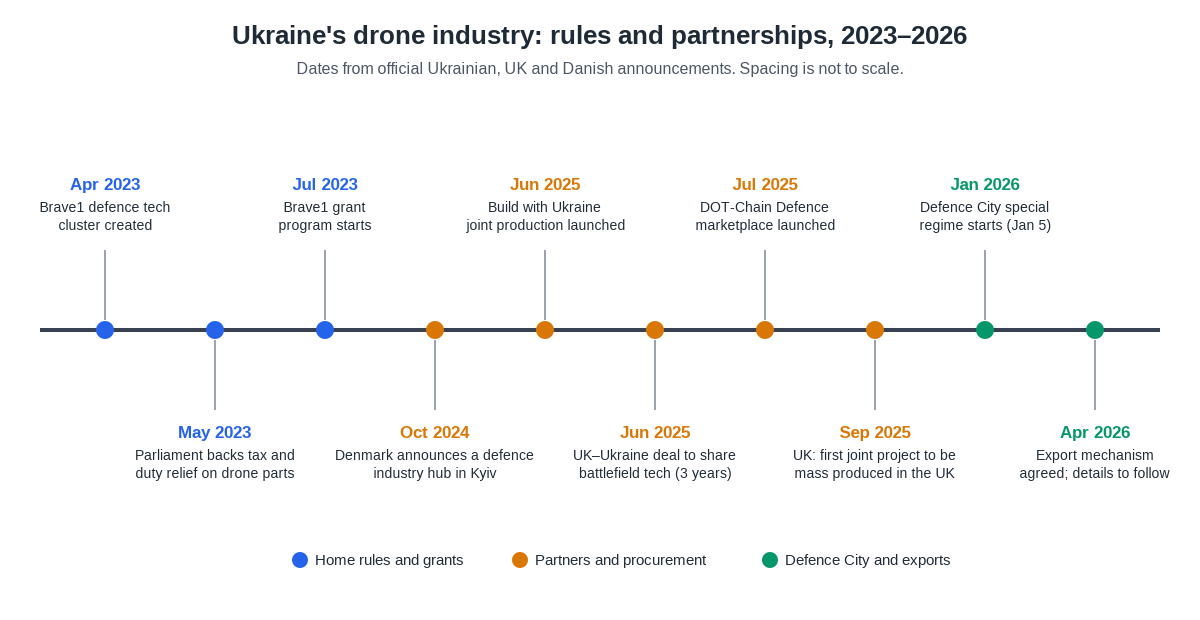
The rules kept changing after that. In the year and a half up to February 2024, about 20 laws and regulations were adopted, and the margin that firms may earn was raised to 25%. In 2023, the government set aside UAH 40 billion for drones.
A funding channel appeared too. The Brave1 defence tech cluster was created in April 2023 on the initiative of the Ministry of Digital Transformation. The defence ministry, the General Staff, the Ministry of Strategic Industries, the Ministry of Economy and the National Security and Defense Council took part. Today it is a government program run by the Innovation Development Fund, and it began as a grant program for defence start-ups.
Grants started in July 2023. In the first year, 186 grants worth more than $3.2 million went out, and developers registered more than 1,600 products on the platform. In September 2026, Brave1 reported UAH 6.2 billion in funding since 2023 and more than 1,000 grants.
Which fields received the most? Of 977 standard grants worth UAH 2.3 billion, drones led with 215. Ground robotic systems followed with 199, and electronic warfare systems with 49. The grants do not have to be repaid, and the companies do not have to hand ownership stakes or intellectual property to the state.
Firms and output in numbers
In February 2024, the Ministry of Digital Transformation said about 200 companies were working on drones and related products. At that point, 67 drone models were receiving state contracts. In 2023, 100 times more drones were produced and bought than in 2022.
The figures for 2025 came from the defence ministry. In December 2025, the defence minister said Ukraine's armed forces would receive 3 million first-person view (FPV) drones by the end of the year. That is almost 2.5 times what they received the year before. Of these, 2.4 million were supplied by the Defense Procurement Agency, mostly bought under direct contracts with manufacturers.
There was another route as well. A marketplace called DOT-Chain Defence, opened at the end of July, brought in a further 200,000 drones. Units pick the drones they need on the marketplace, and the procurement agency handles contracts, payment and compliance checks. In December 2025, the marketplace listed nearly 300 drone and electronic warfare models from 90 manufacturers.
The minister also said that most of the unmanned systems Ukrainian troops use are built at home. There are also figures for the defence industry as a whole. In February 2026, an adviser to the defence minister said production capacity had grown 50-fold during the full-scale war, to as much as $50 billion. The adviser added that domestic makers supply more than half of the armed forces' weapons needs.
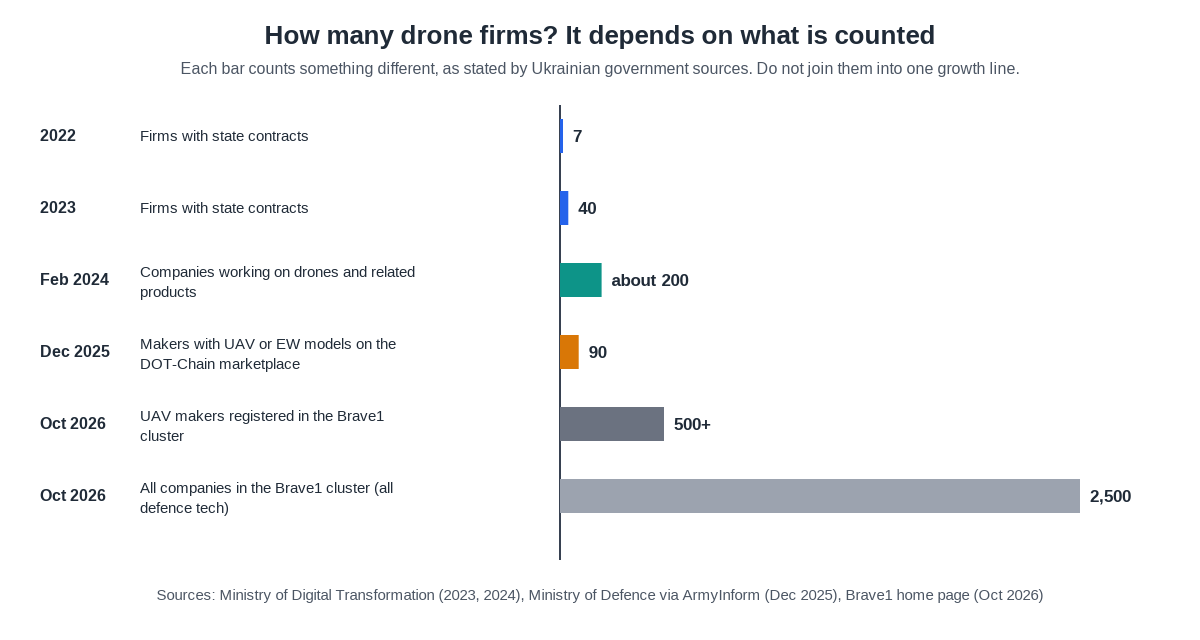
In October 2026, the Brave1 home page lists 2,500 companies in the cluster and more than 5,000 products. By field, it shows more than 500 drone makers, more than 200 makers of unmanned ground vehicles (UGV), and more than 20 makers of naval drones. The article on unmanned ground vehicles explains what those are.
Defence City: a special regime for defence firms
At the end of 2025, the government built one more legal framework, this one only for defence firms. It is called Defence City. The prime minister said half of the weapons for Ukraine's armed forces are already made at home, and that the regime was created to raise that capacity further.
On December 17, 2025, the government approved a package of decisions prepared by the defence ministry, and the regime started on January 5, 2026. Its basis is Cabinet Resolutions No. 1745 and No. 1746 of the same date.
The defence ministry describes Defence City as a special legal framework through which the state backs defence firms. Its aim is a high-tech defence sector that can expand its output of weapons and military gear. Firms may join if they matter strategically for Ukraine's defence and meet set criteria.
Joining is a paper review. A firm sends in an application with a compliance report, annual accounts and an auditor's report, and the defence ministry reviews them within 10 working days of receipt. If they are in order, a ministry order enters the firm in the register as a resident. After that, it must file the same three reports every year.
What do residents get? Profits put back into the business are exempt from corporate income tax. Residents get special protection for their information and the confidentiality of their data, and state support if they need to move production sites or protect them better. Half of the personal income tax paid by residents goes to a special fund in the local community's budget.
The first resident status went to a drone maker on January 2, 2026, just before the regime started.
Paid for by partners, built on partners' soil
Partner money reaches Ukraine's drone makers by two main routes.
The first is the "Danish model." Denmark led efforts to buy equipment and weapons from Ukrainian industry, through Ukraine's defence ministry and Ministry of Strategic Industries, and donate them to Ukraine's military. In October 2024, announcing a defence industry hub inside its Kyiv embassy, Denmark used that name for the approach. The factory stays in Ukraine, and the partner pays.
Other countries added money to this route. At a meeting of the Ukraine Defense Contact Group on June 4, 2025, partners agreed to put as much as €1.3 billion into the Danish model in 2025. Denmark, Sweden, Canada, Norway and Iceland provided the first €428 million.
The second route is building together on partner soil. At the same meeting, Ukraine launched Build with Ukraine. Under it, Ukrainian weapons are made jointly on the territory of Contact Group members to meet the urgent needs of Ukraine's armed forces. At a meeting on January 9 that year, roadmaps through 2027 were approved for eight capability coalitions, drones among them.
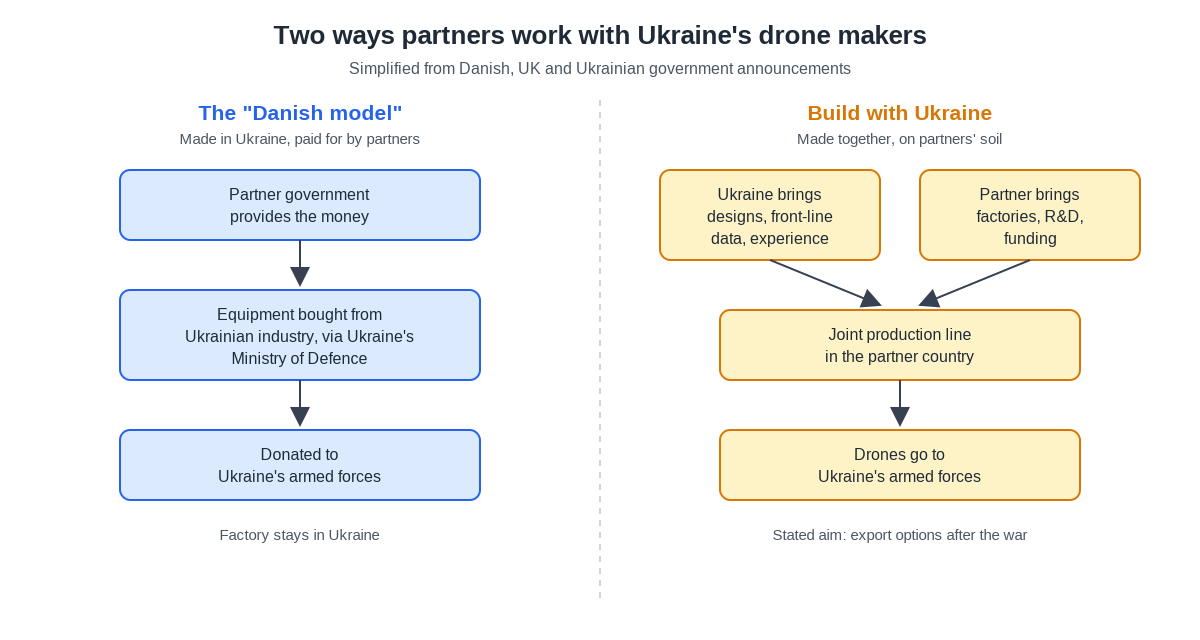
The UK set out concrete deals first. On June 23, 2025, the British prime minister and the Ukrainian president reached a deal covering the next three years. It plugs technology data from Ukraine's front line into UK production lines.
A technology-sharing agreement followed on September 10. Its first joint project is an interceptor drone, Project OCTOPUS, designed by Ukraine with help from UK scientists and technicians. The UK government's goal is to mass produce it in the UK and send thousands a month to Ukraine.
Other countries signed similar agreements.
| When | Partner | What the official announcement says |
|---|---|---|
| October 2025 | Denmark | A memorandum on joint defence production in Denmark and a demonstration hub |
| November 30, 2025 | Norway | Ukraine brings technology and operating experience, Norway production capacity and R&D facilities. The first pilot line is due in 2026 |
| December 1, 2025 | Netherlands | Joint production lines in both countries, with Dutch funding; the Netherlands buys the drones and hands them to Ukraine's forces |
| February 2026 | Finland, Denmark, Latvia | Four framework defence agreements (two with Finland, one with Denmark, one with Latvia) under Build with Ukraine |
The road to exports
The joint production deals also point to a next step. Announcing the agreements with Finland, Denmark and Latvia in February 2026, Ukraine's president said this co-production would also open chances for exports after the war.
A policy came two months later. On April 28, 2026, ArmyInform, the defence ministry's news agency, reported that Ukraine had agreed a mechanism for exporting its own weapons and was preparing special agreements with partners. Called "Drone Deals," these are agreements between governments covering the production and supply of drones, missiles, ammunition and military equipment.
The conditions came with it. The president said the military will get the weapons it needs first and only the surplus will be exported, and that in some segments spare production reaches up to 50%. Countries that cooperate with Russia will go on a separate list of banned destinations. The National Security and Defense Council will coordinate, and the defence ministry and the General Staff will decide what the front actually needs.
The core of the policy is that the army comes first and the leftover output is sold abroad. The government is to set out the details separately.
What to check when reading the numbers
Every number in this article was announced by the government of Ukraine or of a partner country. When news reports give figures for Ukraine's drone industry, three questions help.
First, what was counted? Companies with state contracts (7, then 40) and companies working on drones and related products (about 200) are different groups. So are makers listing products on a marketplace (90) and companies registered in a cluster (more than 500 drone makers, 2,500 in all). Joining them into one line draws a growth curve that did not happen.
Second, is it output, deliveries or capacity? The 3 million for 2025 is the number of FPV drones the army received. The $50 billion is the production capacity of the whole defence industry, and "100 times" is a ratio against the year before. Each uses a different yardstick.
Third, who said it, and when? A minister's speech, a ministry summary article and a cluster's home page do not carry the same weight. Figures with no date, like those on the Brave1 home page, may have changed by the time you look again.
What to read next
- FPV drones: what the drone these firms made most of actually is.
- The Russia-Ukraine War: A Timeline: the dates of the war in which this industry grew.
- Counter-drone systems: the technology on the defending side.
- "FPV Drones in Ukraine: How Production and Organisation Changed," "Ukraine's Unmanned Systems Forces: A Military Branch for Drones," and "The Drone Supply Chain: Where Motors, Batteries and Cameras Come From": articles in this series that are still being written.