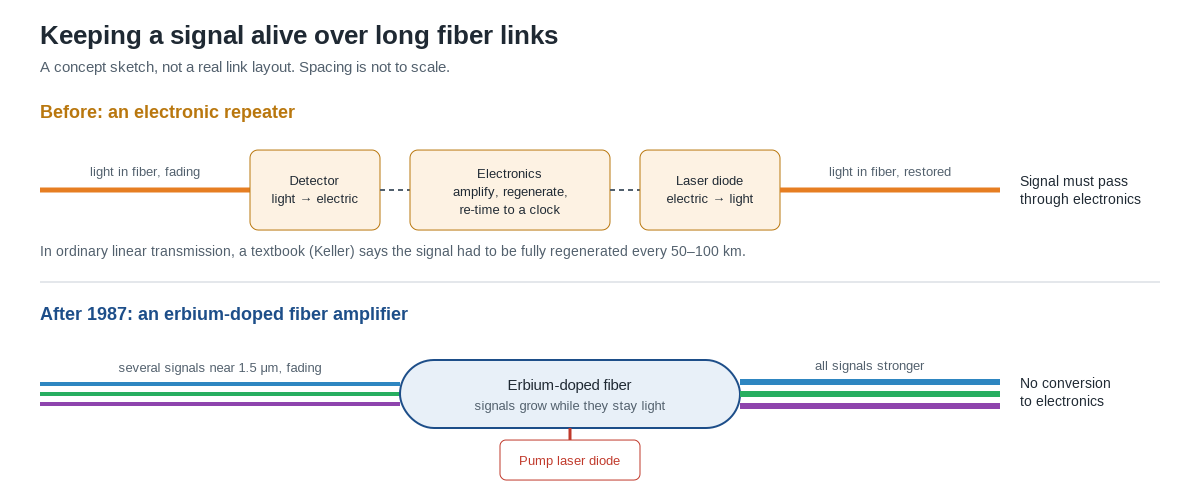
Picture a single optical fiber lying on the floor of the Atlantic. Light travels a very long way through the glass, but after tens of kilometers it grows weak. Until the mid-1980s there was one way to revive that weak light: turn it into electricity, clean it up with electronics, and turn it back into light.
In the autumn of 1987, two papers, one from the University of Southampton in Britain and one from a team in the United States, showed another way. Shine pump light into a fiber doped with the rare-earth element erbium (Er), and a telecom signal grows while it stays light. The device is the erbium-doped fiber amplifier (EDFA). This amplifier replaced the repeaters on undersea fiber cables, and the same idea led to kilowatt fiber lasers in factories.
Before the amplifier
Optical fiber loses very little light. Over long distances, though, problems pile up. Attenuation slowly dims the light, dispersion spreads the pulses, and nonlinear effects in strong light blur the signal.
Keller's textbook Ultrafast Lasers says that, for these reasons, ordinary linear transmission needed the signal fully regenerated every 50–100 km. That was the job of a repeater. A repeater detected the optical signal and turned it into an electrical one. It amplified it, cleaned it up, and re-timed it to a clock, then used a laser diode to make light again and send it back into the fiber.
It resembles a letter on a long journey, copied out by hand onto fresh paper at every station. In reality the copying is done by a detector and electronics, not a person, and what gets rebuilt is a pattern of flashing light, not handwriting. Still, as in the letter picture, the light had to become electricity partway along the route.
An earlier path: a glass laser in 1961
The idea of boosting light with light is far older than 1987. An IEEE History Center milestone record credits Elias Snitzer and his colleagues with building the first laser made of optical fiber, in 1961. Three years later, the same team demonstrated the first optical fiber amplifier.
A fiber amplifier works like any other amplifier. Atoms excited by pumping release extra light in step with the passing signal, through stimulated emission, and the signal grows. In a fiber, the light stays trapped in the thin core for a long distance, so this happens over a long length. The difference between an amplifier and an oscillator is covered in Oscillators and amplifiers: making light, then growing it.
Telecom use needed two more things. One was a way to put rare-earth ions evenly into low-loss fiber. The other was an element that works at the wavelengths telecom uses. The first came in a 1985 paper by Poole, Payne, and Fermann, "Fabrication of low-loss optical fibres containing rare-earth ions."
The two papers of 1987
In September 1987, Mears, Reekie, Jauncey, and Payne published "Low-Noise Erbium-Doped Fibre Amplifier Operating at 1.54 μm" in Electronics Letters, volume 23, issue 19. The University of Southampton's Optoelectronics Research Centre (ORC) credits this paper with announcing the first practical optical amplifier to the world.
Two months later, in November 1987, a paper by Desurvire, Simpson, and Becker appeared in Optics Letters in the United States. Its abstract reports +22 dB of gain for a 1.53 μm signal in an erbium-doped single-mode fiber at room temperature (295 K). A gain of 22 decibels means the signal grew more than a hundredfold.
The abstract also notes a limit. Light that the amplifier gives off on its own, spontaneous emission, was amplified along with the signal and capped the signal-to-noise ratio. Cooling the fiber to 77 K raised the gain to +29 dB. The pump in this experiment was a 514.5 nm light source.
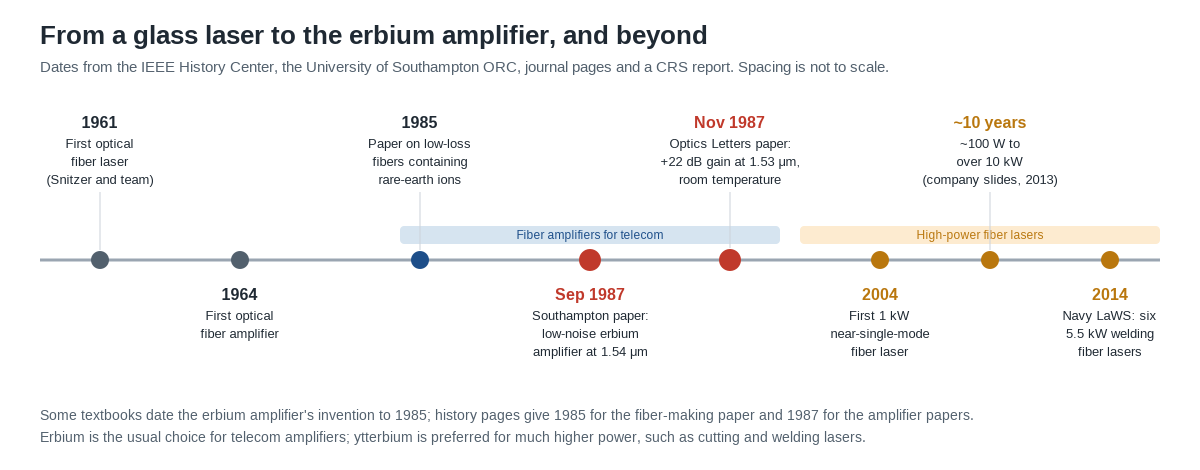
Some textbooks give 1985 as the year of invention. That was the year of the rare-earth fiber-making paper; the amplifier papers came out in 1987.
Why erbium, and why 1.5 μm
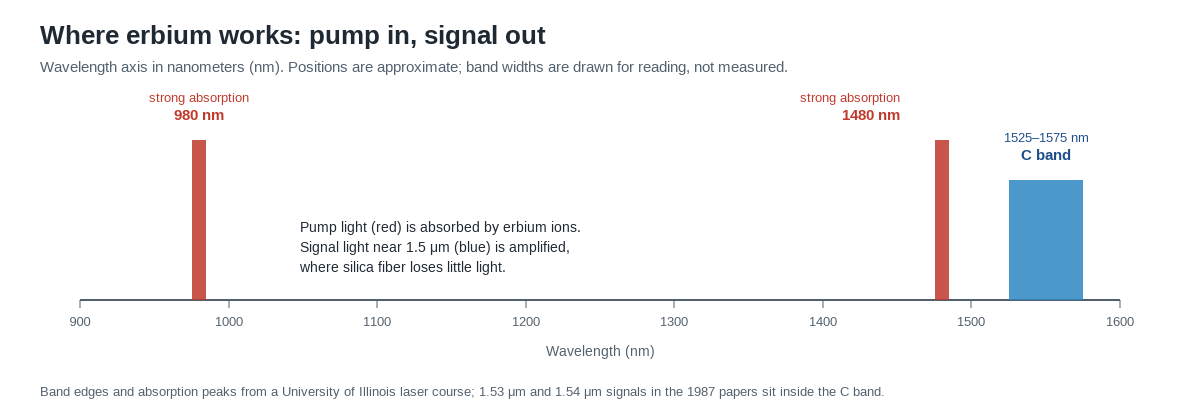
Erbium won out because of wavelength. Erbium has several closely spaced energy levels that let it amplify light from 1525 to 1575 nm. This range is called the C band, and optical communications use it because fiber loses little light there.
The pump light that excites erbium is set as well. Erbium has strong absorption bands at 1480 nm and 980 nm. In a working amplifier, light from a pump diode, a laser diode, is fed into the fiber to pump the erbium atoms.
It was not all easy. Erbium is basically a three-level laser, so it needs a lot of pump power.
What changed in optical communications
The biggest change was that a signal could be boosted while it stayed light. The University of Southampton credits this with putting long-distance optical links within practical reach, since many signals could travel hundreds of miles without electronic conversion. Huge amounts of bandwidth became available cheaply over very long distances. The university counts this as a major prerequisite for the Internet as it is today.
Today the world's fiber network leans on these amplifiers every day. Thanks to them, a message can travel across an ocean or a continent in one unbroken run.
The amplifier also meshed with later technology. Coherent optical communication has since made a strong comeback, combining erbium-doped fiber amplifiers with improved coherent receivers and digital signal processing. Dense wavelength division multiplexing (DWDM), which packs many wavelengths tightly into one fiber, together with coherent communication, has become important for transmission at multi-terahertz bit rates.
The same idea, at higher power
Pumping rare-earth-doped fiber with diode light did not stop at telecom. The Southampton ORC lists ytterbium, neodymium, erbium, erbium with ytterbium, thulium, and holmium as active dopants for high-power laser fibers. How the light differs from one element to the next is covered in Rare-Earth Dopants: What Light Ytterbium, Erbium and Thulium Give.
The elements did split into different jobs. Erbium is the current choice for telecom amplifiers, while ytterbium turns out to be better for much higher power. In fiber lasers that cut and weld sheet metal, ytterbium is the dopant of choice.
Power rose quickly. Webinar slides from the fiber maker Coherent (formerly Nufern), dated 2013, put the first 1 kW near-single-mode fiber laser in 2004. Over about 10 years, by the same slides, output rose from about 100 W to over 10 kW. Along the way, fiber lasers became manufacturing tools whose multikilowatt beams cut and weld everything from plastics to metals.
Lasers from the factory floor went to sea as well. In a 2015 Congressional Research Service report, the prototype of the U.S. Navy's shipboard laser, LaWS, combined light from six welding fiber lasers. They were commercial, off-the-shelf units of 5.5 kW each, for 33 kW in total. From the 1961 glass laser and the 1987 telecom amplifier to a laser on a warship, one line runs through it all.
That does not make a telecom amplifier and a high-power laser the same device. High-power fiber lasers usually use ytterbium, while telecom amplifiers use erbium. What carried over was not a device but an idea, boosting light with rare-earth fiber and diode pumps, along with the fiber-making skills that backed it.
Further reading
- Rare-Earth Dopants: What Light Ytterbium, Erbium and Thulium Give: why erbium and ytterbium take on different jobs
- What is a fiber laser? Growing light inside a thin glass fiber: the step from amplifier to laser
- Double-clad fibers and how pump light gets in: separate paths for laser light and pump light: the pumping method that raised output to kilowatts