DJI's official blog looks back on a time when smooth aerial shots were only possible with a camera operator in a helicopter. In that account, people who wanted to fly a drone had to find the parts and put it together themselves. Drones that fly straight out of the box came later, and DJI, a company based in Shenzhen, China, is one that has been releasing products along the way.
DJI is a civilian company known for camera drones and camera gear. So why does a defense site look at it on its own? A U.S. House report singled the company out, and the U.S. government has started to treat the civil drone market as a national security issue.
This article follows the order in which DJI released its products, using the company's own sources. It then sets beside them what U.S. government documents say about the company's place. This article reflects the situation as of October 2026.
A company that began in a dorm room
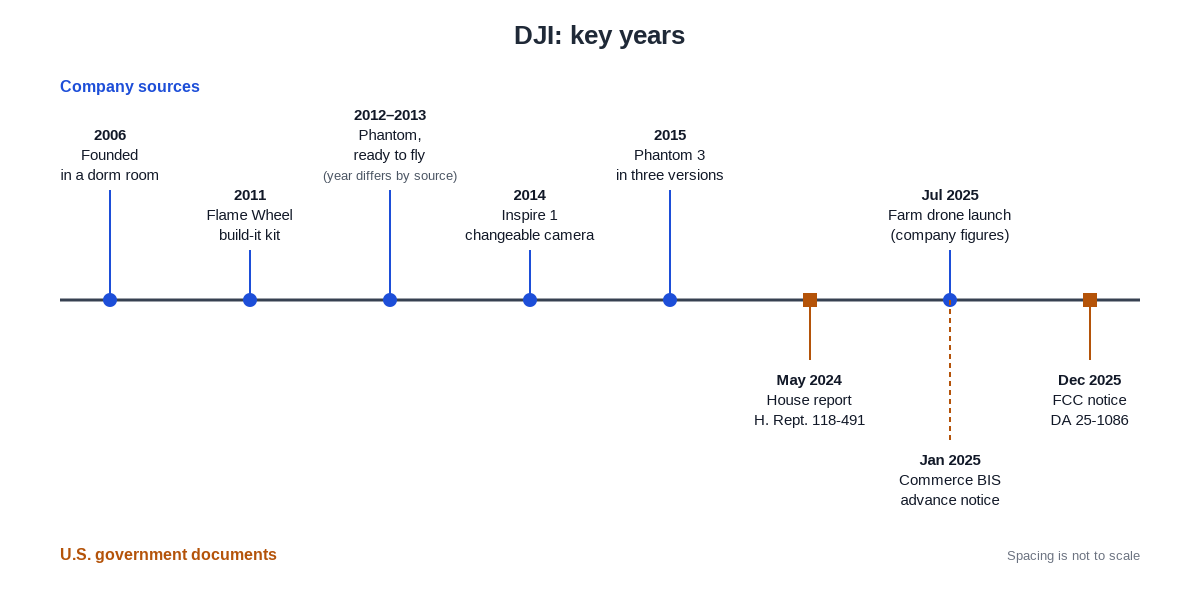
DJI was founded in 2006 in a college dorm room. Its founder was Frank Wang, a student at the time. From here through the Phantom 3, most of the early history comes from the company's official blog, so it is the company's own account.
The starting point was a problem: radio-controlled flight was too hard. In 2006, remote-controlled flight mostly meant radio-controlled airplanes and helicopters, and only dedicated hobbyists could handle them.
The company's About page puts its start in a small office in 2006 and says it now has more than 6,000 employees. The headquarters is in Shenzhen. The company has offices in the United States, Germany, the Netherlands, South Korea, Japan, China and Hong Kong. The full name is Shenzhen Da-Jiang Innovations Sciences and Technologies Company Limited, usually shortened to DJI.
From flight controllers to ready-to-fly drones
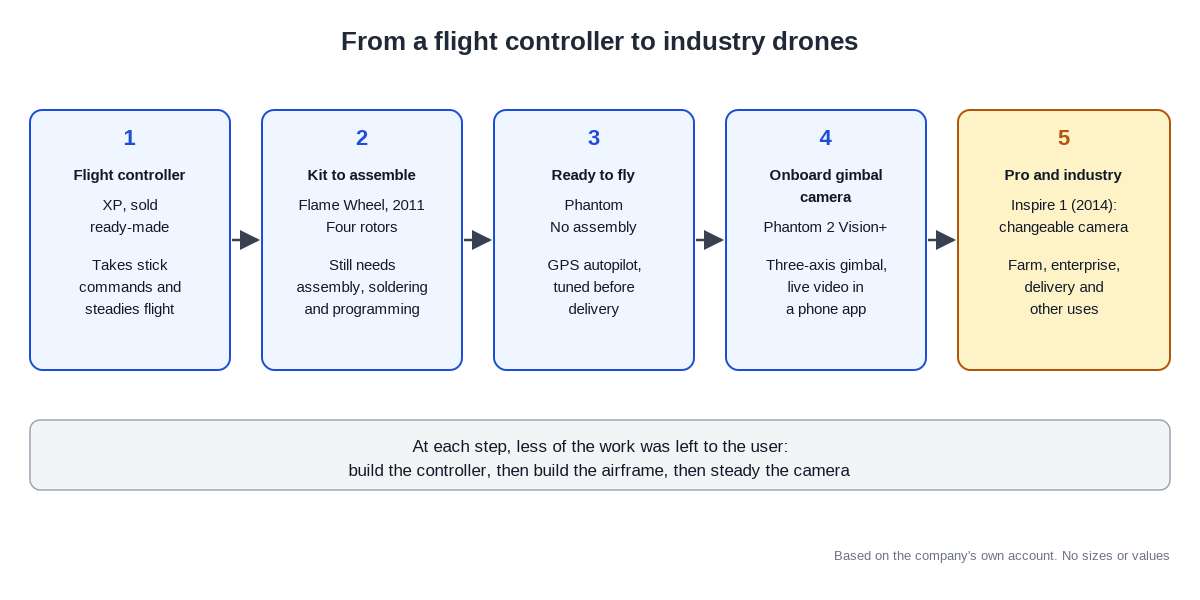
The first product was not a drone but a flight controller. A flight controller takes the pilot's stick commands and decides how each part of the aircraft should move. At the time, experienced hobbyists had to assemble one by hand. DJI released the XP, a flight controller that came ready-made, and sold 20 a month through word of mouth and online RC forums.
The next question was the shape of the aircraft. Several small propellers instead of one large one share the work of lifting, so each motor can be smaller, lighter and quieter. The thinking was that four rotors would be simpler and lighter than eight and would fly longer. The result, in 2011, was the Flame Wheel, the company's first drone product.
The Flame Wheel was a kit that users put together from the parts in the box. It still needed assembly, soldering and programming. Flying a drone still took some skill with tools.
The Phantom did away with the assembly step. It was a ready-to-fly drone with nothing to assemble, and its wires and controls were hidden inside. The Phantom had a built-in autopilot that used GPS, one kind of global navigation satellite system (GNSS). Its flight settings were tuned before delivery so it could fly as soon as it arrived, and it could carry a light action camera.
Even the company's own sources disagree on the Phantom's year. A 2020 blog post puts the Phantom 1 in 2012, while another blog post gives 2013 as the release year. The newsroom post that first announced the Phantom is dated January 7, 2013.
A camera that does not shake: the gimbal
Once flying became easy, the next problem was the footage. A camera fixed to a drone follows every move of the aircraft. If the aircraft tipped forward or a gust shook it, the camera moved with it, and video came out shaky and photos blurred.
The answer was a motorized gimbal. Instead of bolting the camera to the airframe, a gimbal sets it on a mount that turns on its own. The camera then does not simply follow every shake. It is a bit like a wrist steadying a cup of water during a walk, except that motors move the mount.
The idea behind such a mount is set out in a Johns Hopkins Applied Physics Laboratory (APL) Technical Digest article on missile target sensors. The sensor sits on a gimbaled platform that isolates it from the motion of the body. A typical design uses two gimbals at right angles, rate gyros that sense turning and steady the platform, and a motor on each axis. When the body turns, the gyros sense it and the motors turn the platform so the sensor keeps looking the same way.
How a gimbal holds a laser beam on one spot is covered in Gimbals, pointing and tracking.
DJI first released the Zenmuse gimbal for professionals who carried large cameras. Drones could now get the kind of smooth aerial shot that only a camera operator in a helicopter could get before.
Next, the technology went inside the Phantom. The Phantom 2 Vision+ carried DJI's first onboard gimbal camera. The three-axis gimbal was shrunk to fit the aircraft, and it cost one tenth as much to make as the Zenmuse 15. Users could watch the footage live in Vision, the first DJI phone app.
Uses beyond aerial photos
Phantom owners soon included more than hobby pilots: people selling houses and people shooting weddings picked it up too. In 2014 came the Inspire 1, a professional drone with a camera that could be swapped. In 2015 the Phantom 3 arrived in three versions: Standard, Advanced and Professional.
The company's About page says professionals in the film industry, as well as in agriculture, environmental protection, search and rescue, and energy, trust its products. The product menu on its website now shows handheld camera gear, robot vacuums, enterprise solutions, agriculture, delivery (DJI Delivery) and education alongside camera drones.
Agriculture is where the numbers show. At a July 2025 farm drone launch, DJI Agriculture's global sales head put its farm drones at more than 500,000, working in 100 countries on 300 kinds of crops. The same release says close to 500,000 operators around the world had been trained by May that year. Both figures come from the company.
How large is its place in the market
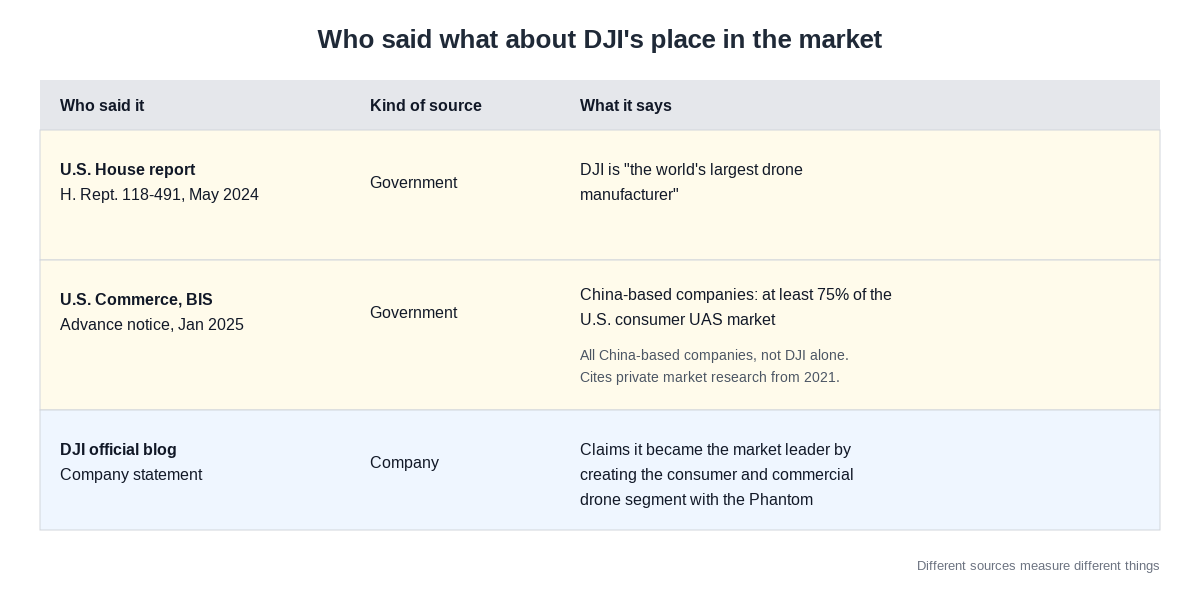
How big DJI is in the market depends on who measured what. A May 2024 report from the House Committee on Energy and Commerce calls DJI the world's largest drone manufacturer. In the report's account, DJI's large role in supplying drones to many sectors, U.S. police agencies among them, drew closer attention to its ties with the Chinese government.
An advance notice of proposed rulemaking from the Commerce Department's Bureau of Industry and Security (BIS), published January 3, 2025, gives a more specific number. In the U.S. consumer market for unmanned aerial systems (UAS), the notice says, at least 75% of products come from companies based in China. That figure covers all China-based companies, not DJI alone, and the notice cites 2021 private market research as its basis.
The company tells it differently. On its official blog, DJI argues that it became the market leader because it created the consumer and commercial drone segment with the Phantom. A government document's description, a research figure quoted by a government document, and a company's claim are three different kinds of statement.
The security debate and the company's position
The size of that market became the starting point for concern. The May 2024 House report goes with the bill H.R. 2864. The bill aimed to add DJI's communications and video surveillance equipment to the Covered List of the U.S. Federal Communications Commission (FCC). The Covered List names equipment and services that pose, in the government's judgment, an unacceptable risk to U.S. security or to the safety of Americans.
Two of its reasons are these. DJI is subject to Chinese law because its headquarters is in Shenzhen. Many federal agencies have warned about DJI drones, citing the company's links to China's ruling Communist Party.
DJI's reply came two months before the report, in a post on its official blog dated March 1, 2024, answering the House members who had introduced the bill. In its words, it is not a military company, it does not make military-grade equipment, and it does not seek business for combat use. Its distributors and resellers have committed to this policy, and the company says it will end the relationship with partners that do not keep it. Another point of its reply is that, in default settings, the company does not gather flight records, pictures or video from its drones.
The company proposed that security standards be based on technology rather than on the country where a product is made. The U.S. government went another way.
On December 22, 2025, the FCC's Public Safety and Homeland Security Bureau (PSHSB) issued Public Notice DA 25-1086. It put foreign-produced uncrewed aircraft systems and their critical components on the Covered List. Communications and video surveillance gear and services named in section 1709 of the FY2025 National Defense Authorization Act (NDAA) went onto the list at the same time.
Equipment on the list cannot receive FCC equipment authorization. The newly covered foreign-made aircraft and parts are identified by where they are produced, not by company. The section 1709 items are the exception.
The list will be updated again if the Department of War or the Department of Homeland Security finds that a given aircraft or part is not an unacceptable risk. What section 1709 lists and the rules around this notice are covered in a separate article in this series, "US Restrictions on DJI: From the Entity List to the FCC."
What to read next
- FPV drones: flying through the drone's eyes: how a way of flying small civil drones, or small unmanned aircraft systems (sUAS), turned up in defense documents.
- Counter-drone systems: why one device is not enough: the problems on the defending side as small drones spread.
- US Restrictions on DJI: From the Entity List to the FCC: the rules touched on here, followed by the dates in the original documents.
- A Map of Civil Drone Makers: Autel, Skydio, Parrot, Teal and More: civil drone companies other than DJI.