Stand at an airport and the engines all look different. A small cargo plane has propellers spinning in front of its wings. A big airliner carries fat pods under its wings.
A fighter sometimes throws flame out of its tail, and a vehicle headed to space rides a rocket. They all do the same job, pushing the vehicle forward. So why are they so different?
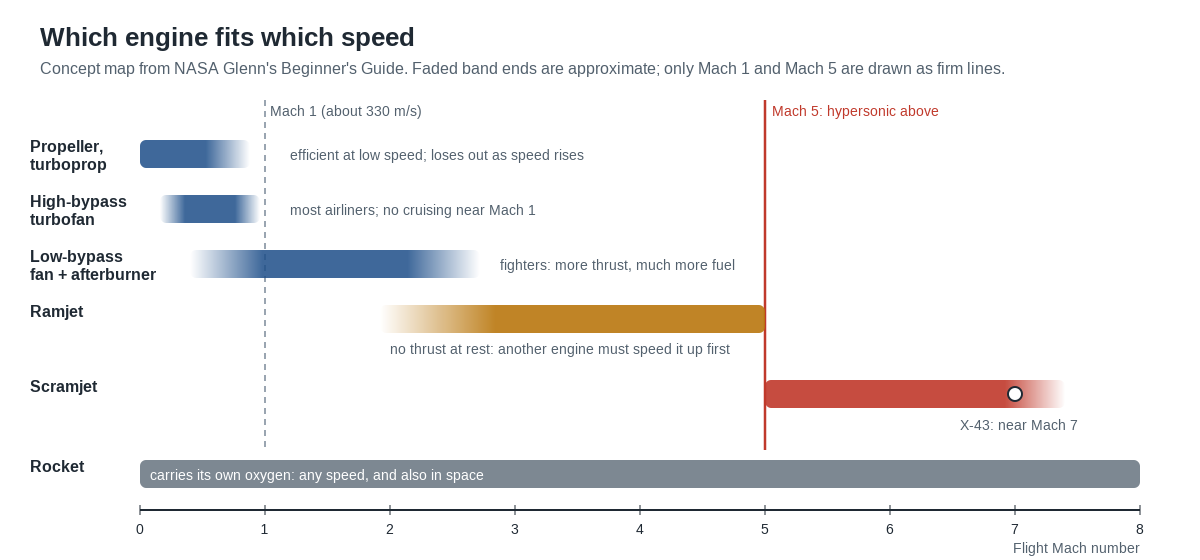
The main reason is speed. Each engine has a speed range where it works efficiently, so lining them up from slow to fast puts six engine types on a single map. First, the map needs a ruler.
A ruler for speed: the Mach number
In aviation the ruler is the Mach number: the aircraft's speed divided by the speed of sound. NASA Glenn Research Center's teaching pages give the speed of sound as about 330 m/s.
Flight near Mach 1 is called transonic. Squeezing of the air there raises drag sharply, so aircraft do not cruise near Mach 1.
Above Mach 1 the flow is supersonic. At high supersonic speeds, above Mach 3, heating from the air becomes a major design problem. Above Mach 5 the flow is called hypersonic.
Strong at low speed: propellers and turboprops
Propellers are very efficient for low-speed flight. As speed rises, though, parts of the propeller blade see air moving faster than sound, and shock waves rob performance. That is why high-speed aircraft do not use propellers.
A turboprop uses a gas turbine to spin a propeller. Many low-speed transports and small commuter aircraft use one. Because propellers lose efficiency as speed rises, turboprops are used on low-speed aircraft such as cargo planes.
The airliner's range: turbofans
There are two ways to make thrust. You can speed up a large mass of air by a little, or a small mass by a lot. The first way saves fuel, because propellers and fans are aerodynamically efficient. It suits aircraft like airliners, where fuel efficiency matters more than spare thrust.
The turbofan carries that idea to higher speeds. Its fan sits inside the inlet and has many blades, so it stays efficient at speeds where a simple propeller would not.
A high-bypass turbofan, which sends a lot of air around the core, is nearly as fuel efficient as a turboprop. That is why most modern airliners use one. The inside of the engine is covered in Turbofan Engines.
Crossing the sound barrier: low-bypass fans and afterburners
Fighters have different needs. To accelerate quickly and beat the high drag of high speed, they need a lot of spare thrust. So they use low-bypass turbofans, which send less air around the core. These are still more fuel efficient than a basic turbojet, so a fighter can cruise efficiently and still have high thrust in a dogfight.
One detail is surprising. Even when a fighter flies much faster than sound, the air entering the engine must move slower than sound for high efficiency. The inlet does the job of slowing the supersonic air down.
To push through the steep climb in drag as the aircraft nears Mach 1, a pilot may light the afterburner. It sprays extra fuel into the hot exhaust and burns it. Thrust goes up, and fuel use goes up far more. Afterburners are used mainly on fighters; among airliners, the supersonic Concorde used them.
Up to Mach 5: the ramjet
A ramjet has no compressor. It uses the vehicle's own forward speed to ram outside air into the combustor and build pressure. Hold your hand out of a moving car's window and the wind pushes hard against your palm; the idea is similar. The real engine is different in that its inlet slows the rammed air to subsonic speed and raises its pressure before it burns with fuel.
So a ramjet cannot make thrust while standing still. Another propulsion system, often a rocket, has to bring it up to speed first.
It works better the faster it goes, but only up to a point. NASA notes that ramjet propulsion becomes very inefficient above Mach 5. The shock losses in the inlet, where supersonic air is slowed to subsonic speed, grow too large.
Above Mach 5: the scramjet
To cut those losses, an improved ramjet that burns fuel in a supersonic flow was proposed in the 1960s. This is the scramjet. Because it does not slow the flow as much, it can make net thrust at hypersonic speed, and NASA calls it ideally suited to hypersonic flight within the atmosphere.
The X-43 test vehicle is one example. A rocket boosted the X-43 to almost Mach 7, then the X-43 separated and flew on its scramjet. Like the ramjet, the scramjet has to borrow its starting speed from something else. Both engines get their own article in Ramjets and Scramjets.
The rocket pushes anywhere
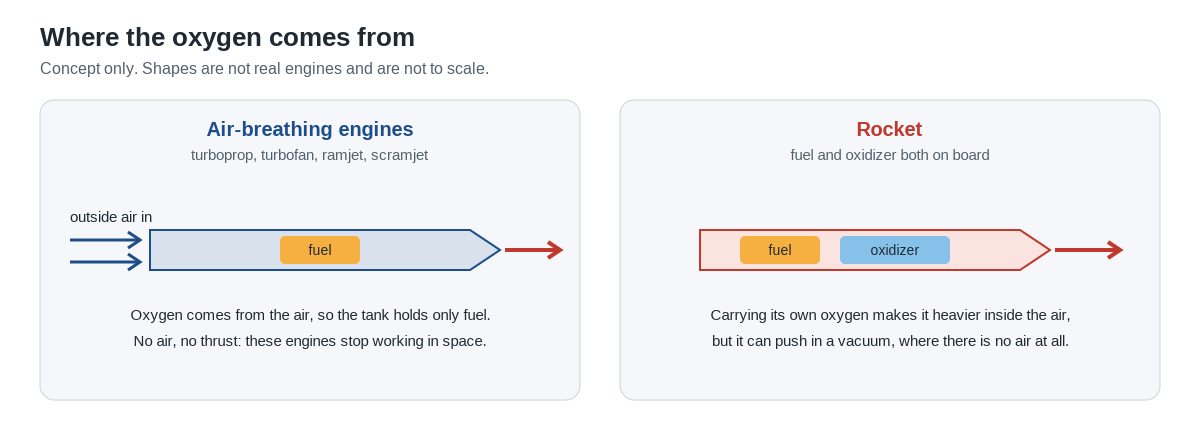
Every engine so far breathes air. It uses air as its working fluid and burns fuel with the oxygen in that air. A rocket carries both its fuel and its oxidizer. So it makes thrust in a vacuum with no oxygen around, and it works in space, where gas turbines and propellers stop.
The trade-off comes inside the atmosphere. Ramjets and scramjets burn outside air, so within the atmosphere they are more efficient than a rocket, which has to haul every bit of its oxidizer. During and after World War II, several rocket-powered aircraft were built to explore high-speed flight, and one of them, the X-15, passed six times the speed of sound. Rocket types are covered in Solid and Liquid Rockets.
What to keep in mind when reading the map
The speed where one engine stops suiting a vehicle is not a sharp line. The same type of engine can suit different speeds depending on its design. So the bands on the map fade at their ends, and only Mach 1 and Mach 5 are drawn as lines.
Also, a vehicle does not always use just one engine. Ramjets and scramjets start with help from a rocket, and NASA expects future hypersonic aircraft to use ramjet or rocket engines of some kind. Read the map as the first question in choosing an engine: how fast, and where, will this vehicle fly?
Further reading
- Supersonic Flight and Shock Waves: what happens to the air past Mach 1
- Turbofan Engines: inside airliner and fighter engines
- Ramjets and Scramjets: engines that use speed, not a compressor, to squeeze air