Picture an unauthorized drone hovering over a stadium. The crowd below makes it hard to shoot it down. In moments like this, people often talk about equipment that stops a drone with radio waves: jamming, which smothers a signal, and spoofing, which sends a fake one.
Not just anyone may use that equipment, though. Radio energy aimed at a drone can also block the emergency calls of people nearby. This article looks, in principle only, at which part of a drone each technique affects and at who may use it under US, Korean and UK law and international rules. It reflects the situation as of October 2026.
Three radio threads a drone relies on
A drone does not fly on its airframe alone. The US Federal Communications Commission (FCC) defines an unmanned aircraft system (UAS) as the aircraft plus its associated elements, such as communication links and the parts that control it. The radio link between the person on the ground and the aircraft is part of the system from the start.
The first two threads form a pair. Control commands go up to the aircraft, and telemetry about the aircraft's state comes back down. Official documents call this two-way traffic control and non-payload communications (CNPC). Losing or compromising this link could have catastrophic consequences.
The third thread is satellite navigation. The satellites of the US GPS, one global navigation satellite system (GNSS), send one-way signals carrying their position and the time. A receiver uses those signals to work out its own three-dimensional position and time. At ground level these signals are very weak, and unwanted transmissions can easily overpower them.
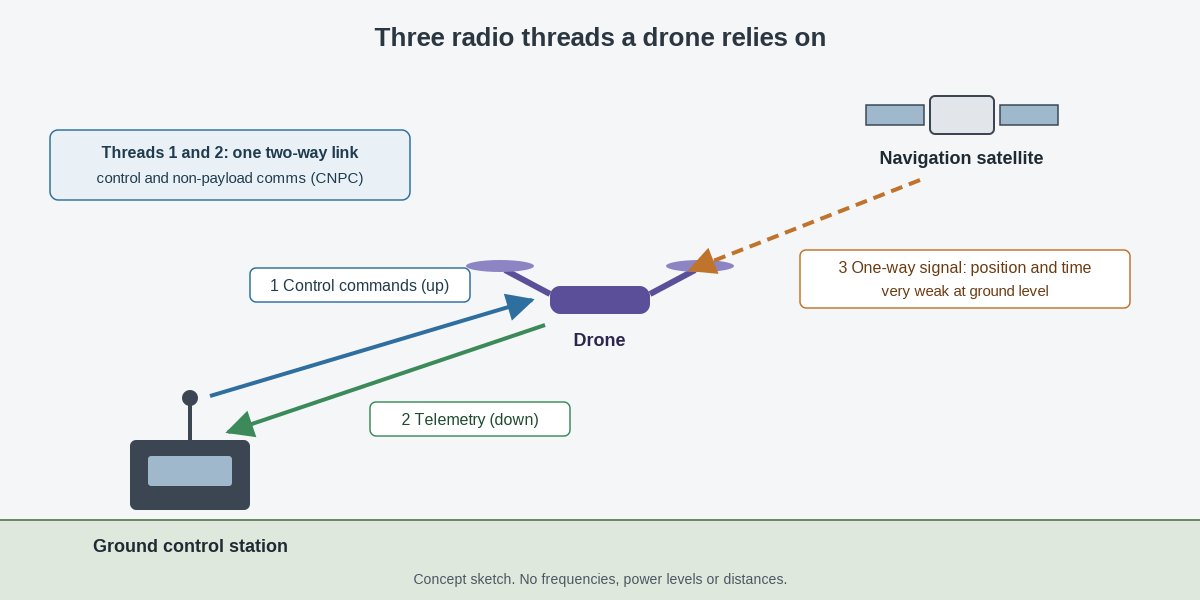
Why the satellite signal is so faint is covered in Jamming and spoofing: interference versus deception. Here, the point to keep in mind is that all three threads are radio.
Jamming: drowning out what must be heard
Jamming blocks a signal. In August 2020, the FAA, the Department of Justice, the FCC and the Department of Homeland Security issued a joint advisory. In its words, jamming tools are built to block or disrupt radio traffic that is permitted under the rules. One of its examples is stopping a GPS receiver from getting position signals from a satellite.
Imagine holding a walkie-talkie next to a construction site. If the other person's voice is lost in the noise, the radio is useless even though it is switched on. In reality the listener is a machine receiver, not a human ear, and what gets buried is a control command or a position signal, not a voice.
Militaries use this approach too. The US armed services have fielded non-kinetic counter-drone equipment. Part of it grew out of gear made in the Iraq and Afghanistan years to defeat improvised explosive devices (IEDs). The Navy's DRAKE is a backpack system meant to jam the link between a hostile drone and the person flying it.
There is handheld equipment as well. A handheld device that the Army and Air Force first acquired in 2017 uses jamming to disrupt drone communication signals. Gear like this is meant for small drones close by. Sometimes it is the final fallback when nothing else has worked or nothing else is at hand.
Spoofing: a convincing false signal
If jamming is noise, spoofing is false directions. It sends false information to a receiver. Spoofing tools can copy and replace or alter signals, and can make a drone lose control of its navigation and communications link. The link to its ground controller is one of those targets.
Which is harder to deal with? Noise at least leaves the fact that nothing can be heard. Well-made false directions look normal. The European Union Aviation Safety Agency (EASA) judged spoofing riskier than jamming for air operations, because it is tougher to spot and can touch several systems at once.
Hacking belongs to the same group. Hacking techniques generally go after a drone's communications link or its onboard computer processors. That is a different target from jamming and spoofing, which smother or imitate the radio signal itself.
Why it is called non-kinetic, and its limits
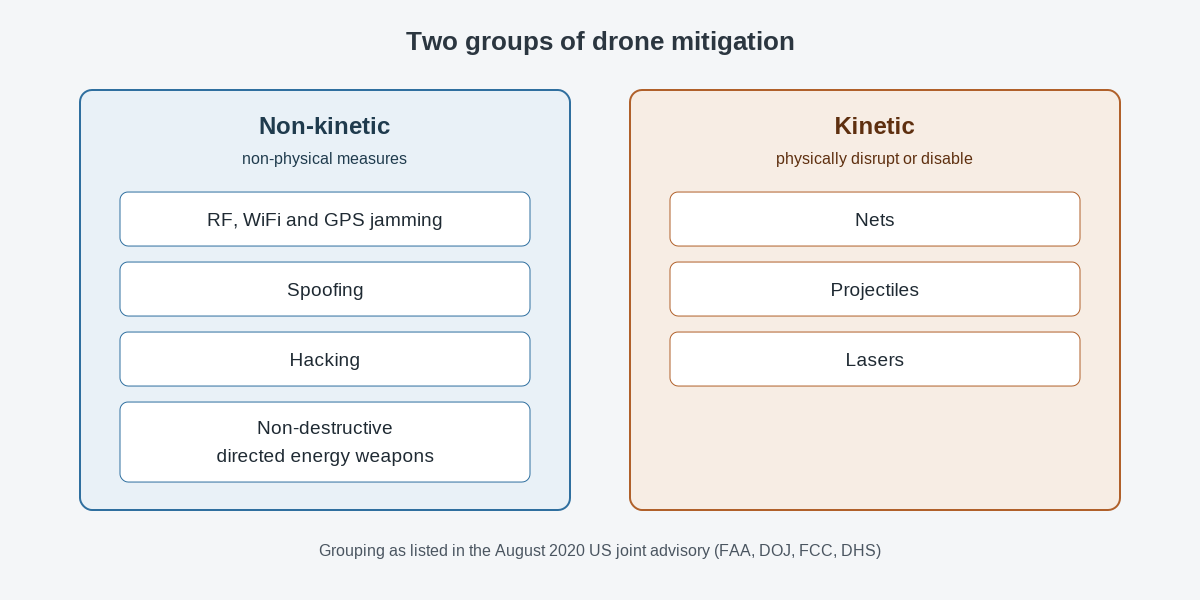
The joint advisory splits drone mitigation into two broad groups. The non-kinetic group includes RF, WiFi and GPS jamming, spoofing, hacking, and non-destructive directed energy weapons (DEW). The kinetic group includes nets, projectiles and lasers. Jamming and spoofing belong to the first group because they disturb a drone's functions with radio waves instead of breaking or catching the aircraft.
The first limit is a drone that does not use radio. A US Army article notes that drones could historically be jammed into a failed mission by cutting their communications. It expects threats to begin shifting to fiber-optic drones, which jammers will not affect. Drones that send control signals down a wire are the subject of "Fiber-Optic Controlled Drones: Why Use a Wire Instead of Radio" in this same series.
The second limit is that radio waves do not choose who receives them. A jamming device can block 911 and other emergency calls for the user and for people nearby, and it seriously endangers public safety radio. The US Department of Defense and federal aviation regulators have also seen risks to public safety and privacy in domestic use of counter-drone equipment. Systems designed for combat are the main concern.
United States: who may use it
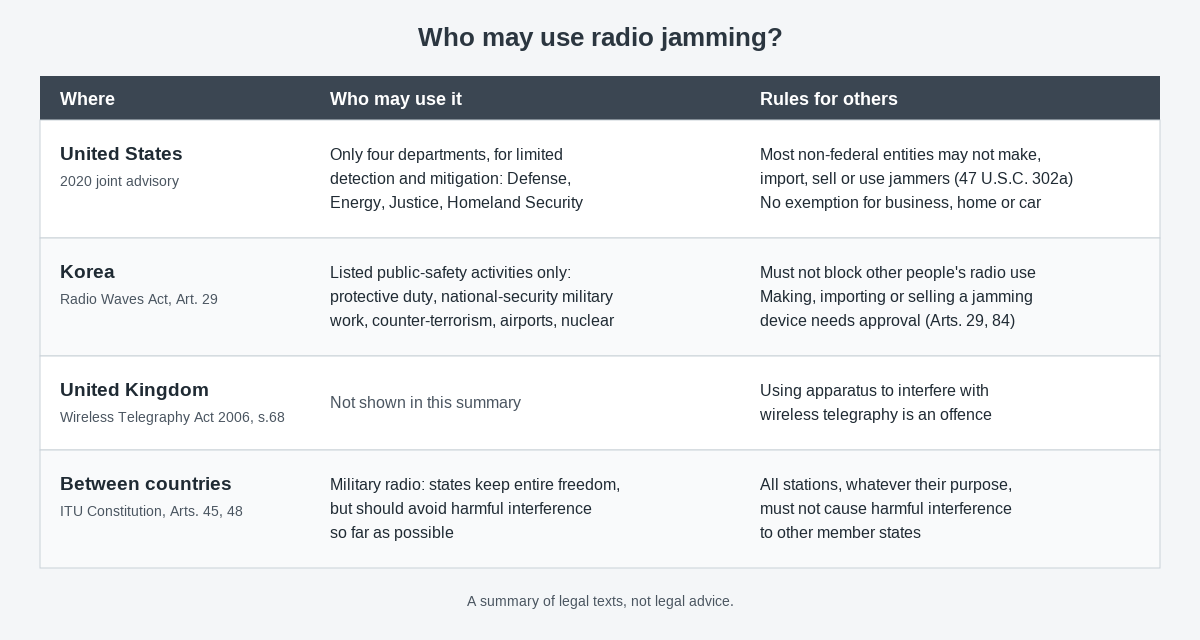
The US answer is short. Under the August 2020 joint advisory, Congress has authorized only four departments to carry out limited drone detection and mitigation: Defense, Energy, Justice and Homeland Security. Even then, the drone must seriously threaten a facility or asset that has been designated for protection. The FAA does not back mitigation by anyone Congress has not clearly empowered.
For everyone else, prohibitions pile up. The provisions in the joint advisory that touch on jamming and spoofing are gathered below.
| Provision | What it prohibits |
|---|---|
| 47 U.S.C. 302a | Most non-federal entities making, importing, selling or using transmitters built to jam or block wireless links |
| 47 U.S.C. 333 | Willful or malicious interference with licensed or authorized stations or US government stations |
| 18 U.S.C. 1367 | Obstructing satellite transmissions; jamming or spoofing the GPS signals that reach a drone or its control station may fall under it |
| 18 U.S.C. 32(a) | Damaging, destroying or disabling an aircraft |
| 49 U.S.C. 46502 | Taking over or steering an aircraft with wrongful intent |
The last two rows reach drones because, in US law, a drone counts as an aircraft. The FAA Reauthorization Act of 2018 described it as an aircraft flown with no way for a person on or in it to step in directly. The joint advisory adds that non-kinetic options need the same legal check.
Everyday settings are no exception. Using a jammer in a business, classroom, home or vehicle violates federal law, and local police have no authority of their own to use jammers. Only federal law enforcement agencies may use it, under limited exceptions in the applicable statutes.
The joint advisory is not law itself. It is guidance for information only, without binding force, and it urges entities not to rely on vendors' claims of legality but to do their own legal and technical review. Changes after 2020 need to be checked against the current legal texts.
Korea, the UK and international rules
Korea's Radio Waves Act starts from preventing interference. Article 29 says radio resources must be used so that they do not block or cut off other people's use of radio waves through interference. Radio stations must also be operated so that they do not hinder other stations.
The exception, in paragraph 3 of the same article, is narrow. It applies only where public safety leaves no other choice, and only within the scope of that activity. In those cases, a device that blocks or cuts off radio use may be aimed at threats such as drones and explosives. The law calls this a "radio blocking device."
The permitted cases are protective activities for the president and others, military activities for national security, and counter-terrorism. They also include stopping violations under the Airport Facilities Act, physical protection of nuclear facilities, and related police work to prevent danger and crime.
Users of these devices take on duties. An agency that acquires or disposes of one must report its specifications and quantity to the Minister of Science and ICT. It must also set up its own operating plan to keep unintended interference down, and record and keep its usage history. An April 2026 amendment added a step for education and training: such use is limited to sites the Minister designates and announces, and the plan must be reported.
Makers and sellers are covered too. Making, importing or selling a radio blocking device requires the Minister's approval. Doing so without it carries up to three years in prison or a fine of up to 30 million won.
In the United Kingdom, section 68 of the Wireless Telegraphy Act 2006 makes it a crime to use any apparatus in order to disrupt wireless telegraphy. On conviction on indictment, the penalty is up to two years in prison, a fine, or both.
Rules between countries sit in the International Telecommunication Union (ITU) Constitution. Article 45 requires every station, whatever it is for, to be set up and run without causing harmful interference to radio services in other member states.
Article 48 grants member states entire freedom over military radio installations. Still, those installations must observe, so far as possible, the rules on helping in distress and on preventing harmful interference. Military radio does not sit outside international rules either.
Where this meets lasers
In the joint advisory's two groups, lasers sit on the kinetic side along with nets and projectiles. Non-destructive directed energy weapons sit on the non-kinetic side with jamming. Even within directed energy, the official document draws its line at whether the aircraft is physically disabled.
The strengths and limits of lasers against drones are in Strengths and limits of laser weapons. What such a weapon is made of besides the laser is in A laser weapon is more than a laser: the system at a glance.
What to read next
- Jamming and spoofing: interference versus deception: why satellite signals are weak, and public cases from aviation and shipping.
- Counter-drone systems: why one device is not enough: where jamming sits among the response options.
- Electronic warfare: the invisible contest: the wider frame of electronic warfare that jamming and spoofing belong to.
- The Counter-Drone Chain: Detect, Identify, Track, Defeat: how defeat connects as the last step of a response.