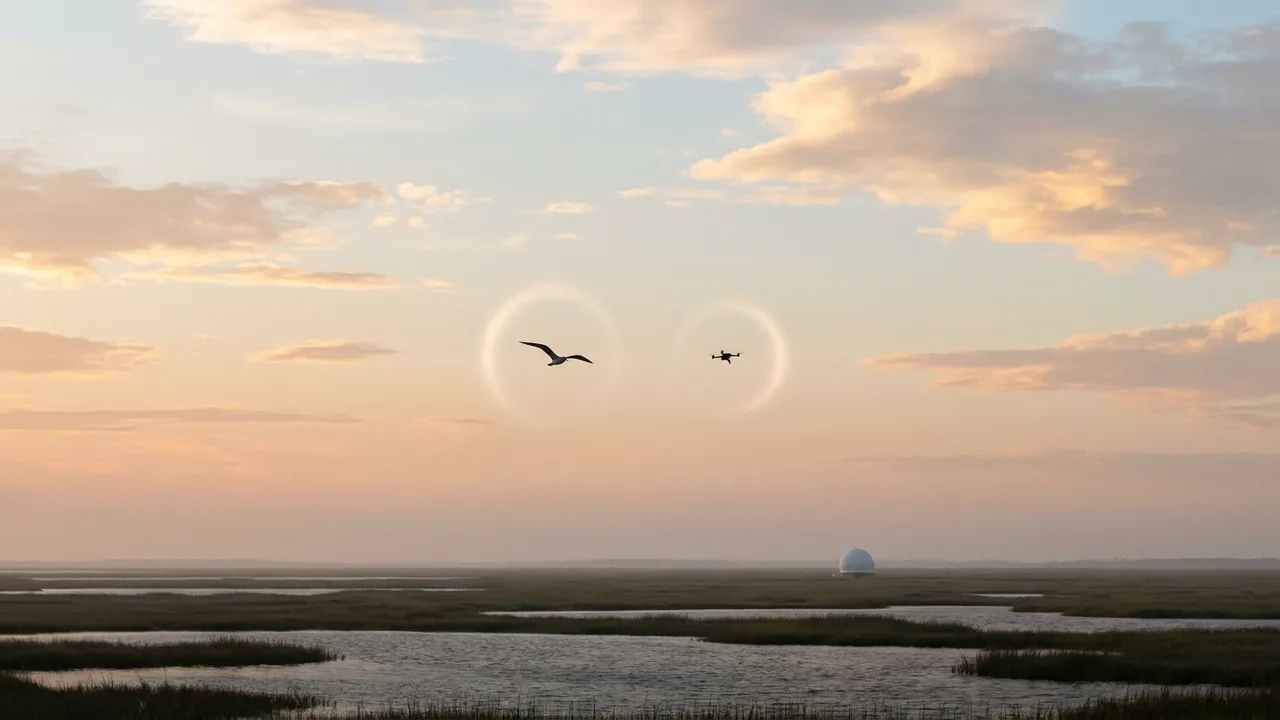
On an overcast day, a dark speck hangs in the sky near an airport. It could be a gull, or a small drone someone has launched. Even the human eye can be fooled, and from far away, through a radar or a camera, it is harder still.
To stop a drone, you first have to know that what you found is a drone. This article uses open papers and official sources to look at what sensors use to tell drones from birds, why the call is hard, and where it goes wrong. Where this task sits in counter-drone work as a whole is covered in "Counter-drone systems: why one device is not enough."
Why they get mixed up: similar size, height and speed
An ordinary air surveillance radar finds aircraft by their radar cross section (RCS). RCS is a measure of how strongly an object sends radio waves back. A paper in an open journal, which measured drones and birds side by side, points out that this may not always work for drones. Even a dedicated radar sensitive enough to catch something as small as a drone cannot rely on RCS alone.
Birds are the reason. They are about the same size as drones and fly at similar heights and similar speeds. To a radar, the two look like dots with similar echoes, positions and speeds. So birds are the main source of confusion in drone detection, and a dependable drone detection radar has to tell the two apart.
Patterns of motion: wingbeats and propellers
Same size or not, they move differently. A drone's propellers spin fast, while a bird beats its wings up and down. Radar sees this difference through micro-Doppler. Micro-Doppler is the Doppler effect caused by small parts of a target moving on their own.
An ambulance siren sounds higher as it comes closer and lower as it moves away: that is the Doppler effect. Radar measures a target's speed from how much the phase of the returned wave has shifted. The idea is explained in "Radar: measuring distance and motion with radio waves."
The whole body moving gives the bulk Doppler. A coherent radar, which keeps track of the wave's phase, can also pick up the small extra patterns from propellers or wings moving on their own.
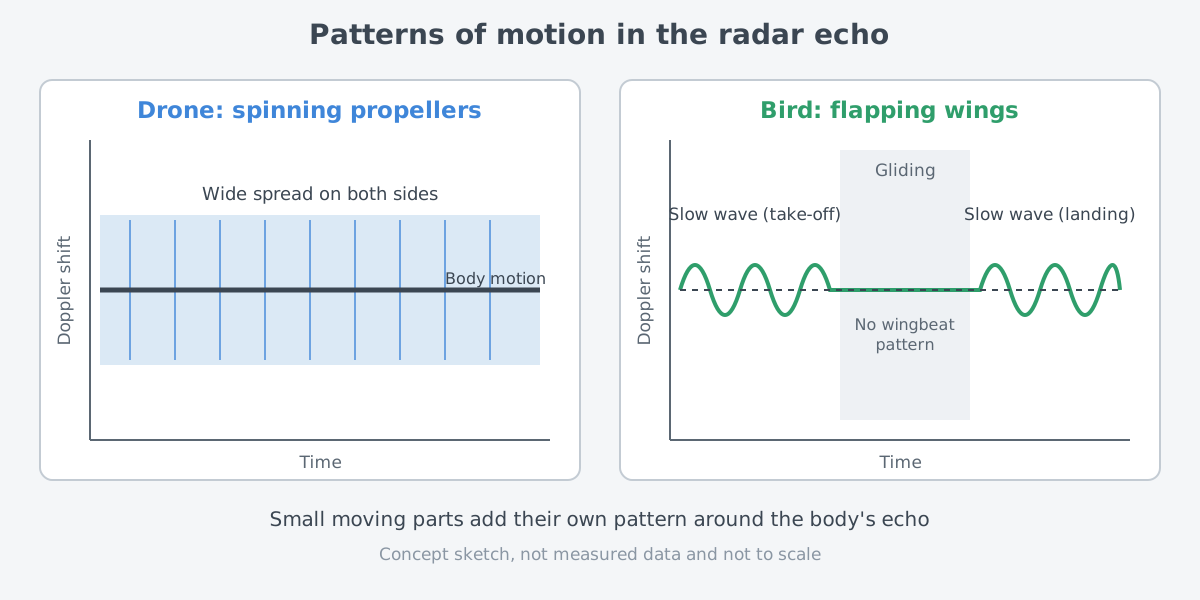
In the measurements, the patterns of drones and birds were clearly different. The mark of a drone is a signal that spreads widely above and below the bulk Doppler line. Wingbeats are much slower: for the four bird species in this experiment, the wingbeat frequency was at most about 10 Hz. The experiment used three drone models and four bird species of different sizes.
A fan and a hand fan give a rough picture. The blades of an electric fan spin fast without stopping, while a hand fan sways slowly back and forth. A real radar does not see the shape of the blades; it reads how the frequency of the returned wave changes over time. And unlike a hand fan, a bird does not keep flapping all the time.
The patterns have limits. In the same experiment, birds usually flapped only when taking off and landing, and glided in between to save energy. While they glided, no wingbeat pattern showed. Drones are not simple either: each rotor spins at its own speed, which makes the pattern more complex.
Even collecting the data is hard. A bird's flight path cannot be fully controlled, so gathering bird data was harder than gathering drone data. The researchers see the results as useful for building classification algorithms that tell drones from birds.
Through a camera: a small dot on the screen
What about video instead of radar? A paper in an open journal that reports on an international contest for spotting drones among birds in video says drones are easily mistaken for birds, especially at long range. Video analysis can help, but it needs algorithms that still work with weak contrast, long range and poor visibility.
Telling birds and drones apart is known to be hard even for air traffic controllers. In video, the clues come down to size and shape. In the 2020 contest, difficulty depended on how large the drone looked and how well its shape could be seen. Clips with a fairly large, clearly visible drone were solved almost perfectly, while clips from a moving camera and clips with very distant drones were the hardest.
The limits of AI classification
All three methods in the contest were artificial intelligence (AI) that used deep learning to find drones in video. The contest data, however, did not mark birds, so the algorithms were not taught about birds when they were designed. As a result, false alarms generally rose for every method in videos with several birds, above all in one scene showing a whole flock. A distant bird looks as small as a distant drone.
The farther away an object is, the smaller it gets on screen, and the shape clue fades with it. So among things with wings, the farther they are, the harder it is to tell them apart by their outline.
Marking every bird is not easy either. Labeling birds one by one in video takes a great deal of time and does not scale to scenes full of birds. Labeled data for this purpose was limited from the start.
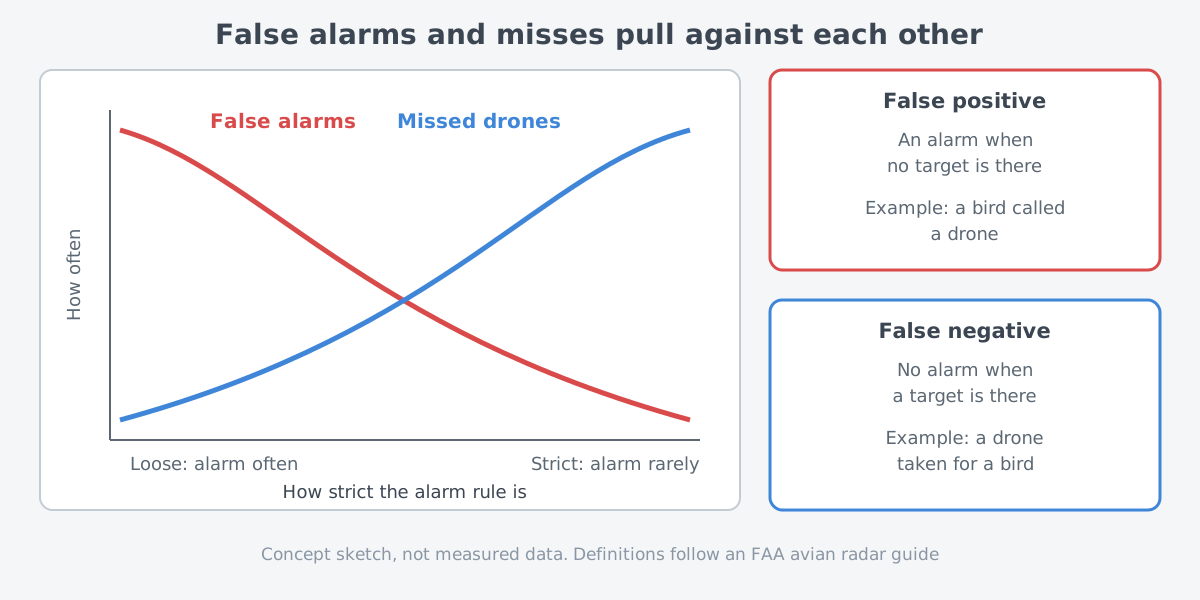
There are two ways to be wrong, and a U.S. Federal Aviation Administration (FAA) guide on bird-detecting radar names both. A false positive is an alert when no target is there; a false negative is failing to report a target that is there. The two pull against each other. One contest team tried a way to cut false detections; they did fall, but correct detections also dropped sharply and overall performance got worse.
Those who look for birds face the same issue. The FAA treats birds as the most common wildlife hazard and the main concern for aviation safety, and it has issued guidance on using bird-detecting radar at airports. That guidance says the person watching the radar must understand what the radar is "seeing." Only then can bird tracks be told apart from insects, airport vehicles, multiple echoes, or objects that have already moved because of a time lag.
Why sensors are used together
When one sensor is not enough, several are used. 3D lidar, passive radio detectors, video analysis and passive acoustic sensors each have strengths and weaknesses taken alone, and may work well only in certain conditions. That is why integrated approaches combining several technologies are studied. The three contest methods also showed strengths that complemented one another.
A counter-drone primer from the Congressional Research Service (CRS) points the same way. Cameras, infrared and acoustic sensors, radar and radio frequency sensors do not always catch a small drone, so they are often combined into layered detection. Merging what many sensors see into one picture continues in "Integrated air defense and sensor fusion."
The job does not end once the call is made. A dot judged to be a drone has to be followed without losing it, and for a laser weapon, the beam has to be aimed at it. This process of finding, following and aiming is called acquisition, tracking and pointing (ATP).
What to read next
- Gimbals, pointing and tracking: holding the beam on one spot: how a laser follows one chosen dot to the end.
- Radar: measuring distance and motion with radio waves: the Doppler effect behind micro-Doppler, from the start.
- Counter-drone systems: why one device is not enough: the whole chain of detecting, identifying and responding.