In the winter and spring of 1968, almost everything that reached one base in the far northwest of South Vietnam came by air. Route 9, the road in, was cut. The Air Force count alone came to 14,356 tons, and Marine helicopters flew in more on top of that.
The base was Khe Sanh. The siege began nine days before the Tet Offensive and lifted in April.
Through those months, people in the United States argued over whether it would become "an American Dien Bien Phu." This article draws on the 1969 official Marine Corps history and State Department records. It looks at what happened at Khe Sanh, what the argument was about, and why the records disagree on the numbers.
A plateau near the Laotian border
Very few people lived on the Khe Sanh Plateau. Even so, it sat across a main route running from large North Vietnamese base areas in Laos toward the coast.
William C. Westmoreland, the U.S. commander in Vietnam at the time, wrote in the foreword to the Marine history that the plateau was an early target for the North Vietnamese Army. He believed they hoped for a decisive victory there like the one at Dien Bien Phu in 1954.
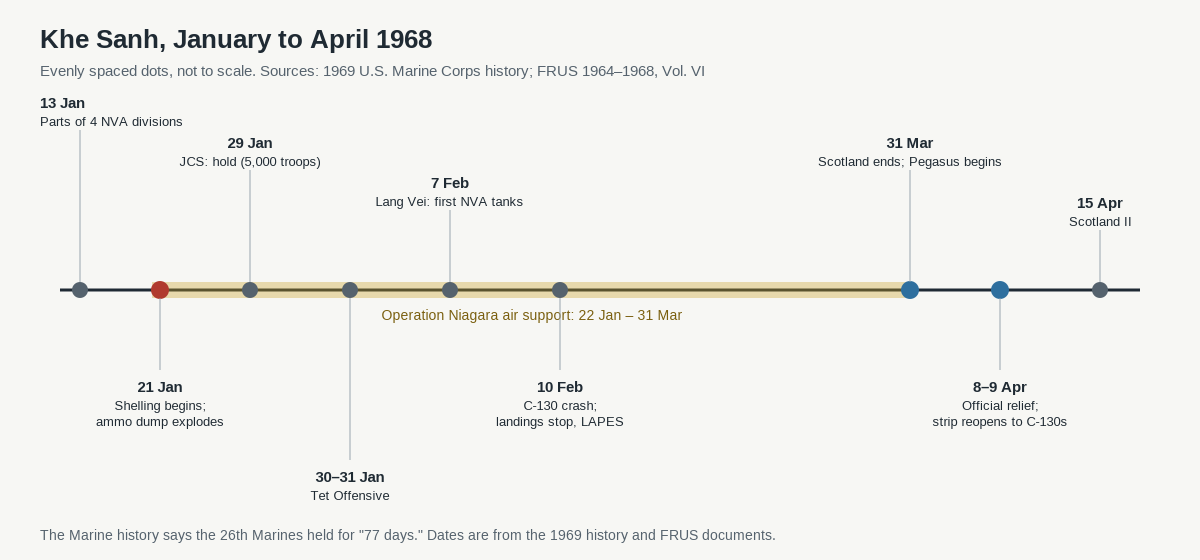
Intelligence pointed the same way. A 13 January 1968 memo from Earle G. Wheeler, chairman of the Joint Chiefs of Staff, to the secretary of defense carries a footnote on a CIA report of 8 January. That report said parts of four North Vietnamese divisions had moved into the Khe Sanh area to prepare an attack.
In the Marine history, the 325C Division came back to the area north of Hill 881N. The 304th Division, which had fought at Dien Bien Phu, crossed from Laos and set up southwest of the base.
Here are the numbers. A 29 January memo from the Joint Chiefs to President Johnson put the Khe Sanh garrison at 5,000 U.S. and South Vietnamese troops and recommended holding the position. The North Vietnamese force in the hills around it was estimated at 15,000–20,000.
21 January: the morning the ammunition dump blew up
The siege is usually dated from 21 January. At 05:30 that day, mortar rounds, artillery shells and 122 mm rockets fell on the base. One of the first rounds hit the largest ammunition dump, near the east end of the runway, and thousands of rounds were lost as they exploded or burned.
Soldiers were not the only people inside. The local district office, the Huong Hoa District Headquarters, kept working inside the base perimeter for the whole siege.
Nine days later, on 30 January, attacks in parts of the I and II Corps areas opened the Tet Offensive. Before dawn on 7 February, the nearby Special Forces camp at Lang Vei came under attack. It was the first time North Vietnamese troops used tanks in the South.
Supplies that could only come by air
At first, large transports landed on the strip and unloaded. On 10 February, a Marine C-130 full of fuel bladders was hit by gunfire as it came in and caught fire. After that crash, the way cargo was unloaded changed sharply, and C-130 landings at Khe Sanh stopped.
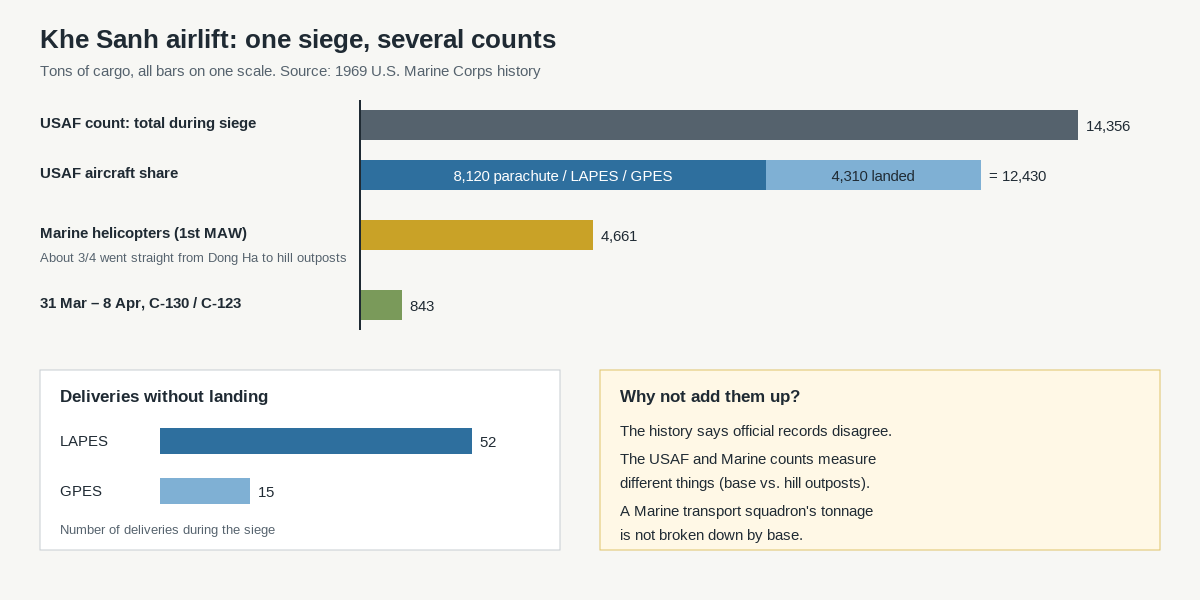
The replacement was the Low Altitude Parachute Extraction System, or LAPES. The aircraft flew along the runway a few feet up without touching down, and an opened parachute pulled the cargo out through the rear door. The siege saw 52 LAPES deliveries. The Ground Proximity Extraction System, or GPES, used a hook at the back of the aircraft to drag cargo out, and it was used 15 times.
Plain parachute drops went on as well. How transports are built to carry heavy loads is covered in the military transport aircraft article.
So how much got in? There is no single answer. The Marine history explains that the official records do not agree, which makes an exact total hard to fix.
In the count of the U.S. Air Force Historical Division Liaison Office, 14,356 tons arrived during the siege, 12,430 of them by Air Force aircraft. Of that, 8,120 tons came by parachute and extraction, and 4,310 tons by aircraft that landed.
The 1st Marine Aircraft Wing records count something else. Marine helicopters alone carried 4,661 tons, but about three-fourths of that went straight from Dong Ha to the hill outposts and never passed through the main base. Because the two counts measure different things, they cannot be added together.
Niagara: the bombs around the base
The sky did more than bring supplies. Air support aimed at the area around the base was named Operation Niagara, and it ran from 22 January to 31 March. Every service took part, from Marine, Air Force and Navy units to the South Vietnamese air force and Army aviation companies.
The scale of the plan shows in the 29 January memo of the Joint Chiefs. It called for about 40 sorties a day by B-52 strategic bombers and about 500 by tactical aircraft. Afterward, the Marine history listed fixed-wing tactical sorties as 7,078 for the Marines, 9,684 for the Seventh Air Force and 5,167 for the Navy. An Air Force CHECO report credits the Marines with 6,385 instead, so the records split here too.
Over the siege, U.S. forces dropped more than 100,000 tons of bombs, along with 150,000 rounds of artillery fire. That is several times the weight of everything flown in to the base.
Would it be "an American Dien Bien Phu"?
In 1954, at Dien Bien Phu, the Viet Minh side won a decisive victory over a French garrison. Fourteen years later, many Americans worried that Khe Sanh would share that garrison's fate. The concern was that it was an isolated base, and once Route 9 was blocked, everything had to come in by air. People who held this view wanted to pull out.
Washington was split two ways as well. Wheeler's January cable weighed turning an attack on Khe Sanh into "Dien Bien Phu in reverse" against a withdrawal because the enemy seemed to be preparing another Dien Bien Phu.
In Vietnam, where the decision was made, there was little disagreement: Westmoreland and Marine Lieutenant General Robert E. Cushman Jr. agreed to hold. The Marine history gives as its first reason why Khe Sanh did not become Dien Bien Phu the overwhelming fire support that the French had lacked.
A second question is who was pinning down whom. The FRUS editors list "draw strength away from Khe Sanh" among the aims of the Tet Offensive. In that picture, the attacks on the cities helped the fight at Khe Sanh. During the siege, Hanoi radio pushed the opposite line, saying that 20,000 North Vietnamese troops had "tied down" the 26th Marines.
Whether Khe Sanh was the real target or a place to hold American attention and strength has not been settled one way. Wheeler's remarks on Khe Sanh in late March were also recorded a little differently in different documents, and that story continues in the Tet Offensive article.
Operation Pegasus and the 77 days
The siege ended when the road opened again. On 31 March, Operation Scotland, the operation covering the Khe Sanh area, ended, and Operation Pegasus began under the U.S. Army 1st Air Cavalry Division. Control of the 26th Marines passed to that division, and Marine and South Vietnamese airborne units moved to reopen Route 9.
The official relief came at 08:00 on 8 April, when the division's 3rd Brigade moved its command post into the base. From 31 March to 8 April, C-130s and C-123s delivered 843 tons by parachute and extraction. Only on 9 April did the strip reopen to C-130s.
Operation Scotland II began on 15 April. Three days later, the new commander of the 26th Marines and two of its battalions moved to Quang Tri. The Marine history says these men had held out for "77 days."
What the numbers say and do not say
The human losses were also recorded. During Operation Scotland, from 1 November 1967 to 31 March, U.S. losses were 205 killed, 852 wounded and evacuated, and 816 with minor wounds. In Operation Pegasus, 41 U.S. Army soldiers, 51 Marines and 33 South Vietnamese troops were killed.
North Vietnamese losses are less certain. The Marines counted 1,602 bodies around the perimeter. The same history estimates total North Vietnamese deaths at 10,000–15,000, yet it also says the real extent of their losses was never determined. During Pegasus, North Vietnamese losses were counted separately at 1,304 killed and 21 captured.
All of these figures were counted by the American side. Each operation also covers a different span of time, so the "casualties of the Battle of Khe Sanh" cannot be given as one number.
The base afterward
Once the siege was lifted, Khe Sanh's role changed. Westmoreland wrote that with better weather, more troops and helicopters, and a secure forward base built over the mountains to the east, the Khe Sanh base lost its earlier importance. Its supplies were drawn down, and the base was taken apart.
That the base held for 77 days and was then dismantled by its own side after the siege kept the questions about Khe Sanh alive for longer. Whether holding it was right, and what the place was from the start, still sit side by side with the records. The war as a whole is covered in The Vietnam War at a Glance.
Read next
- The Tet Offensive: When the Military Result and Public Opinion Split: the offensive across South Vietnam at the same time as Khe Sanh
- The Battle of Hue, 1968: A Month in the Heart of a City: the longest city battle of the Tet Offensive
- Military Transport Aircraft: Planes That Can Carry a Tank: how the aircraft behind the airlift are built
- The Vietnam War at a Glance: 1955 to 1975: the wider war around Khe Sanh