Picture a radio that suddenly gives nothing but static. When home Wi-Fi drops, it is a short annoyance. When the link between two military units drops, orders do not arrive and reports do not come back.
So military communications start from the idea that a link will drop sooner or later, not that it will always work. The public ideas for living with that fall into three groups. Layer several paths, hold data during an outage and send it later, and decide ahead of time what to do when the link is lost. The last part looks at how links made of laser light fit into this picture.
Losing the link is not the exception
Today the military leans heavily on the electromagnetic spectrum. Nearly every modern weapon system, from airplanes and satellites to tanks, ships and radios, needs the electromagnetic spectrum to work. Commanders have also grown used to reaching their forces almost instantly.
Radio waves only reach so far. Ground radios usually work over short distances, limited to what lies within the line of sight, and the Congressional Research Service (CRS) puts those ranges at 50 miles at most. Longer distances are generally covered through satellites.
Then there is interference on purpose. Electronic jammers are used to keep an adversary from using the spectrum, and they can block communications on land as well as in space. In a 2013 strategy, the Department of Defense called the commercial sector's growing demand for spectrum "congestion." In a 2017 strategy, it used "contested" for adversaries building systems to push back against U.S. dominance in the spectrum.
This weighs most on plans that tie everything into one network. The Defense Department's Joint All-Domain Command and Control (JADC2) concept aims to connect sensors from every military service into a single network. Some analysts ask if such a network could reliably and securely tie sensors to weapons and back up command and control where fighting is deadly and electronic warfare is heavy. As long as that question stands, a lost link is not an exception but a condition to plan for first.
Never trust one path: layering the routes
When home internet fails, you switch to mobile data, and if that fails too, you make a phone call. Military communications plans can write down the same idea. Unlike at home, though, the next option is not found after the link drops; the order is set in advance.
A U.S. Army article describes such a plan under the name PACE. The letters stand for primary, alternate, contingency and emergency. For one Army transportation brigade, the plan provides these four levels of backup resources so the network stays ready and effective at a contested or congested port. If the primary and alternate systems do not work, communications move over to a contingency medium.
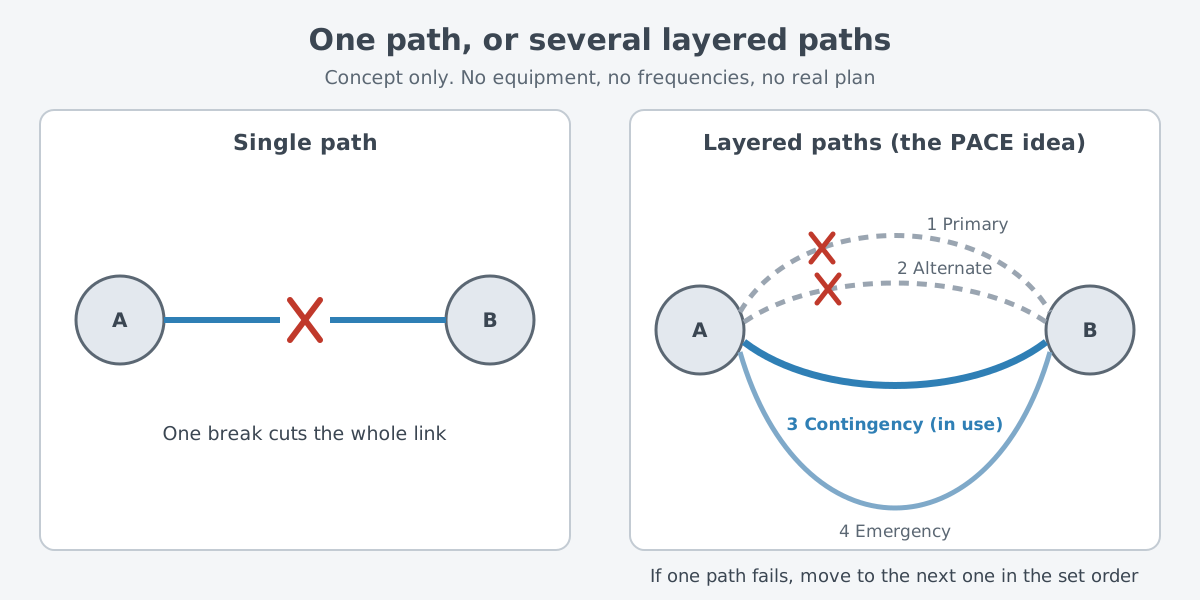
The unit's exercise showed that it could respond to system outages. The threats it keeps building resilience against include cyber, electromagnetic and digital threats, and natural disasters as well. A lost link does not always come from an adversary.
Satellite networks are drawn with overlap in mind too. The Space Development Agency (SDA) plans its Transport Layer to provide assured, resilient connectivity. The goal is that with the full constellation, 95% of places on Earth will always see two or more of its satellites, and 99% will see at least one. The network is also linked dynamically for fault tolerance.
Losing the link without losing the data
Even with several paths, there are moments when every path is blocked for a while. What happens to the data that was on its way?
Space communications live with this problem all the time. Delays are frequent in space, and often there is no link that runs all the way from sender to receiver. The Delay/Disruption Tolerant Networking (DTN) approach that NASA uses gets around this with store-and-forward.
When the connection between two nodes breaks, each node holds on to the data and waits until it can reach the next node. It is a bit like an email sitting in the outbox until a network connection comes back. Unlike a single email, though, the data passes through several nodes in turn, and DTN can also use multiple paths and providers to deliver it.
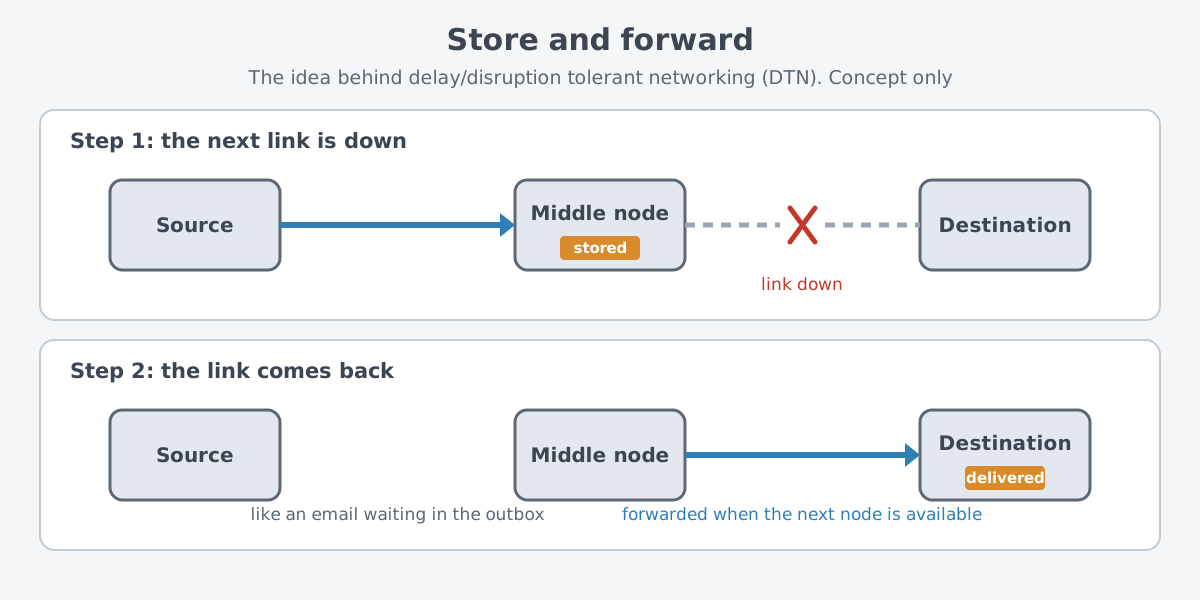
This approach is already in use. Now that NASA's DTN project is complete, DTN is an operational service in both the Near Space Network and the Deep Space Network. On one science spacecraft, DTN handled unplanned disruptions by resuming the downlink once the link became available again. That is civil space communication, but it deals with the same question as military communications: designing as if a lost link were one of the normal states.
What a machine does when the link drops
A crewed airplane and a remotely piloted drone are in very different places when the link drops, as a footnote in a 2012 CRS report shows. An F-16 is fairly likely to keep flying if it loses contact with the people on the ground. A drone that loses contact with its ground operators is unlikely to keep flying. Except for the few models that fly autonomously, drones need people on the ground to step in and steer them all the time.
Drones even have a name for the moment the connection is lost. The Federal Aviation Administration (FAA) glossary calls it a lost link. It means the control link is cut off or lost, or the pilot cannot control the aircraft, and as a result the uncrewed aircraft flies a predictable or planned maneuver. There are two kinds of link: an uplink that sends commands to the aircraft, and a downlink that sends back its status and gives the pilot situational awareness.
The key idea is deciding ahead of time. A lost link procedure is a set of preprogrammed or predetermined steps that keep the uncrewed aircraft operating safely after a lost link. What to do is settled before the link breaks, not worked out afterward. That is the same idea as the PACE plan above.
Where this meets lasers: links made of light
Most military communications use radio and microwave frequencies, but emerging communications technologies send laser light between antennas instead of radio waves. The military has started to use lasers for talking to satellites as well. SDA's satellites are linked to each other by Optical Inter-Satellite Links (OISLs). These perform significantly better than existing radio crosslinks.
The reason for using light is the amount of data. For NASA's missions, radio frequency links cannot carry higher data rates without larger antennas or more powerful transmitters. NASA lists four gains for optical links: more speed, more security, less weight and more flexibility.
The security gain has a reason behind it. Optical terminals use narrower beams than radio systems, so the spot they light up is small. That sharply cuts the area where a link can be intercepted or received. The terminals are also smaller, lighter and use less power, which reduces size, weight and power (SWaP).
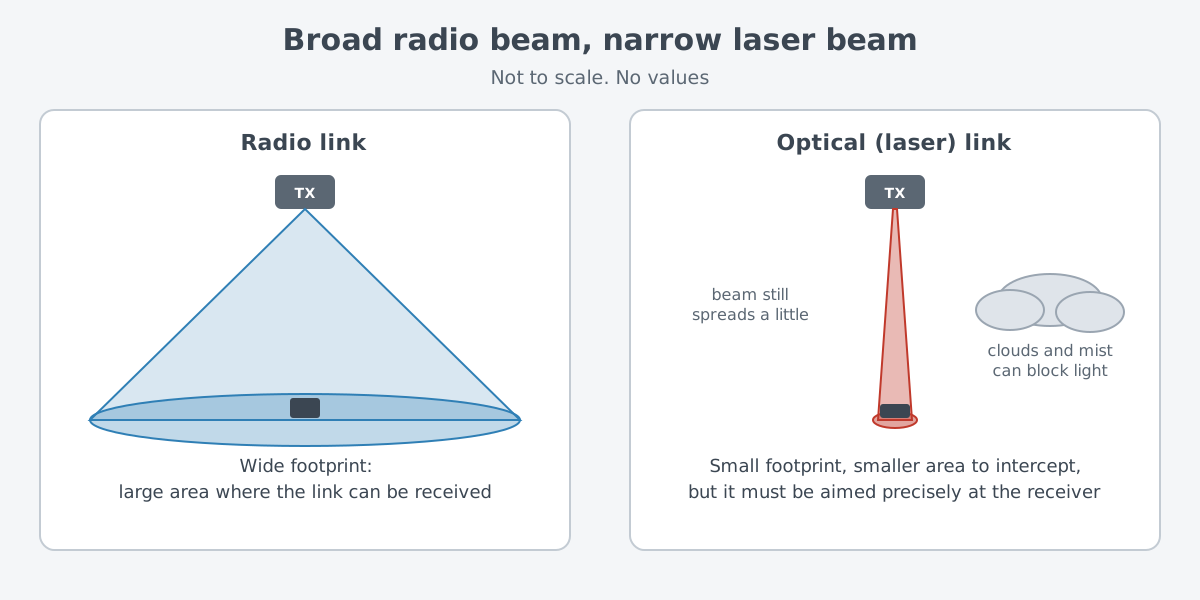
A narrow beam has limits too: radio can blanket an area with a broad beam, but light must be pointed straight at the receiver. Over distances of thousands or even millions of miles, a pointing error of even a small fraction of a degree can be enough for the laser to miss the receiver. A laser beam in space spreads out just like one on the ground, and the angle at which a beam opens up is called beam divergence. As the beam spreads, the light thins out and the data gets harder to recover, and clouds and mist can cut the link entirely.
The fixes look much like the earlier parts of this article. NASA points to building several ground stations, so that a signal can be sent to another station when one is under clouds. DTN and satellite arrays are among the other approaches being studied. A laser link, too, ends up working alongside layered paths and a network built to ride out a lost link.
What to read next
- Tactical data links: when equipment shares information. It looks at what the links that must survive a drop actually carry.
- Jamming and spoofing: interference versus deception. It explains, as a concept, the interference that can cut a link.
- Why a beam spreads: divergence, focus and aperture: why a laser beam slowly spreads out.
- Light through air: absorption, scattering, turbulence, thermal blooming: how clouds and air block and scatter laser light.