Stand at a window and look outside, and you see the view with a faint copy of your own face on top of it. Glass lets most light through but sends a little of it back. Wherever lasers are used, this everyday effect is strengthened and shaped on purpose.
A part that divides one beam into two is a beamsplitter. When it divides by share of strength, it is an ordinary beamsplitter. When it divides by color, it is a dichroic mirror, which reflects some colors and passes others.
Both look like coated glass plates or blocks. What happens inside depends on how they divide the light. The path below starts with plates and cubes and goes on to lab benches, space telescopes, history and eye safety.
Why a sheet of glass splits light
When light meets a thin film or a glass surface, part of it is reflected and part is refracted into the material. That is the faint reflection in a window. A beamsplitter carries an optical coating on its surface that sets those shares of reflection and transmission.
The split is written as a ratio of reflection (R) to transmission (T). A 50/50 split, half and half, is a common example. Where polarization does not matter, an ordinary beamsplitter divides unpolarized light, such as natural light, at a set R/T ratio.
The same part can also run in reverse. It then takes two different beams arriving from two directions and merges them into one. The fact that a splitter is also a combiner becomes important again in beam combining.
Plates and cubes
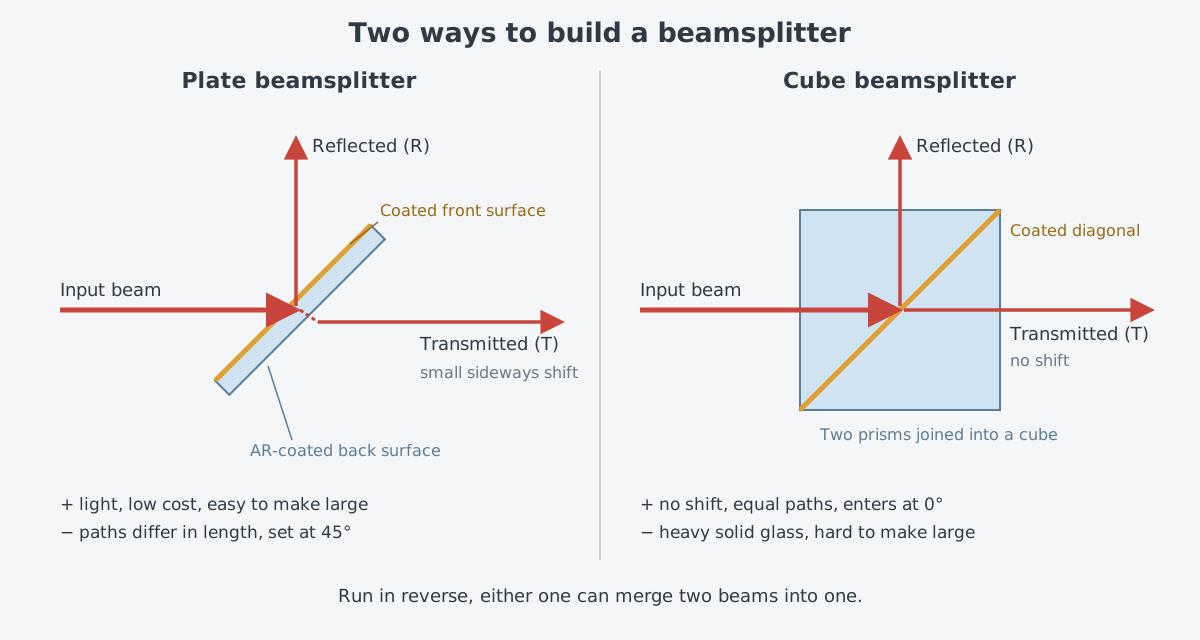
Beamsplitters are usually grouped by how they are built: plate or cube. A plate beamsplitter is a thin, flat glass plate with a coating on its first surface. Most also have an anti-reflection coating on the second surface to remove the unwanted reflection from the back. They are usually designed to sit at 45° to the beam.
A cube beamsplitter is usually made from two right-angle prisms. The long face of one prism is coated, and the two are joined into a cube. Light goes in straight at the face, at 0°.
Each design gains where the other loses. According to an Edmund Optics note, plates are light, fairly cheap and easy to make in large sizes. But the reflected and transmitted paths differ in length, light passing through the tilted plate is shifted slightly sideways, and the 45° angle can take extra time to align. Cubes do not shift the beam and give both paths the same length, but they are heavy solid glass, hard to make large and more expensive.
Splitting by polarization
Light is a wave that vibrates across its direction of travel, and the direction of that vibration is its polarization. How much light a tilted surface reflects depends on polarization. Reflected light is partly polarized, and near Brewster's angle it becomes highly polarized.
For beamsplitters the two polarizations are called s and p. In s-polarized light the electric field lies in the same plane as the reflecting surface. In p-polarized light the field has one part along the surface and one part normal to it.
A polarizing beamsplitter sends s-polarized light one way by reflection and p-polarized light the other way by transmission. It can split unpolarized light half and half, and it is used where polarizations must be separated, as in an optical isolator. A non-polarizing beamsplitter does the opposite job: it divides light at a set ratio and keeps the original polarization.
The separation is not perfect. Beamsplitters usually reflect s-polarized light well but do not stop p-polarized light from reflecting as well. So the transmitted light is almost free of s-polarization, while the reflected light still carries some p-polarization. Polarization itself is covered in Polarization: the direction in which light vibrates.
Splitting by color: dichroic mirrors
A soap bubble in sunlight shows rainbow colors. Light reflected from the front and back of the film overlaps and shows interference, called thin-film interference. The brightest colors are the ones that interfere constructively.
Which colors are strengthened depends strongly on the film's thickness compared with the light's wavelength. Light reflecting at a boundary with a material of higher refractive index also flips its phase by 180°, and that has to be counted too. A film of fixed thickness therefore reflects each color differently.
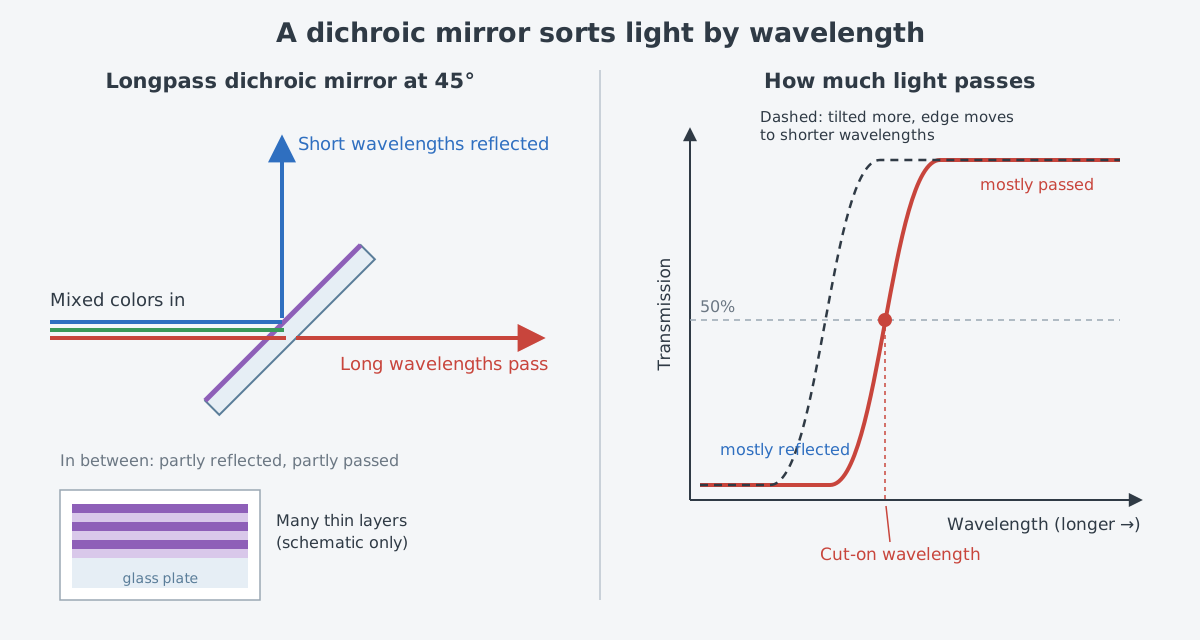
A dichroic mirror is a glass plate coated with many such thin films. It passes or reflects light depending on wavelength. An absorptive filter, such as colored glass, blocks light by absorption in the glass, while a dichroic filter turns unwanted wavelengths away by reflection. The reflected light leaves along another path, so a dichroic mirror acts as a beamsplitter that divides light by color.
Its shape depends on the job. A longpass filter passes wavelengths longer than a set edge, and a shortpass filter passes shorter ones. In a longpass filter, the wavelength where transmission rises to 50% is called the cut-on wavelength.
Some types have their own names. A cold mirror reflects visible light and passes infrared, and it is used where heat buildup would cause trouble. A hot mirror does the reverse, reflecting infrared and passing visible light, and it is mainly found in projectors and lighting. Edmund Optics also lists laser beam combiners made for specific laser wavelengths as dichroic beamsplitters, and notes that this type is common in fluorescence work.
Tilt it and the color shifts
Dichroic mirrors have one awkward trait. Absorptive filters are not very sensitive to angle, but dichroic filters are extremely sensitive to it. According to the company note, as a rough rule a larger angle of incidence moves the edge toward shorter (bluer) wavelengths, and a smaller angle moves it toward longer ones.
Used outside the angle it was designed for, a dichroic filter cannot meet its original transmission and wavelength specifications. A dichroic mirror made for 45° and set at another angle will divide the colors at a different edge. For a dichroic mirror, the mounting angle is part of the specification.
From the lab bench to a space telescope
The most common job is picking off a little light to measure it. A reflectivity setup in Keller's textbook uses an uncoated glass plate with a small wedge as its beamsplitter. The reflection from the front of the plate is proportional to the incoming power, so measuring that weak reflection tracks the power as it rises and falls. A lab bench where beam splitters send light to a power meter and a beam-shape instrument is drawn in Inside a laser lab.
The same book describes splitting a beam into two of equal intensity and delaying one by changing the path length in one arm. This is a way to measure very short pulses. In lasers pumped by diodes, a dichroic mirror sends the pump light and the laser output along different paths. In one experiment the crystal was pumped through a dichroic beamsplitter that passed the pump light and reflected the output beam.
Beamsplitters also sit at the center of precision measurement. A Michelson interferometer splits light in two, sends the halves along different paths and then recombines them to make interference fringes. In the LIGO gravitational-wave detector, laser light likewise goes from a beam splitter into two arms, each 4 km long. In each arm the light bounces between mirrors about 300 times before it merges with the light from the other arm.
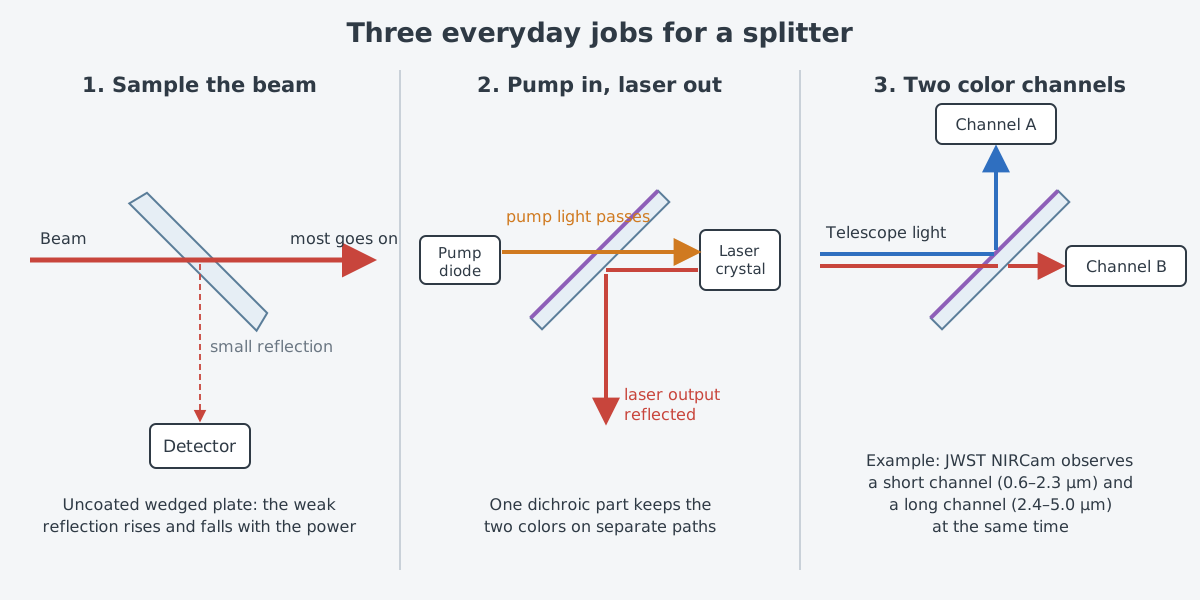
Space telescopes divide light with dichroics too: the James Webb Space Telescope (JWST) carries a Near Infrared Camera (NIRCam) that covers 0.6 to 5.0 μm. According to the operator's documentation, it has two nearly identical modules. Each uses a dichroic to watch two channels at once: one for shorter wavelengths (0.6–2.3 μm) and one for longer wavelengths (2.4–5.0 μm). In effect, it views roughly the same field in two wavelength bands at once.
A splitter is also a combiner
Run a beamsplitter in reverse and two beams become one. This links directly to beam combining, which is used to raise laser power. Coherent beam combining: the principle, from published reviews presents the beam splitter as the simplest combiner. With the phases of two identical beams matched, the combined light can be gathered into one output.
How beams of different colors are overlapped is covered in Spectral beam combining in detail. The company nLIGHT, which makes defense lasers, says a laser it calls 10 kW-class uses its own method called dichroic beam combination (DBC). The name includes "dichroic," but the public page does not explain the principle. So how dichroic mirrors are used inside it is not known.
From half-silvered mirrors to multilayer films
Mirrors that divide light are an old tool. In the textbook, the interferometer of the American physicist Albert A. Michelson (1852–1931), who invented it, is drawn around a half-silvered mirror. The beam strikes this mirror, and half is reflected to the side while half passes through.
Coating glass with thin films on purpose grew up in the 20th century. The groundwork came from General Electric in the 1920s and 1930s, where Irving Langmuir and Katharine Burr Blodgett worked. Blodgett patented her nonreflective glass in 1938, and it was used almost at once in filming Gone With the Wind. Even so, such nonreflective coatings only partly cancel other wavelengths.
The abstract of a 1953 review of dichroic mirrors in the SMPTE journal (Society of Motion Picture and Television Engineers) sums up what followed. During World War II, coating glass with thin films moved from laboratory work to practical use in optical devices, and by then almost every lens carried an anti-reflection coating. Glass plates with multilayer films, called dichroic mirrors, were already serving as efficient light dividers. One of the best known uses was experimental color television equipment.
Split beams and the eye
A beamsplitter does not destroy light; it sends it two ways. The picked-off light may look weak, but it is a reflection from a smooth, mirror-like surface. A dichroic mirror also sends unwanted colors off in another direction instead of absorbing them.
A laser safety handbook from the University of Texas at Austin describes the worst-case exposure. It occurs when a direct beam or a specular (mirror-like) reflection enters an eye that is focused far away. The same handbook notes that more beam stops along the path may be needed so the useful beam stays within the experimental area.
Each added beamsplitter adds one more light path to watch. Laser classes and eyewear labels are covered in Laser safety: classes and how to read eyewear labels.
What to read next
- Interference and diffraction: how light adds up and spreads: the interference behind dichroic mirrors, from the beginning.
- Mirrors, lenses and coatings: optics for strong light: the parts that work alongside beamsplitters in an optical system.
- Optical Coatings and Laser-Induced Damage Threshold: what the films of a dichroic mirror must withstand under strong light.
- Isolators and fiber components: keeping light from going backwards: parts that use polarizing beamsplitters.