Sunlight glints off a calm lake. Put on polarizing sunglasses and the glare drops noticeably. What did the glasses filter out of that light?
Polarizing sunglasses sort light by the direction in which it vibrates. That direction is called polarization. If you have met an unfamiliar name like optical isolator in an article about laser parts, that part's job is usually to pick or change this direction of vibration too.
What polarizing sunglasses filter out
Light reflected from water or glass is polarized. That is why polarizing sunglasses cut the glare in reflected light. After reflection, more of the light vibrates horizontally.
Yet no matter how you turn a polarizing filter, it cannot black out the reflection completely. The reflected light is only partially polarized. Light from a blue sky is partially polarized too, because it is light scattered by the air.
So what exactly points in which direction when light is "polarized"? The answer lies in what kind of wave light is.
Polarization is the direction of the electric field
The light basics article said that light is one type of electromagnetic wave. An electromagnetic wave is a transverse wave: its electric and magnetic fields oscillate at right angles to the direction of travel. Because the oscillation is at right angles to the travel, it can point in many directions within that perpendicular plane.
Polarization is the property that a wave's oscillations have a definite direction relative to the direction of travel. For an electromagnetic wave, the direction of polarization is defined as the direction parallel to the electric field. So in this article, "the direction in which light vibrates" always means the direction in which the electric field vibrates.
Light whose electric field oscillates in one fixed direction is linearly polarized. The Sun and many other light sources are different. Their light is a mix of waves with electric fields in random directions, so every direction of polarization is present. Such light is called unpolarized.
Picture two ropes. You shake one up and down and the other side to side. The first carries a vertically polarized wave and the second a horizontally polarized wave. Pass both through a tall, narrow slit, and the vertical wave goes through while the horizontal one is blocked.
Real light differs from this picture. In a rope, the rope itself moves; in light, what vibrates is the electric field. A polarizing filter is not a board with a slit, either. The filter's molecular structure absorbs the part of the electric field that is perpendicular to a set axis.
In physics, the English word "polarization" also names the separation of charges in a material. That is a different idea from the polarization of light in this article.
Linear, circular and elliptical polarization
The vibration of the electric field can be split into two perpendicular parts. Think of a horizontal part and a vertical part, each rising and falling like a wave. How far their timing, or phase, is out of step decides the shape of the polarization.
If the phase difference between the two parts is zero, they grow and shrink together. The tip of the electric-field arrow then moves back and forth along a straight line. That is linear polarization.
If the phase difference is 90°, a quarter of a cycle, and the two parts are the same size, things change. When one part is at its largest, the other passes through zero, so the tip of the arrow goes around a circle. That is circular polarization. In the general case the tip traces an ellipse, which is called elliptical polarization.
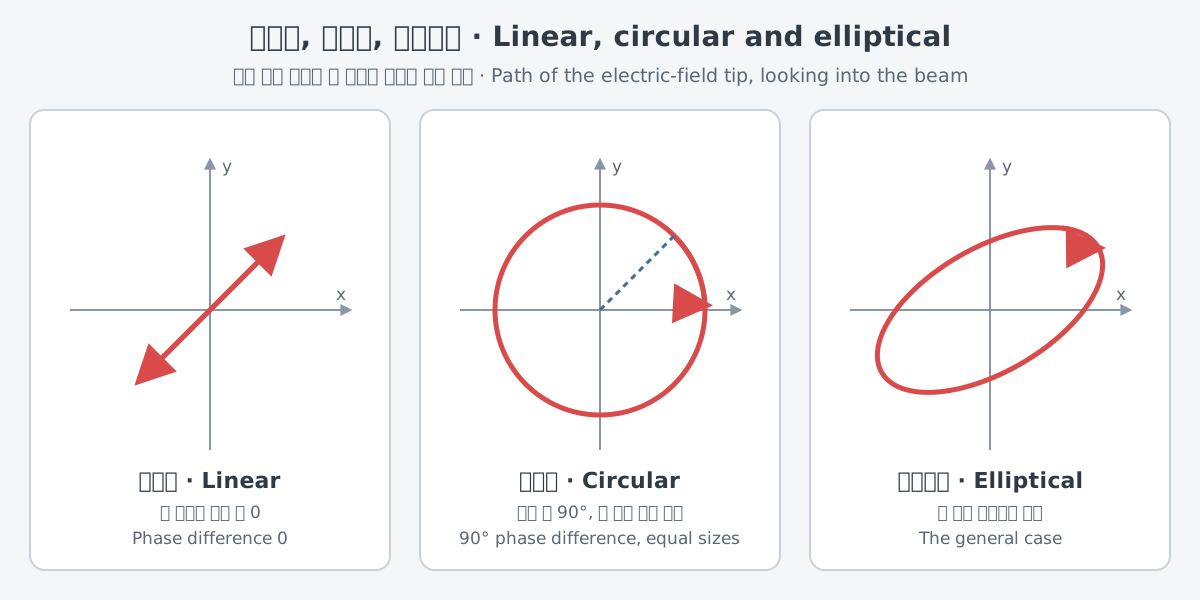
Linear and circular polarization are not separate kinds so much as special cases of elliptical polarization. Flatten the ellipse into a line and you get linear polarization; make it perfectly round and you get circular polarization.
Polarizers and angles: how much gets through
A polarizer is a filter that passes only the electric field along a set axis. Of the incoming electric field, only the part parallel to the axis gets through, and the part perpendicular to it is absorbed.
When unpolarized light passes one polarizer, it becomes polarized along that axis and its intensity drops by half. When this polarized light meets a second polarizer, the angle between the two axes sets how much gets through. With the axes parallel, all the light from the first polarizer passes. With the axes at right angles, none does.
At angles in between, the light follows Malus's law. If θ is the angle between the polarization direction and the polarizer axis, the transmitted intensity I equals the intensity before the polarizer, I₀, times cos²θ.
I = I₀ × cos²θ
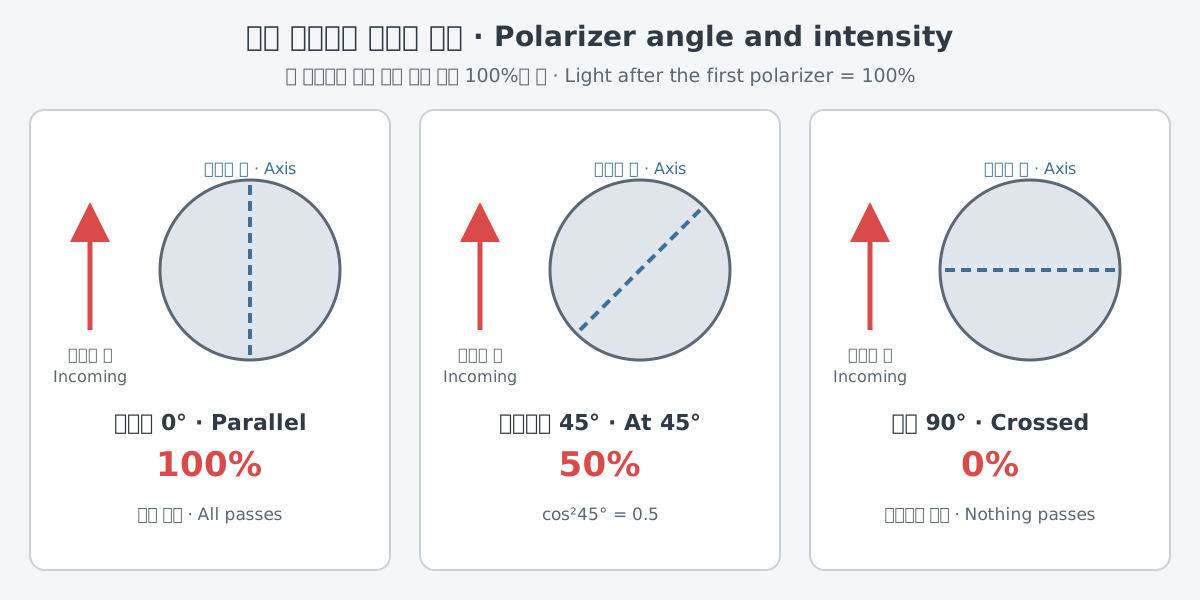
An example in the OpenStax university physics textbook gives a feel for it. With the axes 45° apart, the intensity falls to 50% of its original value. To cut the intensity by 90.0%, the filter has to be turned by 71.6°.
The two steps can be chained. Call the intensity of unpolarized light 100. After the first polarizer it is 50, and after a second polarizer whose axis is 45° off, half of that, 25, is left. This cos²θ is why the brightness changes as you turn one of two stacked polarizers.
Reflection and Brewster's angle
Back to the lake. Light reflected from water or glass was partially polarized, with more of it vibrating horizontally. But at one special angle of reflection, the reflected light becomes completely polarized.
That angle of reflection is called Brewster's angle, written θb. When light goes from a material with refractive index n₁ into one with index n₂, tan θb equals n₂ ÷ n₁. This relation is known as Brewster's law.
In OpenStax textbook examples, Brewster's angle is 53.1° for light going from air into water and 56.7° for air into crown glass. These values come from refractive indices of 1.333 for water and 1.520 for crown glass. As with the angle of reflection in the light basics article, the angle is measured from the normal.
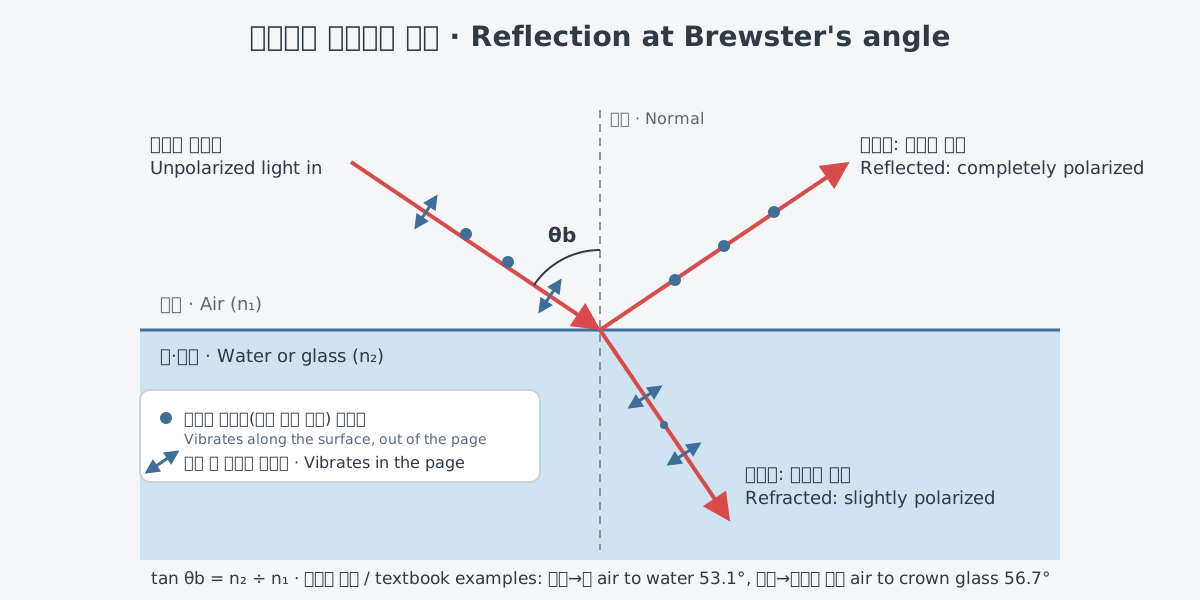
The term plane of incidence is worth knowing here. The plane of incidence is the plane that holds both the incoming ray and the normal; in the diagram it is the page itself.
At Brewster's angle, the only light reflected is the part that vibrates at right angles to the plane of incidence, that is, along the surface. The part that vibrates in the page is not reflected at all and goes in. On a surface lying flat like a lake, the direction along the surface is horizontal, so the reflected light is horizontally polarized.
Even at Brewster's angle, the light that refracts into the material stays mostly mixed. The refracted light is only slightly polarized in the vertical direction. One reflection cannot neatly polarize all of the light.
Birefringence and wave plates: parts that change polarization
A polarizer removes the parts that do not fit. Other parts change the shape or direction of the polarization instead. Wave plates are the main example, and behind them is a property called birefringence.
Some crystals have one refractive index for light polarized in one direction and a different index for light polarized at right angles to it. Such crystals are called birefringent. They split unpolarized light into two beams polarized at right angles to each other, so they can also produce polarized beams from unpolarized light.
Because the refractive indices differ, the two parts fall out of step as they cross the crystal. With the right thickness, the phase difference between the two parts can be changed by exactly 90°. For linearly polarized light at 45° to the plate's axes, whose two parts are the same size, the 90° phase difference gives circular polarization, as shown above. A plate like this is called a quarter-wave plate.
A quarter-wave plate is not a filter. A University of Illinois physics lecture points out that no intensity is lost passing through it.
A half-wave plate turns the direction of linear polarization. A half-wave plate set to turn the polarization 45° in one direction turns it back by the same amount when light passes through the other way. So after a round trip, the total turn is 0°, and the light is back where it started. To change how much it turns the polarization, the plate itself must be physically rotated.
Wave plates and other birefringent optics are widely used to control polarization. But a half-wave plate undoes its own turn on a round trip, so it cannot tell returning light apart from the original light by polarization.
Where polarization matters in lasers
Brewster windows. A laser course from the University of Oldenburg uses a helium-neon (HeNe) laser as its example. The ends of that laser's discharge tube must have low loss inside the optical resonator, so they use windows tilted at Brewster's angle. For an air-glass interface, this is an angle of incidence of 56°. That is close to the 56.7° of the crown glass example above; the value differs a little from glass to glass because refractive indices differ.
Light polarized parallel to the plane of incidence, that is, vibrating in the page, passes a window tilted at Brewster's angle completely, with no reflection. Because light with this polarization builds up resonance with the lowest loss, the laser in that course emits polarized light. In this laser the window is tilted vertically, so the polarization that is not reflected points horizontally.
At the lake, the reflected part was the horizontal one, so this looks reversed. But horizontal and vertical only change with the way the surface sits. In both cases the reference is the plane of incidence.
Polarization-maintaining fiber. Polarization-maintaining (PM) fiber is, as the name says, fiber made to keep the polarization of light. Stress rods built into the fiber deliberately increase birefringence to hold the polarization. One fiber maker says it designed such fiber for applications that need linearly polarized output, and lists industrial, medical and defense laser systems as uses.
Optical isolators. An optical isolator is a part that lets light pass almost freely in one direction and blocks most light coming the other way. An explainer from Coherent, a maker of laser components, compares a Faraday isolator to "a one-way valve for light." A common use is at the output end of a laser or laser amplifier, to protect it from back-reflected light.
If back-reflected light is strong enough, it can damage a laser. Even at much lower levels, it can cause unstable operation, such as noise and power fluctuations.
The effect behind the device is that light passing through a magneto-optic material in a magnetic field has its polarization rotated; according to Coherent, Michael Faraday discovered it in 1845. The part that uses this effect is the Faraday rotator. It is a magneto-optic crystal placed in a magnetic field, and it differs from a half-wave plate in one key way. It always turns the polarization in the same direction, no matter which way light enters.
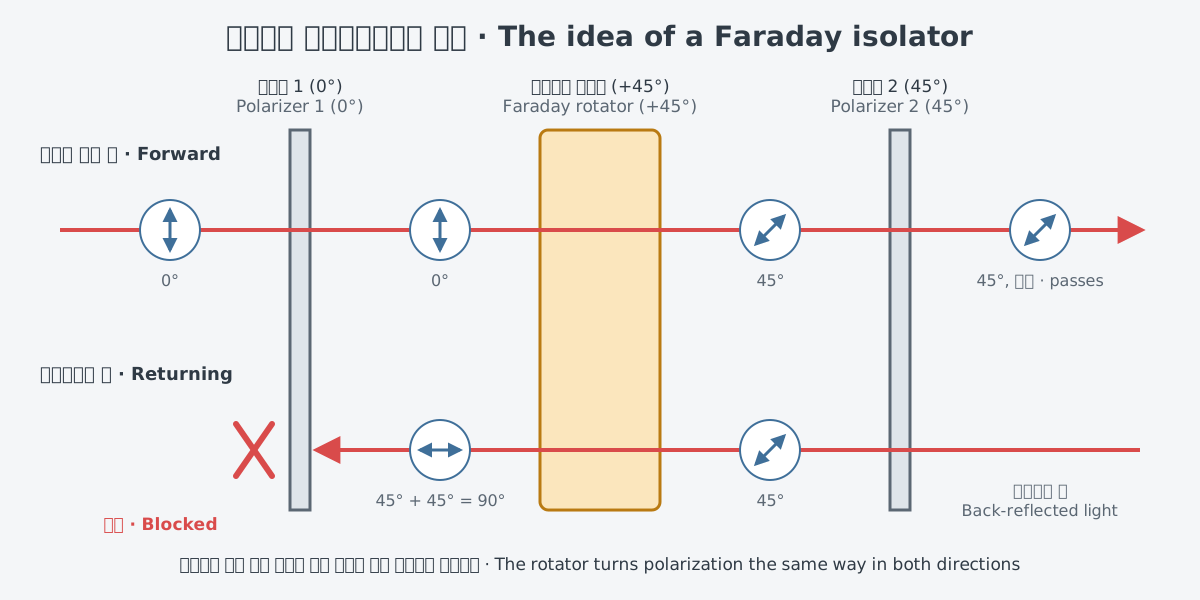
Follow the setup step by step. Linearly polarized light passes polarizer 1, turns 45° in the rotator, and leaves through polarizer 2, which is set to match. Light reflected back from somewhere passes polarizer 2, returns to the rotator, and turns another 45° the same way. Its polarization is now at 90°, at right angles to where it started, and polarizer 1 filters it out.
The valve comparison only matches the result. In reality no door closes; the polarization turns 90° over the round trip, so the light cannot pass the polarizer.
What to read next
- "Isolators and fiber components: keeping light from going backwards": continues from the isolator at the end of this article, from the parts side.
- "How a fiber guides light: core and cladding": the fiber structure that polarization-maintaining fiber builds on.
- "The three parts of a laser: gain medium, pump and resonator": the resonator where Brewster windows sit.
- "Interference and diffraction: how light adds up and spreads": continues the idea of phase from this article.
- Jones matrices and Stokes parameters, which treat polarization with calculation, are a good next step in sections 1.6–1.9 of chapter 1 of Yariv and Yeh, Photonics, 6th edition.