On 20 November 1953, parachutes began to open over a deep valley in Vietnam, not far from the Laotian border. By the next day, five French battalions had landed in and around Dien Bien Phu. The operation was called Castor, French for "beaver."
Less than six months later, on 7 May 1954, the central position of this base fell. Two months after that, cease-fire agreements were concluded at Geneva, and France pulled out of Indochina.
Why a mountain valley? How did a base that depended on two airstrips hold on, and why did the United States never send its bombers? Cables from American diplomats, minutes of the National Security Council (NSC) and an internal Defense Department study let us follow those six months.
A colonial war and American money
After the Second World War, France tried to regain its position in Indochina. When talks broke down in 1946, full-scale war began in northern Vietnam, with Ho Chi Minh's Viet Minh fighting French troops. Laos became independent in 1949 and Cambodia in 1953, while France tried to bring back the former emperor Bao Dai as a rival to Ho Chi Minh.
Why did the United States take France's side in a colonial war? President Eisenhower linked Vietnam to the rest of Southeast Asia with the image of falling dominoes: once one country became communist, its neighbors would go the same way. Washington also needed French help to build NATO and rebuild West Germany.
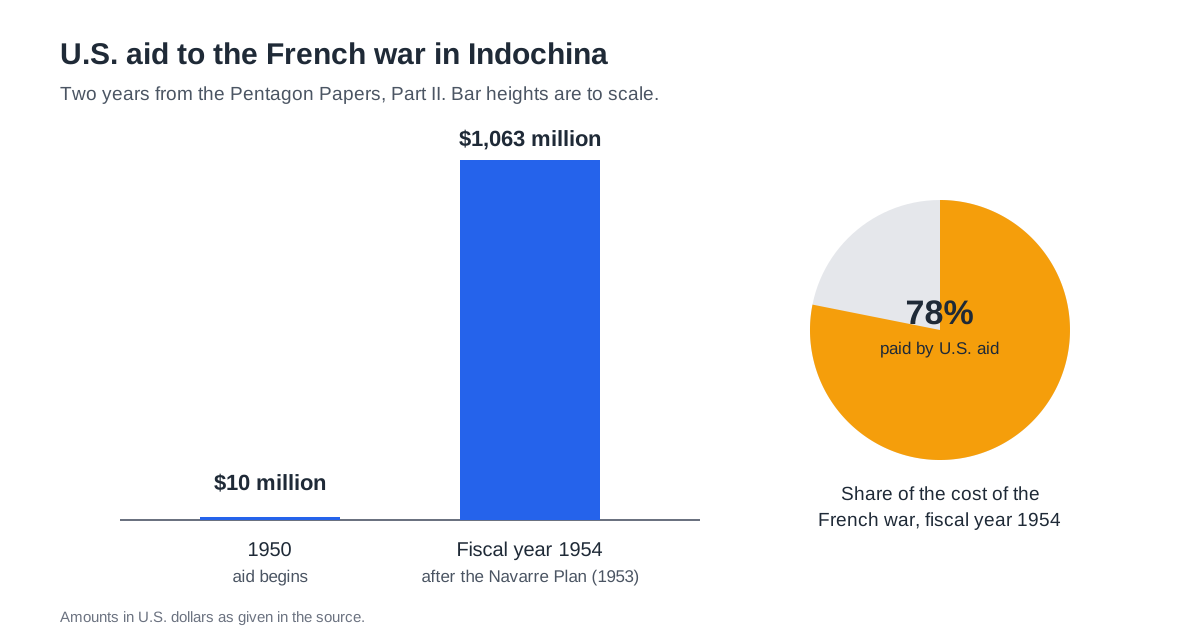
The flow of money shows the change. U.S. aid began with $10 million in 1950 and had grown to $1,063 million by fiscal year 1954. That year it covered 78% of the cost of France's war.
Most of the increase came in the war's last year, after the Navarre Plan was presented in 1953. The plan called for larger French and Vietnamese forces and a strategy to retake the initiative and open the way to victory by 1955. When the Korean War armistice came in 1953, Washington was already deeply tied to the defense of the French.
Parachutes into a mountain valley
Three days after Operation Castor, the U.S. consul in Hanoi passed on a briefing by a spokesman for the French general Cogny. The aim was a base in the region where the Thai people lived.
It would anchor the northern end of the defense of Laos, with the Plaine des Jarres as the southern anchor. It would also launch raiding parties in all directions and support local Thai guerrilla forces. The spokesman stressed that it was a base for offensive operations, not only for defense.
By December, French hopes had become clearer. The French High Command hoped to force a major battle near Dien Bien Phu soon. According to the French Commissioner General Dejean, as reported by the U.S. chargé in Saigon, General Navarre had almost a division there, including two artillery battalions. He was confident of victory if two approaching Viet Minh divisions, the 316th and 304th, chose to fight.
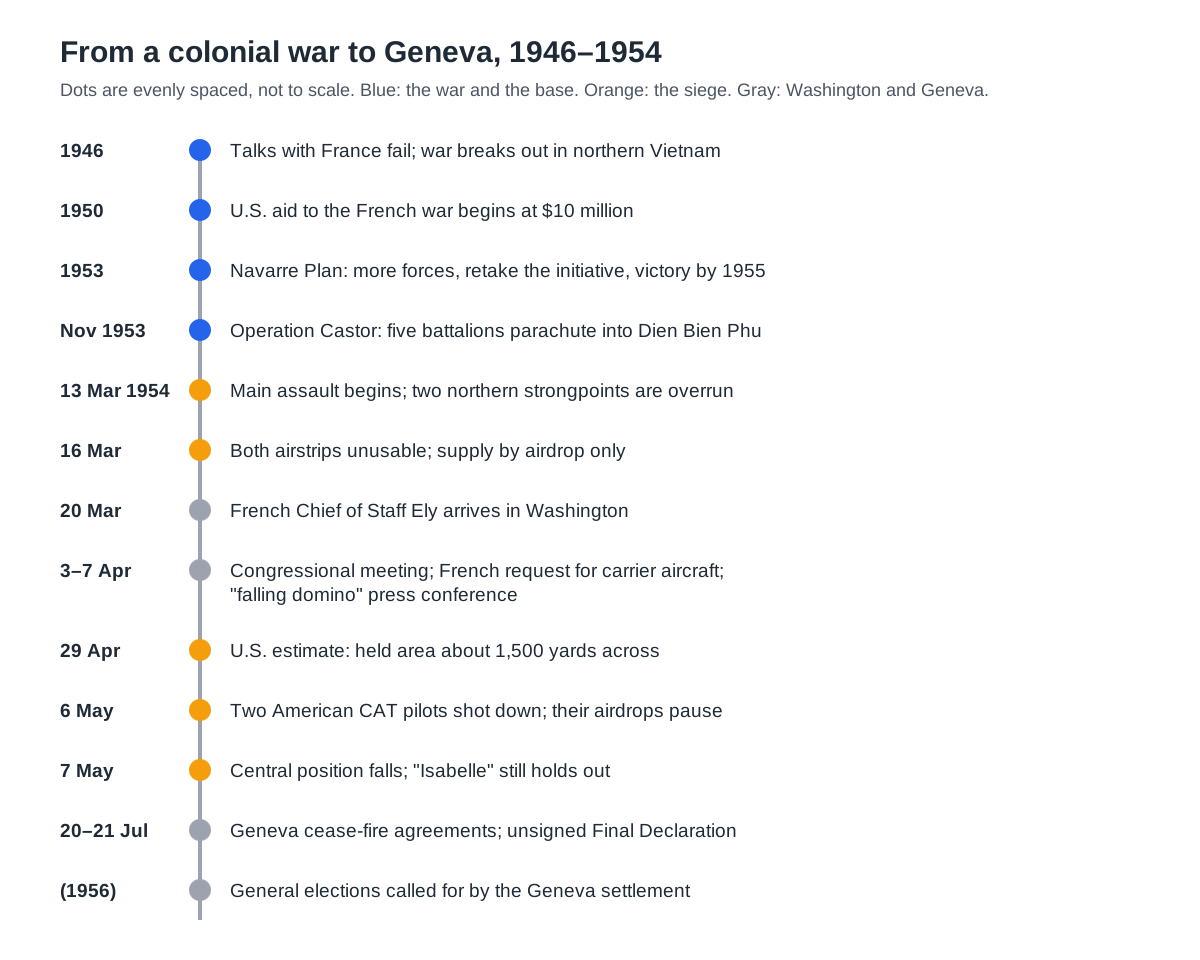
The base sat deep in a valley near the Laotian border and was heavily fortified. It had two airstrips for links with the outside. The timeline below shows where this choice, to draw the enemy in and settle things in one place, ended up.
13 March: the airstrips close
On 13 March 1954, the Vietnam People's Army (VPA), under the direct command of General Võ Nguyên Giáp, began its assault on Dien Bien Phu. Politics shaped the timing. The Indochina question was already on the agenda of an international conference soon to meet in Geneva.
The Pentagon Papers, the Defense Department's internal study, judged that the coming Geneva Conference gave the fortress political and psychological weight far beyond its real strategic value. Around the same time, Dejean told the U.S. consul that the Viet Minh decision to attack was almost wholly political. He called the fight "the crucial engagement of the war."
In the first days, two strongpoints at the northern edge of the base were overrun. "Gabrielle" was held for two days by one Algerian battalion, and "Béatrice" by a Foreign Legion battalion. About 250 men from the two battalions came back. The French side claimed that thousands of Viet Minh soldiers died in front of the two positions.
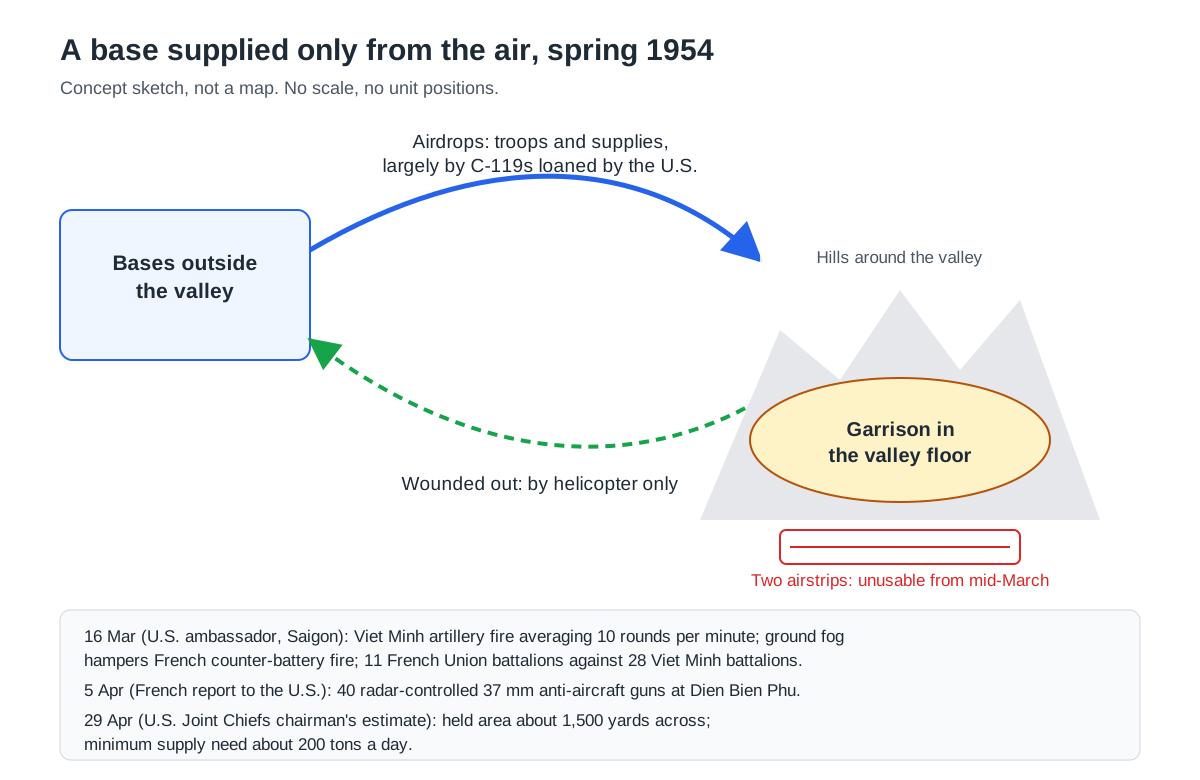
By 16 March, Viet Minh artillery was firing on French positions at an average of 10 rounds per minute. As a result, both airstrips could not be used. From then on, all reinforcements and supplies had to be dropped from the air.
The weather did not help the French either. Ground fog over the valley made counter-battery fire, firing back at the enemy's guns after finding them, almost impossible for French artillery. The same fog made it hard for the French Air Force to find and bomb the Viet Minh guns. At this point, French Union forces had 11 battalions against 28 Viet Minh battalions.
Supply by air alone
With the airstrips closed, logistics at the base became a matter of flying. Reinforcements and supplies alike had to come down by parachute from transport aircraft. These airdrops relied heavily on C-119 transports that the United States had loaned to France.
The way out was even narrower. Only helicopters could carry out the wounded, and the Viet Minh had weapons that could fire on aircraft.
Where did those weapons come from? The Pentagon Papers note that the Viet Minh were greatly helped by a large rise in Chinese military aid, with artillery and radar among it.
A French report given to the U.S. ambassador in early April went further. It said that 40 radar-controlled 37 mm anti-aircraft guns, operated by Chinese crews, were at Dien Bien Phu. Of 1,000 supply trucks driven by Chinese army personnel, 500 had arrived since 1 March. This was the French government's report.
Some of the pilots flying the drops were American. On 6 May, McGovern and Bufford, American CAT pilots flying C-119s, were shot down over Dien Bien Phu by anti-aircraft guns. CAT airdrops stopped for a time and resumed on 8 May.
At an NSC meeting on 29 April, Admiral Radford, chairman of the U.S. Joint Chiefs of Staff, described the base in numbers. By his estimate, the French now held a patch only about 1,500 yards (about 1.4 km) across, which made supply drops very difficult. The garrison needed at least about 200 tons of supplies a day. French casualties were about 5,500, and nearly 1,000 stretcher cases lay in underground aid stations.
At the same meeting, he estimated the French force at about 8,500 infantry and 1,200 artillerymen, facing about 40,000 Viet Minh. General Navarre expected the Viet Minh to take Dien Bien Phu by "asphyxiation."
Hesitation in Washington
Once the siege began, France turned to Washington. On 20 March, the French Chief of Staff, General Paul Ely, arrived in Washington. A name connected with this visit has lasted: Operation Vulture.
French reports cited in the Pentagon Papers describe an informal proposal that Radford made to Ely. About 60 B-29 bombers would fly from Clark Field, near Manila. With 150 Seventh Fleet fighters as escort, they would strike around Dien Bien Phu.
Yet the authors of the Pentagon Papers found no record of Operation Vulture in the files they examined. In a 1965 interview, Radford said planning for an air strike never went beyond the idea stage.
The record of 3 April is also thin. The Pentagon Papers say government documents give no details and rely on published sources. On that day, Secretary of State Dulles and Radford appear to have met, at the State Department, with eight members of Congress: five Democrats and three Republicans. Radford apparently outlined an air strike with 200 planes from the carriers Essex and Boxer.
The next night in Paris, Foreign Minister Bidault, joined by Laniel, called in the U.S. ambassador. Their request: U.S. carrier aircraft had to intervene at Dien Bien Phu right away to save the situation.
At a press conference on 7 April, Eisenhower was asked why Indochina mattered. He named resources such as tin and tungsten, the many people who could come under communist rule, and the "falling domino" principle. Knock over the first domino in a row, he said, and the last one will go over very quickly.
The words were strong, but the decision was cautious. By late March, discussion inside the U.S. government had settled on one point: acting alone without ground forces would not work. Congress and administration officials would not intervene unless a wider coalition acted together. Britain and the other NATO members declined to join a rescue they saw as a lost cause.
7 May and Geneva
At 8:30 p.m. local time on 7 May, Dejean told the U.S. chargé in Saigon that the central position at Dien Bien Phu had fallen. There was no surrender, and scattered fighting went on. The strongpoint "Isabelle" was still holding out.
The next morning, the Director of Central Intelligence gave the NSC the first reports. Viet Minh radio claimed to have taken 17 companies prisoner, or 3,000–4,000 men. General de Castries was probably a prisoner as well.
Who made up the garrison? A table in the Pentagon Papers lists the troops at Dien Bien Phu on 6 May, the day before the fall. There were 393 officers, 1,666 noncommissioned officers and 13,026 enlisted men, 15,105 in all.
Vietnamese soldiers made up over a third of the fighting force and nearly 40% of the enlisted men. Yet they filled only one-sixth of the NCO posts and less than 3% of the officer posts.
With the fall of the fortress, any chance that the United States would step in at Dien Bien Phu disappeared. Eisenhower sent messages to French President Coty and to Bao Dai of Vietnam.
Talks at Geneva went on for more than two months after the fall. On the night of 20–21 July, separate cease-fire agreements were concluded for Vietnam, Laos and Cambodia. An unsigned Final Declaration followed on 21 July. Under Secretary of State Bedell Smith declared that the United States "takes note" of the agreements.
France and the Viet Minh agreed to stop fighting and to split the country, for the time being, at the 17th parallel. Another Geneva agreement set general elections for 1956. Washington did not sign that agreement.
As France left, Washington appointed Ngo Dinh Diem as the leader of South Vietnam and backed the founding of the Southeast Asia Treaty Organization (SEATO). As the State Department's historians put it, the United States then stayed in Vietnam for twenty more years. Dien Bien Phu was where France's war ended, and also where a long American war began to take shape.
What to read next
- Anti-aircraft artillery in the missile age: how the kind of gun that fired on transport aircraft over Dien Bien Phu works.
- Helicopter rotors: how coaxial helicopters fly without a tail rotor: how the helicopters that carried out the wounded lift off and move.
- The Vietnam War at a Glance: 1955 to 1975: the big picture of the twenty years after Geneva.
- Ia Drang and Helicopter Airmobility: the first large battle that U.S. troops fought by helicopter in Vietnam, eleven years later.