An invisible infrared laser beam enters a small, clear crystal. Bright green light comes out of the other side. No paint was mixed in and no filter picked out the green. The color of the light, which is its wavelength, really changed inside the crystal.
The 532 nm green light from NASA's ICESat-2 satellite is made this way. The laser first produces 1064 nm infrared light, and a crystal turns it into light with half the wavelength. The effect is called second-harmonic generation (SHG), and a crystal that does it is called a nonlinear crystal.
How can one crystal change the color of light? This article follows the principle, the first experiment in 1961, and the condition that decides the efficiency. It then looks at where the effect is used and where it runs into limits, using public sources.
Under strong light, matter responds differently
When light reaches matter, electrons bound to atoms are pulled by the light's electric field and start to oscillate. With weak light, this motion is simply proportional to the field. The oscillating electrons send out light at the same frequency as the incoming light. That is why a window pane or a pair of glasses does not change the color of light.
Think of a spring. Pull it a little and it stretches in proportion, but pull it very hard and the stretch no longer follows the force. In reality, electrons do not hang on springs. The point is that treating the force that holds an electron like a spring stops being a good approximation in strong light.
With very intense light, such as a pulsed laser, this approximation breaks down. The response of the material then picks up extra parts that grow with the field squared and with even higher powers. A system whose output depends on the intensity of its input is called a nonlinear system, and doubling the frequency of light is one example.
Twice the frequency, half the wavelength
Why does a square term create a new color? Squaring a sine wave gives a sine wave at twice the frequency. So when strong enough light passes through a suitable material, light at twice the original frequency appears: the second harmonic. The same principle also allows the frequencies of two beams to be added or subtracted.
When the frequency doubles, the wavelength halves. Red light from a ruby laser at 694.3 nm turns into ultraviolet light near 347 nm. Infrared light at 1064 nm becomes green light at 532 nm.
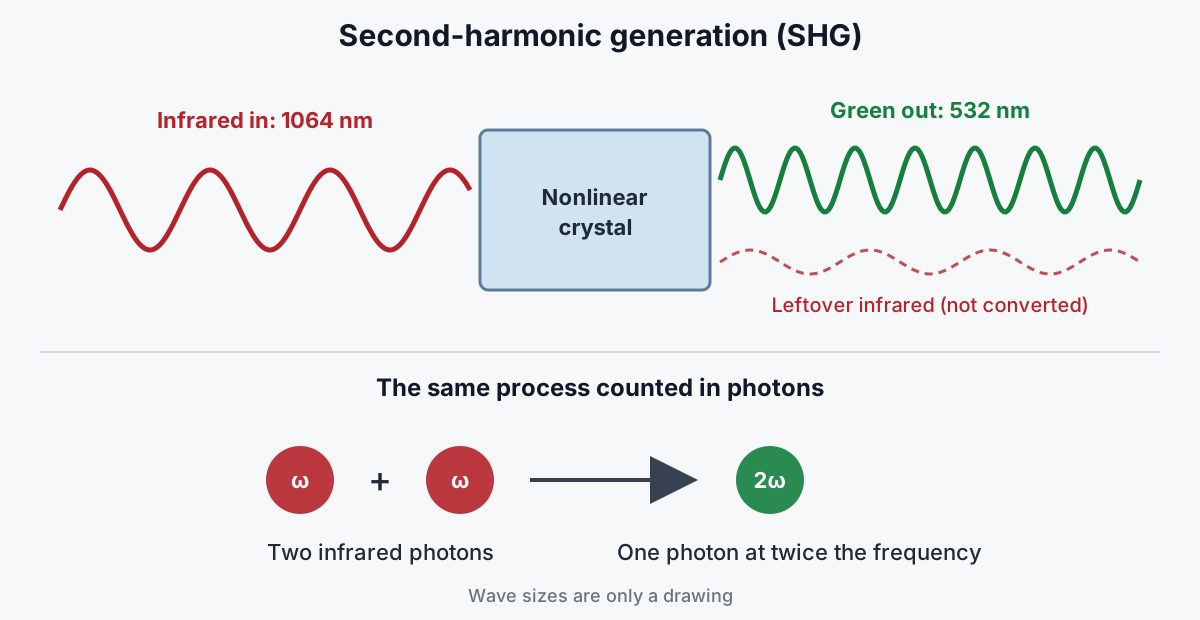
The story is the same if light is counted in particles. The National Ignition Facility (NIF) is run by Lawrence Livermore National Laboratory (LLNL) in the United States. Its user guide explains that the first crystal combines two infrared photons into one second-harmonic photon. Not all of the light is converted, so the light leaving the crystal is a mix of green light and unconverted infrared.
Why not just any material: symmetry
While preparing the 1961 experiment, Peter Franken first planned to use glass or fused quartz. His colleague Gabriel Weinreich pointed out that these materials are too symmetric for frequency doubling to happen.
Here is the reason. In a material with a center of inversion, moving every atom through that center is the same as reversing both the applied field and the polarization it creates. However, the part that depends on the square of the field does not change sign when the field is flipped. The only way to satisfy both conditions is for the square term, the one that doubles the frequency, to be zero.
So second-harmonic generation needs a crystal without a center of inversion. Franken's team chose a single crystal of quartz, a material whose properties depend on direction. Quartz, KDP, lithium triborate (LBO), and lithium niobate, which all appear in this article, are nonlinear crystals used for this kind of conversion.
1961: a faint spot on a photographic plate
Just one year after the first laser in 1960, Franken and co-workers at Ann Arbor's University of Michigan ran a simple experiment. They focused ruby laser light onto a point inside a quartz crystal, split the light that came out with a spectrometer, and recorded it on a photographic plate. The plate showed a large spot from the original light plus a dim spot from light at double the frequency.
When they replaced the quartz with a piece of glass, the faint spot disappeared. That confirmed the new light was a second harmonic made by the crystal. The result appeared as "Generation of Optical Harmonics" in Physical Review Letters, volume 7, pages 118–119 (1961). It is regarded as the first time anyone showed a nonlinear optical effect.
There is a postscript. According to Weinreich, recalling the work in an American Physical Society (APS) article, someone at the printing company took the faint spot for a blemish and erased it. So the published figure does not show the very spot that mattered.
The result inspired Nicolaas Bloembergen and his group to enter the field, and they built the theoretical foundations for describing nonlinear optics with quantum mechanics. Half of the 1981 Nobel Prize in Physics went to Bloembergen and Arthur L. Schawlow "for their contribution to the development of laser spectroscopy." Other nonlinear effects, such as sum-frequency generation and four-wave mixing, were also shown in the early 1960s.
Staying in step: phase matching
Inside the crystal, electrons make a small second-harmonic wave at every point the light passes. These small waves grow only if they stay in step with the waves made earlier. For that, the original light and the second harmonic must travel through the crystal at the same phase velocity. Meeting this condition is called phase matching.
It is a bit like pushing a swing. Push each time the swing moves forward and it rises higher, but miss the timing and push against it, and the swing slows down. In reality, there is no single person pushing once at a time. Countless waves made all through the crystal add up or cancel out by interference, depending on their phase.
When the phases match, energy moves from the original light to the second harmonic with high efficiency. When they are far apart, the second harmonic forms weakly and then flows back to the original light, again and again. Once the two waves fall out of phase, the newly made light cancels the earlier light and the conversion efficiency drops.
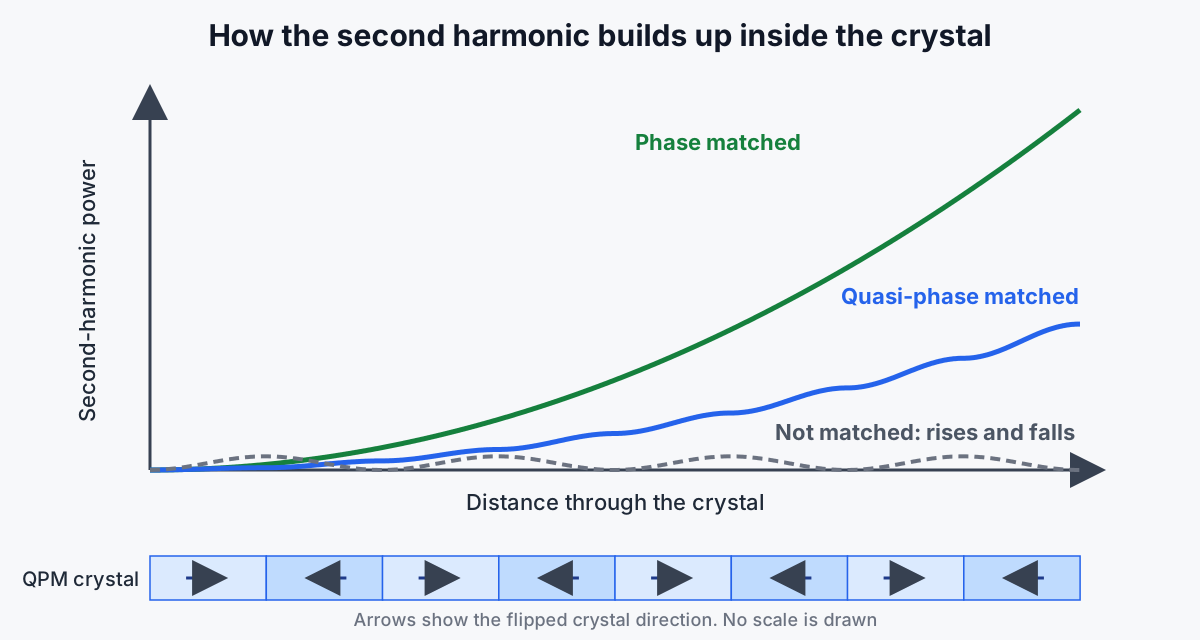
One way to match the velocities is to use a birefringent crystal. In such a crystal, choosing the right polarization for each beam can make the two phase velocities equal. NIF states that it chooses the thickness and cut angle of its crystals for the best conversion efficiency.
Flipping the crystal back and forth: quasi-phase matching
There is still a way when the phase velocities cannot be matched. A crystal whose direction is flipped back and forth at regular intervals can be used instead. This is called quasi-phase matching (QPM). A common example is periodically poled lithium niobate (PPLN).
In such a crystal, the sign of the nonlinear property switches between plus and minus from one section to the next. Just as the new second harmonic would start to cancel the earlier light, the sign flips, so the light builds up again instead of being erased. So even when the phase velocities of the two beams differ, a longer crystal can raise the conversion efficiency. The blue curve in the figure above shows this idea.
Where infrared turns green
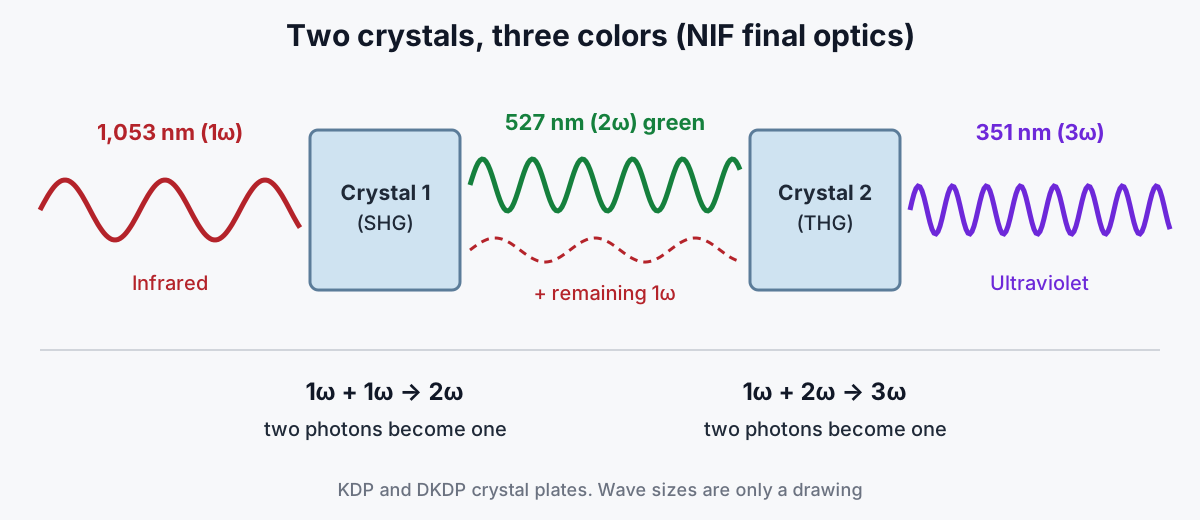
One large facility that relies on this is NIF at LLNL. Its neodymium glass lasers produce infrared light at about 1,053 nm. Fusion targets, however, work more efficiently when 351 nm ultraviolet light drives them.
So in the final optics the beams go through a pair of crystal plates of potassium dihydrogen phosphate (KDP). The user guide describes them as a pair of KDP and deuterated KDP (DKDP) crystals.
According to LLNL, the first plate turns two-thirds of the 1,053 nm light into 527 nm green light, the second harmonic. The second crystal mixes this green light with the remaining infrared to make 351 nm ultraviolet light, the third harmonic. In terms of photons, one infrared photon and one green photon combine into one ultraviolet photon. This KDP is also the kind of crystal found in the NIF optical switch, a Pockels cell.
In space, ICESat-2's ATLAS instrument uses the same principle. ATLAS is a laser altimeter that sends 532 nm light out in six beams. Its transmitter is a frequency-doubled Nd:YVO4 laser that fires 10,000 pulses per second (10 kHz).
A second-harmonic generator inside the laser turns the 1064 nm output into 532 nm, and the NASA Goddard team chose lithium triborate (LBO) as the doubling crystal. How ATLAS measures distance is covered in Measuring with lasers: range finding and lidar basics.
Measuring short pulses
Nonlinear crystals do more than change the color of light. Very short laser pulses are hard to measure with electronics, because electronic instruments have limited time resolution. Here, autocorrelation based on second-harmonic generation is used.
The method works like this. The pulse is split in two, one copy is delayed slightly, and the two beams are focused so they overlap inside a nonlinear crystal. A new signal appears only when the two pulses overlap in the crystal, and the more they overlap, the stronger it is. Recording the signal while changing the delay step by step reveals the pulse duration.
Because second-harmonic generation is a coherent process, it is also used with frequency combs made by mode-locked lasers. The simplest method of measuring the offset frequency of a comb includes one second-harmonic step. Femtosecond frequency combs like these are used for ultrahigh-resolution laser spectroscopy.
Limits and difficulties
First, the efficiency depends on the intensity of the light. The NIF user guide states that, because the share of light converted changes with intensity and many experiments use shaped pulses, a large share of the light stays unconverted. Most of it is the original infrared, and all three wavelengths reach the target chamber.
Crystal thickness is another challenge. When measuring a pulse, the conversion efficiency must stay even across the whole pulse spectrum. The range of wavelengths a crystal accepts, its bandwidth, is inversely proportional to its thickness, so the crystal must be thin enough. A thin crystal also reduces how far the original pulse and the second-harmonic pulse drift apart inside it.
Temperature and durability matter as well. In ATLAS, the pulse energy drifts as the temperatures of the part that sets the laser wavelength and of the second-harmonic generator change. During development, the NASA Goddard team listed the fading of second-harmonic output in the doubler among its most critical reliability concerns. In early prototypes, the output face of the crystal and the surfaces of the optics behind it darkened after exposure to intense 532 nm light.
What to read next
- "Optical Parametric Oscillators: Splitting One Beam into Two Wavelengths": another job that nonlinear crystals do.
- "Electro-Optic Modulators and Pockels Cells: Controlling Light with Voltage": how crystals such as KDP switch light with voltage.
- Why wavelength matters: visible and invisible light: what changes when the wavelength changes.
- Q-switching and mode locking: two ways to make short pulses: how the strong pulses that enter nonlinear crystals are made.