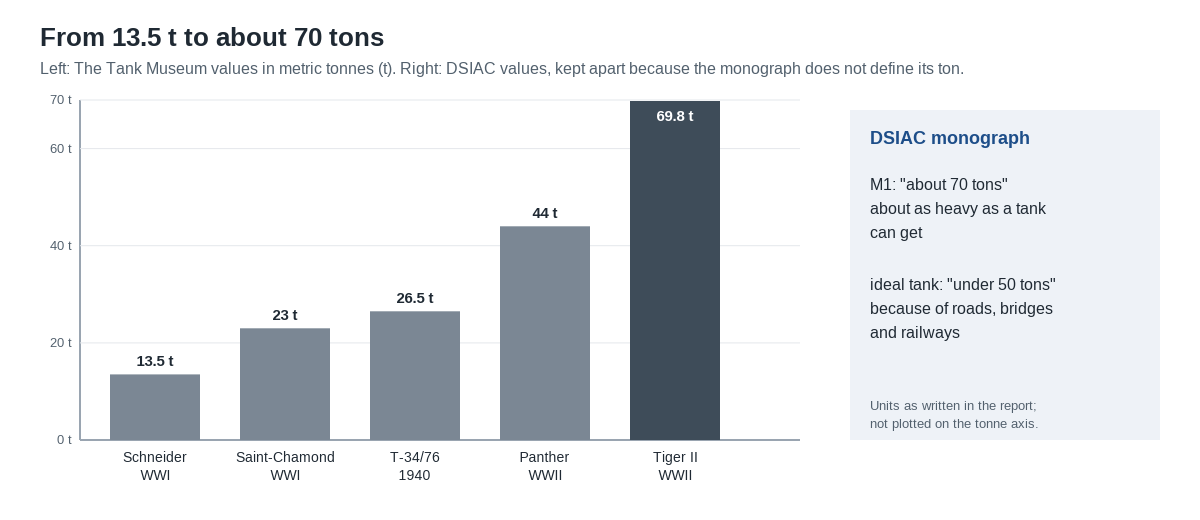
The French Schneider, one of the first tanks of World War I, weighed 13.5 t. Today's U.S. M1 tank is about 70 tons, as written in the monograph from DSIAC, an information center under the Defense Technical Information Center. Yet the same monograph treats that figure as close to the practical ceiling for a tank.
Why did tanks get so heavy, and why is it hard for them to get heavier? The answer is that armor and weight are bound together, and that separate limits set the weight from outside. Lately there has also been an effort to turn the trend around.
Armor means weight
Even the yardstick for armor is weight. The usual measure is the weight needed to stop a threat with a given penetrating power. Stopping a stronger round usually takes more weight.
For a sense of scale, 1 inch (25.4 mm) of rolled homogeneous armor seen head-on weighs about 200 kg on every 1 m². Cover a larger area and that figure multiplies.
The amount of armor needed is not uniform either. The threat varies with direction and elevation around the vehicle, so the armor needed varies from place to place. A tank's weight is therefore less about "how thick" than the sum of "how much, and where." Building the armor into the structure and supports as much as possible almost always cuts weight.
Heavier with every era
The trend in weight can be traced through The Tank Museum's collection records. The French tanks of World War I weighed 13.5 t for the Schneider and 23 t for the Saint-Chamond. The Soviet T-34/76, first fielded in 1940, weighed 26.5 t.
The German Tiger shows how weight swells. Its first designs were meant to meet a requirement for a tracked vehicle of about 30 t. Experience in France in 1940, however, showed that a stronger gun and thicker armor were needed, and the result had to exceed 30 t. The later Tiger II reached 69.8 t and was prone to mechanical and mobility problems because of its size and weight.
The same era shows another way to handle weight. The 44 t Panther used wide tracks to spread its weight on soft ground. If the weight could not come down, a larger contact area could at least share the load.
What sets the weight from outside
The outer limit on a tank's weight is set by the route, not the vehicle. Most of the world has old, narrow roads hemmed in by buildings and terrain, plus bridges, roads and railways with real weight limits. The DSIAC monograph therefore says the ideal tank should stay under 50 tons. What the ground, roads and bridges can bear sets the maximum weight.
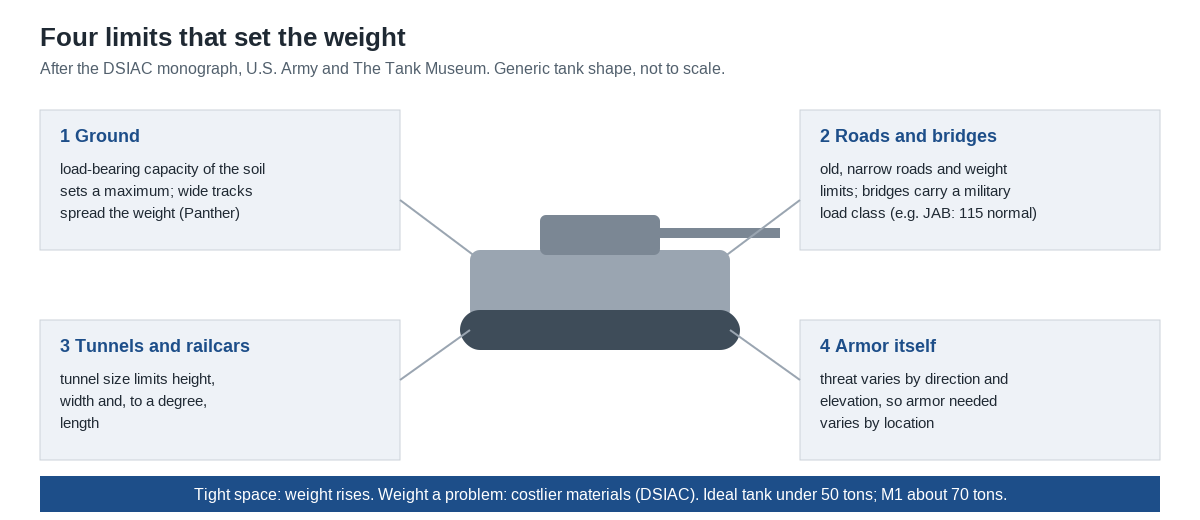
Size is constrained too. Road and rail tunnels and other obstacles limit a vehicle's height and width, and to some degree its length. Thicker armor makes a bigger vehicle, and a bigger vehicle runs into tunnels and railcars again.
Bridges have a way to put this weight into numbers. The U.S. Army's Joint Assault Bridge carries a Military Load Classification of 115 normal and 124 caution and spans a gap of more than 18 m. How vehicles and bridges are matched on the same class system is covered in Armored bridging: tanks need bridges too.
Adding protection without adding weight
Facing the weight wall, designers turned to space and materials. Leaving plenty of air space inside the armor was one way to add protection without a weight penalty. Compared with the older generation and its single-plate armor, protection on the new generation grew far more than its weight did.
Space has a price as well. On a cramped tank, weight rises in the end, and if weight becomes the problem, costlier materials have to be used. The DSIAC monograph notes that new technology always goes more cheaply and easily into the threat munitions than into their targets. So modern tanks and armored vehicles remain heavy and slow.
A push to get lighter again
On 6 September 2023 the U.S. Army announced it would close out the M1A2 SEPv4 effort and develop the M1E3 Abrams. The program executive officer for ground combat systems said the Abrams "can no longer grow its capabilities without adding weight." He added that its logistical footprint had to shrink.
He also said the war in Ukraine had shown a critical need for soldier protection built in from within rather than added on. The announcement promised a more survivable, lighter tank. Half a century after the M1 program began in 1971, it is now facing the weight problem head-on. However, according to the Congressional Research Service (CRS), the Army has not made the M1E3's design requirements public, and no target weight is known.
What to read next
- Main battle tanks: is it all about the gun?: balancing firepower, protection and mobility
- Armored bridging: tanks need bridges too: load classes for bridges and vehicles
- Tank Armor Types at a Glance: Rolled, Spaced, Composite, Reactive, Active: names for protecting more with less weight
- What "So Many mm of RHA" Means: Describing Armor with One Thickness: comparing armor by areal density