It is hard to believe at first that a cloth vest can stop a handgun round. Scissors cut cloth easily, so why can't a bullet get through it? The answer lies less in the cloth than in the threads it is made of, and in where the force goes and how it spreads.
Body armor comes in two broad kinds. One is a flexible vest made of fibers. The other is a hard plate made of something like ceramic.
This article explains how each material stops a round, using a physics textbook. It then looks at the blow that still reaches the body, and at the history of the materials, from steel plates in the Second World War to today's ceramic plates.
Spread the force, stretch the time
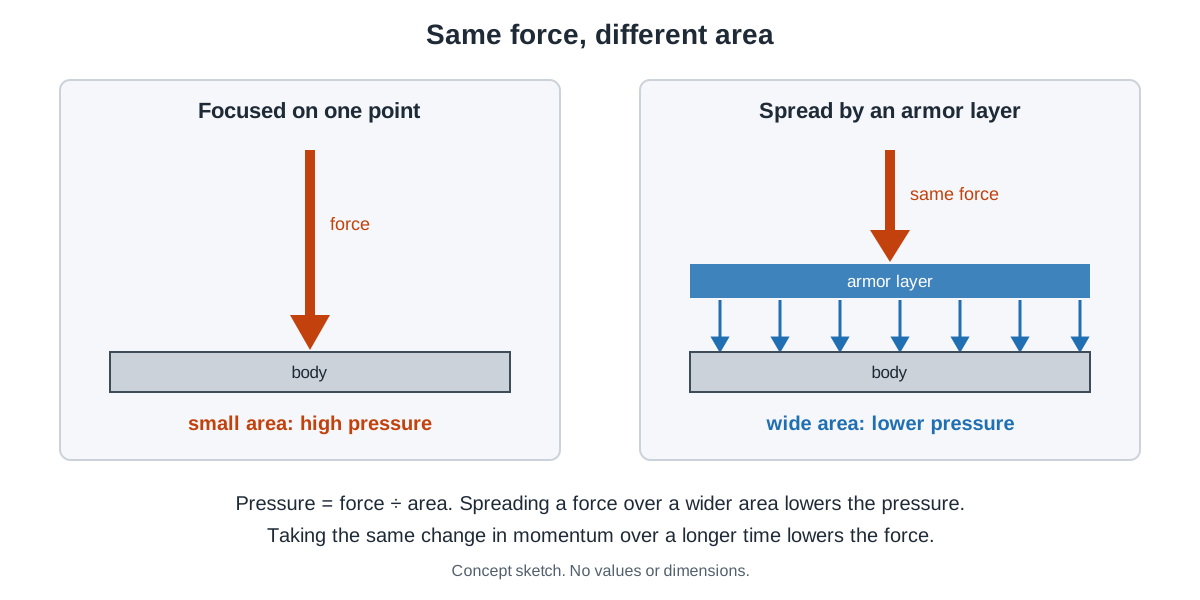
Press a finger hard into your arm and it only hurts a little. Put the same force on the tip of a needle and it breaks the skin. Physics explains the difference with pressure. Pressure is force divided by the area it acts on, so the same force produces more pressure when it is packed into a small spot.
pressure = force ÷ area
An incoming round brings a lot of kinetic energy on a very small area. The first job of an armor material is to spread that force over a wide area.
Time matters too. Think of a car's airbag.
With or without the airbag, a person's change in momentum in a sudden stop is the same. But if that change happens over a longer time, the force on the person is much smaller. A physics textbook points to this idea, impulse, as one that saves lives.
Body armor works along the same two ideas. It takes the force a round brings and shares it out over a wide area. Unlike an airbag, though, armor first has to keep the round from getting through. Fibers and ceramics do that job in different ways.
A web of fibers: soft armor
The U.S. National Institute of Justice (NIJ) writes the test standards for police body armor. Its selection and application guide sorts body armor into two kinds. Soft armor is made of flexible panels of ballistic material and is designed to protect against handgun attacks. Hard armor is made of rigid plates of ballistic-resistant material and is designed for higher threats.
Think of a baseball catcher's mitt. A soft panel behaves much the same way: a handgun round that hits it gets tangled in a "web" of tough fibers. The fibers absorb the impact energy passed from the round to the panel and spread it out. Along the way, the round flattens or mushrooms.
A soft panel is usually built from many layers of ballistic material. Each layer absorbs a little more energy. The number of layers and the order they are stacked in affect how the whole panel performs. The side meant to face away from the body, the strike face, is marked on the panel so the wearer does not put it in the wrong way.
What kind of thread makes the web? Two in wide use today are Kevlar, an aramid fiber, and ultra-high molar mass polyethylene (UHMMPE) fiber. UHMMPE is common in body armor because its fibers are very strong and its density is low.
Hard plates: what ceramics do
NIJ Standard 0101.06 has five levels, and the top two are usually hard plates designed to protect against rifle threats. Here a rigid plate takes the place of flexible cloth. A plate can be made of ceramic, compressed laminate sheets, metal, or a composite that combines more than one material.
Hard plates usually do their job in two ways. Either they catch and deform the round, or they break it up. Either way, the plate then absorbs the force of the impact and spreads it out.
Ceramic fits the second way well. The NIJ guide notes that a harder, denser round is more likely to break up when it hits a plate that contains ceramic or metal.
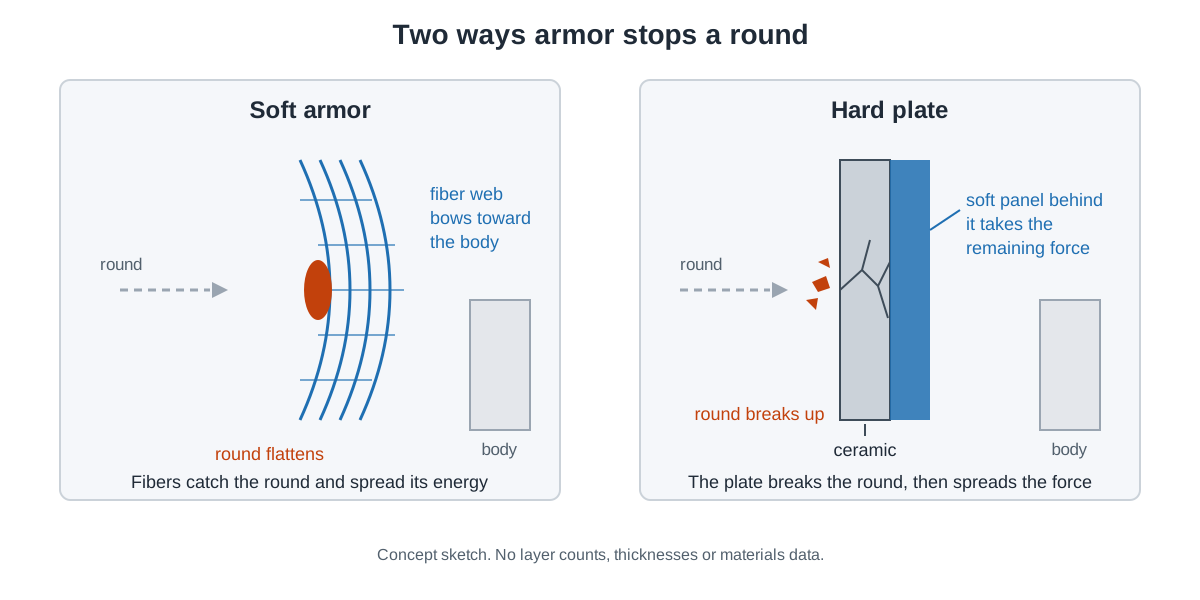
Many plates are not meant to be worn alone. They reach the intended level of protection only when paired with a specific soft panel. So each hard plate is labeled with the soft panel model it goes with. Tactical armor that pairs the two ends up thicker and heavier than a soft vest on its own.
Joining several materials into one system is the same idea behind composite armor on tanks. The tank side of the story is in Composite and reactive armor.
Ceramic is itself a material that breaks easily. Drop a plate with ceramic in it on a hard floor and it can crack or break in ways that hurt its performance. That is why the standard tests include a drop test, to check that a plate can survive low-level impacts.
Materials research keeps working on this trait. In 2012, a university team working alongside the Army Research Laboratory named boron carbide as one of its research materials. It is a tough, light ceramic that is 30% less dense than existing armor, yet it fails all at once under high-pressure impacts.
When struck, armor needs to flex, stretch or squeeze together so it can take in the energy. The researchers hoped to rework the crystal structure of this compound at the atomic level and work out how to make it.
The blow that remains
Stopping the round is not the end of the story. As the fibers catch a round, they bend in the direction the round was traveling, which is toward the body. The bent panel pushes into the body and injures the torso. This kind of injury, which happens without penetration, is called blunt force injury, and it can cause severe bruises.
So armor tests look at more than whether the round got through. During a test, clay is placed behind the panel. The dent the panel leaves in that clay after stopping a round is called the backface signature. Its depth is used as a stand-in for how likely the wearer is to suffer a serious blunt force injury.
The first version to set a 44 mm backface signature limit as the minimum threshold for blunt force injury was NIJ Standard 0101.01, issued in 1978. That figure came from 1970s work by U.S. Army researchers, funded by the NIJ, on the upper limits of blunt injury a person can tolerate. The idea that stopping a round and protecting the body are not the same thing was built into the test.
For the same reason, the NIJ guide is careful with the word "bulletproof." It warns that no vest stops every threat and that no body armor is "bullet proof."
From steel plates to Kevlar
Modern body armor began in the sky. In the Second World War, the Army's Eighth Air Force took the lead in creating modern body armor, directed by Colonel Malcolm C. Grow, its chief surgeon.
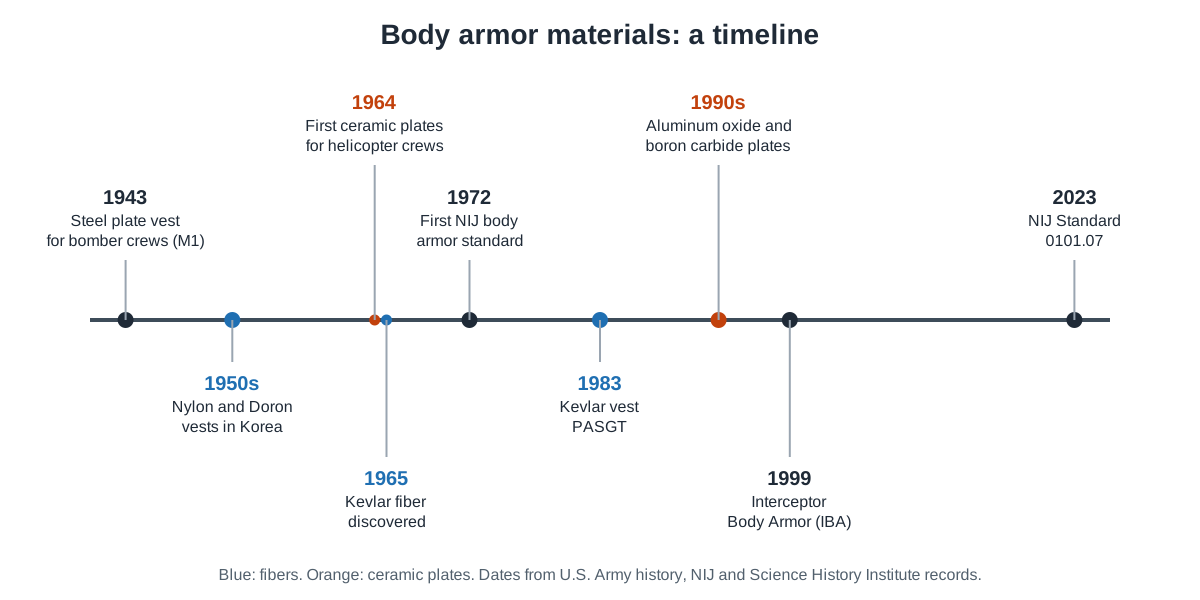
From 1943, bomber crews received an armored vest made in Great Britain. Square manganese steel plates, 2 inches on a side, were stitched into a canvas vest, and they guarded against fragments from bursting antiaircraft shells. Its official name was the Flyer's Vest, M1, but most people called it a "flak vest."
On the ground, things were different. At first the Army turned down armor for ground troops because of its weight and the way the designs restricted movement. Late in the war came the M-12 vest, which combined aluminum plates with nylon cloth.
In the Korean War, fibers moved to the front. The M-1951 vest combined nylon with Doron, a layered fiberglass material created during the Second World War. The M-1952A was an 8.5-pound vest built from twelve flexible layers of laminated nylon. Judging laminated nylon better than steel at stopping fragments, the Army relied mainly on nylon for years.
Having a vest did not always mean wearing it. In Vietnam, soldiers seldom wore body armor on patrol even when it was available. The vests were bulky and held in heat and moisture in the tropics.
Ceramic plates entered Army armor around this time. In 1964, the Army added ceramic plates to armor for helicopter crews. But the plates tended to splinter when hit, putting pilots and crew at risk from secondary fragments thrown off the plate. In the field, crews wore a nylon vest over the plates to contain the pieces.
On the fiber side, a big change came from the lab. In 1965, DuPont chemist Stephanie Kwolek (1923–2014) was studying a runny, cloudy liquid when she found a material five times as strong as steel. Under certain conditions, its rod-shaped molecules lined up side by side, and when spun straight into thread they made fibers that were extremely strong and stiff. This became the product Kevlar, which today has some 200 uses, from protective vests to boats, airplanes, ropes and cables.
Police armor moved in the same years. Modern police body armor came into use in the 1970s thanks to NIJ-funded research, and the NIJ published its first body armor standard in 1972. The standard does not say how armor must be designed. It says what armor must be able to do.
After the Vietnam War, the Army redesigned its body armor around Kevlar, a promising new material that was light. The Kevlar PASGT vest (Personnel Armor System for Ground Troops), introduced in 1983, was a little heavier than the M-69 vest with its twelve layers of nylon. But it stopped fragments better, flexed more and fit better.
Weighing protection against weight
The 1990s brought armor that paired Kevlar with ceramic plates. Ranger Body Armor (RBA), from the early 1990s, added an aluminum oxide ceramic plate to the same Kevlar used in the PASGT. In 1996 came the ISAPO, with boron carbide ceramic plates front and back.
These vests began the move from "flak jackets" that only stopped fragments to body armor that protected against both fragments and small arms fire. Interceptor Body Armor (IBA), which arrived in June 1999, made that change stick. It paired an outer vest with improved Kevlar inserts and two boron carbide ceramic plates called SAPI.
The price was weight. A Veritas article from the U.S. Army Special Operations Command History Office sums up the Army's goal since the Second World War. It has looked for armor that acceptably balances two competing needs, protection and mobility.
Before the RBA and ISAPO arrived in the mid-1990s, a soldier's body armor rarely topped 10 pounds. Since then, it has rarely come in under 25 pounds. Efforts to lighten the soldier's load were offset by the weight of added armor.
At a 2011 House Armed Services subcommittee hearing, the head of the Army's Program Executive Office Soldier (PEO Soldier) admitted that body armor had "hit a technical wall" on weight. He also acknowledged that easing the load would mean trading off some level of protection and some area of coverage.
Materials also change while they are in use. The U.S. National Institute of Standards and Technology (NIST) has studied how conditions such as heat and humidity affect high-strength fibers since early 2004. Polymers like UHMMPE can weaken from heat during storage and use, which lowers fiber strength and hurts ballistic resistance. NIST has also run an aging study that combined heat and humidity on two types of aramid fiber.
Care rules follow from the materials. The NIJ guide says never to dry soft panels outdoors, even in the shade, because ultraviolet light is known to weaken certain ballistic materials. Even heavily watered-down bleach or starch may lower the level of protection.
The standard keeps changing as well. In a post dated December 1, 2023, the NIJ announced the updated NIJ Standard 0101.07, the sixth revision since the first edition. It is built on ASTM test methods developed over many years with the U.S. Army, NIST, test labs, manufacturers and materials suppliers. It also improves how armor made for women is tested.
What to read next
- Composite and reactive armor: how the idea of layering several materials is used on the surface of a tank.
- Main battle tanks: the story of a vehicle wrapped in armor far heavier than a soldier's vest.
- Power, energy and intensity: a laser article about how tightly the energy of light, rather than the kinetic energy of a round, gets packed into a small spot.