One U.S. Department of Veterans Affairs medical center has a special task. It screens and follows 1991 Gulf War veterans who were exposed to a certain metal through friendly-fire incidents. That metal is a leftover of the nuclear industry and the material of the rods tanks fire. It is depleted uranium.
Why use such a material in a round at all? The answer lies in the job a penetrator has to do. This article first looks at how the two candidate materials, tungsten alloy and depleted uranium, differ. It then sets out separately what official agencies have said about the health effects of depleted uranium.
Why heavy metals are needed
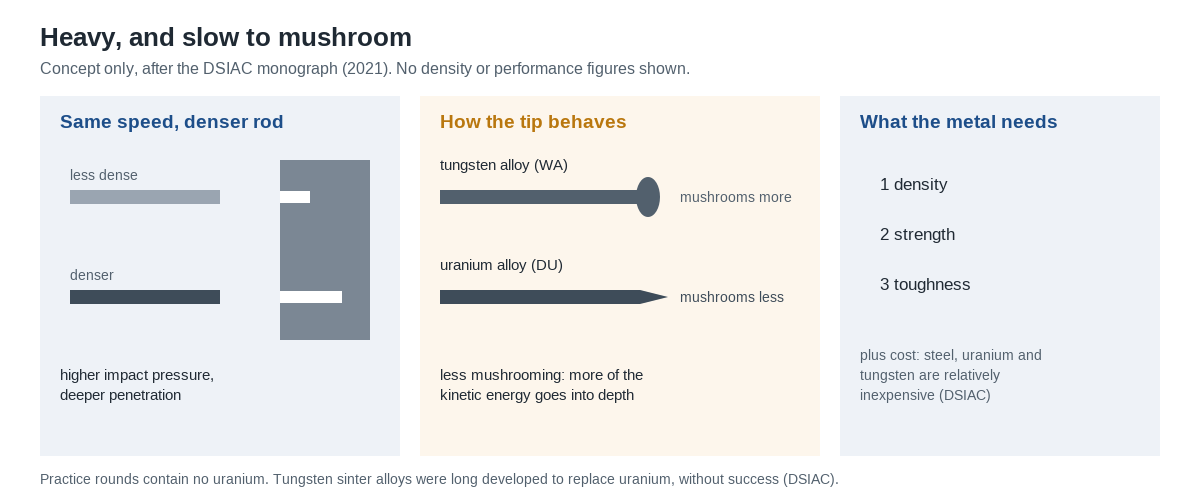
A kinetic energy penetrator carries no explosive and pushes through armor with its own mass and speed. DSIAC is an information center under the Defense Technical Information Center. In its monograph, three properties matter most: density, strength and toughness. Toughness is the ability to hold together without breaking easily.
Density comes first because of pressure. A denser penetrator produces higher impact pressure at the same speed and so goes deeper. How a long penetrator erodes its way in is covered in Kinetic Energy Penetrators: Why Fin-Stabilized Darts Are So Long.
Cost matters too. Iron in the form of steel is fairly cheap, and uranium and tungsten are not costly either. Among dense materials, these two were the metals within reach on price.
Tungsten alloy and depleted uranium
The two materials grew up together. Sintered tungsten alloy (WA) and depleted uranium (DU) alloys were developed alongside the rest of the long-rod round. The materials used successfully so far are uranium alloys and tungsten-nickel-iron sintered alloys.
The difference shows at the moment of penetration. According to the DSIAC monograph, U.S. kinetic energy penetrators used in combat are almost always uranium alloy. The uranium alloy mushrooms less at the tip while penetrating, so it turns more of its kinetic energy into depth than tungsten does.
Price plays a part. Uranium is almost free, since it is left over from making enriched uranium for power and weapons. It is mildly radioactive, though, so practice rounds contain no uranium at all.
The tungsten side also had long, costly work behind it. Tungsten sinter alloys are not as good as uranium weight for weight, yet they were developed over many years at great expense in hopes of replacing radioactive uranium. Even so, they did not take over as the main penetrator material.
What depleted uranium is
"Depleted" means lowered. The U.S. Environmental Protection Agency (EPA) describes depleted uranium as what is left after most of the highly radioactive U-235 is removed from natural uranium ore. The U.S. Department of Veterans Affairs (VA) notes that its radioactivity is 40% lower than that of natural uranium, while its chemistry is identical.
The military chose it for hardness and density. In the 1970s the U.S. Defense Department began making ammunition from it, since few known metals are harder or denser. Contamination left by spent rounds and their fragments remains a hazard at some military firing ranges.
What official agencies say about health
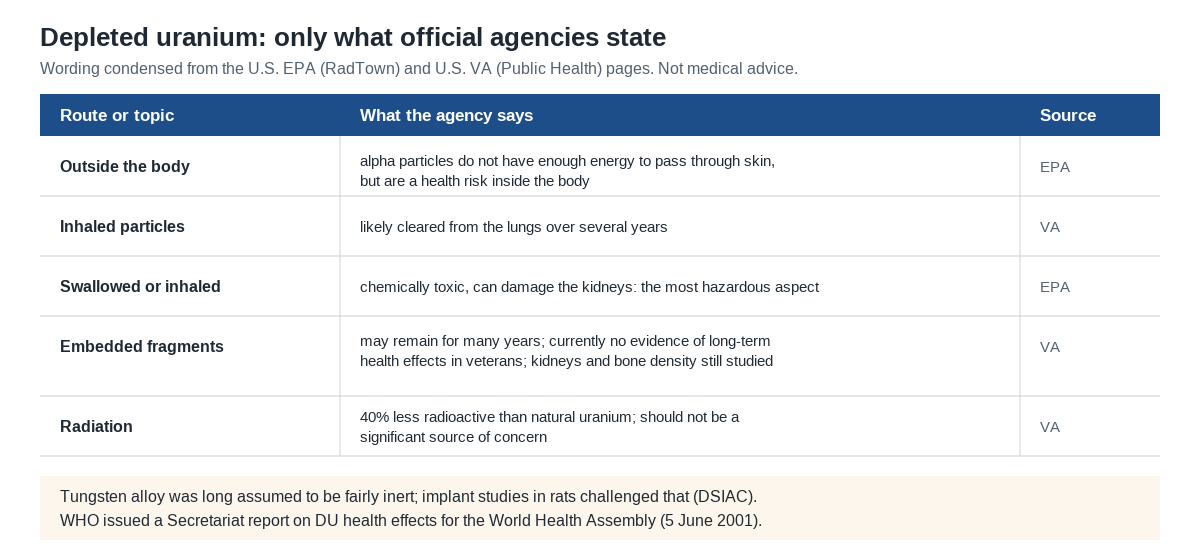
On health, this article reports only agency judgments. The VA sees two main health concerns from DU exposure, radiation and heavy metal toxicity. It says radiation should not be a significant concern because DU is less radioactive than natural uranium, and that the kidneys are the first organs of concern for toxicity.
The EPA points the same way. Alpha particles lack the energy to pass through skin, but they are a health risk once inside the body. If DU is swallowed or inhaled it is toxic and can damage the kidneys, which the EPA calls its most hazardous aspect.
On embedded fragments the VA's wording is careful. So far, it says, embedded DU fragments have not been shown to cause long-term health effects in veterans.
It adds that fragments may stay for many years and that effects on the kidneys and bone mineral density are still being studied. Particles that are breathed in probably leave the lungs over a span of years. The Metal Exposures and Depleted Uranium (MEDU) Surveillance Center at the Baltimore VA Medical Center offers screening to any veteran worried about exposure.
Where the debate continues
The issue did not stay inside one country. The World Health Organization (WHO) issued a Secretariat report, "Health effects of depleted uranium," dated 5 June 2001, as an agenda document for the fifty-fourth World Health Assembly. The question became a formal item in international health as well.
Tungsten was not a simple safe alternative either. The DSIAC monograph explains that, before a series of studies, uranium seemed the bigger worry because it is radioactive. Tungsten alloys were wrongly assumed to be fairly inert.
Rats given implants of penetrator-grade tungsten alloy died, and so did rats given pure nickel. So the debate between the two materials is no longer only about radioactivity.
Neither material satisfied performance, cost, health and environment all at once. That is why the topic does not end with how well a round performs. It leads on to firing-range management and to screening veterans.
What to read next
- Kinetic Energy Penetrators: Why Fin-Stabilized Darts Are So Long: how a heavy rod erodes its way in
- APFSDS vs HEAT: Two Different Ways to Get Through Armor: the comparison that includes the M829 depleted uranium long rod
- The Gulf War, 1991: From Desert Shield to Desert Storm: the war behind the VA's screening program
- The Kosovo Air War, 1999: Seventy-Eight Days of Air Power Alone: an air campaign where depleted uranium use became contested