A news story may say a tank's frontal armor is "equivalent to so many millimeters of RHA." It is easy to picture a slab of steel that thick bolted to the front. Measure the real armor and it may not be that thick, and it may hold materials other than steel. So what does the number actually measure?
The word "equivalent" holds the answer. The value restates armor made of different materials and structures in terms of one reference steel plate. Depending on what the reference is, and on what is held equal in the comparison, the same armor can produce different numbers. Reading the number correctly takes at least four pieces of context.
The reference plate: RHA
RHA stands for rolled homogeneous armor. The RHA used in the United States is a low-alloy steel that hardens deep into thick plate. It is rolled in crossing directions, so its properties barely depend on direction, which is where "homogeneous" comes from.
The U.S. Munitions List (22 CFR 121.1) gives the density of RHA used in its armor-effectiveness formula as 7.85 g/cm³. The standard named there is MIL-A-12560. With a plate of fixed properties and density, other armor can be compared against it.
Look at areal density before thickness
The DSIAC armor monograph names areal density as the most important property when comparing armor designs. It is the mass of armor packed into each square meter of target face, counted along the path a round would take. It is usually given in kg/m².
For example, 1 inch of RHA viewed head-on has an areal density of about 200 kg/m². The density gives the same result.
2.54 cm × 7.85 g/cm³ ≈ 19.9 g/cm² ≈ 199 kg/m²
Areal density matters because a tank is bound by weight. How much mass you spend to cover a given area turns directly into the weight of the whole vehicle.
Two meanings of an equivalent thickness
"So many mm of RHA" mixes at least two meanings. The first holds weight equal. The Munitions List calls this Em, the line-of-sight mass effectiveness ratio, and defines it as a measure that sets the tested armor against rolled homogeneous armor. If the round does not get in at all, Em is simply the areal density of RHA divided by that of the target.
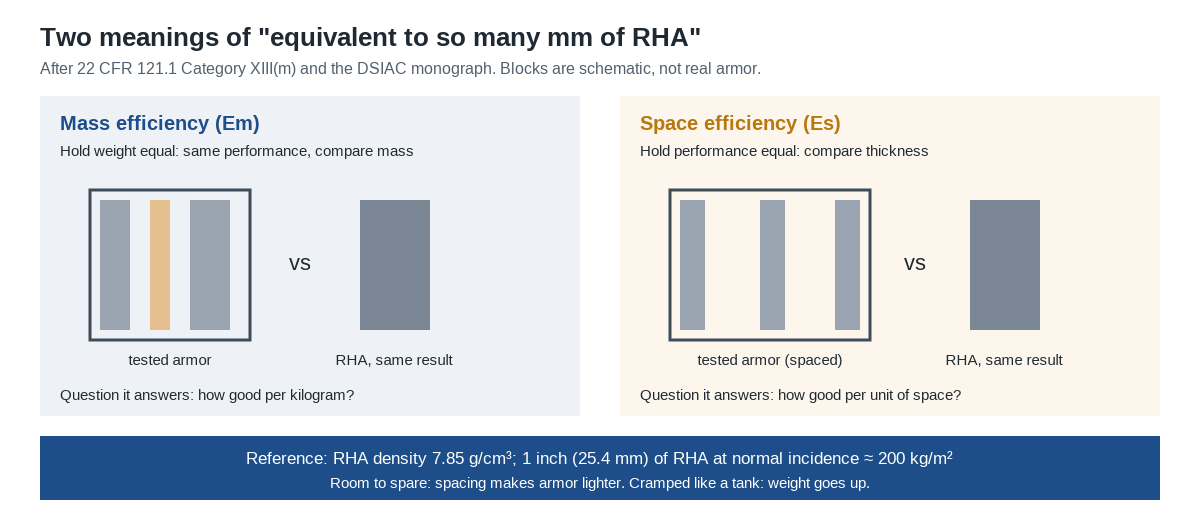
The second holds thickness equal. The DSIAC monograph calls this space efficiency, Es. It compares how thick the tested armor must be with how thick RHA must be for the same result. The two values tell you different things.
High mass efficiency means better protection for the same weight. High space efficiency means better protection for the same volume.
Which one matters depends on the vehicle. With room to spare, plates can be spaced apart to make armor lighter. On a cramped tank, weight goes up instead. So the same armor can be "so many mm by weight" and a very different "so many mm by thickness."
The monograph also notes a simpler estimate. Start from an armor design's areal density. Find the head-on RHA plate that would weigh the same over that area, and treat it as a rough floor on protection. This is also called an equivalent, but it comes from a weight calculation rather than a performance test.
Tilting makes it look thicker: line-of-sight thickness
Tilt an armor plate and a horizontal shot has a longer path through it. That path length is the line-of-sight (LOS) thickness. Divide the plate thickness by the cosine of the tilt angle.
LOS thickness = plate thickness ÷ cos(obliquity)
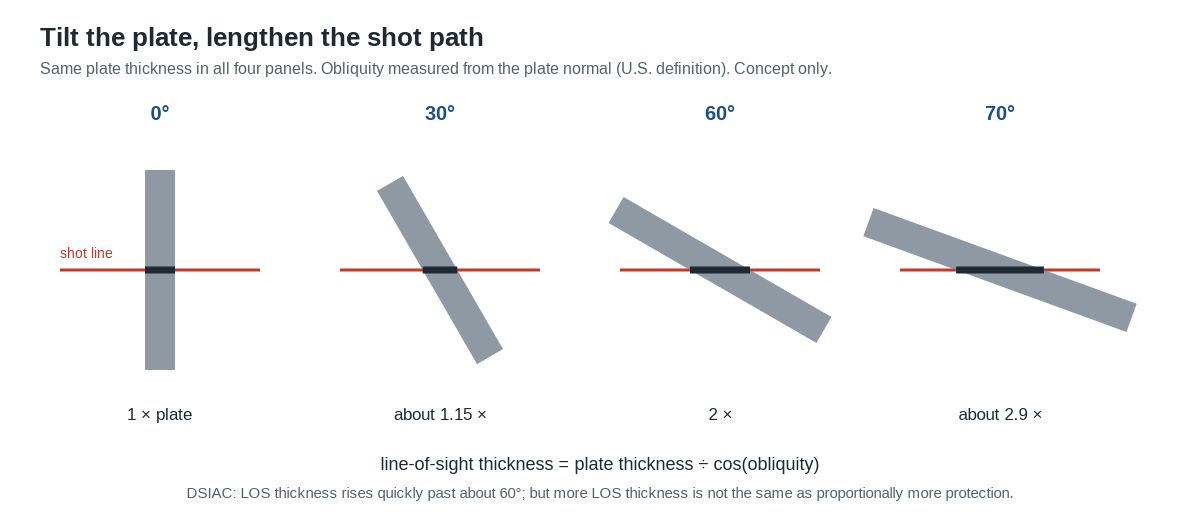
According to the DSIAC monograph, LOS thickness rises quickly once obliquity passes about 60°. At 60° the LOS thickness is twice the plate thickness, and at about 70° it is about three times. At 30° it is only about 1.15 times.
There is a catch. The same monograph says that, except at extreme angles, obliquity by itself is not a useful way to stop long-rod penetrators or shaped-charge jets. Twice the LOS thickness does not mean exactly twice the protection. Tilt is only one factor that adds thickness.
Four things to check when you read the number
First, ask what threat the value is for. Shaped-charge penetration hardly depends on speed and turns on the density ratio, while a long rod erodes its way in faster the harder it hits. There is no reason the same armor should have the same equivalent value against two threats that behave so differently.
Second, ask whether the value was converted by weight or by thickness, since Em and Es answer different questions.
Third, ask whether it is a straight-on thickness or an LOS thickness. Countries also measure tilt differently. The United States uses the angle between the plate normal and the shot line, while the British use the smallest angle between the shot line and the plate face. The same plate can therefore be written as "60°" in one place and "30°" in another.
Fourth, tell armor apart from armor plate. The DSIAC monograph treats armor as the whole protective package between the threat and what lies behind it. It adds that the way the package is mounted can matter as much as its design. One "mm of RHA" figure cannot describe that whole package.
Where lasers come in
The same habit helps with numbers in laser stories. Ask what the reference was, and what was held equal when the value was converted. Practice in converting units is collected in Units and dB notes: reading W, dBm and ratios.
What to read next
- Tank Armor Types at a Glance: Rolled, Spaced, Composite, Reactive, Active: the reference plate and the other kinds of armor
- Kinetic Energy Penetrators: Why Fin-Stabilized Darts Are So Long: how a long rod erodes its way in
- Units and dB notes: reading W, dBm and ratios: practice in reading the unit in front of a number