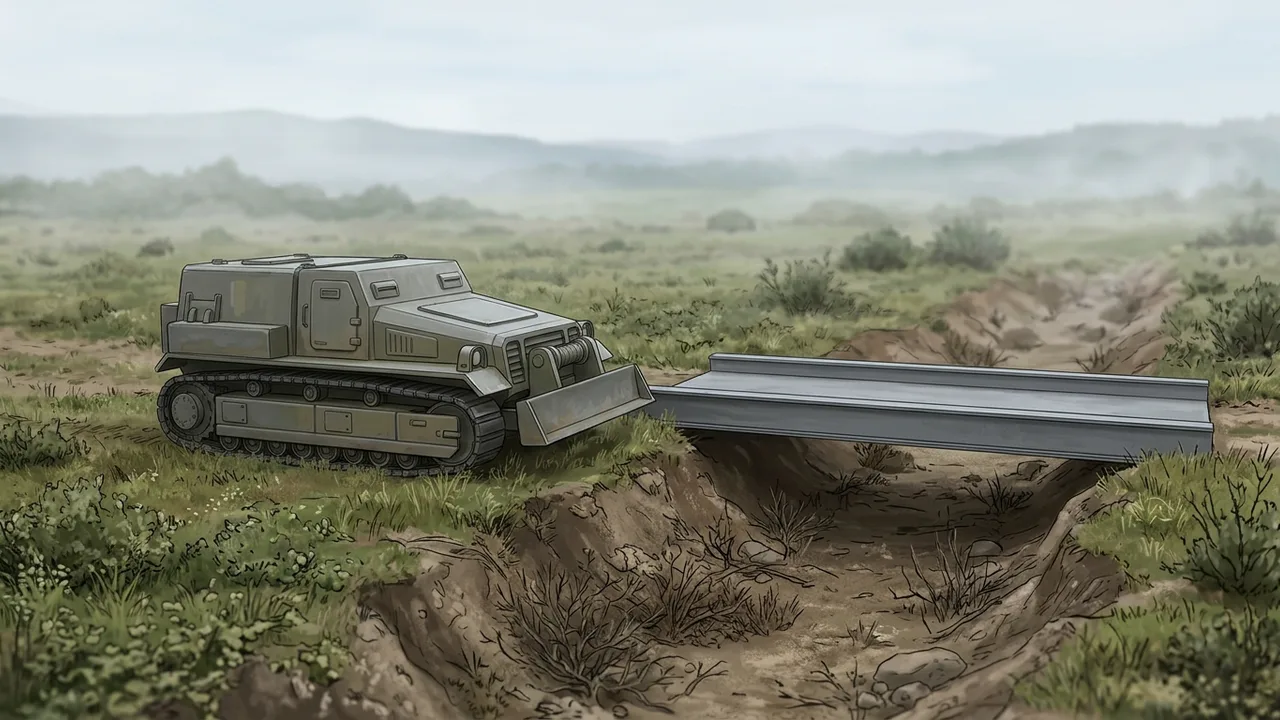
Picture a tank moving forward until it stops at a ditch a dozen meters wide. A big gun and thick armor do not help if the tank cannot reach the other side. So who lays a bridge that a heavy tank can drive over?
That job belongs to engineers. This article looks at how armies sort the openings they must cross, how they split bridges by purpose, and why a bridge-layer carries its bridge on a tank hull. It ends with the "weight numbers" given to vehicles and bridges. The material comes from a 2008 U.S. Army and Marine Corps manual on gap crossing and from public U.S. and British Army sources.
The gap that must be crossed
The military calls such an opening a gap. A ravine, a mountain pass, a river or any other feature of the land that blocks the way and could be spanned by a bridge counts as a gap. Gap crossing is defined as moving combat power across this kind of linear obstacle.
Obstacles can be natural or man-made, and they come in all sizes. Forces first look for a way around, but that is not always possible. Gaps turn up in almost every kind of environment.
In the past, this work was described only as "river crossing." A river is still counted among the hardest gaps to cross. In the manual's view, though, it is just one of many gaps that can block movement.
Dry gaps and wet gaps
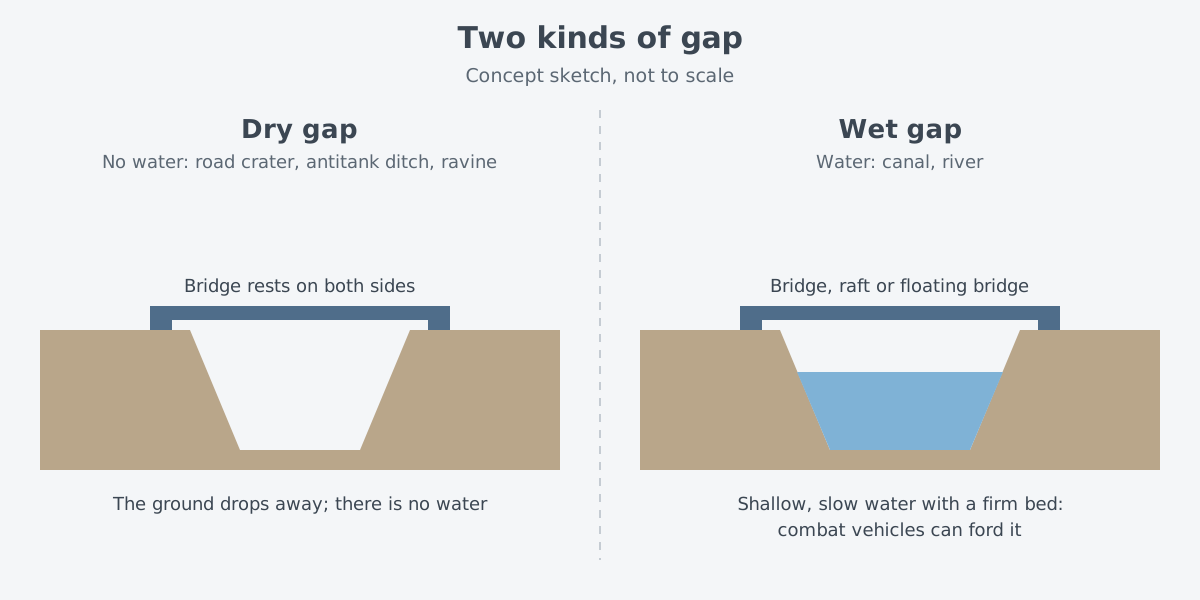
The first split is whether there is water. A gap without water is a dry gap, and a gap with water is a wet gap. The places the manual lists for the JAB include dry openings such as road craters, antitank ditches and ravines, and waterways such as canals and rivers.
Water does not always mean a bridge is needed. Where the water is shallow and slow and the bed is firm, combat vehicles can simply drive through. This is called fording.
Three kinds of bridges by purpose
The 2008 U.S. Army and Marine Corps manual sorts military bridges into three categories by purpose: tactical bridging, support bridging and line of communications (LOC) bridging.
Tactical bridges let units in close combat move right away. They are very often used while direct or indirect fire is a threat, and they are meant to be used many times for short periods. Bridge-layers such as the AVLB, JAB and Wolverine belong here.
Support bridges back up planned routes and road networks on a semipermanent or permanent basis. They are laid with heavy use by both tracked and wheeled vehicles in mind. When needed, a support bridge takes over from a tactical bridge, and the tactical bridge can then move forward with the units again.
LOC bridges are usually built in areas away from direct enemy action. They are not usually under tactical time pressure either. For a crossing that must last a long time, the support bridge is in turn replaced by an LOC bridge.
This looks a bit like road work, where a temporary bridge is later replaced by a permanent one. The military case is different. The tactical bridge that comes out is not thrown away; it goes forward with the units and is used again at the next gap.
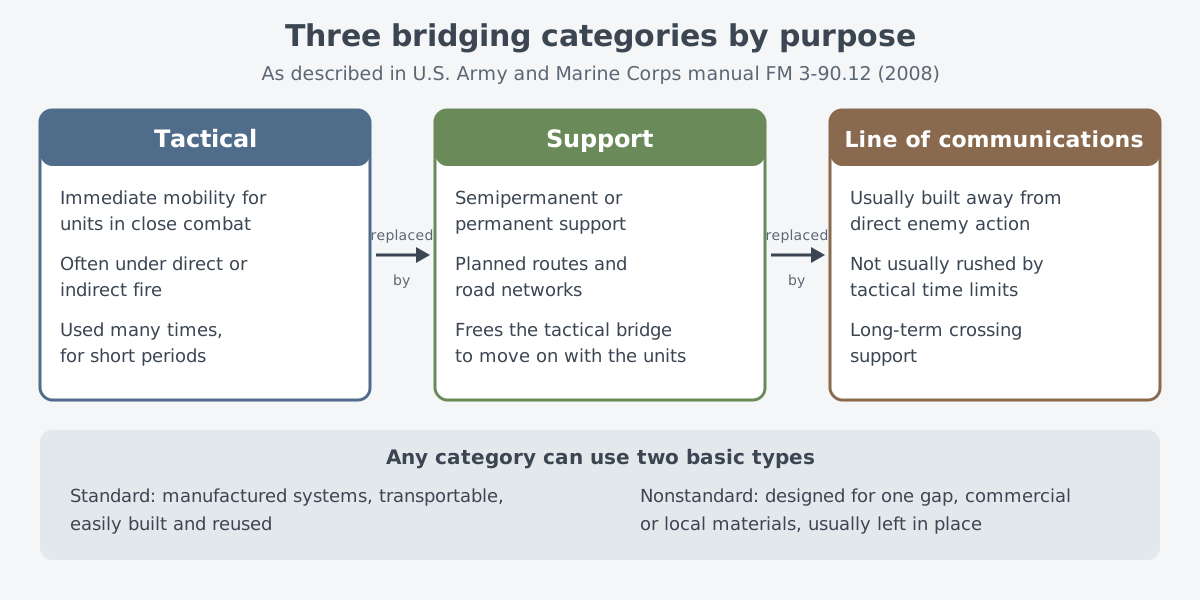
Bridges can also be sorted by how they are made. A standard bridge comes from a manufactured bridge system designed to be easy to move, quick to put up and reusable. A nonstandard bridge is designed for one particular gap and built from commercial or local materials, and it usually stays in place even after the military no longer needs it. Any of the three categories can be either standard or nonstandard.
Military bridges are not used only on the battlefield. The British Army's Medium Girder Bridge (MGB) is one example. The British Army describes the MGB as light, easy to transport and buildable by hand. It also says the bridge will serve in disaster relief as well as in military operations.
The bridge-layer: a bridge on a tank hull
An armored vehicle-launched bridge (AVLB) is a vehicle that carries a bridge on a tank hull and lays it across a gap. The U.S. AVLB in the 2008 manual used an M60 tank hull, and some nations used an M48 hull. It travels with maneuvering units and can quickly close gaps of up to 18 m for MLC 70 vehicles.
The launcher has another advantage. It can put the bridge in place without exposing the bridge crew to enemy fire, and it can pick the bridge up again from either end.
The same manual notes, however, that the AVLB cannot properly keep pace with units equipped with M1 tanks or M2 fighting vehicles. Its successors, the Wolverine and the Joint Assault Bridge (JAB), are both based on the M1 Abrams tank hull. The manual explains that being mounted on the M1 hull lets them keep pace with all combat maneuver units.
A U.S. Army article from December 2020 lists the parts of the JAB. An M1A1 tank hull gets the heavier M1A2 suspension, and it carries a hydraulic launcher and a bridge called the Heavy Assault Scissor Bridge. The JAB works over both wet and dry gaps, and its span, the length the bridge covers, is more than 18 m. Its mobility is described as comparable to the M1A1 Abrams.
Why replace the old vehicle? In the same article, the deputy commandant of the U.S. Army Engineer School said that parts are hard to find for the M60A2 hull under the 30-year-old AVLB. He added that it matters to have an M1-type hull as the base, since it shares parts with armored units. A hull that carries a bridge is still a vehicle that needs maintenance and spare parts.
The JAB completed its Initial Operational Test (IOT) in November 2020, and during the test soldiers made more than 40 crossings of natural gaps. The 1st Armored Brigade Combat Team, 1st Infantry Division, at Fort Riley was named the first unit to receive it, with fielding planned for March 2021. At the time of the 2020 article, the Army planned to replace every Wolverine and AVLB in the active force, the National Guard and the Reserve with the JAB.
What came next appears in the FY2022 annual report of the Pentagon's Director, Operational Test and Evaluation (DOT&E). The Army entered full-rate production of the JAB in FY21.
Britain also builds on a tank hull. The British Army's Titan is an armored engineer vehicle based on the Challenger 2 main battle tank hull. It lays a range of close support bridges so that troops and vehicles can cross gaps of up to 60 m. The British Army says Titan can support many kinds of operations, including humanitarian missions.
Bridges on water: rafts and floating bridges
When a river is too wide for tactical bridging, floating equipment takes over. The first tool is the raft, a large platform that carries vehicles back and forth across the river. In the 2008 manual, heavy rafts built for heavy vehicles are often the first way tanks and other fighting vehicles get across, and they go together faster than bridges.
In most cases, though, rafts alone cannot move all the traffic across in the time available. The main way to get a force and its supplies across quickly is a floating bridge, a continuous road laid across the water. Rafts used earlier are often joined to form the floating bridge.
The U.S. Improved Ribbon Bridge (IRB) is built from aluminum-alloy modules. Each bridge bay travels folded and opens by itself once it enters the water. A ramp bay goes at each bank, and as many interior bays as needed fill the space between to finish the bridge. A few bays joined together also serve as a raft.
The British Army's M3 amphibious bridging vehicle takes another approach. The vehicle drives into the river itself and works as a ferry, and several of them linked from bank to bank become a bridge. The British Army says the M3 can carry vehicles as heavy as the Challenger 2 main battle tank.
Weight numbers for vehicles and bridges
Each bridge can bear a different weight. How much weight rafts, bridges and similar gear can carry is a safety matter that shapes how they are used. Military load classification (MLC) is the system that compares this with a single number.
The idea is simple. A vehicle has a class number, and a bridge has a class number too. By the manual's definition, a normal crossing is one where the vehicle's number does not exceed the bridge's. Going above the bridge's number falls under an exceptional category called "caution" or "risk" crossing, kept for special situations.
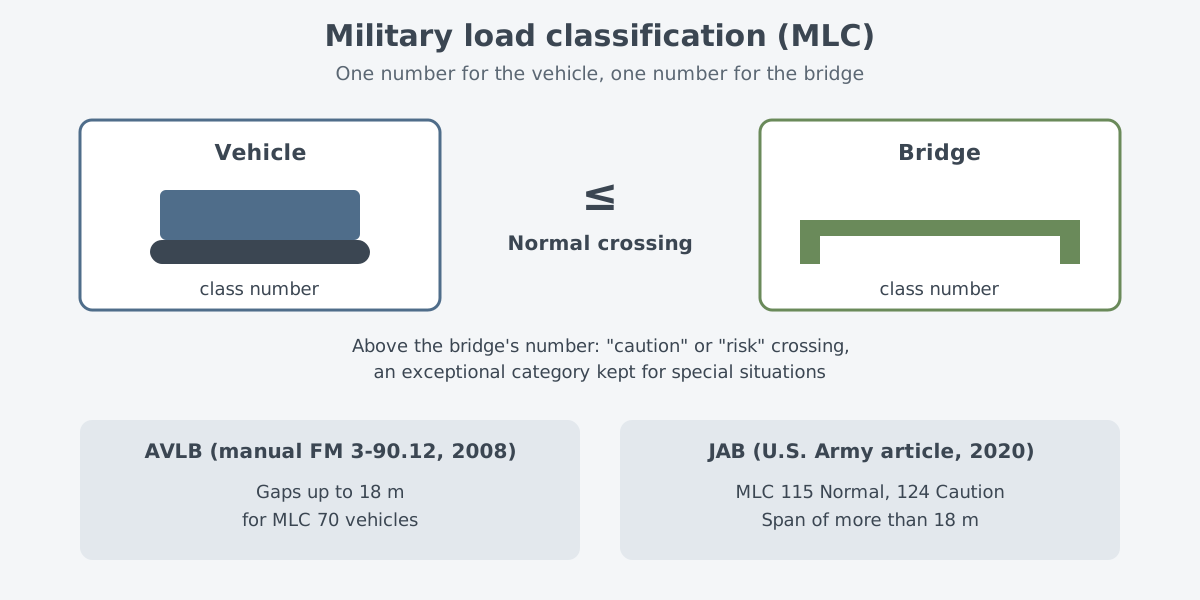
With this in mind, the earlier numbers make more sense. The AVLB in the 2008 manual closes gaps of up to 18 m for MLC 70 vehicles. The JAB in the 2020 Army article is rated MLC 115 Normal and 124 Caution. A single bridge can carry separate normal and caution ratings.
Where this meets lasers: carrying heavy loads
A bridge-layer takes a large, heavy load, the bridge, and puts it on a tank hull so it can move at the same speed as the fighting units. What matters is not only what the equipment does but also what carries it and how it keeps up.
Laser weapons face the same question. When they go on a vehicle, a ship or an aircraft, size, weight and ruggedness all have to be weighed. That story continues in Weight and platforms.
What to read next
- Main battle tanks: is it all about the gun?: a look at the tank hull that bridge-layers are built on.
- Weight and platforms: fitting on a vehicle, ship or aircraft: the conditions to weigh when a laser weapon goes on a vehicle or ship.
- Unmanned ground vehicles: robots for dangerous places: another land system, one that takes on dangerous work in place of people.