On the night of February 11, 2010, a short-range ballistic missile lifted off from a launch platform at sea off the central California coast. Less than two minutes later it broke apart in the sky. What hit it was not an interceptor missile but a laser carried on a Boeing 747.
The Missile Defense Agency (MDA) announced the test as the first directed energy lethal intercept of a liquid-fuel ballistic missile in its boost phase from an airborne platform. Yet a Government Accountability Office (GAO) report came out a month later. In an assessment prepared before the test, it said of the same effort that "the current program will not result in an operational system." The story of YAL-1, the Airborne Laser (ABL), only comes into full view with the announcement and that assessment side by side.
Not the first laser in the sky
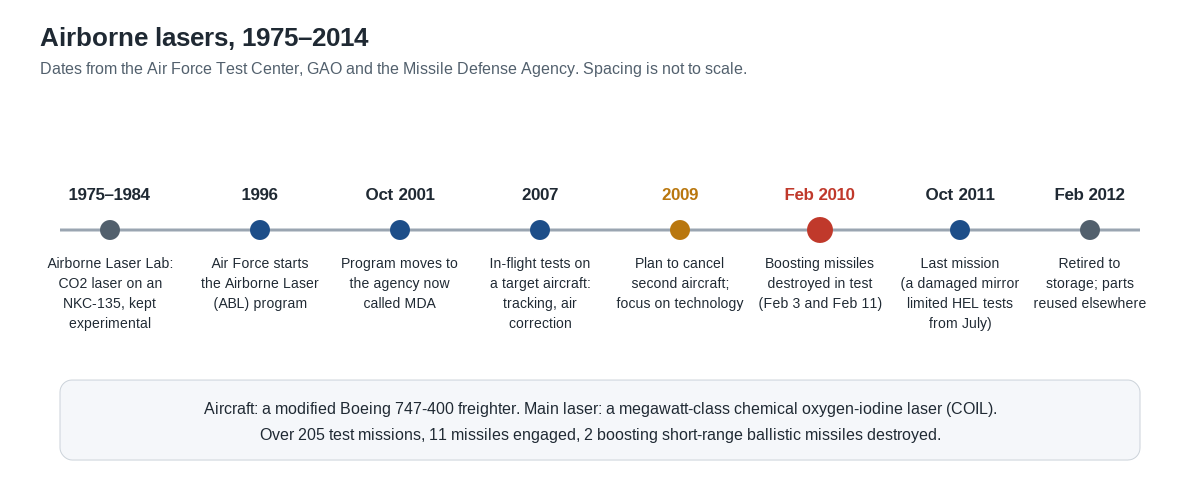
Putting a laser on an airplane is an older idea than YAL-1. From 1975 to 1984, the Airborne Laser Lab program flew a laser on an NKC-135 aircraft. The modified aircraft carried a carbon dioxide laser with a wavelength of 10.6 μm, and in tests it intercepted small air-to-air missiles and drone aircraft.
Even so, the system stayed experimental. Interest came back with the Gulf War. The Air Force Test Center credits the Scud missile threat of that war with reviving interest in an airborne laser, which led to the Boeing YAL-1.
A chemical laser on a 747
The Air Force started an acquisition program for the ABL in 1996. The goal was a laser weapon that could defeat a ballistic missile in the boost phase of its flight. Late in 2001, in October, the Pentagon passed the program to the agency now called MDA. The boost phase is the stretch right after launch, while the rocket motor is still burning.
The aircraft was a modified Boeing 747-400 freighter. It carried two solid-state lasers and a megawatt-class chemical oxygen-iodine laser (COIL).
A chemical laser gets its energy from chemical reactions. That is a different basis from today's electrically powered solid-state lasers. "Megawatt-class" is the published description; the exact power is not in the public record.
2007: flight tests against a target aircraft
Before shooting at missiles, the program tested against an airplane. On March 15, 2007, YAL-1 fired a laser in flight and hit its target: Big Crow, an NKC-135E test plane with a target board fixed to its side. The test showed that the system could follow a target in the air and sense and undo distortion along the path.
That summer came a test that imitated a missile intercept. The ABL tracked Big Crow, corrected for atmospheric turbulence, and then fired a stand-in laser instead of the high-energy laser (HEL). The Test Center describes this as showing most of the steps needed to stop an incoming missile. How turbulence is corrected is explained in Adaptive optics.
February 2010: two kills
On February 3, 2010, the Airborne Laser Test Bed (ALTB) destroyed a climbing Terrier Black Brant rocket, which used solid fuel. Eight days later came the test at the top of this article.
MDA's news release lays out what happened. At 8:44 p.m. Pacific Standard Time on February 11, a short-range ballistic missile rose from a mobile launch platform at sea in the Point Mugu range. Within seconds the aircraft's sensors found it.
One low-energy laser tracked it, and a second measured and corrected for disturbance in the air. Finally, the megawatt-class high-energy laser heated the missile until its structure failed.
The whole engagement ended within two minutes of launch, while the rocket motors were still firing. Less than an hour later a second, solid-fuel missile went up. The laser met all of the test criteria against it and then stopped before destroying it.
What the announcement said, and what it did not
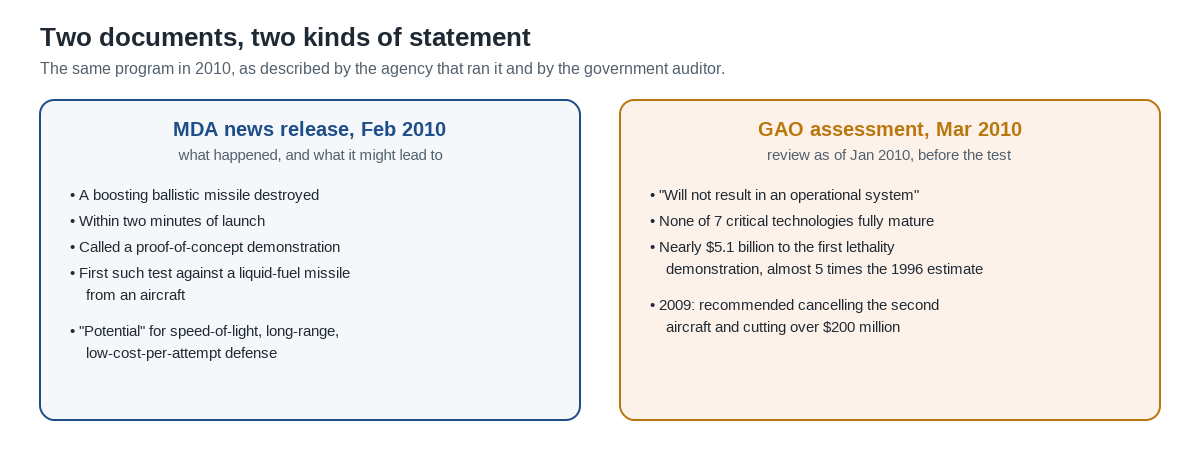
The release called the test a proof-of-concept demonstration. It also spoke of the "potential" of directed energy.
That meant hitting several targets at the speed of light, hundreds of kilometers away, at a low cost per attempt next to current technology. One word matters here. What the test actually showed was two missiles destroyed on a test range; range and cost were written as potential.
The GAO report from March of the same year looks at the other side, in a review completed in January, before the test. It said the program would not lead to an operational system and that none of the ABL's seven critical technologies were fully mature. It also gave the cost. Reaching the first lethality demonstration was estimated to cost close to $5.1 billion, nearly five times the 1996 contract estimate of about $1 billion.
Cost growth had been flagged before. A 2004 GAO report found that the main contract had roughly doubled in value between 1996 and 2003, from about $1 billion to $2 billion.
The 2009 decision and the 2012 retirement
The key decision came before the test. In 2009, years of technical trouble, rising costs and slipping schedules pushed the Secretary of Defense to act. He recommended trimming the fiscal 2010 request by over $200 million, dropping the second aircraft, and turning the effort toward technology development. The 2010 success came after the effort had already become a research program.
The test aircraft kept flying for a while.
On July 14, 2011, a mirror in the high-energy beam path was damaged during testing. That limited further high-energy laser tests, though low-power tracking and atmospheric tests went on. On October 11, 2011, it flew its last mission, gathering data on jitter and boundary-layer effects on the laser beam. On February 14, 2012, it was flown to Davis-Monthan Air Force Base, placed in storage, and retired from active service.
What was left
MDA's summary counts more than 205 flight test missions, 11 missiles engaged, and two boosting short-range ballistic missiles destroyed. The aircraft was demilitarized, and by April 2014 more than 36,000 of its parts had gone to 17 government agencies, including NASA's SOFIA program.
The YAL-1 story showed that a high-energy laser could destroy a missile on a test range. It also showed the distance between a successful test and a usable weapon. The shift from chemical lasers to electrically powered ones continues in A history of laser weapons: from chemical to electric lasers.
Further reading
- A history of laser weapons: from chemical to electric lasers: laser weapon programs before and after the ABL
- Adaptive optics: restoring a blurred beam: how turbulence in the air is corrected
- CO2 Lasers: The Gas Laser That Ran Factories for Decades: the laser used by the 1970s Airborne Laser Lab