Once a shell leaves the muzzle, the gun can do nothing more for it. From then on, only gravity and air change its path. Working out that simple-looking flight in advance was hard, slow work. In World War II, U.S. Army Ordnance developed the electronic computer ENIAC for exactly this job: computing firing tables.
The study of what happens to a shell after it leaves the gun and flies through air is called exterior ballistics. This article starts with the parabola a body would follow without air. It then looks at how drag bends that parabola out of shape, what changes near the speed of sound, and how a body in flight keeps its attitude. Finally, it follows how hand calculations of trajectories led to a computer.
The science after the muzzle
FM 6-40, a 1996 artillery manual shared by the U.S. Army and Marine Corps, splits ballistics into several areas. Three of them, it says, bear directly on how accurate artillery fire is. Each one covers a different stretch of the shell's journey.
- Interior ballistics: what moves the projectile while it is still inside the tube.
- Transitional ballistics: sometimes called intermediate ballistics, the handover from the inside of the gun to free flight. The manual itself admits this stage holds many poorly understood variables, so it cannot be treated as exact.
- Exterior ballistics: what moves the projectile once it has left the muzzle.
Exterior ballistics begins with a thought experiment. Without gravity and without the atmosphere, a shell would keep going at a constant speed along an endless extension of the gun tube. Gravity and air are what pull the real shell off that straight line and bring it back to the ground. Strictly speaking, the word trajectory means the path traced by the shell's center of gravity.
Without air: Galileo's parabola
Throw a ball at an angle and it falls along a curved path. With no engine pushing it, such a flight looks a lot like that of an artillery shell or a rifle bullet. Flight that assumes weight is the only force is called ballistic flight.
Galileo Galilei worked out what that curve is. He went back to studying motion in 1602 and spent the next two years on inclined planes and pendulums, finding along the way that a thrown body traces a parabola. These results stayed unpublished for another 35 years, until the Discorsi (1638), known in English as Two New Sciences.
Galileo treated a projectile's motion as two motions added together. Sideways, it moves at a steady speed. Downward, it falls with a steadily growing speed. Together they give half a parabola.
Ballistic flight has one surprising property. The equations for the path contain nothing about the body's size, shape or mass. With air ignored, an iron ball and a feather launched at the same speed and angle trace the same path.
Only two things then decide the flight: how fast the body starts and how strongly gravity pulls. The maximum height grows with the square of the launch speed, so doubling the launch speed gives four times the height.
Galileo knew his results were not exact. A University of Virginia course page comments on that attitude: the point is to know the size of the error and judge whether it is small enough for the job. For a shell, the main source of that error is the air.
With air, the arc gets lopsided
In air, resistance acts against the shell's forward motion. That component is drag. Because of drag, the shell moves more slowly both sideways and up-and-down than it would in a vacuum. The loss of speed is larger when drag is larger, and smaller when the shell's mass is larger.
That changes the shape of the path. The manual compares a trajectory in a vacuum with one in the standard atmosphere and lists the differences.
- The most obvious difference is a shorter range. At any point, the path in air is shorter and lower.
- In a vacuum the horizontal speed stays the same to the end. In air it keeps falling over time.
- In a vacuum the summit sits midway between the start and the landing point. In air it moves toward the landing point.
- In a vacuum the angle of fall equals the launch angle. In air the angle of fall is steeper.
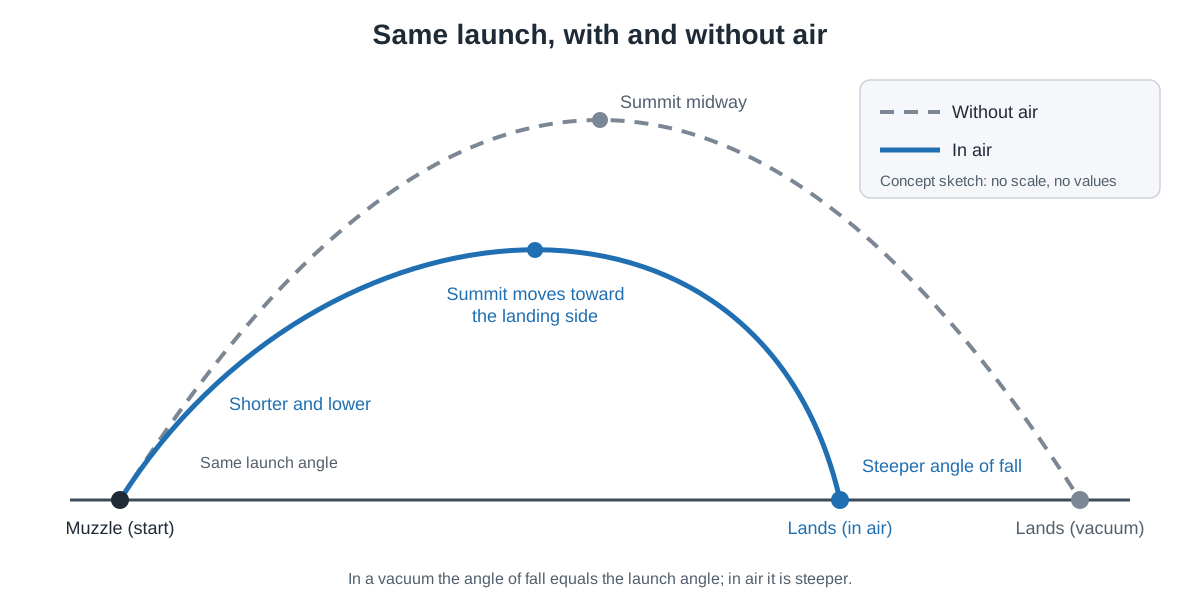
Galileo's parabola thus becomes a lopsided curve, long on the way up and steep on the way down. The math also gets much harder. Drag grows with speed squared, and speed keeps changing during the flight, so drag keeps changing too. That is why the path no longer fits in a one-line formula like the parabola.
What sets the drag
Several things set the drag: how dense the air is, and speed, which counts twice because it is squared. The air's stickiness (viscosity) and how easily it squeezes (compressibility) matter as well. So do the body's size, its shape and the angle at which it meets the oncoming air. NASA Glenn Research Center's education pages gather these into one line.
D = Cd × ρ × V² × A ÷ 2
D is drag, ρ (rho) is air density, V is speed and A is a reference area. Cd is the drag coefficient, a single number that collects complex effects such as shape, tilt, viscosity and compressibility. It is hard to get directly by calculation, so it is almost always found by experiment in a wind tunnel.
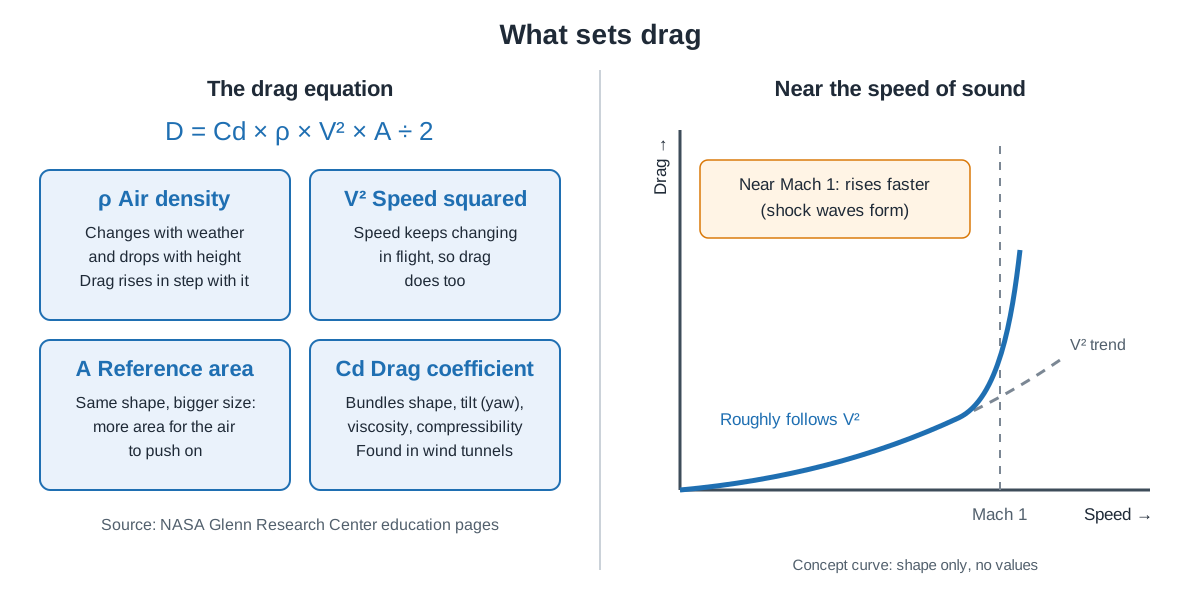
Density deserves a closer look. A shell's drag moves in direct step with the density of the air around it. A given percentage rise in density raises drag by the same percentage.
Yet air density does not stay put. The atmosphere's properties keep changing with time and place, and that change is what weather is. With height, both temperature and pressure drop, and air density drops with them.
So calculations need a reference. Aviation and rocketry use several model atmospheres, including an average or standard day and versions for hot, cold and tropical days. Artillery firing tables likewise start from set values of air density and temperature with no wind, and their standard trajectories assume density changes with height in one fixed way. When the real air on a given day differs from this reference, the shell does not fly the standard path either.
Size also changes drag. Two shells of the same shape but different size do not feel the same drag. The larger shell gives the air a larger area to push on.
Near the speed of sound
The rule that drag follows the square of the speed comes with a catch. The manual says the square rule holds only roughly, and breaks down as a shell nears the speed of sound. Right at that speed, pressure builds up behind the sound wave and drag climbs more steeply.
At low speed (typically under 250 mph), air density stays essentially constant. Go faster and part of the moving body's energy is spent squeezing the air, which changes the density of the nearby air. This is the compressibility effect. Close to and above the speed of sound, roughly 330 m/s, a sharp disturbance creates a shock wave, and the shock wave changes both lift and drag.
A body's speed divided by the speed of sound is its Mach number. Compressibility effects are strongest in transonic flow, where the Mach number is close to 1. The old belief in an unbreakable "sound barrier" came from this: in reality it was only a rise in drag near sonic speed.
Shell calculations run into the same issue. Measuring a drag coefficient at low speed and using it at Mach 2 is completely wrong, because the compression of the air changes the physics between the two cases. The artillery manual also lists the ratio of shell speed to the speed of sound among the properties a shell's drag coefficient bundles together.
On top of that, sound travels at a speed set by air temperature, and it slows with height. A shell at the same speed has a different Mach number at a different height.
Holding steady with spin or fins
Drag, as noted above, also depends on how a body is tilted to the flow. The angle between a shell's axis and its direction of motion is called yaw, and the manual lists yaw among the properties bundled into the drag coefficient. A body in flight has two main ways to hold its attitude.
The first is spin. Spiral grooves, called rifling, cut inside a barrel make the projectile spin as it leaves. The U.S. National Park Service, writing about rifles in the American War of Independence, explains that the grooves set the bullet spinning to improve range and accuracy.
A spun shell also behaves differently in air. The manual says the spin given at the start makes the projectile respond differently in the atmosphere. It lists drift, crosswind and the rotation of the earth among the factors that affect a shell's left-right direction.
Baseball shows how spin and air together can create a sideways push. A spinning ball makes a force at right angles to both the flow and its spin axis, and that force is what bends a curveball. The real airflow around a baseball is very complex, and a shell differs greatly from a baseball in both shape and speed. The curveball only shows the idea that spin can produce a side force.
The second is fins. NASA's explanation of model rockets shows the idea clearly. A flying model rocket turns around its center of gravity. When its axis tilts away from the flight direction, the body and fins create lift, and lift and drag act at a point called the center of pressure.
With the center of pressure sitting behind the center of gravity, these forces swing the nose back toward the flight direction. This is called a restoring force, and a body that comes back this way is considered stable.
With the center of pressure ahead instead, a small wobble keeps growing. Modern full-size rockets, however, usually do not rely on aerodynamics for stability and pivot their exhaust nozzles instead.
Hand calculations that led to a computer
A path through air does not fit in a one-line formula. One of the first to attack this problem by experiment was the English engineer Benjamin Robins. He invented the ballistic pendulum, which made precise measurement of the speed of projectiles fired from guns possible. A bullet strikes a heavy bob, its momentum passes to the bob, and the size of the bob's swing gives the bullet's speed.
Robins's New Principles of Gunnery, published in 1742, dealt with the enormous resistance of air to fast motion, far beyond what earlier theories had assumed. The mathematician Leonhard Euler translated it into German with his own commentary, published in Berlin in 1745.
In the 20th century this work became the job of a government laboratory. The U.S. Army Ballistic Research Laboratory (BRL) traces its roots to a Ballistics Branch created in 1918, and the Aberdeen Proving Ground unit took the BRL name in 1938. It was responsible for preparing the Army's firing and bombing tables. Firing tables are where the standard-condition trajectories described above end up.
The need to compute faster and more accurately kept pushing the ballisticians at Aberdeen, and in 1935 they installed an analog calculating machine called a differential analyzer.
When the war came, the work piled up. U.S. Army Research Laboratory (ARL) history says that even with two analyzers running, BRL fell behind on requests for new tables, which came in at about six a day. In those years a "computer" was not a machine but a human worker who worked out artillery firing tables on a desk calculator. The differential analyzer's torque amplifier also tended to break down late in a long trajectory run, wiping out the work done before.
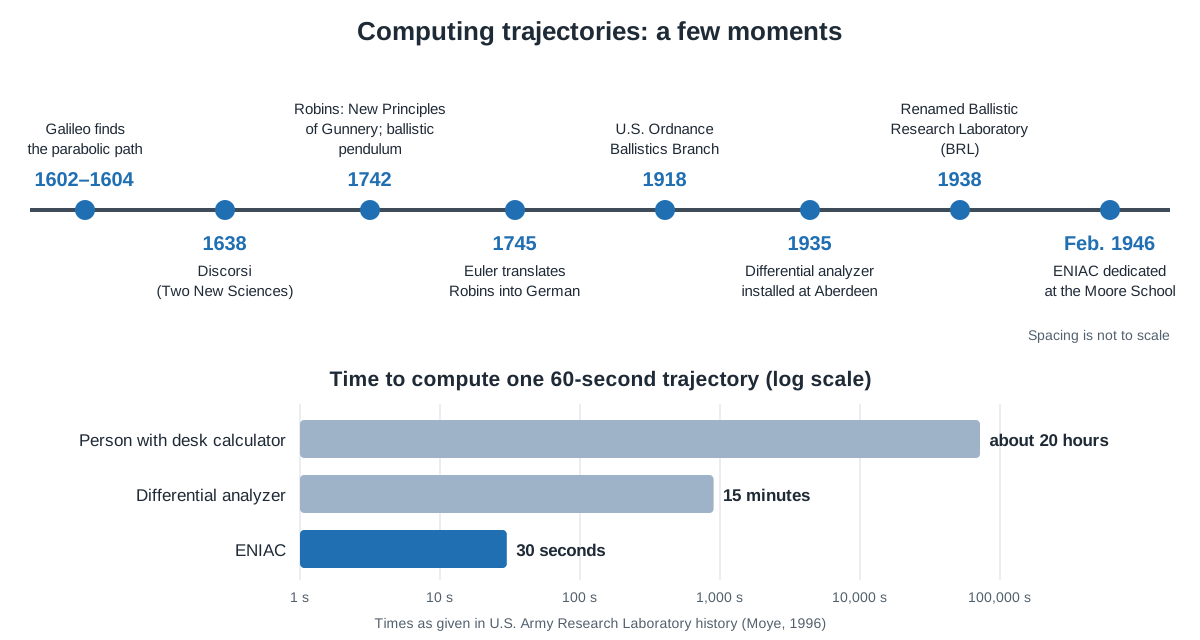
ENIAC was the answer. It was dedicated at the University of Pennsylvania's Moore School on February 15, 1946.
The same history compares the time to compute one trajectory lasting 60 seconds. An expert working a desk calculator needed about 20 hours, the differential analyzer 15 minutes, and ENIAC 30 seconds. The calculation now finished before a real shell would have landed. Throughout 1946, ENIAC was put to work on problems ranging from atomic energy to the paths of shells.
Where this meets lasers: same air, different problems
A shell and a laser beam cross the same air. The problems the air causes are different, though. For a shell, the trouble is gravity and drag, plus air density that shifts with weather and height. For a laser beam, the trouble is absorption, scattering, turbulence and thermal blooming.
A shell, which has weight, is slowed by the air and falls to the ground. A laser beam instead is weakened, scattered and shaken by the air, and spread by air it heats itself. What happens to a laser beam in air is covered one effect at a time in Light through air: absorption, scattering, turbulence, thermal blooming.
What to read next
- Self-propelled howitzers: guns that move themselves: the gun side of the story, the weapon that fires the shells exterior ballistics studies.
- Fire-control systems: linking sensors and weapons: where trajectory calculation sits between sensors and weapons.
- Light through air: absorption, scattering, turbulence, thermal blooming: what the same air does to a laser beam.