In October 2025, Anduril announced that a prototype uncrewed fighter for the U.S. Air Force had flown for the first time. Anduril built this aircraft, the YFQ-44A. Four months later, a different company, Shield AI, announced that it had been picked to supply the software that would run the aircraft's mission.
So one company built the airplane and another built the software that "flies" it. Both are new defense companies that put software at the front of their business.
What do these two companies make, and what contracts and selections appear in government records? How should a reader separate a company announcement from a system that is actually in service? This article reflects the situation as of October 2026.
Companies that start with software
A drone is more than an airframe. An unmanned aerial system (UAS) also includes a ground control station and a data link. On top of that sits one more layer: software that gathers what the sensors see, shows it to people, and lets the aircraft choose its own path.
The ability of a machine to sense, decide and carry out a goal that a person gave it is called autonomy. Both companies put this layer at the center of their business. Anduril has Lattice. Shield AI has Hivemind.
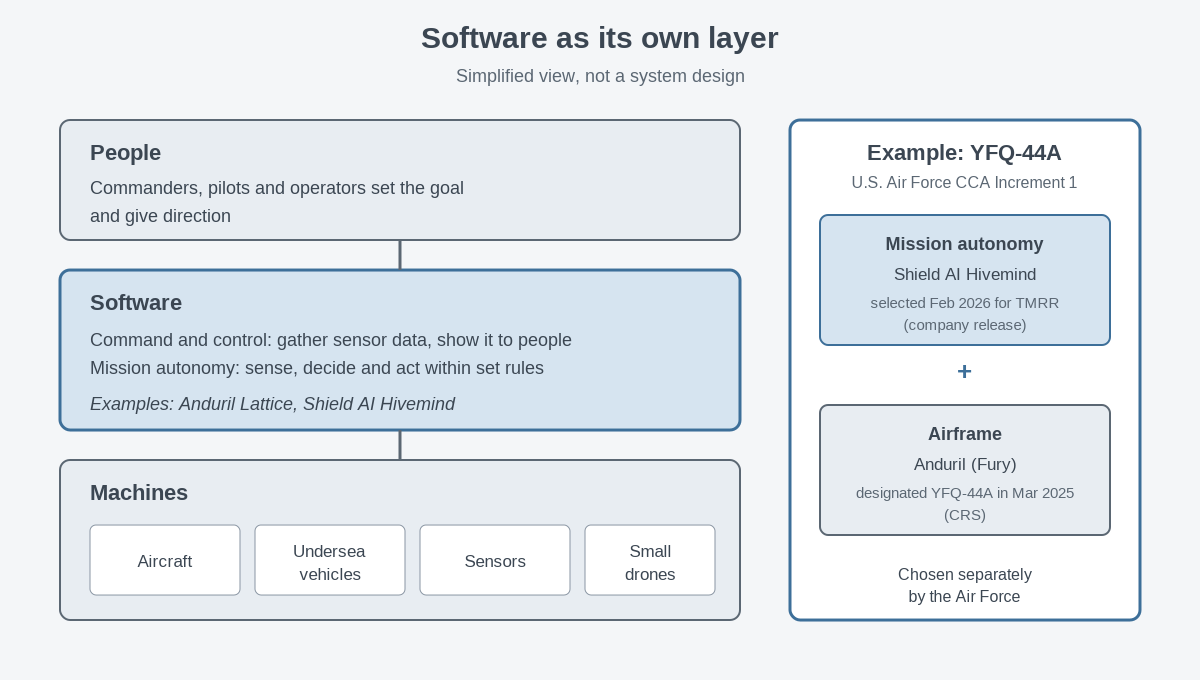
Traditional defense firms write software too. What sets these two apart is that they treat software as a product of its own, not as a part bundled with one airframe. Shield AI says Hivemind is not tied to any single platform and can serve both military and civil users. That is the company's description, and which aircraft actually use it, and how widely, has to be checked in contract records.
Anduril: Lattice and many machines
Lattice is Anduril's open systems software. In 2023, Anduril bought Blue Force Technologies, the company that had developed a large drone called Fury. Anduril is now integrating Fury with Lattice to support manned-unmanned teaming (MUM-T), in which crewed and uncrewed systems work as one team.
Anduril said in January 2025 that it would make Fury in a new plant in Columbus, Ohio. The plan puts aircraft production in the company's own plant, alongside its software.
Anduril machines in government records are not only in the air. The Altius-600 and Ghost-X drones were selected for the Pentagon's Replicator initiative. The Dive-LD uncrewed undersea vehicle was reportedly selected as well.
In Australia, the company builds Ghost Shark, an extra-large autonomous undersea vehicle. In the U.S. Army's medium-range reconnaissance program, Anduril is one of three companies supplying a small unmanned aircraft system (sUAS). It also holds a Marine Corps contract to protect bases from drones and an Army command-and-control prototype contract. Its work spans aircraft, undersea vehicles, and the command systems that tie them together.
Shield AI: the Hivemind AI pilot and the V-BAT
Shield AI's own timeline shows the company was founded in 2015. Its leadership page lists Ryan Tseng, Brandon Tseng and Andrew Reiter as co-founders. The current chief executive is Gary Steele.
The company describes Hivemind as AI software that takes the role of a human pilot or operator, so that an uncrewed system can sense, decide and act. Unlike a traditional autopilot that only follows a preplanned route, it can reroute around a no-fly zone. If an autopilot is like a bus on a fixed route, Hivemind is pitched as a driver who picks another road when one is blocked. The real difference from a driver is that it chooses only within the mission and rules that people set.
One root of this software is a 2020 DARPA simulated air combat contest. In the final event of the AlphaDogfight Trials, the F-16 AI agent of Heron Systems, a small Maryland company, beat the agents of seven other companies and took first place. It then faced a seasoned Air Force F-16 pilot in simulated dogfights and won 5-0.
DARPA's program manager said the AI won "in this limited environment." The contest was close-range combat inside a simulator, not real flight. Its goal was to draw more AI developers into DARPA's Air Combat Evolution (ACE) program.
In July 2021, Shield AI acquired Heron Systems, and the following week it signed a definitive agreement to buy Martin UAV. Martin UAV made the V-BAT, a drone that takes off and lands vertically. The V-BAT moves on a single fan inside a duct, and the direction of that thrust can be changed. A software company had bought an aircraft maker, giving it an airframe of its own to run its software on.
Shield AI has also unveiled the X-BAT, a vertical takeoff and landing uncrewed fighter. The company lists a first flight in 2026, mission capability by 2028 and production in 2029 as its goals. For now, these are company plans.
Contracts and selections in government records
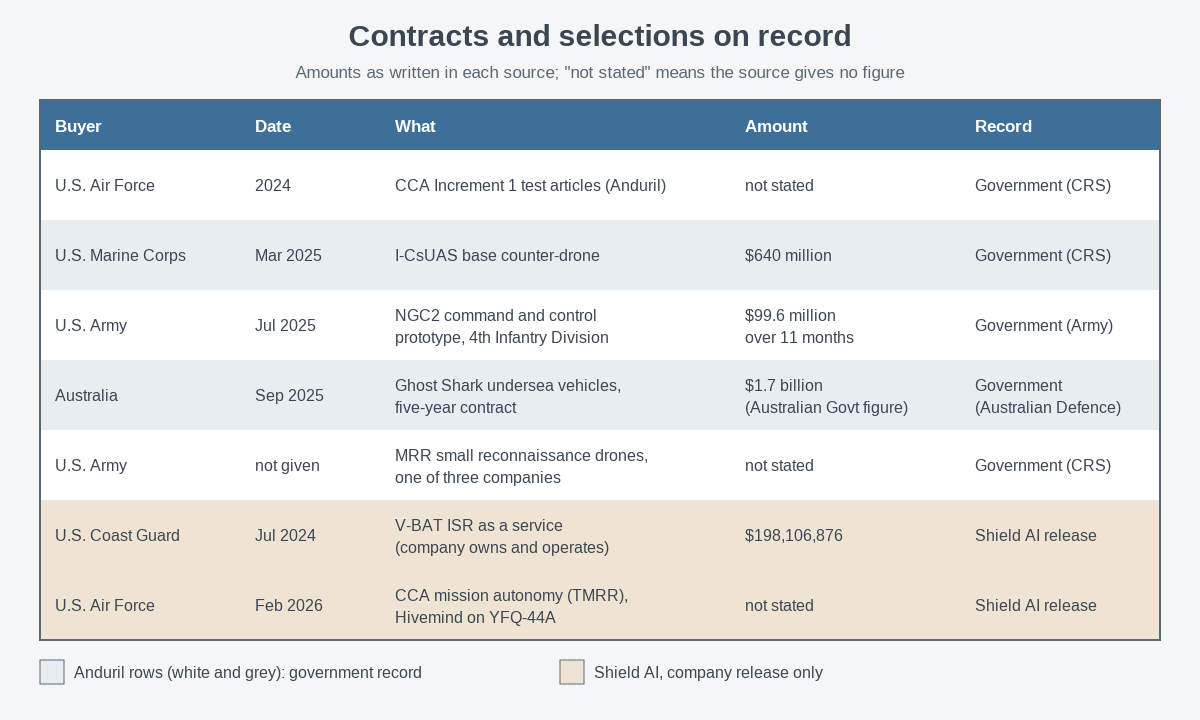
The rows in the table fall into two groups. Some were stated directly by a government or summed up in a congressional report. Others were announced only by a company.
Replicator is a Defense Department initiative unveiled on August 28, 2023, that set out to put thousands of uncrewed systems into service by August 2025. The department has released only limited information on which systems it picked, citing operational security. That is why some items, such as Anduril's Dive-LD, are listed only as "reportedly" selected.
The Marine Corps I-CsUAS program aims to give permanent and temporary bases a fixed-site counter-drone capability to detect, identify, track and defeat drones in Groups 1–3. Anduril received a $640 million Marine Corps contract for it in March 2025. The article on counter-drone systems explains why drone defense takes more than one device.
On July 18, 2025, the U.S. Army awarded Team Anduril an agreement to deliver a prototype Next Generation Command and Control (NGC2) architecture to the 4th Infantry Division. It is worth $99.6 million over 11 months. Anduril and several partner companies provide command-and-control capabilities spanning hardware, software and apps, joined through a common data layer. Prototypes for other units, such as the 25th Infantry Division and III Corps Headquarters, were set to be chosen in a separate competition.
On September 10, 2025, the Australian Government announced it would spend $1.7 billion to bring Ghost Shark into the Navy. Defence signed a five-year contract with Anduril Australia for delivery, maintenance and continued development. About $140 million had already been spent since a collaborative contract in 2022, and all three prototypes were delivered on budget and ahead of schedule.
On Shield AI's side, the company announced a U.S. Coast Guard contract in July 2024. The amount is $198,106,876. Under this deal the Coast Guard does not buy V-BATs. Instead, the company owns and operates the aircraft and provides intelligence, surveillance and reconnaissance as a service.
This shows that the drone business can sell services, not only aircraft. The article on ISR drones explains why long-endurance reconnaissance drones matter.
Two companies on one aircraft
The Air Force describes the collaborative combat aircraft (CCA) as a large, jet-powered uncrewed aircraft. It has said that CCA software driven by AI will work with human pilots and take direction from them.
In 2024, the Air Force gave initial CCA design and build contracts to five companies. Later that year, two of them, Anduril and General Atomics (GA-ASI), were picked to build Increment 1 test aircraft. The Air Force gave Anduril's prototype the designation YFQ-44A in March 2025. That October, Anduril said the aircraft, which is designed to be semi-autonomous, had flown for the first time.
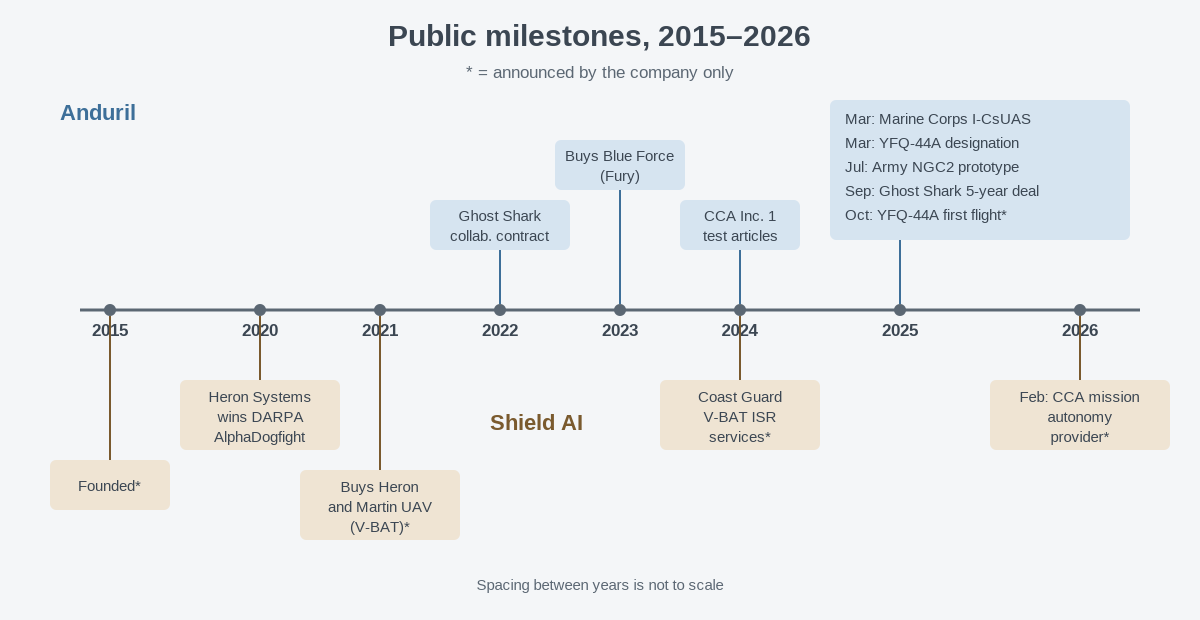
On February 13, 2026, Shield AI announced that it had been selected, after a competitive evaluation, as a mission autonomy provider for the CCA program. Its role covers the Technology Maturity and Risk Reduction (TMRR) phase. According to the company, Hivemind had been integrated on the YFQ-44A and was supporting tests ahead of flight demonstrations expected in the following months.
The notable point here is that the Air Force chose the airframe and the mission autonomy software separately. Shield AI said Hivemind complies with the government's Autonomy Government Reference Architecture (A-GRA). How far a machine should decide on its own, and where people keep control, is the question taken up in the article on autonomous weapons and human control.
Telling announcements from fielded systems
News about companies like these comes fast. Checking three things first makes it easier to avoid being carried away by hype.
First, check who said it. In this article's table, the Coast Guard V-BAT contract and the CCA mission autonomy selection were confirmed only through company releases. Even for the YFQ-44A's first flight, the congressional report writes that "Anduril announced" it. That does not make the release wrong, but it carries different weight from a government record.
Second, check the stage: selection, prototype agreement, test flight, test and evaluation, production and operational use are all different steps. A Congressional Research Service (CRS) summary from late 2025 shows where the YFQ-44A stood. It was a test aircraft going through development tests in California and an operational assessment at Nellis Air Force Base. NGC2 is an 11-month prototype agreement, and X-BAT is a company plan.
Third, check when the number is from. In the 2021 acquisition release, the V-BAT was listed with 11 hours of flight and 25 pounds of payload. The company's current page lists a maximum payload of 40 pounds and endurance of more than 12 hours. The same name can carry different numbers as versions change, so look at the date of the source along with the figure.
What to read next
- Collaborative Combat Aircraft: Uncrewed Jets Flying Beside Fighters: the whole program the YFQ-44A belongs to.
- Counter-drone systems: why one device is not enough: the layers of detection and response that a base counter-drone program brings together.
- Autonomous weapons and human control: the debate around AI pilot software.
- What is a laser weapon? Film versus reality: the basics of laser weapons, which often come up in counter-drone discussions.
- General Atomics and the Reaper family, and AeroVironment: other drone makers covered in the same series, still being written.