Picture a tank shell and you probably see a pointed nose on a stout body. The part of a modern tank round that actually goes through armor looks nothing like that. It is a long, thin metal rod with fins on its tail, closer to an arrow than to a shell.
There is no explosive in this rod. It gets through armor with nothing but the force of its flight. So why a long rod, and why fins on the tail? This article starts from textbook kinetic energy and pressure, then follows how the heavy steel shot turned into a rod.
A round that pierces without explosives
Rounds that defeat armor come in two broad families. One uses an explosive charge in the warhead to form a metal jet, as a shaped charge does. The other carries no explosive: the projectile itself pushes its way in. That second kind is called a kinetic energy penetrator (KE penetrator).
A KE penetrator relies on its own motion to force a way into armor and, ideally, out the other side. Kinetic energy is one-half of the mass times the square of the speed. Because speed is squared, a faster object of the same mass carries much more energy.
The same force on a smaller spot
A lot of energy is not enough by itself. How small a spot that force lands on matters too. Pressure equals the force spread over the area it presses on at right angles.
A textbook example makes this concrete. A poke with a finger is only annoying. The same force on an area the size of a needle tip is enough to break the skin.
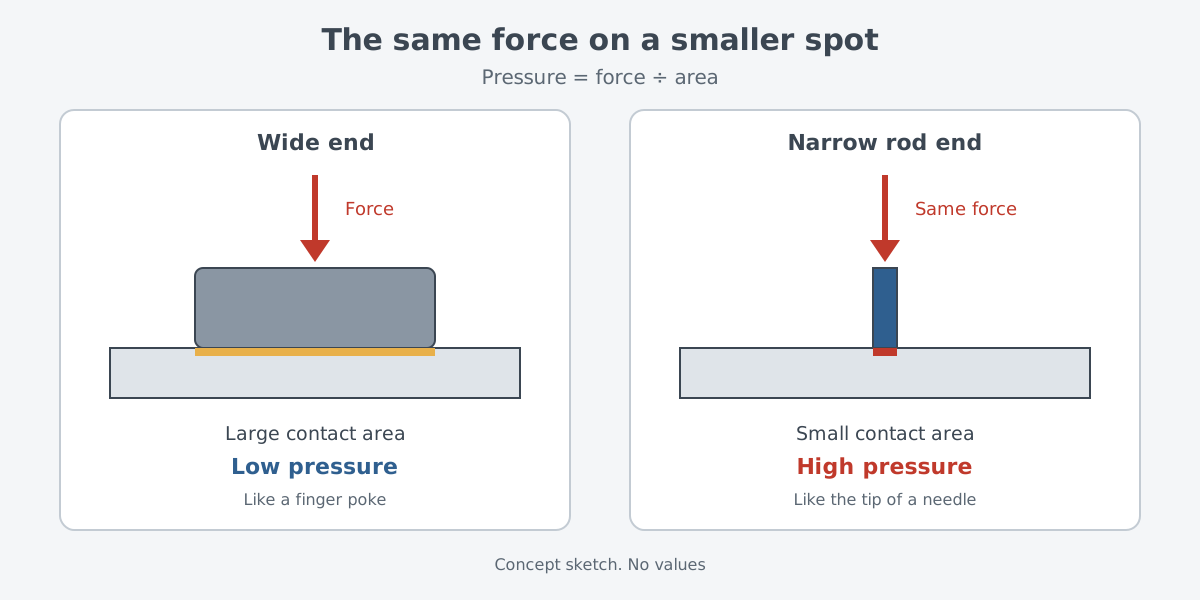
A penetrator works on the same idea. A denser penetrator produces a higher impact pressure at the same speed, and so it goes deeper. The needle picture has a limit, though. A penetrator that hits very fast wears itself away as it pushes through the armor.
From full-bore shot to a thin rod
Once tanks appeared with tough, strong steel armor, kinetic energy rounds against them began as full-bore solid shot of hardened steel. This is armor-piercing shot (AP shot). It strikes at a very low speed by modern standards, so it does not wear away in most materials. It opens a hole and moves through it, much like a factory punch going through a metal sheet.
Getting better results meant bigger guns, and the guns grew more costly and harder to handle. Designers looked for another path. If less mass moves down the bore, more of the propellant's energy can go into the projectile.
The hypervelocity armor-piercing (HVAP) round for the 90 mm tank gun used this idea. It came in as World War II was drawing to a close. A light aluminum carrier held a smaller penetrator of tungsten carbide or another dense material.
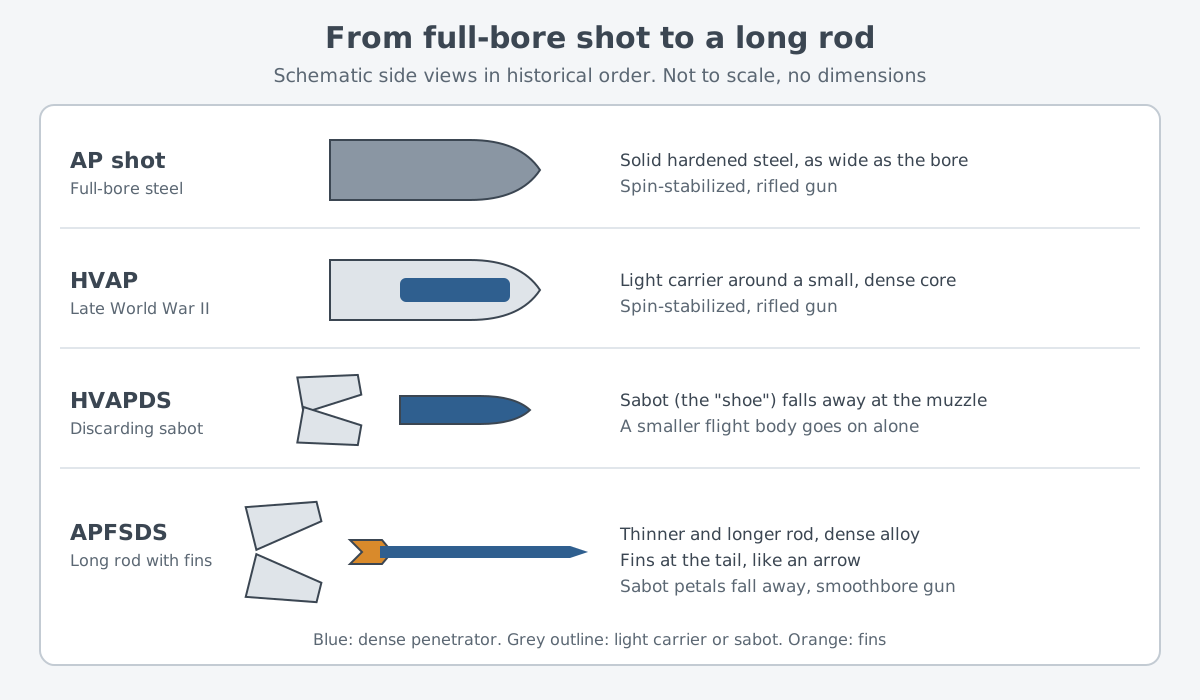
The abstract of the DSIAC monograph sums up what came next. A thinner, denser penetrator core and a higher striking speed raised the impact pressure, and that line of development led to the long rod penetrator.
A shoe that falls away at the muzzle
For the 105 mm gun, HVAP was improved into the HVAPDS round, short for HVAP discarding sabot. "Sabot" is French for "shoe." This part separates from the projectile once it leaves the muzzle.
Think of kicking off your shoes and running on in bare feet. In reality the shoes do not just drop quietly. Sabot petals thrown off by a KE round put a large area in front of the gun in danger.
Fins instead of spin
A bullet holds its attitude by spinning, and so did AP shot and HVAP rounds. To shoot them accurately, the barrel needed spiral grooves inside it, called rifling.
The modern armor-piercing fin-stabilized discarding sabot (APFSDS) round works differently. It holds its attitude with tail fins, like an arrow, so a smoothbore gun with no rifling can launch it. The gun on the U.S. M1 main battle tank (MBT) is one example. According to DSIAC, the M829 long rod round was designed for the M1's 120 mm smoothbore cannon.
The way fins hold the direction is the same principle NASA uses to explain model rockets. An object in flight turns about its center of gravity. If the body tilts a little away from its flight path, the air pushes on it at a point called the center of pressure. When this point sits behind the center of gravity, the air pushes the tail back and the nose turns back toward the flight direction.
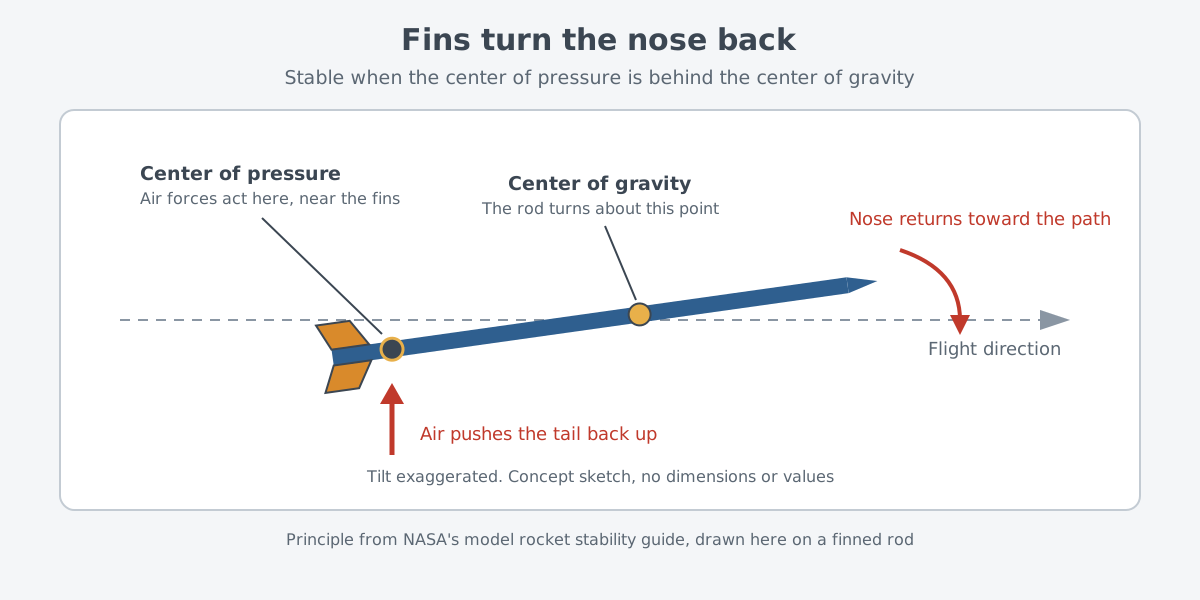
The drawing only shows the principle. It does not show the shape or size of the fins on a real round.
Why so long
APFSDS rounds made the penetrator thinner still and stretched it longer. That kept the launched mass about the same as in HVAPDS rounds. With the same mass and a thinner cross-section, the same weight is packed onto a smaller area.
A thin body has one more benefit. Its small frontal area means it loses less speed to drag. It reaches the target faster as a result.
At high striking speeds, the rod wears away from the front as it pushes through the armor. This is called erosion. Because the rod penetrates by eroding, DSIAC sums it up this way: longer rods get through thicker armor.
Rods could not simply keep growing, though. As rods got longer, the sabot around them got heavier too. From the penetrator's point of view, the sabot is dead weight. Better sabot design and materials, along with progress in interior ballistics, let longer rods leave the gun at higher muzzle velocities.
The same idea shows up in other weapons. According to a National Research Council (NRC) report, penetrating weapons for underground targets also get the highest possible cross-sectional density to go deeper. Cross-sectional density is mass divided by cross-sectional area. That story is in the article on bunker busters.
Materials and the problems they leave
Density, strength, and toughness all matter for a KE penetrator's material. Toughness means the ability to hold together rather than shatter. Sintered tungsten alloys and depleted uranium (DU) alloys are dense materials developed alongside the other parts of long rod rounds.
DSIAC states that the anti-armor KE penetrators the U.S. has fired in combat are nearly always uranium alloy. The reason it gives is that uranium mushrooms less than tungsten as it penetrates. Uranium is also a by-product of making enriched uranium for power plants and nuclear weapons.
Depleted uranium is the leftover once most of its strongly radioactive uranium-235 has been taken out of natural uranium ore. The EPA explains that the U.S. Department of Defense began making ammunition and weapons from DU in the 1970s. The reason was that DU ranks among the hardest and densest known metals.
Health concerns come with it. The EPA says that DU inside the body is a toxic chemical as well as a radiation health hazard. Spent shells and their fragments have left DU contamination that is a hazard on some military firing ranges. Practice ammunition used for training contains no uranium.
Materials are not the only open issue. A KE round slows down as it flies farther, and its effect drops with range. The long, thin shape cuts this loss but cannot remove the fact that the round keeps losing speed.
Where this meets lasers: concentrating on a small area
At its core, the penetrator story is about how small an area the same energy is packed onto. Lasers face the same question. For a laser, the power that light carries per unit area is called intensity, and putting the same power on a smaller area raises the intensity.
The two work in different ways, of course. A penetrator is a solid object with mass striking a target, while a laser heats a surface with light. How power, energy, and intensity differ continues in Power, energy and intensity.
What to read next
- Main battle tanks: is it all about the gun?: firepower, protection, and mobility of the tank that fires these rounds
- Composite and reactive armor: the blocks on a tank: the side that takes the hit
- The Shaped Charge: What Is the Munroe Effect?: the other family, which pierces with a metal jet formed by explosives
- Electromagnetic railguns: launching with electricity: pushing a projectile with electricity instead of gunpowder