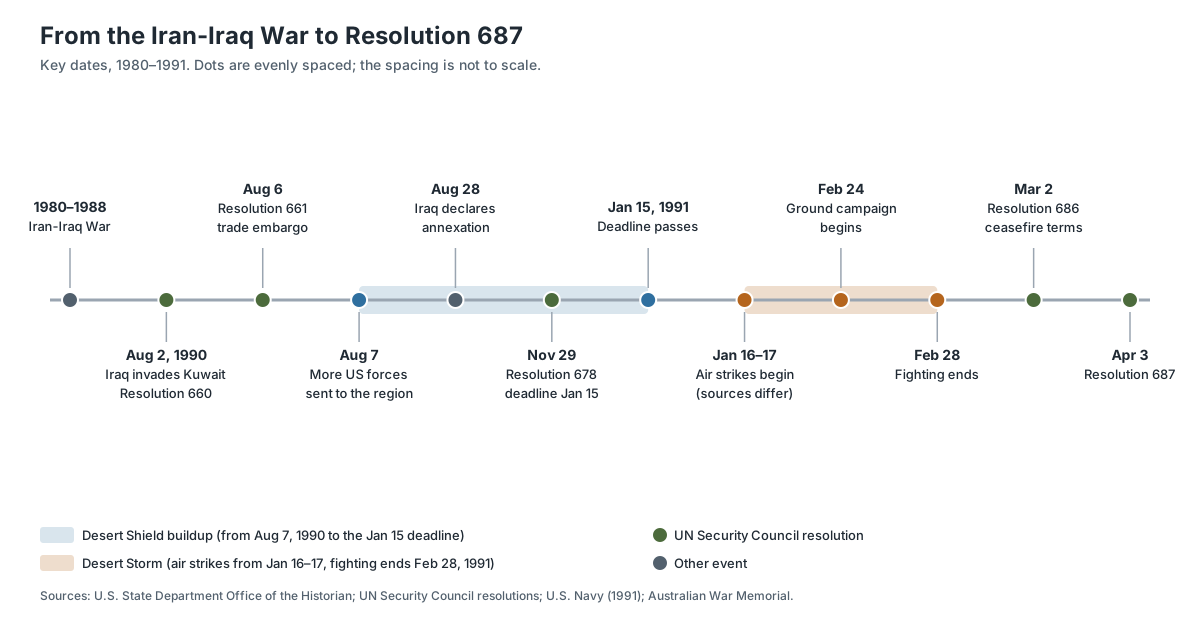
On August 2, 1990, 100,000 Iraqi troops crossed into Kuwait. It took only a matter of hours for the whole country to fall under their control. Less than seven months later, on February 28, 1991, Iraqi forces had been pushed out of Kuwait.
Two operation names cover those seven months. Desert Shield was the five-plus months of gathering forces in Saudi Arabia. Desert Storm was the air strikes and the ground campaign that followed.
Why did the war start, and what did it leave behind? This article follows the path from invasion to ceasefire. It draws on the State Department's Office of the Historian and UN Security Council resolutions. It also uses reports from the Congressional Research Service (CRS), the General Accounting Office (GAO) and the US Navy, along with the Australian War Memorial.
Where sources give different numbers, as with casualties, each figure comes with the agency that reported it.
Debt and borders: up to the summer of 1990
When the Iran-Iraq War of 1980–1988 ended, Iraq came out with its state intact but deep in debt. It had paid for the war mostly with loans. In 1990 it owed about $37 billion to Gulf creditors.
President Saddam Hussein asked Kuwait and the UAE to write off that debt. His argument was that the loans should count as payment for shielding the Arabian Peninsula from Iranian expansion, but no answer came. The Office of the Historian sees that refusal as one factor in his decision to threaten Kuwait, a rich neighbor with a weak military.
Money was not the only dispute. Ownership of Warbah and Bubiyan Islands had long been a central point in the territorial quarrel between the two countries. In 1961, when Britain ended its protectorate over Kuwait, Iraqi Prime Minister Qasim claimed Kuwait as part of Iraq because it had belonged to the old Ottoman province of Basra. Iraq backed down once British troops arrived in Kuwait.
In July 1990, Saddam accused Kuwait and the UAE of breaking the production quotas of the Organization of Petroleum Exporting Countries (OPEC). He said their extra oil had pushed prices down. He also said Kuwait was taking oil from the Rumayla field, which straddles the border, and demanded the two islands. In early July the United States held maneuvers in the Gulf as a warning, while keeping a conciliatory policy aimed at holding on to ties with Iraq.
August 2, 1990: an occupation within hours
The United States knew of Saddam's threats but had not expected an actual invasion. There was some Kuwaiti resistance, and it was quickly put down.
Members of the Kuwaiti royal family fled to Saudi Arabia and appealed for international help. On August 28, Iraq declared Kuwait its nineteenth province. Iraqi forces refused to leave and began looting Kuwait and wrecking its infrastructure.
Security Council resolutions: from a withdrawal demand to the use of force
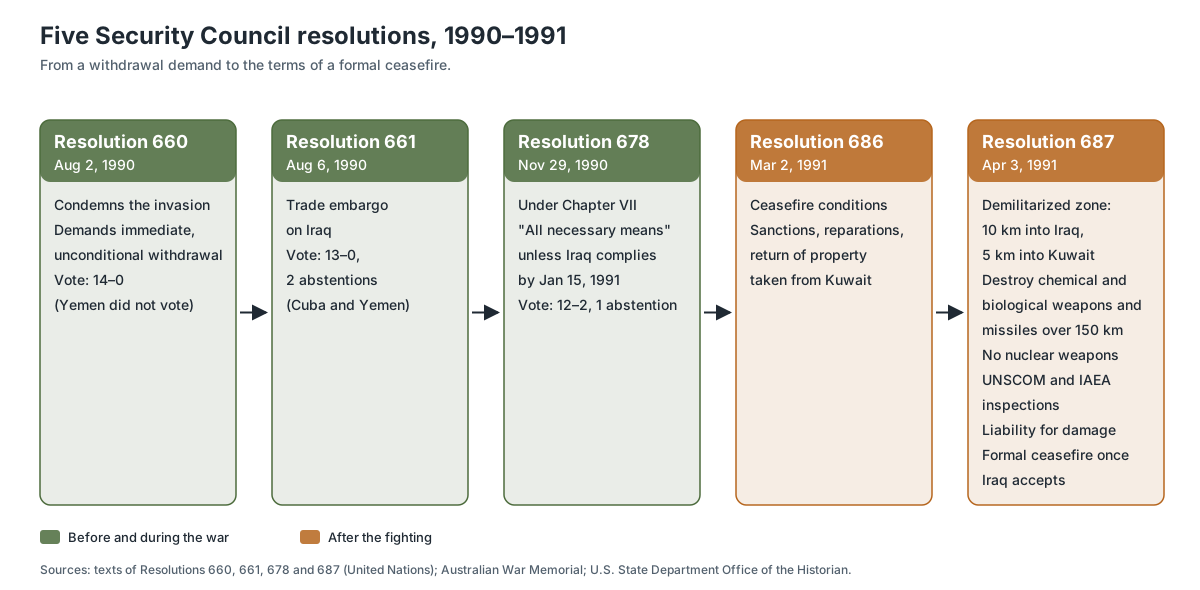
On the day of the invasion, the UN Security Council passed Resolution 660. It condemned the invasion and demanded that Iraq pull all its forces back, at once and without conditions, to where they had been on August 1. The vote was 14 to none, and Yemen did not take part.
Four days later, Resolution 661 barred trade with Iraq. It passed with no votes against: 13 in favor, with Cuba and Yemen abstaining.
On August 9, Resolution 662 declared that annexation of Kuwait in any form had no legal validity. Within weeks a blockade cut Iraq off from the sea. Condemnation of the invasion was widespread and close to unanimous.
While Iraq refused to withdraw, the United States prepared the next step. By October 30, the Bush administration had decided to force Iraq out of Kuwait if necessary. It added troops and asked the United Nations to authorize the use of force.
Resolution 678 of November 29 was adopted under Chapter VII of the UN Charter. Unless Iraq fully carried out the earlier resolutions by January 15, 1991, it allowed member states working with Kuwait's government to use "all necessary means." The text called this a final chance, given "as a pause of goodwill."
The vote was 12 in favor, 2 against (Cuba and Yemen) and 1 abstention (China). The Office of the Historian describes Resolution 678 as an authorization of force to make Iraq withdraw and says it gave Iraq a 45-day grace period.
Desert Shield: five months of buildup
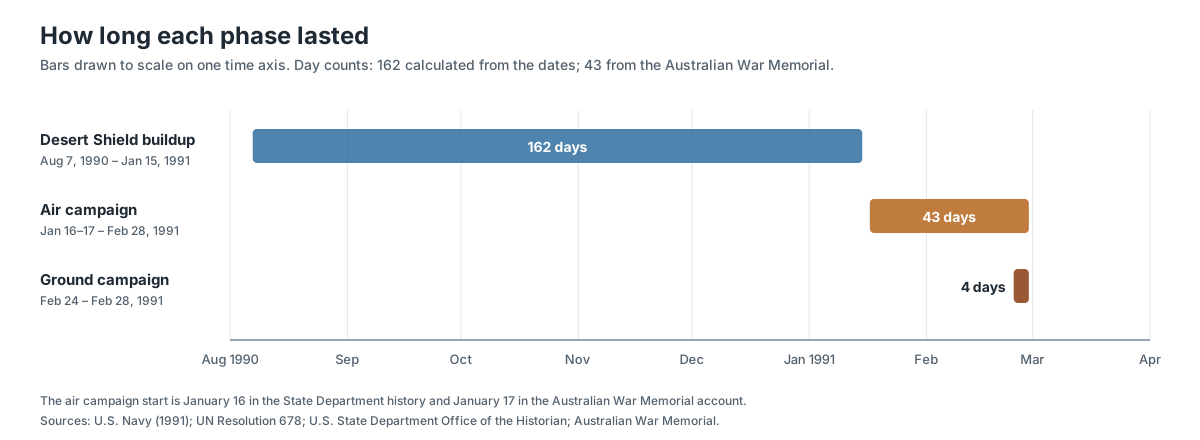
Soon after the invasion, Washington and Riyadh agreed that US forces would be based in Saudi Arabia to defend the peninsula. According to a 1991 US Navy summary report, the president decided to send additional forces to Southwest Asia starting August 7. From that day to the January 15 deadline is 162 days, a little over five months.
The force that gathered was large. In Defense Department figures compiled by CRS, US troops serving inside the theater numbered 584,342 on active duty plus 110,208 recalled reservists, for a total of 694,550. That count covers Desert Shield and Desert Storm together.
The United States was not alone. The coalition drew forces from 34 countries, several of them Arab states. The Royal Australian Navy first contributed a pair of frigates and the supply ship HMAS Success to a multinational interception force enforcing UN sanctions.
At sea, an ongoing interdiction of Iraq's seaborne trade cut off resupply to Iraqi forces. More than 90% of the material supporting the campaign arrived by sea, and the Navy supplied most of the medical assets in the early months. The work of moving supplies and keeping equipment running is covered in Military logistics: performance must be sustainable.
Desert Storm: the air war and four days on the ground
Once the January 15 deadline passed, the US-led coalition began air strikes. Sources differ by one day on the start. The Office of the Historian gives January 16; the Australian War Memorial gives January 17.
The bombing went on without a break for 43 days, until the war ended. Why stealth aircraft and precision-guided weapons drew attention in that air campaign is a topic for "The Gulf War Air Campaign: Why Stealth and Precision Weapons Drew Attention."
In retaliation, Saddam fired missiles at Israel and at coalition bases in Saudi Arabia. Israel did not strike back.
On February 24, with over a month of bombing behind them, coalition ground troops advanced on Iraqi positions both in Kuwait and inside Iraq. The ground campaign lasted four days. Coalition forces freed Kuwait City and forced the Iraqi army to fall back.
Baghdad radio announced that Iraqi forces had been ordered back to the positions they held before August 1990. Two days later the coalition stopped fighting and declared victory. It was February 28. Even so, Iraq kept significant military strength intact on its own soil.
Weapons and transport: what drew attention
Missiles fired from the sea were part of this war too. Cruisers, destroyers, battleships and submarines in the Red Sea and the Persian Gulf launched 288 Tomahawk cruise missiles in all, the US Navy report records.
In the sky, missile met missile. Among the missiles Iraq fired was its modified Scud, known as the Al-Hussein. The US Army sent the Patriot, a surface-to-air guided missile system, to Southwest Asia to defend against it.
The Patriot was built to protect US forces from air attack. Over time it grew to handle aircraft, then cruise missiles and, later, short-range ballistic missiles. Still, it had not been designed from the start for a stretched-range, high-speed ballistic missile like the Al-Hussein.
So how many did it stop? Even the Army's own assessment changed several times.
An early report said Patriot destroyed about 96% of the Scuds it engaged over Saudi Arabia and Israel. As more information came in, the Army lowered that to 80% in Saudi Arabia and 50% in Israel. A revised assessment in April 1992 put it at 70% and 40%.
The General Accounting Office (GAO) focused less on the percentages than on the evidence behind them. The Army operated Patriot in a war zone, not on a test range, and did not collect performance data that could settle how many targets it hit. So there is no way to settle the question conclusively. The strongest evidence supports about 9% of engagements, and the Army is highly confident of warhead kills in about 25%.
So 96% and 9% sit side by side in the record for the same weapon. The 96% is the Army's first figure, which it later lowered itself. The 9% is the share of all engagements that GAO found backed by the strongest evidence of a warhead kill.
The ceasefire and Resolution 687
On March 2, the Security Council set ceasefire conditions in Resolution 686. Iraq had to accept sanctions, pay reparations for war damage and return property taken from Kuwait.
Resolution 687 of April 3 was far longer and more detailed. It set up a demilitarized zone reaching 10 km into Iraq and 5 km into Kuwait along the border. It required chemical and biological weapons, and ballistic missiles with a range over 150 km, to be destroyed under international supervision. It also created the UN Special Commission (UNSCOM) to inspect them.
Iraq also had to agree not to acquire or develop nuclear weapons or material usable in them. On-site inspection of its nuclear capabilities went to the International Atomic Energy Agency (IAEA).
Iraq was held liable under international law for damage caused by the invasion and occupation, including environmental damage and the depletion of natural resources. A formal ceasefire would take effect once Iraq officially notified the UN that it accepted these terms. The United States sought to keep the trade embargo from Resolution 661 of 1990 in place.
Inside Iraq, the end of the war did not bring calm. Shiite rebels rose in the south and unrest spread among Kurds in the north, and Saddam's government eventually crushed both. What came of twelve more years of inspections and sanctions belongs to "The Iraq War, 2003: Three Weeks to Baghdad."
What the numbers record, and what they cannot
Start with US deaths. In Defense Department figures compiled by CRS, Desert Shield and Desert Storm together cost 383 American lives. During Desert Shield alone, 84 died from causes other than hostile action.
Hostile deaths in Desert Storm appear as 148 in one table of the CRS report and 147 in another, one apart. In the table dated July 16, 2020, 143 were killed in action and 467 were wounded but survived. Across the whole coalition, the Australian War Memorial records 166 killed, many of them by friendly fire.
Iraqi figures vary widely depending on what is counted. Among the sources checked for this article, only the Australian War Memorial gives an overall Iraqi death toll: at least 100,000 Iraqis killed. It is one institution's estimate and does not separate soldiers from civilians.
In a paper in the International Review of the Red Cross, Beth Osborne Daponte used the 1991 Gulf War as a case to split war deaths into five groups. They are military deaths during the war, civilians killed by the war's direct effects, civilians killed by its indirect effects, and civilians and soldiers killed in postwar violence.
Her count of civilians killed by direct effects, built from human rights reports and Iraqi Ministry of Health tallies, came to 3,500. Either source, she noted, could have undercounted. Because 100,000 and 3,500 measure different things, they cannot be compared on one line.
The war also marked the land and the air. From February to November 1991, oil wells set on fire by Iraqi forces sent up dense clouds of soot and gas. The Department of Veterans Affairs (VA) says the smoke can irritate the eyes, nose and throat and cause coughing, but the irritation is mostly temporary. Research so far shows no evidence of long-term health problems from it.
Some returning troops live with chronic symptoms that medicine has not explained. Fatigue, headaches, joint pain, indigestion, insomnia, dizziness, breathing problems and memory trouble appear together. Because symptoms vary so much from person to person, VA avoids the term "Gulf War Syndrome." It uses "medically unexplained chronic multisymptom illness" and presumes that certain symptoms lasting six months or more are linked to Gulf War service, whatever the cause.
The fighting stopped after 43 days. Yet the inspections and sanctions under Resolution 687, and the illnesses of veterans, kept going long after the ceasefire, and they are the other half of this war.
What to read next
- "The Gulf War Air Campaign: Why Stealth and Precision Weapons Drew Attention": a closer look at the 43 days of air strikes.
- "The Iran-Iraq War: Eight Years of Attrition": the earlier war that left Iraq deep in debt.
- "The Iraq War, 2003: Three Weeks to Baghdad": the war that came twelve years later.
- Ballistic missiles: why they climb high and come down: the path a missile like the Scud flies.
- Surface-to-air missiles: ground systems that guard the sky: the parts that make up a system like Patriot.
- Cruise missiles: how they resemble aircraft: how a missile like the Tomahawk flies.
- Precision-guided bombs: what gets added to a plain bomb: how a bomb finds its target, including guidance by a laser spot on the target.