On March 24, 1999, NATO began air strikes against the Federal Republic of Yugoslavia. For the next 78 days, NATO fought only from the air and sent no army onto the ground. When the strikes stopped on June 10, Yugoslav forces were leaving Kosovo. Two days later, a NATO-led peace force moved in.
Many questions about those 78 days are still asked. Did air strikes alone really make the other side back down? Was an intervention without Security Council approval justified? How many civilians died?
This article draws on records from NATO, the United Nations, the International Criminal Tribunal for the former Yugoslavia (ICTY) and the U.S. State Department. It follows why the air war started, how it ended, and where the voices still split.
Kosovo after Yugoslavia broke apart
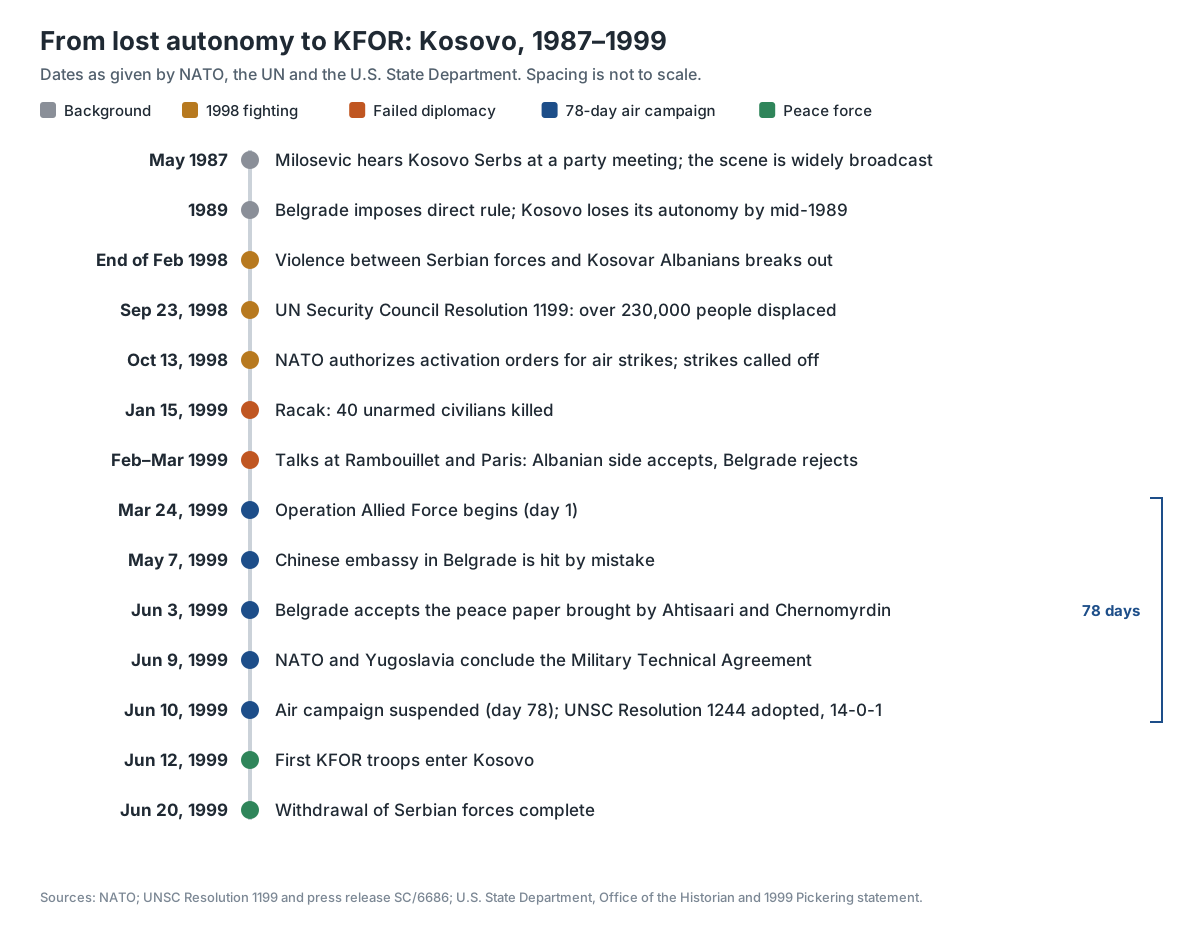
Kosovo is a province in the south of Serbia, and most of its people are ethnic Albanians. In May 1987, Serbian Communist Party leader Slobodan Milosevic went to a party meeting in Kosovo. Local Serbs rioted outside the hall. Serbian-controlled media widely reported how he listened to their complaints, and the former banker became a symbol of Serbian nationalism.
Milosevic was president of Serbia from 1989. He moved to strip Kosovo and Vojvodina of the autonomy that Serbia's constitution had guaranteed them. By mid-1989, both provinces had been folded back into Serbia. Direct rule from Belgrade, imposed in 1989, brought rising tension and repeated outbreaks of violence between Serbs and Albanians in the province.
Meanwhile, Yugoslavia was breaking apart. Slovenia and Croatia declared independence on June 25, 1991, and Serbia and Montenegro joined to create a new Federal Republic of Yugoslavia. In Bosnia and Herzegovina, three years of war then killed hundreds of thousands of people and drove millions from their homes. Then, in 1998–1999, violence broke out again in Kosovo.
1998: fighting and Security Council resolutions
At the end of February 1998, the tension boiled over into fighting between Kosovar Albanians and Serbia's military and police. The UN Security Council passed Resolution 1160 on March 31. On September 23, Resolution 1199 blamed many civilian casualties on "excessive and indiscriminate" force used by the Yugoslav Army and Serbian security forces. It also cited the Secretary-General's estimate that over 230,000 people had left their homes.
On October 13, NATO's North Atlantic Council approved activation orders, the step that readies actual air strikes. U.S. Ambassador Richard Holbrooke then reached agreements with Milosevic on a cease-fire and on Serbian force levels in Kosovo. Milosevic agreed to comply, and the strikes were called off. The Organization for Security and Co-operation in Europe (OSCE) sent a Kosovo Verification Mission to watch the deal, and NATO flew an aerial surveillance mission.
Things did not get better. As 1998 closed, over 300,000 people in Kosovo had already left their homes, the cease-fires were not being kept, and talks had stalled.
Racak and Rambouillet: three months of failed diplomacy
The situation flared up again in early 1999. NATO points to provocations on both sides and excessive force by Serbian military and police. One of the events it lists took place at Racak, a village where 40 unarmed civilians were massacred on January 15. International mediators then made a fresh push for a peaceful solution.
The first round of talks met at Rambouillet, France, in February. The second met in Paris in March. The plan gave Kosovo autonomy inside the Federal Republic of Yugoslavia, guaranteed by a NATO-led force on the ground. The Albanian delegation accepted it, but Belgrade rejected it.
In March, Serbian military and police brought in more troops and tanks and stepped up their operations. Tens of thousands of people started leaving their homes. Holbrooke made one last attempt to persuade Milosevic and failed. NATO began its air campaign on March 24.
Seventy-eight days of air strikes
The operation was called Operation Allied Force. It began on March 24, 1999, and was suspended on June 10, lasting 78 days in all. NATO stated five political objectives:
- a verifiable stop to all military action, violence and repression
- the withdrawal of military, police and paramilitary forces from Kosovo
- an international military presence in Kosovo
- the unconditional and safe return of all refugees and displaced persons
- a political agreement for Kosovo in line with international law and the UN Charter
On the first day, U.S. President Clinton set out three aims. NATO would show it was serious, deter an even bloodier Yugoslav offensive against civilians in Kosovo, and, if needed, seriously damage the Serbian military's ability to wage war there. The second aim failed.
Instead of backing down, Milosevic at once stepped up a massive campaign of ethnic cleansing. Hundreds of thousands of Kosovars ended up in neighboring countries, some fleeing and others expelled.
The strikes were widened step by step rather than all at once. The first targets were Yugoslavia's air defenses, and the campaign then escalated using NATO's most advanced precision-guided systems.
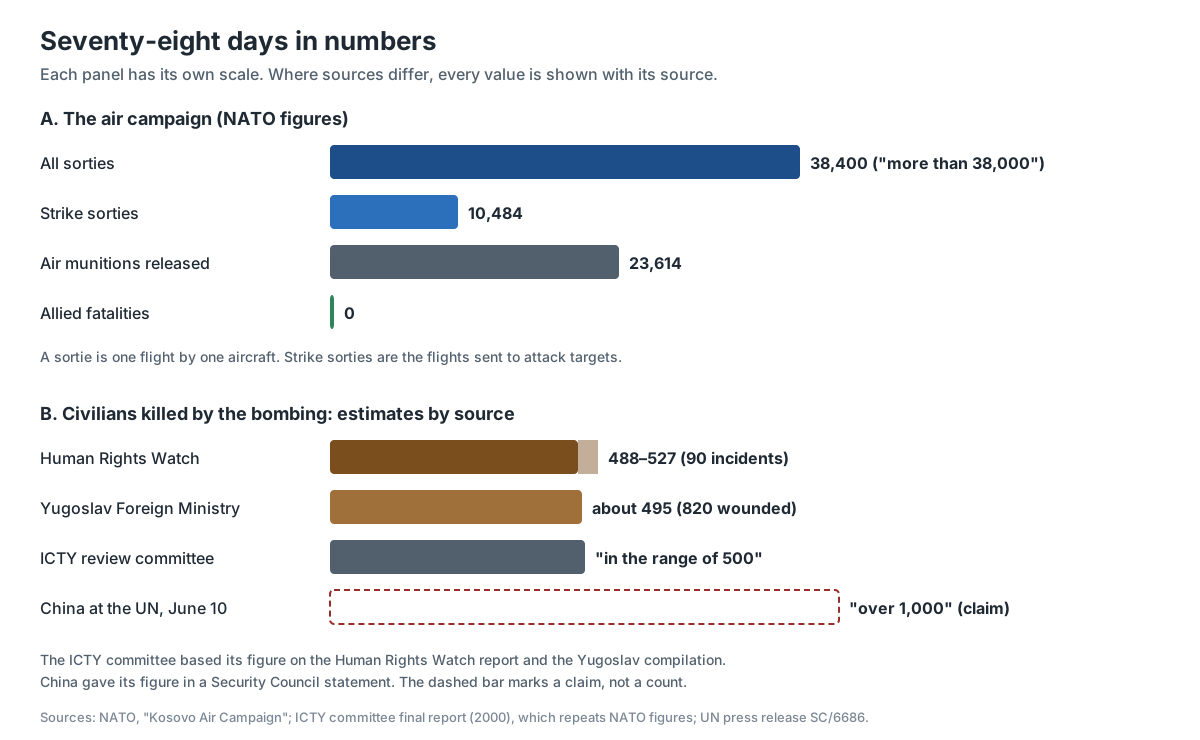
By NATO's count, more than 38,000 sorties were flown over the 78 days, and 10,484 of them were strike sorties sent to attack targets. Another NATO figure puts the sorties at 38,400, and 23,614 air munitions were released. Not a single Allied service member was killed.
Nineteen allies took part. Three new members had joined only two weeks before the conflict began. They gave political support but sent no combat forces. Getting 19 countries with different histories and interests to act together was a major challenge in itself.
Why no ground troops were sent
The part of NATO's strategy debated most openly and most heatedly was the decision to leave out ground forces. On March 24, Clinton said, "I do not intend to put our troops in Kosovo to fight a war." Public statements of that policy drew special criticism.
A 1999 Congressional Research Service (CRS) report called it a militarily unwise statement, made for the political purpose of reassuring hesitant allies. By May 18, Clinton was saying that neither the United States nor its allies should take any options off the table.
Ground troops had clear pros and cons. An army closing in on the ground would make it harder for Milosevic to wait out the air strikes. But every ally would have to accept the risk of soldiers being killed and wounded. Serious invasion planning never got under way in NATO countries, partly out of worry about the political cost of Western casualties.
The only major U.S. ground combat deployment was Task Force Hawk, built around Apache attack helicopters. When it was announced on April 4, it was expected to take 10 days to deploy. It took until April 21 to assemble in Albania.
The airport in the capital, Tirana, had room on the ground for just a single C-5, or two C-17s, at any one time. The task force needed over 150 transport flights. That airport's first job was helping refugees arriving from Kosovo. The Apaches were never used, and the debate over whether using or threatening ground forces would have changed the outcome goes on.
Ending it: the Military Technical Agreement and Resolution 1244
The end came through diplomacy. On June 3, the Yugoslav government accepted a peace paper brought to Belgrade by Finnish President Martti Ahtisaari and Russian envoy Viktor Chernomyrdin. On June 9, NATO and Yugoslavia concluded the Military Technical Agreement. The next day, after confirming that Yugoslav forces had begun to withdraw, NATO announced that the air campaign was suspended.
Also on June 10, the Security Council adopted Resolution 1244 under Chapter VII of the UN Charter, by 14 votes to none, with one abstention (China). The resolution demanded that Yugoslavia end violence and repression in Kosovo at once and pull out all military, police and paramilitary forces on a rapid timetable. It also reaffirmed Yugoslavia's sovereignty and territorial integrity. The international security presence was given tasks that included deterring renewed fighting and disarming the Kosovo Liberation Army (KLA).
The first troops of the Kosovo Force (KFOR) entered Kosovo on June 12, and the withdrawal of Serbian forces was complete by June 20. KFOR started with some 50,000 people. Just before it arrived, 180–200 Russian troops from Bosnia raced ahead to take Pristina airfield. Some critics saw this as a sign of weakness in NATO's chain of command.
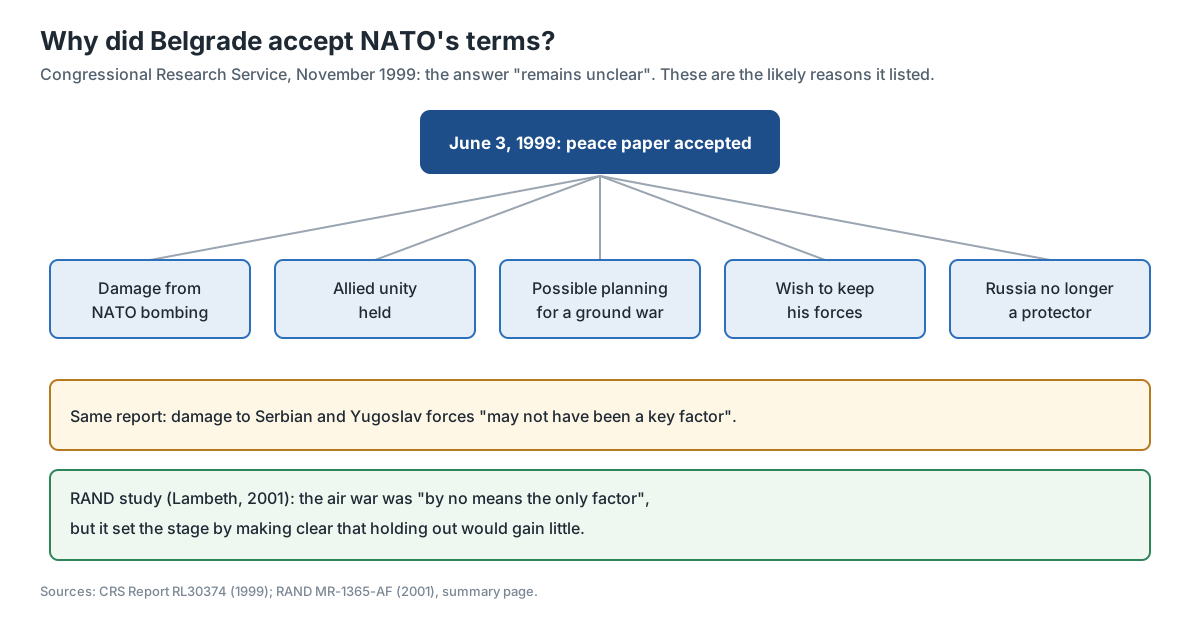
So why did Milosevic give way? The November 1999 CRS report starts by saying the answer "remains unclear." It then lists likely reasons: damage from NATO bombing, allied unity that held, and possible planning for a ground war.
Two more reasons on the list were a wish to preserve his forces and Russia's failure to act as his protector.
The same report adds that the damage done to Yugoslav forces themselves may not have been a key factor. A 2001 RAND study by Benjamin Lambeth concluded that the air war was by no means the only cause of the allies' victory. Even so, in that study's view, it set the stage for surrender by making clear that holding out would gain little.
Precision weapons and the capability gap inside the alliance
NATO's main tool was the precision-guided munition (PGM). This is a bomb or missile that corrects its own path so it lands on a chosen point.
Few allies had such weapons in large numbers, though. Lieutenant General Michael Short of the U.S. Air Force commanded the air operation. He said capability shortfalls changed how targets were assigned and pushed more of the work onto U.S. assets, especially accurate night bombing.
Two senior European officers went further. One was Admiral Venturoni of Italy, then chairman of NATO's Military Committee. The other was General Naumann of Germany, a former chairman. In their view, the European allies could not have carried out the Kosovo mission without the United States, given their current forces.
The list of shortfalls in the first assessments was long:
- precision-guided munitions and laser designator capability
- secure interoperable communications and identification friend or foe
- electronic warfare and air defense threat warning
- intelligence collection and sharing
- heavy airlift, aerial refueling tankers and night vision
A laser designator shines a laser on a target so that a laser-guided bomb can follow the reflected light. NATO's 50th anniversary summit in April 1999 started the Defense Capability Initiative (DCI), meant to find such gaps and propose fixes.
Some weapons were controversial. NATO used cluster bombs, and there was evidence that it had also used depleted uranium rounds. At the time, no treaty provision banned or limited cluster bombs as such. The ICTY committee that reviewed the bombing advised against opening an investigation into either.
Civilian deaths and the Chinese embassy
Behind the figure of zero Allied deaths lie the deaths of Yugoslav civilians. The count differs by source. Human Rights Watch (HRW) documented 90 incidents and put the toll of NATO bombing at between 488 and 527 Yugoslav civilians. It also found that 62–66% of those deaths came from just 12 incidents.
A compilation by the Yugoslav Foreign Ministry listed about 495 civilians killed and 820 wounded in documented cases. The committee that reviewed the bombing for the ICTY prosecutor worked from documents alone, without visiting Yugoslavia. It judged that a figure close to both sources would be about 500.
It recommended against opening an investigation. In the same conclusion, it added that NATO had admitted mistakes, that errors of judgment may have occurred, and that some target choices may be open to legal debate. At the Security Council on June 10, China's representative claimed NATO had killed over 1,000 civilians and left nearly 1 million people displaced or as refugees.
On May 7, the Chinese embassy in Belgrade was hit. Under Secretary of State Pickering gave the Chinese government an explanation on June 17. In it, three Chinese journalists died and 20 embassy staff were injured. The ICTY committee's list records 3 civilians killed and 15 injured.
The United States said the strike was a mistake and that no one had targeted the embassy. Its explanation named three failures that came together. The location of the intended target, a Yugoslav government agency building, was worked out wrongly. No database held the embassy's correct, newer location, and the review process caught neither error.
The building that was struck was plainly a civilian object, not a military target. NATO and U.S. government agencies made a formal apology. The United States agreed to pay $28 million for the Chinese government, plus $4.5 million for the families of the dead and injured. The Central Intelligence Agency (CIA) fired one intelligence officer and formally reprimanded six senior managers.
The bombing was not the only harm done on the ground. When the ICTY indicted Milosevic, the charges included forcibly deporting some 800,000 Kosovo Albanian civilians. Milosevic died on March 11, 2006, and the proceedings ended without a verdict. That figure therefore remains a charge in an indictment.
Was it lawful? Different voices
The Kosovo air war had no Security Council authorization. This is still the point on which views divide most sharply. Setting the statements at the Security Council meeting of June 10 side by side shows the gap.
China's representative, Shen Guofang, said the U.S.-led NATO had attacked a sovereign state without Security Council authorization and seriously violated the UN Charter and international law. Russia's Sergey Lavrov sternly condemned NATO's unilateral action as a blow to the system of international relations. Yugoslavia's Vladislav Jovanovic called his country the victim of aggression.
On the other side, France's representative blamed Belgrade's intransigence for the collapse of the Rambouillet talks. Mounting repression of civilians, he said, had compelled NATO to end the ethnic cleansing and deportations. The U.S. representative said Belgrade could have spared months of killing, ruin and forced displacement by saying yes to peace in March.
The lawyers' summary does not lean one way either. The ICTY committee wrote that the legitimacy of "humanitarian intervention without prior Security Council authorization" is hotly debated. But the tribunal had no jurisdiction over aggression, the crime against peace. So the prosecutor's office did not judge whether going to war was itself lawful, and looked only at whether the means used during the war met the laws of war.
NATO says each target choice was reviewed at several levels of command for legality, military justification and risk to civilians. CRS judged that the conflict broke new ground, since partly humanitarian motives had taken the allies to war. The Security Council record and the ICTY report are both public, so each side's words can be read and compared in the original.
What the 78 days left behind
The air war's stated objectives did not include removing Milosevic or forcibly separating Kosovo from Serbia. Resolution 1244 reaffirmed Yugoslavia's territorial integrity, and Kosovo was placed under UN administration.
In 2001 Milosevic fell from power. He was arrested and sent to the international tribunal in The Hague, and he died in prison in 2006 while his trial was still under way. Kosovo declared independence in 2008, and the United States and most European states recognized it, despite Russian objections.
KFOR is still there. Its strength fell from some 50,000 at the start to around 39,000 by early 2002 and 17,500 by the end of 2003. Today about 4,700 troops from 31 Allied and partner countries carry on its Resolution 1244 mandate. Having intervened to protect ethnic Albanians from ethnic cleansing, NATO says it has been equally committed since June 1999 to protecting Kosovo's Serbs from a similar fate.
On the military side, two things stand out. One is the outcome: the other side withdrew without NATO ground forces entering. The other is a gap inside the alliance, with precision strike and night bombing capability concentrated in the United States. Explanations for the first still differ.
The second may have pushed European countries to take more interest in building capability. By the time of the CRS report in November 1999, though, that interest had not yet shown up in defense budgets.
What to read next
- Precision-guided bombs: how the precision strikes at the center of the Kosovo air war work.
- Aerial refueling: what the tankers named as an alliance shortfall actually do.
- Electronic warfare: what electronic warfare, another listed shortfall, means.
- The Gulf War Air Campaign: Why Stealth and Precision Weapons Drew Attention. A coming article on the air war of 1991, eight years earlier.