Picture the swinging-ball toy on an office desk. Lift the first of five hanging steel balls and let it go: the middle balls do not budge, and only the last one flies off. The armor monograph from DSIAC, an information center under the Defense Technical Information Center, uses this toy to explain how one kind of round works.
That round is the squash head. The British call it high-explosive squash head (HESH), and the U.S. name is high-explosive plastic (HEP). It can break off the inside face of armor without punching a hole through. This article looks at what happens after it hits, and why it became less and less of an anti-tank round.
A round that started on bunkers
The round did not begin as a tank killer. HEP was first meant as a bunker buster. Its effect on solid, one-piece metal armor was then noticed, and rounds were designed specifically for that job.
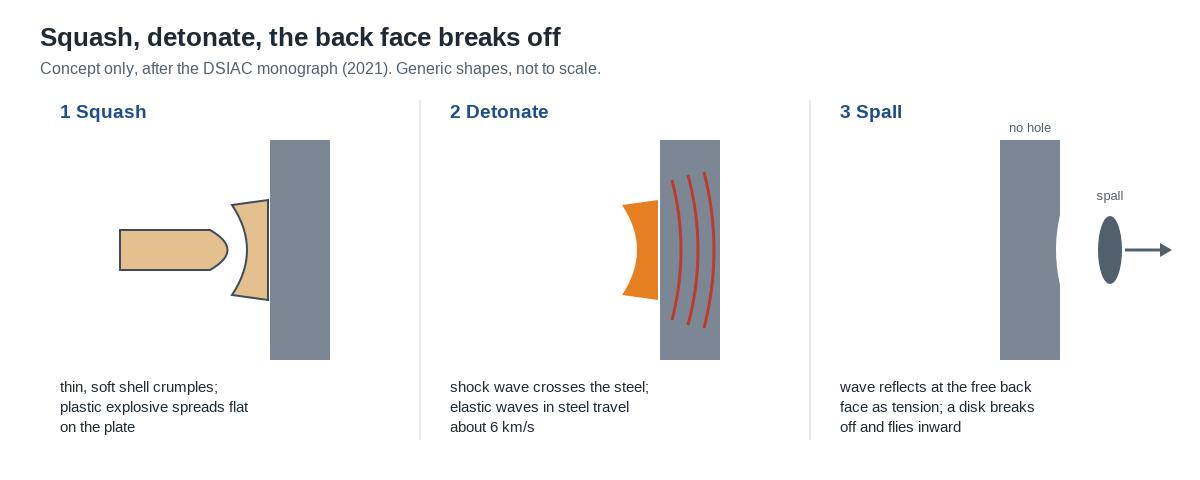
It looks ordinary. It is shaped like a bullet, fills the bore and is kept stable by spin. The difference is a thin, soft shell holding a plastic explosive that easily changes shape. The names "squash head" and "plastic" come from this.
Squash, then detonate
When the round strikes an armor plate, the shell crumples and the explosive spreads flat against the plate. Only then does it detonate. Rather than drilling into one point like a pointed armor-piercing shot, it sits spread across the plate and hands the force of the blast straight into it.
The blast creates a strong shock wave that sweeps through the steel. How fast an elastic wave moves in steel depends on the material's stiffness and density, and it comes to about 6 km/s. That is about 6 mm in a millionth of a second.
Material ahead of the wave front is still undisturbed, and particles start to move only after the wave passes. As the wave spreads out, its strength falls with the inverse square of distance. That is why handing the blast straight into the plate, while spread across it, matters for this round.
Why the back face comes off: spall
This is where the swinging balls come back. When the shock wave reaches the back of the plate, material there can move backward without pushing on any neighbor. A face in contact with air like this is called a free surface. When a wave meets a free surface, inertia carries the material into tension, and a pulling wave travels back inward.
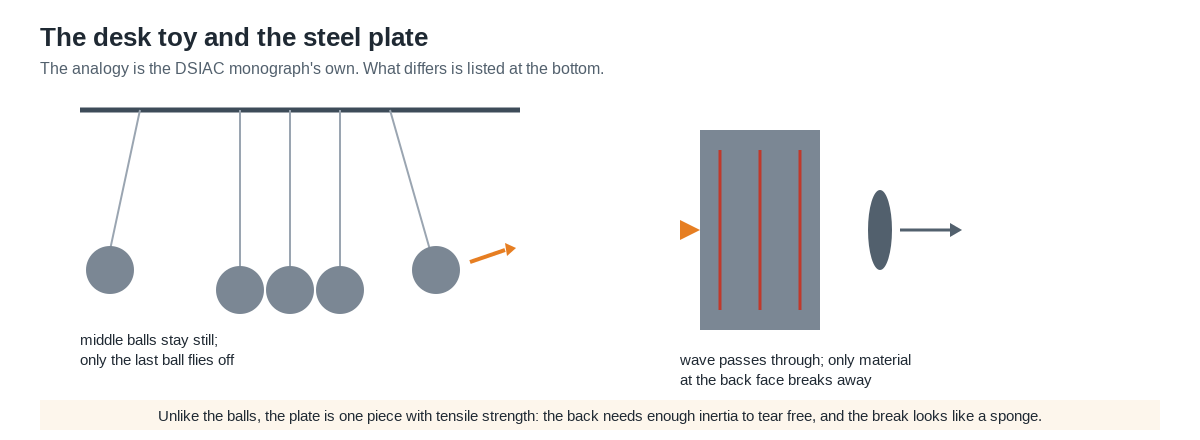
A real steel plate is not a row of balls. The balls are separate, but the plate is one piece, and armor has high tensile strength, so it resists being pulled apart. The backward-moving material needs enough inertia to tear a piece free. Breaking off like this is called spallation, and the piece that breaks off is called a spall.
If a disk-shaped spall from the back face is thrown into the fighting compartment, it can be lethal even though the armor was never perforated. Spallation is pure tension failure, so the broken surface looks like a sponge. What breaks the plate is not the push but the pull that comes back from the rear face, and that is the heart of this round. That differs from the usual shear failure in ductile metal, which leaves striated marks.
From anti-armor to anti-bunker
As armor split into layers or with gaps, and skirting plates, came into wide use, the round's advantage shrank. So in most nations HEP is no longer used as an anti-armor round and remains only as an anti-bunker munition. It did not vanish so much as change jobs.
In the United States, the M393 HEP was the standard round for the 105 mm M68 tank cannon as of 1985. The M393A3 with tracer was later type classified for the M68 on the Stryker Mobile Gun System.
The round Britain kept
Britain was the exception to this trend. It kept the round after most countries had let it go. According to the DSIAC monograph, the British have kept using HESH, first because it worked well against the Soviet T-55. The British Challenger tank had a rifled gun, and this spin-stabilized round was a good match for it.
It was not only a tank-gun round.
The Imperial War Museums hold a record of a 1975 film sponsored by the UK Ministry of Defence, "76MM WEAPON SYSTEM." The film covers the Scorpion light tank's 76 mm gun, built by the Royal Ordnance Factory. Its listing says it shows the effects of high explosive, HESH, smoke and canister rounds. The Ministry of Defence sponsored it, and United Pictures made it.
Viewing it now requires a request to the museum.
What to read next
- Tank Armor Types at a Glance: Rolled, Spaced, Composite, Reactive, Active: where two-layer armor and skirting plates fit
- Tank Guns from Rifled to Smoothbore: the pairing of spin-stabilized rounds and rifled guns
- The Shaped Charge: What Is the Munroe Effect?: another way explosives move metal
- Kinetic Energy Penetrators: Why Fin-Stabilized Darts Are So Long: a round that penetrates without explosive