On 17 September 1862, the Battle of Antietam was fought across fields with a wood at their northern edge called the North Woods. Long afterward, archaeologists went over 25% of that wood with metal detectors. They recovered 317 military objects.
Of these, 217 came from small arms. Some were round lead balls. Others were cone-shaped bullets with a pointed tip and a hollow base.
The second kind has a name: the Minié ball. Stories about the American Civil War (1861–1865) keep returning to this bullet and to the rifled musket. They are often offered as the key to the war's huge casualty figures. Is that right?
This article splits the question in two. First it looks at what the grooves in the barrel and the shape of the bullet changed. Then it turns to the casualty numbers and to an argument among historians.
Smoothbores and rifling: a known idea that armies could not use
A gun whose barrel is smooth inside is a smoothbore. Cutting spiral grooves inside the barrel is called rifling. A bullet that spins along those grooves flies farther and straighter.
Think of a spinning top that stays upright. A real bullet, unlike a top spinning in place, is moving fast through the air, so the comparison only holds as far as "spinning keeps it steadier."
The idea had been known for centuries. Most hunting guns had rifled barrels, and a few armies of the 1700s kept special rifle regiments. Even so, the smoothbore musket stayed the main infantry weapon until the 1850s.
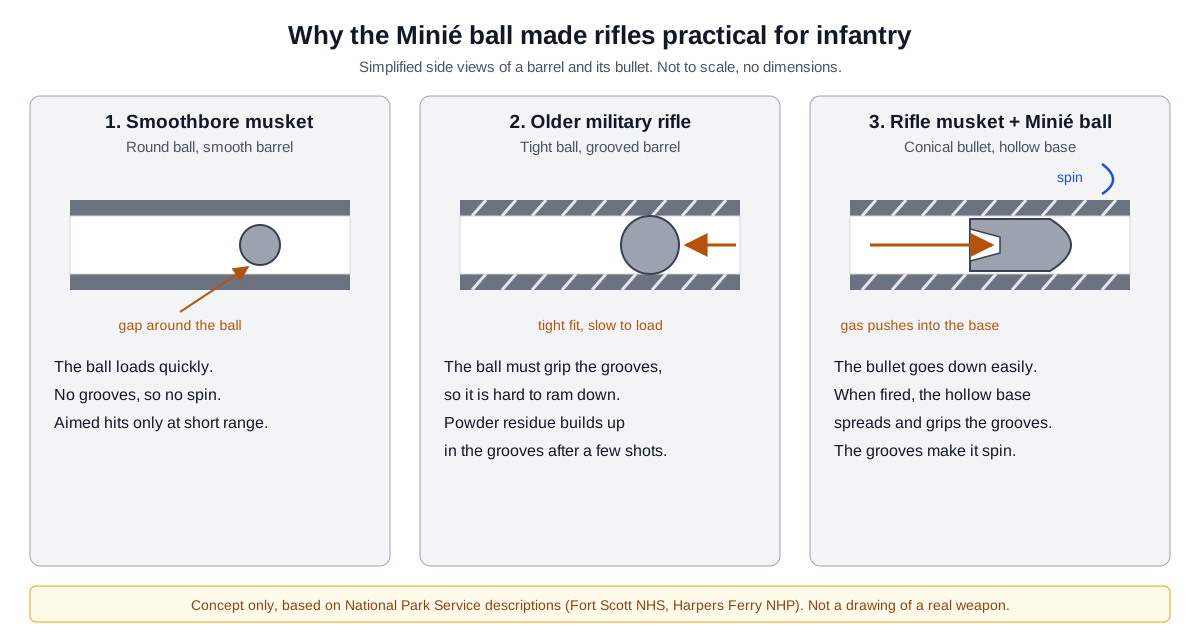
The reason was loading. Military rifles of that era were muzzleloaders: the bullet went in through the muzzle. A bullet big enough to grip the rifling was hard to push down the barrel.
After a few shots, black powder fouling collected in the grooves, and the gun had to be cleaned before it would take another load. Armies need fast loading and long firing, so the rifle stayed a weapon for special uses.
The way smoothbore armies fought matched these limits. Teaching material from Fort Scott National Historic Site puts the smoothbore's maximum range at 250 yards, with aimed hits on a chosen target out of reach past 80 yards. So soldiers stood shoulder to shoulder in lines, and the aim was to send a large amount of lead through the air at once.
Ignition was changing in the same period. The flintlock, which appeared in the early 1600s, lit the powder with sparks from a flint and misfired often. Credit for the small copper percussion cap usually goes to Joshua Shaw, an Englishman, who received a U.S. patent in 1822. By the Civil War the regular Army had switched to percussion arms, though a number of volunteer units began the war with flintlocks.
The Minié ball: a bullet with a base that spreads
The fix came from the shape of the bullet. The Minié ball was a conical lead bullet that a French Army officer, Captain Claude Etienne Minié, brought out in 1848. Some sources, such as the Fort Scott material, give only the 1840s.
The trick is in the base. The base is hollow, so when the gun fires, the powder gas pushes into the hollow and spreads the base outward. The spread base grips the grooves of the rifling and also stops gas from leaking past the bullet.
That is how the old problem of ramming a tight bullet down the muzzle was solved. The spreading bullet also cleaned the grooves as it went through the barrel.
In the United States, the man who refined it was James H. Burton of the Harpers Ferry Armory. He became Acting Master Armorer in 1849 and spent the next four years testing different Minié bullet designs. One of his barrel designs relied on a hard metal plug to force the bullet outward, but the hollow-base bullet he developed worked better still.
In 1855 the U.S. Army adopted Burton's modified design. His drawings were found in 1986, hidden in a crawl space under a house being restored in Winchester, Virginia.
Burton's later path shows where this technology went. In June 1855 he signed on for five years as chief engineer at the Royal Small Arms Manufactory at Enfield, England.
In June 1861, after the war began, he became superintendent of the Richmond Armory in the South. A large share of Richmond's machinery had been removed from Harpers Ferry by Confederate troops that June, with Burton directing the work. In December 1861 he was made a lieutenant colonel in the Confederate army and given charge of every Southern armory.
Springfield and Enfield: the standard rifles of the war
The M1855 Springfield rifle musket was the first American firearm whose rifling was made for the Minié ball. It carried a Maynard tape primer system, which often failed to work. Most soldiers placed a percussion cap on by hand instead.
Its successor, the M1861 Springfield, became the infantry rifle soldiers liked best during the war. It was well balanced and kicked less than other muskets of the time. In the right hands it could fire three times a minute, and its caliber was .58.
The shoulder weapon Confederate soldiers used most was the British-made Pattern 1853 Enfield. Its caliber was .577, almost the same as the Springfield. Roughly 900,000 Enfields came into the country, most of them bound for the Confederacy, though the Union blockade seized or wrecked a large number.
Second in Confederate use was the Richmond rifle, a near copy of the M1855. With machines and stock seized at Harpers Ferry, Richmond and other Southern plants turned out over 30,000.
The South started from a very different place than the North. At the start of the war, Southern arsenals held about 175,000 modern shoulder arms, and about 140,000 of those were smoothbores. Most of the equipment and raw materials for making modern arms were in the industrialized North. The South made up the gap with manufacture, imports and weapons picked up on the battlefield.
Bullets left in the ground: what archaeology shows
Back to the North Woods at Antietam. Historical accounts say only Union troops held the wood, while the nearest Confederates stood roughly 400 yards farther south, around the Miller farm. So every fired bullet found in the wood is treated as a Confederate round.
Some of those bullets were .69 caliber round balls. They came from outdated smoothbore muskets, whose effective range was about 100 yards. They raise a question: did Confederate troops get closer to the wood than the records say?
The bullet types also show who was better supplied. Judging by the finds, Union troops had more of the conical Minié bullets used in Springfields and Enfields, while the Confederates leaned more on the round balls of smoothbore muskets. Many of the Minié bullets fired by Confederates may have been Union-made. They may have come from supplies captured by Stonewall Jackson's men when they captured the Harpers Ferry garrison shortly before Antietam.
The wood also gave up bullets with human teeth marks. These are often linked to wounded soldiers trying to bear the pain. Small pieces of lead in the ground are a reminder that these weapons touched human bodies before they became numbers.
Muzzleloaders had another problem. After the Battle of Gettysburg, 27,574 weapons were collected from the field, and only about 6,000 were properly loaded. Twelve thousand held three to ten loads, and one held twenty-three.
In the confusion of the fight, men lost track of whether they had loaded, or took a misfire for a shot, and loaded again. From these figures came the estimate that one-third of the men on each side were carrying guns that could not fire properly.
How to read the casualty numbers
The National Park Service lists 642,427 Union casualties and 483,026 Confederate casualties. For the Union, 110,100 were battle deaths, 224,580 were lost to disease, 275,174 were wounded in action, and 30,192 became prisoners. For the Confederacy, the figures are 94,000 battle deaths, 164,000 to disease, 194,026 wounded in action and 31,000 prisoners. On both sides, disease took more men than death in battle.
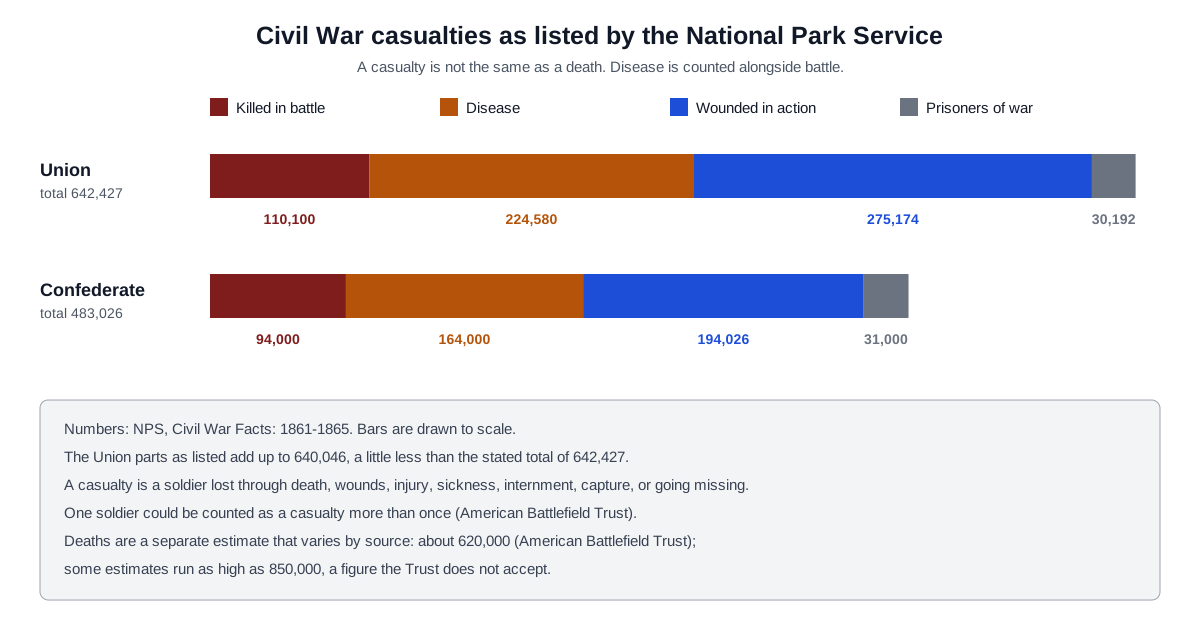
The word "casualty" needs care. A casualty is any soldier taken out of service, whether by death, a wound, an injury, illness, internment, capture or going missing. One soldier could be listed as a casualty several times during the war. So the number of casualties is not the number of dead.
The number of dead is a separate estimate, and it varies by source. The American Battlefield Trust puts it at about 620,000 men who died in service, roughly 2% of the population. It also mentions estimates that reach 850,000, but the Trust rejects that higher figure. It puts casualties at about 1.5 million.
Most casualties and deaths came from disease that had nothing to do with combat. For each three men killed in battle, five died of illness.
So if the question is why Civil War casualties were so high, disease comes before guns. Weighing the share of the rifle comes after that. One more pair of numbers: Gettysburg, the costliest battle, had 51,116 casualties, and Antietam, the costliest single day, had 22,726.
The debate: did the rifle change the battle?
The long-standing explanation goes like this. The rifled musket greatly increased range, but armies still lined up shoulder to shoulder as if they carried smoothbores.
The Fort Scott material says this development revolutionized military tactics, and it credits the rifle with 400 yards of effective range and 1,000 at most. In an interview, Shawn Williams, a historic weapons specialist at Ulysses S. Grant National Historic Site, called the Minié ball the most important weapons development before the war. He added that 75% of wounds in the war were caused by it.
This view goes back to the war itself. A book description from the University Press of Kansas notes how people at the time saw it. Many were impressed by the new weapon's range of 500 yards, against 100 for the smoothbore musket. They assumed the rifle was a major reason the war lasted so long.
Historians, too, long assumed that the weapon pushed casualty rates up sharply, made it hard to win a decisive victory, and left cavalry and artillery with smaller roles.
The challenge comes from Earl J. Hess, an emeritus history professor at Lincoln Memorial University. His book is The Rifle Musket in Civil War Combat: Reality and Myth.
In the publisher's summary, it argues that the rifle mattered far less than people thought and was mostly confined to marginal work such as skirmishing and sniping. In his view, three things almost cancelled out its potential to change fighting between battle lines. They were poor training, soldiers' preference for firing at short range, and how hard it was to make out enemy troops far away.
One of his points is the path of the bullet. Bullets from the new musket flew in an arc, so at middle range they passed well above the enemy. That, in his reading, left two killing zones, one near and one far, with a space between them where troops could move untouched. Hess builds the case on what the soldiers themselves saw and later wrote.
This article does not settle which side is right. Putting the two explanations side by side, though, changes how the numbers read. The round balls in the Antietam wood and the multiply loaded guns at Gettysburg are small pieces of evidence. They point to a gap between range on paper and what happened on the field.

What it left: the road to the breechloader
The Minié ball made the rifle musket the standard infantry weapon on both sides, but the bullet still went in through the muzzle. Muzzle loading was slow and awkward. A breechloader, opened at the rear to take the round, was faster, but gas escaped through the gap at the breech.
In the 1850s several inventors largely solved that problem with copper cartridges and other devices. Even so, the Army was wary of breechloaders as an unproven technology. Breechloaders only came into wide use in the last part of the Civil War.
In 1865, the year the war ended, about 5,000 rifles were converted by removing part of the rear of a muzzleloader's barrel and adding a hinged "trapdoor" mechanism. This was the M1865 Allin conversion rifle.
It stayed at .58 caliber, but it now fired a metal cartridge rather than a paper one. The M1866 that followed reduced the caliber to .50, and 25,000 were made. The age of the Minié ball gave way to the age of the metallic cartridge.
What to read next
- The American Civil War at a Glance: 1861 to 1865: the whole war in which these rifles and bullets were used, on a timeline.
- Monitor and Virginia: The First Duel Between Ironclads: another technology shift in the same war, this time at sea.
- Turning points in military technology: how battlefields changed each time a new weapon arrived, followed through 20th-century technology.
- A history of laser weapons: how the story of long-range weapons reached weapons that use light, told through official records.